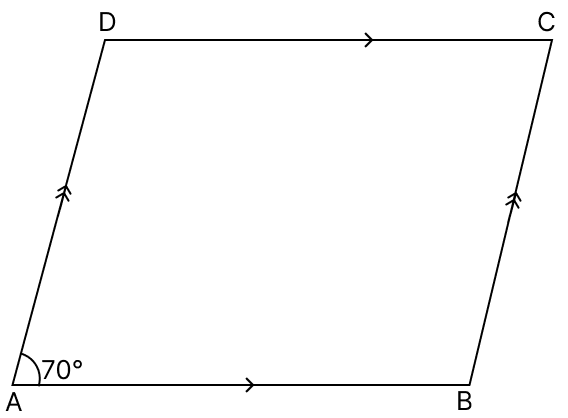
In the given figure, ABCD is a parallelogram in which ∠A = 70°. Calculate ∠B, ∠C, ∠D.
Answer
Given,
∠A = 70°
ABCD is a parallelogram.
⇒ ∠C = ∠A = 70° [∵ opposite angles of a parallelogram are equal]
⇒ ∠A + ∠B = 180° [∵ AD ∥ BC and sum of Co-interior angles is 180°]
⇒ ∠B = 180° - ∠A = 180° - 70°
⇒ ∠B = 110°
⇒ ∠D = ∠B = 110° [∵ opposite angles of a parallelogram are equal]
Hence, ∠C = 70°, ∠B = 110° and ∠D = 110°.
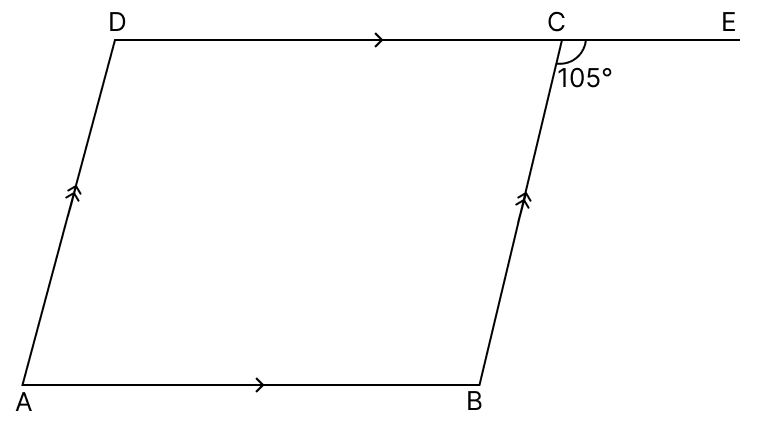
In the given figure, ABCD is a parallelogram. Side DC is produced to E and ∠BCE = 105°. Calculate ∠A, ∠B, ∠C and ∠D.
Answer
Given,
∠BCE = 105°
ABCD is a parallelogram.
⇒ ∠BCE + ∠BCD = 180° [Linear pairs]
⇒ ∠BCD = 180° - ∠BCE
⇒ ∠BCD = 180° - 105°
⇒ ∠BCD = 75°.
⇒ ∠A = ∠BCD = 75° [∵ opposite angles of a parallelogram are equal]
⇒ ∠A + ∠B = 180° [∵ AD ∥ BC and sum of Co-Interior angles is 180°]
⇒ ∠B = 180° - ∠A
⇒ ∠B = 180° - 75°
⇒ ∠B = 105°
⇒ ∠D = ∠B = 105° [∵ opposite angles of a parallelogram are equal]
Hence, ∠A = 75°, ∠C = 75°, ∠B = 105° and ∠D = 105°.
If an angle of a parallelogram is two-third of its adjacent angle, find the angles of the parallelogram.
Answer
Let the measure of the adjacent angle be x. Then, the other angle will be .
We know that,
Sum of its adjacent angles of a //gm = 180°.
∴ x = 108°.
⇒ = 72°
Since opposite angles in a parallelogram are equal, the four angles are : 72°, 108°, 72°, and 108°.
Hence, angles of the parallelogram are 72°, 108°, 72°, and 108°.
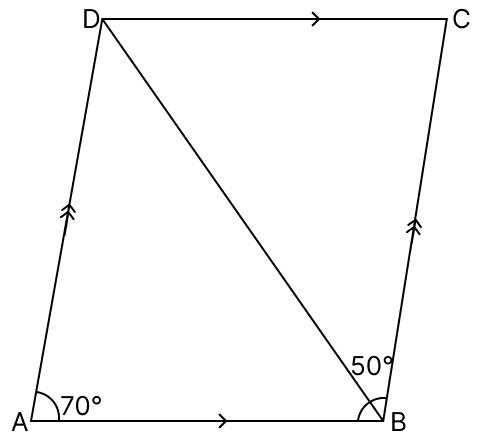
In the adjoining figure, ABCD is a parallelogram in which ∠BAD = 70° and ∠CBD = 50°. Calculate :
(i) ∠ADB
(ii) ∠CDB.
Answer
(i) Given,
∠BAD = 70°
∠CBD = 50°
ABCD is a parallelogram.
⇒ ∠ADB = ∠DBC = 50° [Alternate angles are equal,as AD ∥ BC and DB is transversal]
Hence, ∠ADB = 50°.
(ii) ∠BAD + ∠ABC = 180° [∵ AD ∥ BC and sum of Co-interior angles is 180°]
⇒ ∠ABC = 180° - ∠BAD
⇒ ∠ABC = 180° - 70°
⇒ ∠ABC = 110°.
From figure,
⇒ ∠ABC = ∠DBA + ∠CBD
⇒ 110° = ∠DBA + 50°
⇒ ∠DBA = 110° - 50°
⇒ ∠DBA = 60°
⇒ ∠CDB = ∠DBA = 60°.
⇒ ∠CDB = ∠DBA = 60° [Alternate angles are equal, as DC ∥ AB and DB is transversal]
Hence, ∠CDB = 60°.
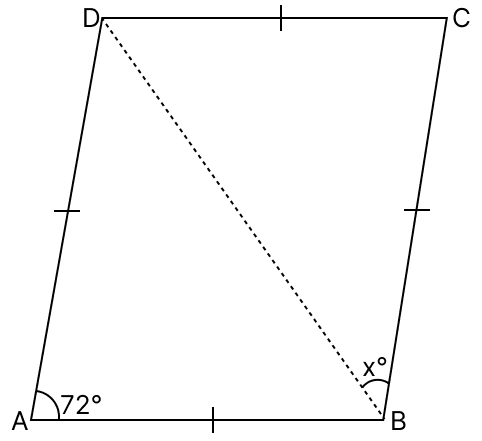
In the given figure, ABCD is a rhombus in which ∠A = 72°. If ∠CBD = x°, find the value of x.
Answer
Given,
∠A = 72°
ABCD is a rhombus. Thus, opposite sides are parallel.
⇒ ∠A + ∠B = 180° [∵ AD ∥ BC and sum of Co-interior angles is 180°]
⇒ 72° + ∠B = 180°
⇒ ∠B = 180° - 72°
⇒ ∠B = 108°
We know that,
In a rhombus diagonals bisects the vertex angle.
⇒ ∠CBD = ∠B [∵ BD bisects ∠B]
⇒ ∠CBD =
⇒ ∠CBD = x° = 54°
⇒ x = 54.
Hence, x = 54.
In the adjoining figure, equilateral △ EDC surmounts square ABCD. If ∠DEB = x°, find value of x.
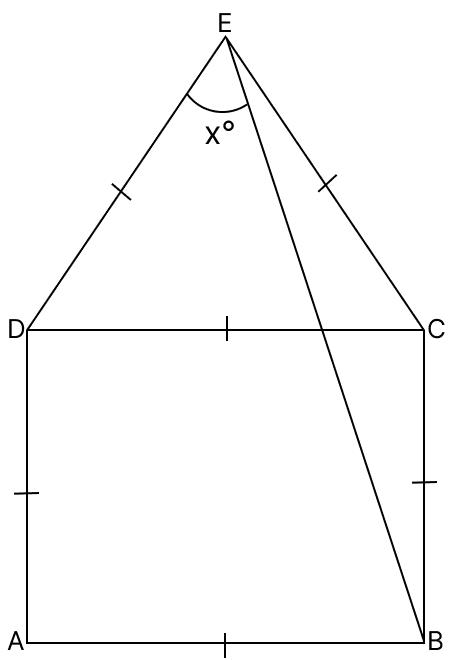
Answer
Given,
△EDC is an equilateral triangle, so all sides are equal.
ED = DC = EC ......(1)
In square all sides are equal.
AB = CB = DC = AD .....(2)
From (1) and (2) we get,
DC = EC = CB
⇒ EC = CB.
In △ECB,
EC = CB
⇒ ∠BEC = ∠CBE = a (let) (Angles opposite to equal sides are equal in isosceles triangle)
From figure,
⇒ ∠C = ∠ECD + ∠DCB
⇒ ∠ECD = 60° (As each angle of a equilateral triangle = 60°)
⇒ ∠DCB = 90° (As each angle of a square = 90°)
⇒ ∠ECB = ∠ECD + ∠DCB = 60° + 90° = 150°.
In triangle BEC,
⇒ ∠BEC + ∠CBE + ∠ECB = 180°
⇒ a + a + 150° = 180°
⇒ 2a = 180° - 150°
⇒ 2a = 30°
⇒ a = 15°.
From figure,
x° = ∠DEC - ∠BEC = 60° - 15° = 45°.
Hence, x = 45.
In the adjoining figure, ABCD is a rhombus whose diagonals intersect at O. If ∠OAB : ∠OBA = 2 : 3, find the angles of △ OAB.
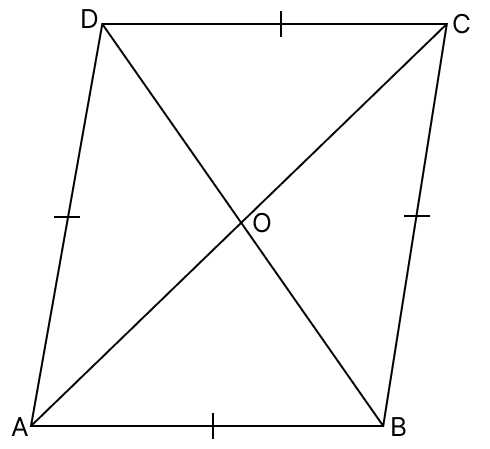
Answer
Let ∠OAB = 2x and ∠OBA = 3x.
The diagonals of rhombus are perpendicular to each other.
∴ ∠AOB = 90°
In △AOB,
⇒ ∠AOB + ∠OAB + ∠OBA = 180°
⇒ 90° + 2x + 3x = 180°
⇒ 2x + 3x = 180° - 90°
⇒ 5x = 90°
⇒ x =
⇒ x = 18°.
∠OAB = 2x = 2(18°) = 36°.
∠OBA = 3x = 3(18°) = 54°.
Hence, ∠OAB = 36°, ∠OBA = 54°, ∠AOB = 90°.
In the given figure, ABCD is a rectangle whose diagonals intersect at O. Diagonal AC is produced to E and ∠ECD = 140°. Find the angles of △ OAB.
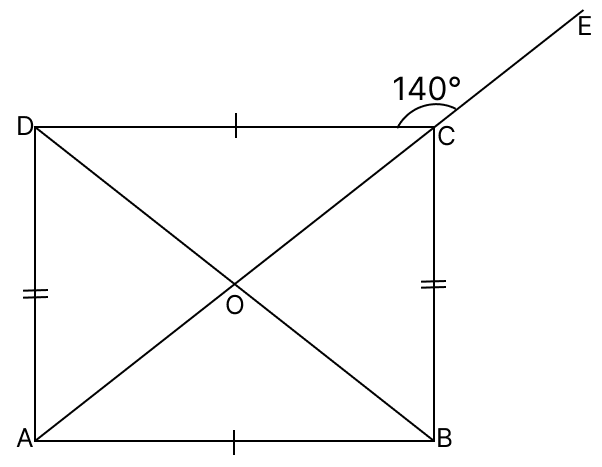
Answer
Given,
∠ECD = 140°.
ABCD is a rectangle.
⇒ ∠DCO + ∠DCE = 180°
⇒ ∠DCO = 180° - 140°
⇒ ∠DCO = 40°.
∠CAB = ∠DCA = 40° [Alternate angles are equal, as CD ∥ AB and AC is transversal]
From figure,
∠OAB = ∠CAB = 40°
OB = OA [∵ diagonals of a rectangle are equal and bisect each other]
∠OAB = ∠OBA = 40° [Angles opposite to equal sides in a triangle are equal.]
In △AOB,
⇒ ∠AOB + ∠OAB + ∠OBA = 180°
⇒ ∠AOB + 40° + 40° = 180°
⇒ ∠AOB = 180° - 80°
⇒ ∠AOB = 100°.
Hence, ∠OAB = 40°, ∠ABO = 40°, ∠AOB = 100°.
In the given figure, ABCD is a kite whose diagonals intersect at O. If ∠DAB = 54° and ∠BCD = 76°, calculate :
(i) ∠ODA
(ii) ∠OBC.
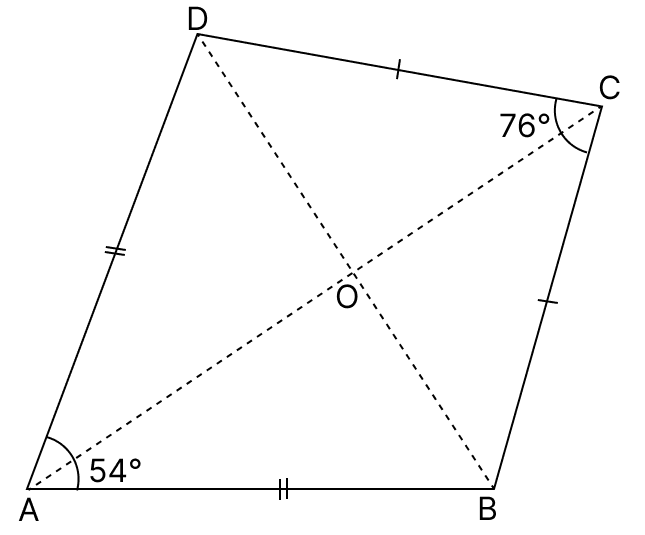
Answer
(i) In kite ABCD,
AB = AD [Adjacent sides of kite are equal]
In triangle ABD,
⇒ ∠BDA = ∠ABD [Angles opposite to equal sides in a triangle]
In △ADB,
⇒ ∠BDA + ∠ABD + ∠DAB = 180° [∵ Angle sum property]
⇒ 2∠BDA + 54° = 180° [∵ ∠ODA = ∠OBA]
⇒ 2∠ODA = 180° - 54°
⇒ 2∠ODA = 126°
⇒ ∠ODA = 63°.
Hence, ∠ODA = 63°.
(ii) DC = CB [Adjacent sides of kite are equal]
∠BDC = ∠CBD [Angles opposite to equal sides in a triangle are equal]
In △CDB,
⇒ ∠BDC + ∠DCB + ∠CBD = 180°
⇒ 2∠CBD + 76° = 180°
⇒ 2∠OBC = 180° - 76°
⇒ 2∠OBC = 104°
⇒ ∠OBC = 52°.
Hence, ∠OBC = 52°.
In the given figure, ABCD is an isosceles trapezium in which ∠CDA = 2x° and ∠BAD = 3x°. Find all the angles of the trapezium.
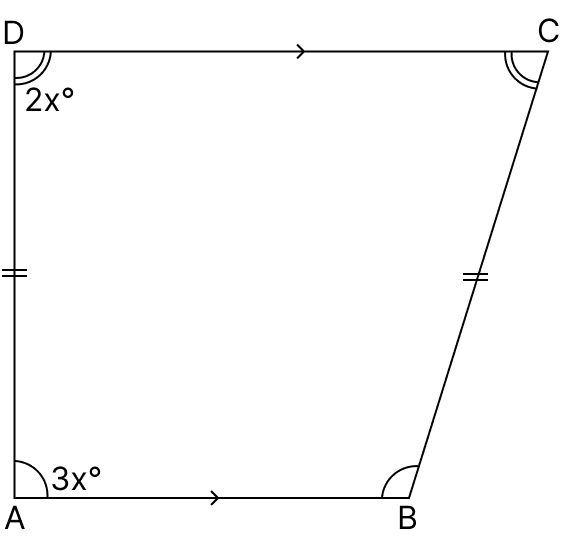
Answer
We know that,
Sum of adjacent co-interior angles of a trapezium = 180°
∴ ∠A + ∠D = 180°
⇒ 3x + 2x = 180°
⇒ 5x = 180°
⇒ x =
⇒ x = 36°.
∠A = 3x = 3(36°) = 108°
∠D = 2x = 2(36°) = 72°
∠B = ∠A = 108° [∵ base angles of an isosceles trapezium are equal]
∠C = ∠D = 72° [∵ base angles of an isosceles trapezium are equal]
Hence, ∠A = 108°, ∠C = 72°, ∠B = 108° and ∠D = 72°.
In the given figure, ABCD is a trapezium in which ∠A = (x + 25)°, ∠B = y°, ∠C = 95° and ∠D = (2x + 5)°. Find the values of x and y.
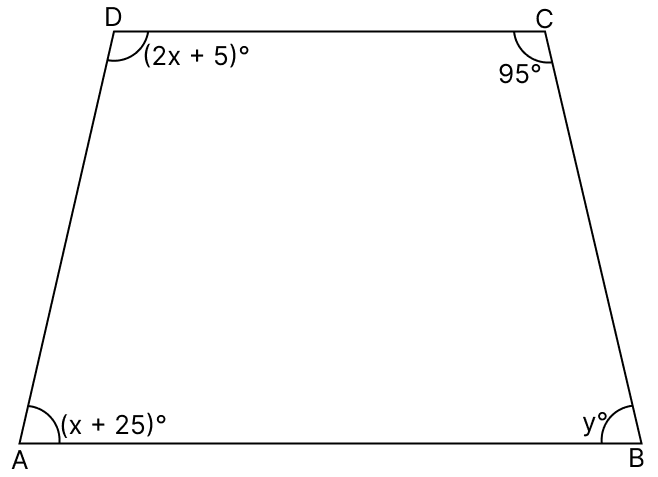
Answer
We know that,
Sum of adjacent co-interior angles of a trapezium = 180° (As AB || DC)
∴ ∠A + ∠D = 180°
⇒ (x + 25)° + (2x + 5)° = 180°
⇒ 3x° + 30° = 180°
⇒ 3x° = 180° - 30°
⇒ 3x° = 150°
⇒ x° = 50°
⇒ x = 50.
Sum of adjacent co-interior angles of a trapezium = 180° (As AB || DC)
∴ ∠C + ∠B = 180°
⇒ 95° + y° = 180°
⇒ y° = 180° - 95°
⇒ y° = 85°
⇒ y = 85.
Hence, x = 50, y = 85.
In the given figure, ABCD is rhombus and △EDC is a equilateral. If ∠BAD = 78°, calculate :
(i) ∠CBE
(ii) ∠DBE
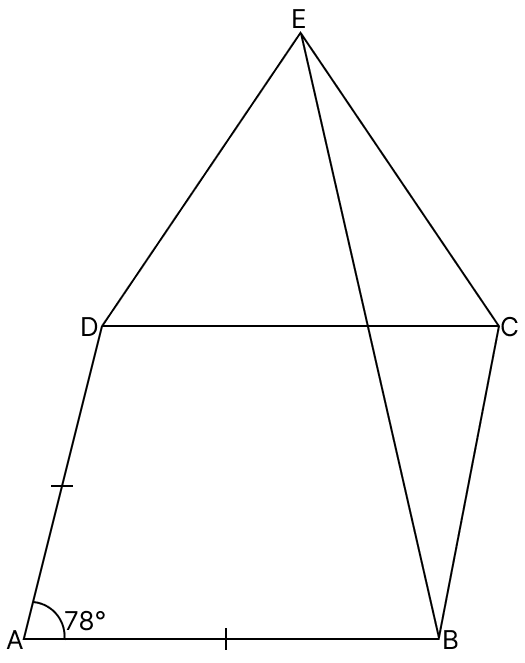
Answer
(i) In rhombus ABCD,
⇒ ∠C = ∠A = 78° (Opposite angles of rhombus are equal)
The sum of adjacent angles of a rhombus is always 180°.
⇒ ∠A + ∠B = 180°
⇒ 78° + ∠B = 180°
⇒ ∠B = 180° - 78° = 102°.
In △ DBC,
⇒ DC = CB (Sides of rhombus are equal in length) .....(1)
⇒ ∠CDB = ∠CBD = x (let) (In a triangle angles opposite to equal sides are equal.)
By angle sum property of triangle,
⇒ ∠CDB + ∠CBD + ∠BCD = 180°
⇒ x + x + ∠BCD = 180°
⇒ 2x + 78° = 180°
⇒ 2x = 180° - 78°
⇒ 2x = 102°
⇒ x =
⇒ ∠CDB = ∠CBD = 51°.
Given,
DEC is an equilateral triangle, so all the sides of triangle are equal.
∴ DC = EC .......(2)
From equations (1) and (2), we get :
⇒ CB = EC
In triangle CEB,
⇒ ∠CEB = ∠CBE = y (let) [Angles opposite to equal sides in a triangle are equal]
By angle sum property of triangle,
⇒ ∠CEB + ∠CBE + ∠ECB = 180°
⇒ y + y + (∠ECD + ∠BCD) = 180°
⇒ 2y + (60° + 78°) = 180°
⇒ 2y + 138° = 180°
⇒ 2y = 180° - 138°
⇒ 2y = 42°
⇒ y =
⇒ ∠CBE = 21°.
Hence, ∠CBE = 21°.
(ii) From figure,
⇒ ∠DBE = ∠CBD - ∠CBE
⇒ ∠DBE = 51° - 21° = 30°.
Hence, ∠DBE = 30°.
DEC is an equilateral triangle in a square ABCD. If BD and CE intersect at O and ∠COD = x°, find the value of x.
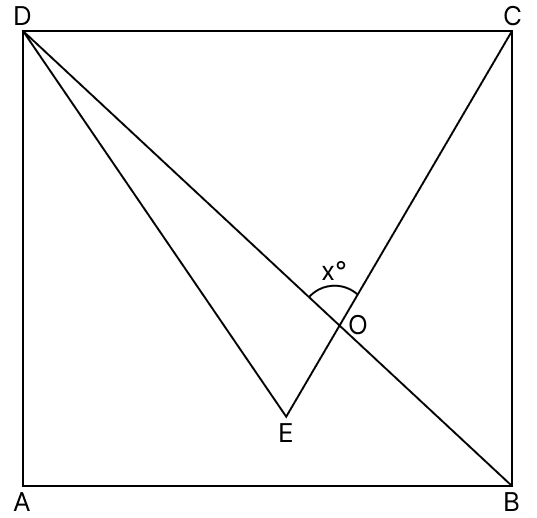
Answer
Given,
ABCD is a square,
∠ADC = 90°
The diagonal BD bisects the ∠ADC at the vertex.
∠BDC = = 45°
DEC is an equilateral triangle.
∠DCE = ∠CDE = 60°
From figure,
∠OCD = ∠DCE = 60°
∠ODC = ∠BDC = 45°
In △COD,
⇒ ∠COD + ∠ODC + ∠OCD = 180°
⇒ x° + 45° + 60° = 180°
⇒ x° + 105° = 180°
⇒ x° = 180° - 105°
⇒ x° = 75°
Hence, x = 75°.
If one angle of a parallelogram is 90°, show that each of its angles measures 90°.
Answer
Let ABCD be a parallelogram where ∠A = 90°.
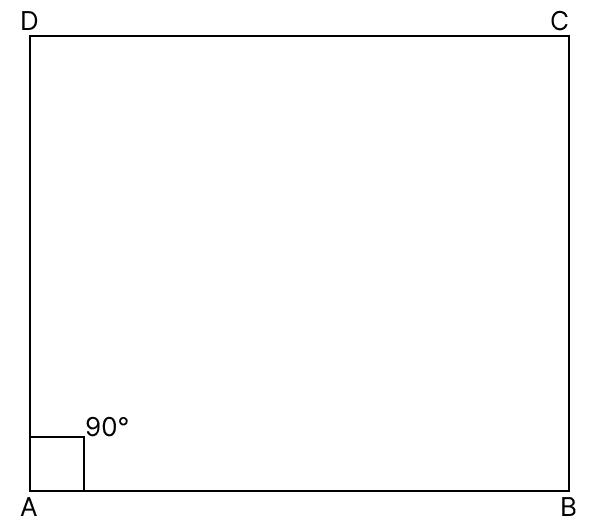
Sum of adjacent angles of a parallelogram = 180°.
∠A + ∠B = 180°
90° + ∠B = 180°
∠B = 180° - 90°
∠B = 90°.
In a parallelogram, opposite angles are equal.
∠C = ∠A = 90°
∠D = ∠B = 90°.
∴ ∠A = ∠B = ∠C = ∠D = 90°
Hence, proved that all angles of parallelogram measures 90°.
In the adjoining figure, ABCD and PQBA are two parallelograms. Prove that :
(i) DPQC is a parallelogram.
(ii) DP = CQ.
(iii) ΔDAP ≅ ΔCBQ.
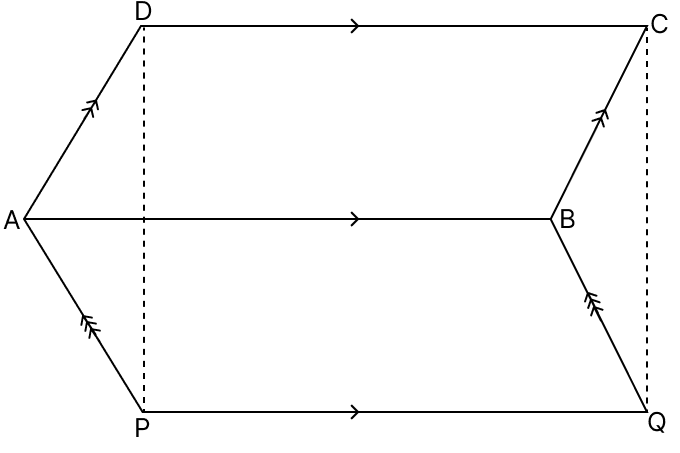
Answer
(i) Given,
ABCD and PQBA are two parallelograms.
DC ∥ AB ....(1)
AB ∥ PQ .....(2)
From (1) and (2) we have,
∴ DC ∥ PQ
Opposite sides of a parallelogram are equal.
Thus, in //gm ABCD
DC = AB .....(3)
Thus, in //gm PQBA
AB = PQ ......(4)
From (3) and (4) we have,
∴ DC = PQ
Since, the pair of opposite sides DC and PQ are equal and parallel. Therefore, DPQC is a parallelogram.
Hence, proved that DPQC is a parallelogram.
(ii) We know that,
DPCQ is a parallelogram.
Opposite sides of a parallelogram are equal.
∴ DP = CQ
Hence, proved that DP = CQ.
(iii) In triangle DAP and CBQ,
DA = CB [opposite sides of parallelogram ABCD]
AP = BQ [opposite sides of parallelogram PQBA]
DP = CQ [opposite sides of parallelogram DPQC]
∴ ΔDAP ≅ ΔCBQ [By SSS rule]
Hence, proved that DP = CQ.
In the adjoining figure, ABCD is a parallelogram. BM ⟂ AC and DN ⟂ AC. Prove that :
(i) ΔBMC ≅ ΔDNA.
(ii) BM = DN.
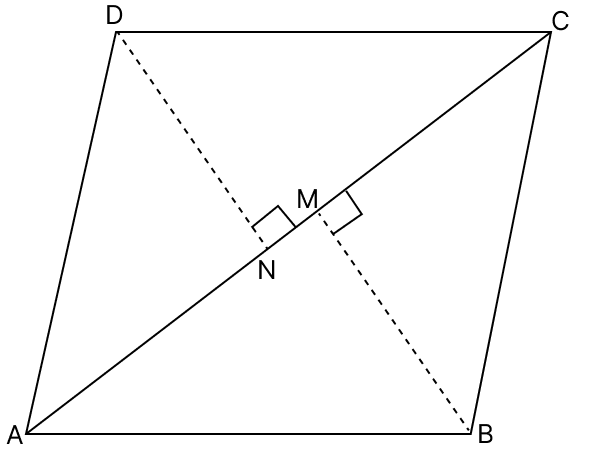
Answer
(i) In triangle DNA and BMC,
∠DNA = ∠BMC = 90° (Given)
∠DAN = ∠MCB [Alternate interior angles BC and AD are parallel, AC acts as a transversal]
BC = AD [opposite sides of parallelogram]
∴ ΔBMC ≅ ΔDNA.[By A.A.S. rule]
Hence, proved that ΔBMC ≅ ΔDNA.
(ii) We know that,
ΔBMC ≅ ΔDNA
∴ BM = DN [Corresponding sides of Congruent Triangles]
Hence, proved that BM = DN.
In the adjoining figure, ABCD is a parallelogram and X is the mid-point of BC. The line AX produced meets DC produced at Q. The parallelogram AQPB is completed. Prove that :
(i) ΔABX ≅ ΔQCX.
(ii) DC = CQ = QP.
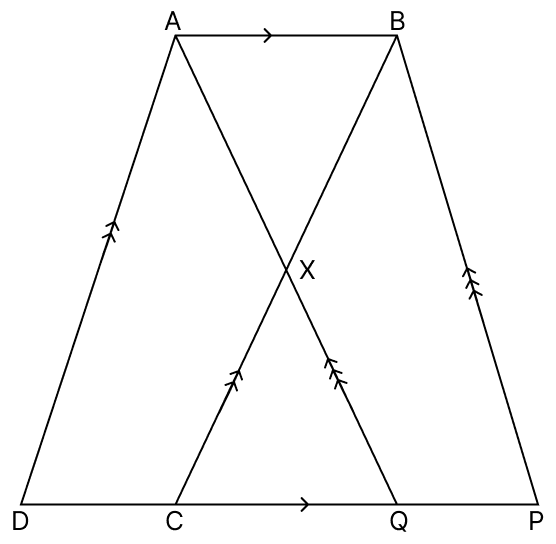
Answer
(i) Considering △ABX and △QCX we have,
⇒ ∠XBA = ∠XCQ (Alternate angles are equal)
⇒ XB = XC (As X is mid-point of BC)
⇒ ∠AXB = ∠CXQ (Vertically opposite angles are equal)
Hence, △ABX ≅ △QCX by ASA axiom.
(ii) Since, △ABX ≅ △QCX
∴ AB = CQ (By C.P.C.T.C.) .......(1)
AB = CD and AB = QP (Opposite sides of parallelogram are equal) ........(2)
From (i) and (ii) we get,
⇒ AB = DC = CQ = QP
⇒ DC = CQ = QP
Hence, proved that DC = CQ = QP.
In the adjoining figure, ABCD is a parallelogram. Line segments AX and CY bisect ∠A and ∠C respectively. Prove that :
(i) ΔADX ≅ ΔCBY
(ii) AX = CY
(iii) AX ∥ CY
(iv) AYCX is a parallelogram
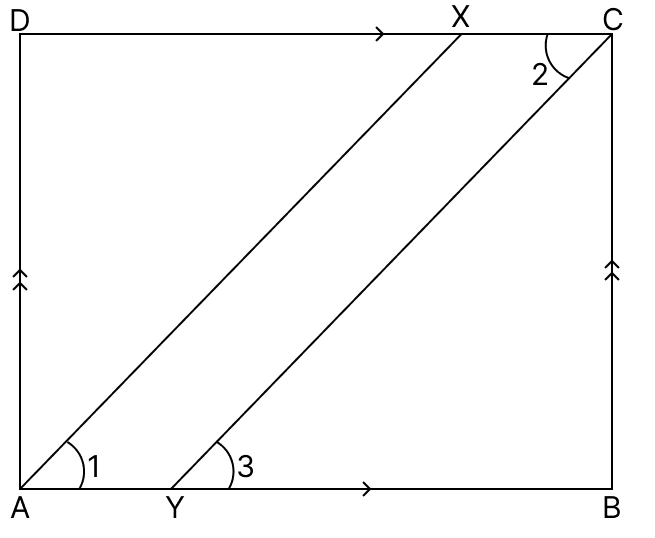
Answer
Given,
ABCD is a parallelogram.
AX bisects ∠A
CY bisects ∠C
(i) In a parallelogram opposite angles are equal, thus ∠A = ∠C.
In ΔADX and ΔCBY,
∠D = ∠B [Opposite angles of a parallelogram are equal]
∠DAX = ∠BCY
AD = BC [Opposite sides of a parallelogram are equal]
∴ ΔADX ≅ ΔCBY [By A.S.A. rule]
Hence, proved that ΔADX ≅ ΔCBY.
(ii) We know that,
ΔADX ≅ ΔCBY
AX = CY [By C.P.C.T.C.]
Hence, proved that AX = CY.
(iii) ∠DCY = ∠CYB [Alternate interior angles, AB ∥ DC, CY is transversal]
∠BAX = ∠DCY ()
∴ ∠BAX = ∠CYB
These are corresponding angles formed by lines AX and CY with the transversal AB.
Since corresponding angles are equal, the lines AX and CY are parallel.
Hence, proved that AX ∥ CY.
(iv) We know that,
AX ∥ CY and AX = CY.
If one pair of opposite sides of a quadrilateral are equal and parallel, then the quadrilateral is a parallelogram.
Thus, AYCX is a parallelogram.
Hence, proved that AYCX is a parallelogram.
In the given figure, ABCD is a parallelogram and X, Y are points on diagonal BD such that DX = BY. Prove that CXAY is a parallelogram.
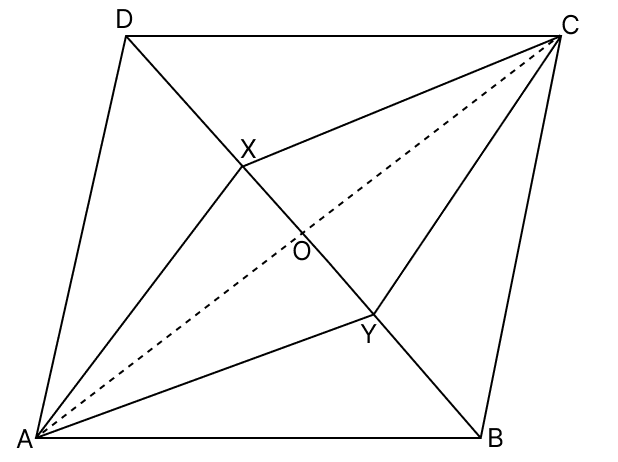
Answer
Given,
ABCD is a parallelogram
DX = BY
Diagonals of ∥ gm bisect each other.So,
OA = OC and OD = OB
Also,
OD - DX = OB - BY [DX = BY]
OX = OY
∴ Diagonals of quadrilateral CXAY bisect each other, CXAY is parallelogram
Hence, proved that CXAY is a parallelogram.
Show that the bisectors of the angles of a parallelogram enclose a rectangle.
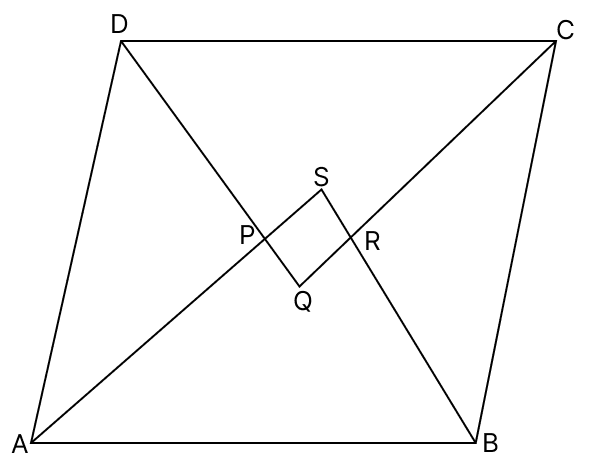
Answer
ABCD is a //gm.
From figure,
∠A + ∠D = 180° [Sum of Co-Interior angles in a // gm is 180°]
⇒ = 90°
In triangle APD,
∠DAP + ∠PDA + ∠APD = 180°
+ ∠APD = 180°
90° + ∠APD = 180°
∠APD = 90°
∠SPQ = ∠APD = 90° [Vertically opposite angles are equal]
∠P = 90°
From figure,
∠B + ∠C = 180° [Sum of Co-Interior angles in a // gm is 180°]
⇒ = 90°
In triangle BRC,
∠CBR + ∠BCR + ∠CRB = 180°
+ ∠CRB = 180°
90° + ∠CRB = 180°
∠CRB = 90°
∠SRQ = ∠CRB = 90° [Vertically opposite angles are equal]
∠R = 90°
From figure,
∠A + ∠B = 180° [Sum of Co-Interior angles in a // gm is 180°]
⇒ = 90°
In triangle ASB,
∠SAB + ∠SBA + ∠ASB = 180°
+ ∠ASB = 180°
90° + ∠ASB = 180°
∠ASB = 90°
∠S = 90°
In quadrilateral PQRS,
By angle sum property of quadrilateral,
∠P + ∠Q + ∠R + ∠S = 360°
90° + ∠Q + 90° + 90° = 360°
∠Q + 270° = 360°
∠Q = 360° - 270° = 90°.
Since, all the angles of PQRS = 90°
∴ PQRS is a rectangle.
Hence, proved that PQRS is a rectangle.
If a diagonal of a parallelogram bisects one of the angles of the parallelogram, prove that it also bisects the second angle and then the two diagonals are perpendicular to each other.
Answer
Let ABCD be a parallelogram, and let the diagonal AC bisect ∠BAD.
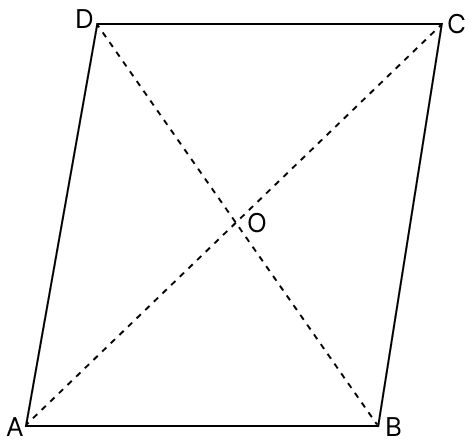
Since ABCD is a parallelogram:
AB ∥ DC
AD ∥ BC
∠DAC = ∠CAB [AC bisects ∠DAB]
In △ABC and △ADC:
AC = AC (common side)
∠BAC = ∠DCA (Alternate interior angles are equal)
∠DAC = ∠BCA (Alternate interior angles are equal)
△ABC ≅ △ADC (A.S.A. congruence)
So, ∠DCA = ∠BCA (By C.P.C.T.C.)
That means AC also bisects the opposite angle ∠DCB.
Now,
AD = AB (From congruence)
AB = CD and AD = BC (Opposite sides of parallelogram)
∴ AB = BC = CD = DA
Thus, ABCD is a Rhombus.
We know that,
Diagonals of a rhombus are perpendicular to each other.
Thus, AC ⊥ BD.
Hence, proved that the diagonal bisects the second angle and AC ⊥ BD.
In the given figure, ABCD is a parallelogram and E is the mid-point of BC. If DE and AB produced meet at F, prove that AF = 2AB.
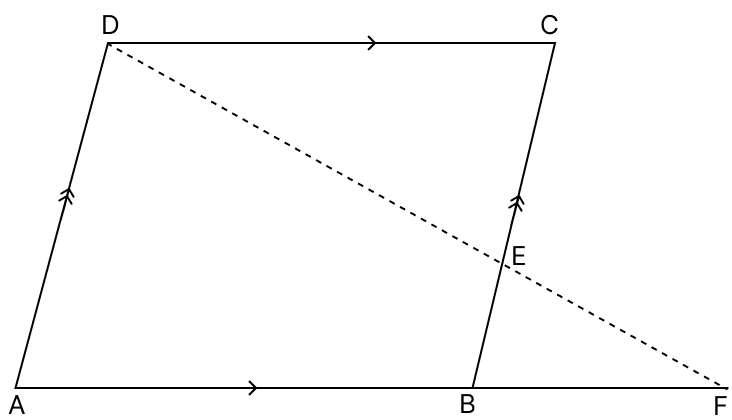
Answer
Given,
ABCD is a parallelogram.
E is the midpoint of BC.
DE meets AB produced at F.
AB ∥ DC
AB = DC (opposite sides of a parallelogram are equal)
Since E is the midpoint of BC :
BE = EC
In △DEC and △FEB:
EC = EB (E is mid-point of BC)
∠DEC = ∠FEB (Vertically opposite angles are equal)
∠DCE = ∠FBE (Alternate interior angles are equal)
△DEC ≅ △FEB (By A.S.A. axiom)
DC = BF [By C.P.C.T.C.]
DC = AB
∴ BF = AB
From figure,
AF = AB + BF
AF = AB + AB
AF = 2AB.
Hence, proved that AF = 2AB.
Construct a quadrilateral PQRS in which PQ = 4 cm, ∠P = 90°, QR = 4.3 cm, RS = 3.6 cm and SP = 3.2 cm.
Answer
Steps of constructions :
Draw PQ = 4 cm.
Draw ∠QPX = 90°.
With P as centre and radius = 3.2 cm, draw an arc, cutting PX at S.
With Q as centre and radius = 4.3 cm, draw an arc.
With S as centre and radius = 3.6 cm, draw another arc, cutting the previous arc at R.
Join QR and RS.

Hence, PQRS is the required quadrilateral.
Construct a quadrilateral ABCD in which AB = 4.5 cm, BC = 5.2 cm, CD = 5 cm, DA = 4.7 cm and ∠ABC = 75°.
Answer
Steps of constructions:
Draw AB = 4.5 cm.
Draw ∠ABX = 75°.
With B as centre and radius = 5.2 cm, draw an arc, cutting BX at C.
With A as centre and radius = 4.7 cm, draw an arc.
With C as centre and radius = 5 cm, draw another arc, cutting the previous arc at D.
Join DC and DA.

Hence, ABCD is the required quadrilateral.
Construct a quadrilateral ABCD in which AB = CD = 5.1 cm, BC = 4.7 cm, DA = 4.2 cm and ∠BCD = 60°.
Answer
Steps of constructions :
Draw CD = 5.1 cm.
Draw ∠DCX = 60°.
With C as centre and radius = 4.7 cm, draw an arc, cutting CX at B.
With D as centre and radius = 4.2 cm, draw an arc.
With B as centre and radius = 5.1 cm, draw another arc, cutting the previous arc at A.
Join DA and BA.

Hence, ABCD is the required quadrilateral.
Construct a quadrilateral UVWZ in which UV = 6 cm, VW = 5.3 cm, UZ = 5 cm, ∠U = 60° and ∠V = 75°.
Answer
Steps of construction:
Draw UV = 6 cm.
Construct ∠VUX = 60°.
With U as centre and radius = 5 cm, draw an arc, cutting UX at Z.
Construct ∠UVY = 75°.
With V as centre and radius = 5.3 cm,draw an arc, cutting arc VY at W.
Join VW and ZW.

Hence, UVWZ is required quadrilateral.
Construct a quadrilateral PQRS in which PQ = 4.5 cm, QR = 5.6 cm, RS = 4.1 cm, ∠Q = 60° and ∠R = 120°.
Answer
Steps of construction:
Draw QR = 5.6 cm.
Construct ∠RQX = 60°.
With Q as centre and radius = 4.5 cm, draw an arc, cutting QX at P.
Construct ∠QRY = 120°.
With R as centre and radius = 4.1 cm, draw an arc, cutting arc RY at S.
Join SP.

Hence, PQRS is required quadrilateral.
Construct a quadrilateral ABCD in which AB = AD = 5.3 cm, BC = CD = 5 cm and diagonal BD = 6.4 cm.
Answer
Steps of construction :
Draw AB = 5.3 cm.
Taking A as center, draw an arc of radius 5.3 cm (= AD) and taking B as center, draw one more arc of radius 6.4 cm (= diagonal BD). Let the two arcs intersect at point D.
Taking D as center, draw an arc of radius 5 cm (= CD) and taking B as center, draw one more arc of radius 5cm (= BC). Let the two arcs intersect at point C.
Join DC and BC.

Hence, ABCD is the required quadrilateral.
Construct a quadrilateral XYZT in which XY = XZ = 5.7 cm, YZ = 4.5 cm, ZT = 4.6 cm and XT = 5 cm.
Answer
Steps of construction:
Draw YZ = 4.5 cm.
With Y as centre and radius 5.7 cm draw an arc.
With Z as centre and radius 5.7 cm draw another arc, cutting previous arc at X.
With X as centre and radius 5 cm, draw an arc.
With Z as centre and radius 4.6 cm draw another arc, cutting previous arc at T.
Join XT and ZT.

Hence, XYZT is required quadrilateral.
Construct a parallelogram ABCD in which BC = 6 cm, CD = 4 cm and ∠C = 60°.
Answer
Steps of construction:
Draw BC = 6 cm.
Construct ∠BCX = 60°.
With C as centre and radius = 4 cm, draw an arc, cutting CX at D.
With D as centre and radius = 6 cm, draw an arc.
With B as centre and radius = 4 cm, draw another arc,cutting the previous arc at A.
Join AB and DA.

Hence, ABCD is the required parallelogram.
Construct a parallelogram PQRS in which QR = 4.7 cm, ∠Q = 120° and PQ = 2.8 cm.
Answer
Steps of construction :
Draw QR = 4.7 cm.
Construct ∠RQX = 120°.
With Q as centre and radius = 2.8 cm, draw an arc,cutting QX at P.
With P as centre and radius = 4.7 cm, draw an arc.
With R as centre and radius = 2.8 cm, draw another arc, cutting the previous arc at S.
Join RS and PS.

Hence, PQRS is the required parallelogram.
Construct a parallelogram ABCD in which BC = 5 cm, CD = 3 cm and diagonal BD = 6 cm.
Answer
Steps of construction:
Draw BC = 5 cm.
With B as centre and radius = 6 cm, draw an arc.
With C as centre and radius = 3 cm, draw another arc, cutting previous arc at D.
Join BD and CD.
With B as centre and radius = 3 cm draw an arc.
With D as centre and radius = 5 cm, draw another arc,cutting previous arc at A.
Join AD and AB.

Hence, ABCD is the required parallelogram.
Construct a parallelogram ABCD in which AB = 4.8 cm, BC = 3.5 cm and diagonal AC = 5.4 cm.
Answer
Steps of construction :
Draw AB = 4.8 cm.
With A as centre and radius = 5.4 cm, draw an arc.
With B as centre and radius = 3.5 cm, draw another arc, cutting previous arc at C.
Join BC and AC.
With A as centre and radius = 3.5 cm draw an arc.
With C as centre and radius = 4.8 cm, draw another arc,cutting previous arc at D.
Join AD and CD.

Hence, ABCD is the required parallelogram.
Construct a parallelogram ABCD in which diagonal AC = 5.6 cm, diagonal BD = 6.2 cm and angle between them is 60°.
Answer
Steps of construction:
Draw AC = 5.6 cm.
Find mid-point of AC.
Construct ∠AOX = 60°, produce XO to Y.
With O as centre and radii = (6.2) = 3.1 cm, draw arcs, cutting OX at D and OY at B.
Join AB, BC, CD and DA.

Hence, ABCD is required parallelogram.
Construct a rectangle whose adjacent sides are 4.7 cm and 3.2 cm.
Answer
Steps of construction :
Draw AB = 4.7 cm.
Construct ∠ABX = 90°.
With B as centre and radius equal to 3.2 cm, draw an arc, cutting BX at C.
With A as centre and radius = 3.2 cm, draw an arc.
With C as centre and radius = 4.7 cm, draw an arc, cutting previous arc at D.
Join DC and DA.

Hence, ABCD is required rectangle.
Construct a rectangle ABCD in which AB = 4.5 cm and diagonal AC = 6 cm.
Answer
Steps of construction :
Draw AB = 4.5 cm.
Construct ∠ABX = 90°.
With A as centre and radius equal to 6 cm, draw an arc, cutting BX at C. Join BC
With C as centre and radius = 4.5 cm, draw an arc.
With A as centre and radius = BC, draw an arc, cutting previous arc at D.
Join DC and DA.

Hence, ABCD is required rectangle.
Construct a rectangle ABCD in which diagonal AC = 6.3 cm and the angle between the two diagonals is 50°.
Answer
Steps of construction :
Draw AC = 6.3 cm.
Find mid-point O of AC.
Construct ∠AOX = 50°.
Produce XO to Y.
Set off OB = 3.15 cm and OD = 3.15 cm.
Join AB, BC, CD and DA.

Hence, ABCD is required rectangle.
Construct a square one of whose diagonals measures 6 cm.
Answer
Steps of construction:
Draw AC = 6 cm.
Draw a perpendicular bisector XY of AC, meeting AC at O.
On XY, setoff OD = 3 cm and OB = 3 cm.
Join AD, CD, AB and BC.

Hence, ABCD is the required square.
Construct a rhombus ABCD in which AB = 4.3 cm and ∠A = 45°.
Answer
Steps of construction :
Draw AB = 4.3 cm.
Construct ∠BAX = 45°.
On AX, cut off AD = 4.3 cm.
With B as centre and radius = 4.3 cm, draw an arc.
With D as centre and radius = 4.3 cm, draw another arc, cutting the previous arc at C.
Join CB and CD.

Hence, ABCD is the required rhombus.
Construct a rhombus ABCD in which AB = 5 cm and diagonal AC = 6.8 cm.
Answer
Steps of construction:
Draw AB = 5 cm.
With A as centre and radius = 6.8 cm, draw an arc.
With B as centre and radius = 5 cm, draw another arc, cutting the previous arc at C.
Join BC and AC.
With A as centre and radius = 5 cm, draw an arc.
With C as centre and radius = 5 cm, draw another arc,cutting the previous arc at D.
Join CD and DA.

Hence, ABCD is required rhombus.
Construct a rhombus ABCD in which diagonal AC = 5.8 cm and diagonal BD = 6.4 cm.
Answer
Steps of construction :
Draw AC = 5.8 cm.
Draw the perpendicular bisector XOY of AC.
Set off OB = 3.2 cm on OY and OD = 3.2 cm on OX.
Join AB, BC, CD and DA.

Hence, ABCD is the required rhombus.
Construct a square one of whose diagonals is 5.6 cm.
Answer
Steps of construction :
Draw AC = 5.6 cm.
Draw a perpendicular bisector XY of AC, meeting AC at O.
On XY, setoff OD = 2.8 cm and OB = 2.8 cm.
Join AD, CD, AB and BC.

Hence, ABCD is the required square.
Construct a regular hexagon of side 2 cm, using ruler and compasses only.
Answer
We know that each angle in a regular hexagon = 120°.
Steps of construction :
Draw a line segment AB = 2 cm.
At A and B, draw ∠ABC = 120° each and cut off AF = BC = 2 cm.
At F and C, draw rays making angle of 120° each and cut off EF = CD = 2 cm.
Join ED. Hence, ABCDEF is the required hexagon.

Hence, ABCDEF is required regular hexagon.
Construct a regular hexagon of side 3.5 cm, using ruler and compasses only.
Answer
We know that each angle in a regular hexagon = 120°.
Steps of construction :
Draw a line segment AB = 3.5 cm.
At A and B, draw ∠ABC = 120° each and cut off AF = BC = 3.5 cm.
At F and C, draw rays making angle of 120° each and cut off EF = CD = 3.5 cm.
Join ED. Hence, ABCDEF is the required hexagon.

Hence, ABCDEF is required regular hexagon.
Three angles of a quadrilateral measure 56°, 115° and 84°. Measure of the fourth angle is :
100°
105°
95°
110°
Answer
Let the fourth angle be x.
Given the three angles are 56°, 115° and 84°:
The sum of the angles of a quadrilateral is 360°
56°+ 115° + 84° + x = 360°
255° + x = 360°
x = 360° - 255°
x = 105°
Hence, option 2 is the correct option.
The angles of a quadrilateral are in the ratio 2 : 4 : 5 : 7. The angles of given quadrilateral are :
40°, 60°, 100°, 140°
40°, 80°, 120°, 120°
40°, 80°, 100°, 140°
40°, 60°, 100°, 160°
Answer
We know that,
The sum of the angles of a quadrilateral is 360°
Given the ratio of the angles is 2 : 4 : 5 : 7.
Let the angles be 2x, 4x, 5x, and 7x.
2x + 4x + 5x + 7x = 360°
18x = 360°
x = 20°
2x = 40°
4x = 80°
5x = 100°
7x = 140°
Hence, option 3 is the correct option.
ABCD is a parallelogram in which ∠A = 72°. Measures of ∠B, ∠C and ∠D respectively will be :
72°, 108°, 108°
108°, 108°, 72°
108°, 72°, 108°
none of these
Answer

In a parallelogram, consecutive angles are supplementary and opposite angles are equal.
∠A + ∠B = 180°
72° + ∠B = 180°
∠B = 180° - 72°
∠B = 108°
∠A = ∠C = 72° (Opposite angles of parallelogram are equal.)
∠D = ∠B = 108° (Opposite angles of parallelogram are equal.)
Hence, option 3 is the correct option.
In parallelogram ABCD, if ∠A = 2x + 25° and ∠B = 3x − 5°, then value of x will be :
x = 13°
x = 23°
x = 33°
x = 32°
Answer

In a parallelogram, consecutive angles are supplementary and opposite angles are equal.
∠A = 2x + 25° and ∠B = 3x − 5°
∠A + ∠B = 180°
2x + 25° + 3x − 5° = 180°
5x + 20° = 180°
5x = 180° - 20°
5x = 160°
x = 32°.
Hence, option 4 is the correct option.
If one angle of a parallelogram is 30° less than twice the smallest angle, then measure of each angle will be :
60°, 80°, 80°, 140°
70°, 110°, 70°, 110°
60°, 120°, 60°, 120°
75°, 105°, 75°, 105°
Answer
Let the smallest angle of the parallelogram be denoted as x.
Given,
One angle of a parallelogram is 30° less than twice the smallest angle = 2x - 30°.
In a parallelogram, consecutive angles are supplementary and opposite angles are equal.
x + 2x - 30° = 180°
3x - 30° = 180°
3x = 180° + 30°
3x = 210°
x = 70°.
The two smaller angles are both 70°.
The two larger angles are both 2(70°) - 30° = 110°.
Hence, option 2 is the correct option.
ABCD is a parallelogram in which AB = 9.5 cm and its perimeter is 30 cm. Length of each side of parallelogram ABCD is :
AB = 9.5 cm, DC = 9.5 cm, BC = 5.5 cm, DA = 5.5 cm
AB = 9.5 cm, BC = 9.5 cm, DC = 5.5 cm, DA = 5.5 cm
DC = 5.5 cm, BC = 5.5 cm, AB = 9.5 cm, AD = 9.5 cm
none of these
Answer

In a parallelogram, opposite sides are equal in length.
AB = CD
BC = DA
Perimeter = 30 cm
We know that,
Perimeter of Parallelogram = 2(Length + Breadth)
30 = 2(9.5 + BC)
15 = (9.5 + BC)
BC = 15 - 9.5
BC = 5.5 cm
BC = AD = 5.5 cm.
AB = CD = 9.5 cm
Hence, option 1 is the correct option.
Each side of a rhombus is 10 cm and one of its diagonals is 16 cm, length of other diagonal will be :
11 cm
12 cm
13 cm
15 cm
Answer
Let ABCD be the rhombus and the diagonals intersect at point O.

Let diagonal AC = 16 cm.
We know that,
Diagonals of rhombus bisect each other at right angles.
∴ AO = OC = = 8 cm and BO = OD = x cm (let).
In right angle triangle AOB,
By pythagoras theorem,
⇒ (Hypotenuse)2 = (Perpendicular)2 + Base2
⇒ AB2 = AO2 + OB2
⇒ 102 = 82 + x2
⇒ 100 = 64 + x2
⇒ x2 = 100 - 64
⇒ x2 = 36
⇒ x = = 6 cm.
From figure,
⇒ BD = BO + OD = 6 + 6 = 12 cm.
Hence, option 2 is the correct option.
ABCD is a rhombus. If ∠A = 70°, then ∠CDB will be :
45°
65°
55°
75°
Answer

The sum of consecutive angles in a rhombus is 180°.
∠A + ∠D = 180°
70° + ∠D = 180°
∠D = 180° - 70°
∠D = 110°.
The diagonal BD bisects ∠D.
∠CDB =
∠CDB =
∠CDB = 55°.
Hence, option 3 is the correct option.
In a parallelogram, an angle is th of its adjacent angle, then angles of the parallelogram are :
80°, 100°, 80°, 100°
70°, 110°, 70°, 110°
60°, 120°, 60°, 120°
none of these
Answer
In a parallelogram, adjacent angles are supplementary.
Let one of the angle of parallelogram be x.
The adjacent angle is given as .
The adjacent angle = = 80°.
The angles opposite to 100° is also 100°.
The angle opposite to 80° is also 80°.
Hence, option 1 is the correct option.
The lengths of diagonals of a rhombus are 24 cm and 18 cm respectively, length of each side of the rhombus is :
25 cm
15 cm
35 cm
45 cm
Answer

The diagonals of a rhombus are 18 cm and 24 cm.
AC = 18 cm
Then, OA = OC = = 9 cm.
And, BD = 24 cm
Then, OB = OD = = 12 cm.
Since the diagonals of a rhombus bisect at 90°.
Applying pythagoras theorem in triangle AOB, we get :
⇒ AB2 = OA2 + OB2
⇒ AB2 = (9)2 + (12)2
⇒ AB2 = 81 + 144
⇒ AB2 = 225
⇒ AB =
⇒ AB = 15 cm.
Hence, option 2 is the correct option.
ABCD is a parallelogram in which ∠BAD = 60° and ∠BAC = 30°, then ∠CBD =
45°
60°
70°
80°
Answer
Given,
∠BAD = 60° and ∠BAC = 30°.

From figure,
∠CAD = ∠BAD - ∠BAC = 60° - 30° = 30°.
If diagonal of a parallelogram bisects a vertex angle, then it is a rhombus.
Thus, ABCD is a rhombus.
In rhombus adjacent angles are supplementary.
Thus,
∠BAD + ∠CBA = 180°
60° + ∠CBA = 180°
∠CBA = 180° - 60° = 120°.
Since, diagonals of rhombus bisect the vertex angle,
∴ ∠CBD = = 60°.
Hence, option 2 is the correct option.
The diagonals of the rectangle ABCD intersect at O. If ∠OBC = 64°, then ∠OAB =
64°
32°
26°
36°
Answer

In a rectangle all angles are equal to 90°.
∠ABC = ∠OBC + ∠ABO
90° = 64° + ∠ABO
∠ABO = 90° - 64°
∠ABO = 26°.
The diagonals of a rectangle are equal in length and bisect each other. This means :
⇒ AC = BD
⇒ AO = BO
In an isosceles triangle AOB, the angles opposite the equal sides are equal.
∠OAB = ∠ABO = 26°.
Hence, option 3 is the correct option.
If ∠ADB of the rhombus ABCD is 30°, then ∠ACB =
30°
60°
70°
90°
Answer

In rhombus opposite sides are parallel. The diagonal BD acts as a transversal line.
Therefore, the alternate interior angles are equal.
∠DBC = ∠ADB = 30°
From figure,
∠OBC = ∠DBC = 30°
∠BOC = 90° [Diagonals of rhombus cut at right angles]
In triangle BOC,
∠OBC + ∠BOC + ∠OCB = 180°
30° + 90° + ∠OCB = 180°
120° + ∠OCB = 180°
∠OCB = 180° - 120°
∠OCB = 60°.
Hence, option 2 is the correct option.
In the parallelogram ABCD, ∠A : ∠B = 3 : 5. ∠C =
67.5°
112.5°
45°
135°
Answer

Given the ratio ∠A : ∠B = 3 : 5.
Let ∠A = 3x and ∠B = 5x.
Sum of adjacent angles in a parallelogram = 180°.
3x + 5x = 180°
8x = 180°
x = 22.5°
In a parallelogram, opposite angles are equal.
∠C = ∠A = 3x
∠C = 3 × (22.5°)
∠C = 67.5°
Hence, option 1 is the correct option.
The bisectors of ∠A and ∠B of the parallelogram ABCD intersect at E. ∠AEB =
100°
90°
80°
60°
Answer

In a parallelogram, consecutive angles are supplementary.
∠A + ∠B = 180°
In triangle AEB,
∠AEB + ∠BAE + ∠EBA = 180°
∠AEB + ∠A + ∠B = 180°
∠AEB + (∠A + ∠B) = 180°
∠AEB + (180°) = 180°
∠AEB + 90° = 180°
∠AEB = 180° - 90°
∠AEB = 90°.
Hence, option 2 is the correct option.
The bisectors of ∠A and ∠B of the parallelogram ABCD intersect at P on the side CD. If BC = 3 cm, then AB =
4 cm
5 cm
6 cm
8 cm
Answer

In parallelogram ABCD, we know that AB ∥ DC. The line AP is a transversal.
∠PAB = ∠APD (Alternate interior angles are equal) ....(1)
Since AP is the bisector of ∠A:
∠PAB = ∠PAD .......(2)
From equation (1) and (2), we get :
∴ ∠PAD = ∠APD
In triangle APD, since two angles are equal, the triangle is isosceles.
AD = DP
ABCD is a parallelogram, AD = BC = 3 cm.
Thus, DP = 3 cm.
Similarly, for the bisector BP and transversal BP:
∠PBA = ∠BPC (Alternate interior angles are equal) .......(3)
Since BP bisects ∠B:
∠PBA = ∠PBC ..........(4)
From equation (3) and (4), we get :
∴ ∠BPC = ∠PBC
In triangle BCP, since two angles are equal, the triangle is isosceles.
PC = BC = 3 cm.
Length of CD = DP + PC = 3 + 3 = 6 cm.
AB = CD = 6 cm [Opposite sides of parallelogram are equal]
Hence, option 3 is the correct option.
If the lengths of the diagonals of a rhombus are 24 cm and 10 cm, then the length of its each side is :
26 cm
17 cm
15 cm
13 cm
Answer
Let the rhombus be ABCD and its diagonals AC and BD intersect at point O.

We know that,
Diagonals of a rhombus bisect each other.
AC = 24 cm
OA = = 12 cm.
BD = 10 cm
OB = = 5 cm.
In triangle AOB,
OA2 + OB2 = AB2
122 + 52 = AB2
144 + 25 = AB2
169 = AB2
AB =
AB = 13 cm.
Hence, option 4 is the correct option.
If the opposite angles of a quadrilateral are equal, then it will definitely be a :
rectangle
square
rhombus
parallelogram
Answer
If the opposite angles of a quadrilateral are equal, then it will definitely be a parallelogram.
Hence, option 4 is the correct option.
The diagonals of a quadrilateral are equal and they bisect each other. The quadrilateral is definitely a :
rectangle
square
rhombus
parallelogram
Answer
A rectangle is defined as a parallelogram with equal diagonals. If the diagonals of a quadrilateral bisect each other and are also equal, it must be a rectangle.
Hence, option 1 is the correct option.
PQRS is a rhombus in which PQ = 6 cm and ∠PQR = 120°. The length of the diagonal QS is :
6 cm
7 cm
8 cm
11 cm
Answer

In triangle PQS,
PQ = PS = 6 cm (because all sides of a rhombus are equal).
Therefore, the base angles are equal:
∠PQS = ∠PSQ.
∠PQR = ∠PSR = 120° [Opposite angles of a rhombus are equal]
∠PQR + ∠QPS = 180° [Consecutive angles are supplementary]
∠QPS = 180° - 120°
∠QPS = 60°.
In triangle PQS,
∠QPS + ∠PQS + ∠PSQ = 180°
60° + 2∠PQS = 180°
2∠PQS = 180° - 60°
2∠PQS = 120°
∠PQS = 60°.
Since all three angles (∠QPS, ∠PQS, and ∠PSQ) are 60°, △PQS is an equilateral triangle.
PQ = PS = QS = 6 cm.
Hence, option 1 is the correct option.
Rajbeer is a farmer. He has a plot of land in the shape of a quadrilateral ABCD as shown in the figure. In ABCD, AB ∥ CD and AD ∥ BC. He divided the field into two parts, viz, triangle BCE and trapezium CDAE by making an embankment CE such that CE = AD.
Based on the above information, answer the following questions :

1. ABCD is a :
(a) Rectangle
(b) Parallelogram
(c) Square
(d) Trapezium
2. ∠A is equal to :
(a) ∠D
(b) ∠B
(c) ∠C
(d) ∠E
3. ∠DCE is equal to :
(a) ∠E
(b) ∠A
(c) ∠D
(d) ∠B
4. Which of the following is correct?
(a) ΔAEC ≅ ΔEAD
(b) ΔACE ≅ ΔAED
(c) ΔCEA ≅ ΔEAD
(d) none of these
5. Diagonal DE is equal to :
(a) diagonal DB
(b) diagonal AC
(c) DC
(d) BC
Answer

1. Given,
AB ∥ CD and AD ∥ BC
Since both pairs of opposite sides are parallel, the quadrilateral ABCD is a parallelogram.
Hence, option (b) is the correct option.
2. Given,
AD = CE
In trapezium CDAE:
AD and CE are the non-parallel sides and they are equal.
∴ CDAE is an isosceles trapezium.
∠A = ∠E [Angles on the same base of an isosceles triangle area equal]
Hence, option (d) is the correct option.
3. Given,
AD = CE
∴ CDAE is an isosceles trapezium.
∠DCE = ∠ADC [Base angles of an isosceles trapezium are equal.]
Hence, option (c) is the correct option.
4. In ΔAEC and ΔAED,
AD = CE (Given)
AE = AE (common side)
∠AEC = ∠EAD [Base angles of an isosceles trapezium are equal]
∴ ΔAEC ≅ ΔEAD [By S.A.S. axiom]
Hence, option (a) is the correct option.
5. As ADCE is an isosceles trapezium and diagonals of an isosceles trapezium are equal in length.
Hence, option (b) is the correct option.
Assertion (A) : The two diagonals of a rectangle are equal and bisect each other at right angles.
Reason (R) : Every rectangle is a square.
A is true, R is false
A is false, R is true
Both A and R are true
Both A and R are false
Answer
The diagonals of a rectangle are equal in length and bisect eah other, but not necessarily at right angles.
∴ Assertion (A) is false.
A square is a special type of rectangle where all sides are equal, but a rectangle is not necessarily a square.
A rectangle only requires four right angles; it does not require all four sides to be equal.
Every square is a rectangle, but not every rectangle is a square.
∴ Reason (R) is false.
Both A and R are false.
Hence, option 4 is the correct option.
Assertion (A) : If diagonals of a quadrilateral are equal, then it must be a rectangle.
Reason (R) : The diagonals of a rectangle are equal.
A is true, R is false
A is false, R is true
Both A and R are true
Both A and R are false
Answer
For a quadrilateral to be a rectangle, the diagonals must be equal and they must bisect each other.Having equal diagonals is not enough to say a quadrilateral to be a rectangle.
Assertion (A) is false.
This is a fundamental property of rectangles.
If we have a rectangle ABCD, we can prove the diagonals AC and BD are equal using the SAS congruence rule on △ABC and △DCB.

AB = DC (Opposite sides)
∠B = ∠C = 90°
BC = BC (Common side)
Therefore, AC = BD.
Reason (R) is true.
A is false, R is true
Hence, option 2 is the correct option.
Assertion (A) : Every square is a parallelogram.
Reason (R) : In a square as well as in a parallelogram, the diagonals are equal in length.
A is true, R is false
A is false, R is true
Both A and R are true
Both A and R are false
Answer
By definition, a parallelogram is a quadrilateral with two pairs of parallel opposite sides.
A square has all the properties of a parallelogram:
Opposite sides are parallel.
Opposite sides are equal.
Opposite angles are equal.
Diagonals bisect each other.
Because a square meets all these criteria, it is considered a special type of parallelogram.
Assertion (A) is true.
A square has equal diagonals, it is not true for a general parallelogram.
In a standard parallelogram (like a rhombus or a slanted parallelogram), one diagonal is typically longer than the other.
Reason (R) is false.
A is true, R is false.
Hence, option 1 is the correct option.
If bisectors of ∠A and ∠B of a parallelogram ABCD intersect each other at P, of ∠B and ∠C at Q, of ∠C and ∠D at R and of ∠D and ∠A at S, then PQRS is a :
rectangle
rhombus
parallelogram
quadrilateral whose opposite angles are supplementary
Answer

∠A + ∠D = 180° [sum of Co-Int. angles in ∥gm is 180°]
⇒ = 90°
In triangle ASD,
∠DAS + ∠SDA + ∠ASD = 180°
+ ∠ASD = 180°
90° + ∠ASD = 180°
∠ASD = 90°
∠PSR = ∠ASD = 90° [Vertically opposite angles]
∠S = 90°
∠B + ∠C = 180° [sum of Co-Int. angles in ∥gm is 180°]
⇒ = 90°
In triangle BQC,
∠QCB + ∠QBC + ∠CQB = 180°
+ ∠CQB = 180°
90° + ∠CQB = 180°
∠CQB = 90°
∠PQR = ∠CQB = 90° [Vertically opposite angles]
∠Q = 90°
∠A + ∠B = 180° [sum of Co-Int. angles in ∥gm is 180°]
⇒ = 90°
In triangle APB,
+ ∠APB = 180°
90° + ∠APB = 180°
∠APB = 90°
∠P = 90°
In quadrilateral PQRS,
By angle sum property of quadrilateral:
∠P + ∠Q + ∠R + ∠S = 360°
90° + 90° + ∠R + 90° = 360°
∠R + 270° = 360°
∠R = 360° - 270°
∠R = 90°
Since, all angles of PQRS = 90°
∴ PQRS is a rectangle
Hence, option 1 is the correct option.
Diagonals of a quadrilateral ABCD bisect each other. If ∠A = 35°, then ∠B is equal to :
145°
135°
155°
35°
Answer

A quadrilateral whose diagonals bisect each other is a Parallelogram.
Since ∠A and ∠B are adjacent angles they are supplementary,
∠A + ∠B = 180°
35° + ∠B = 180°
∠B = 180° - 35°
∠B = 145°.
Hence, option 1 is the correct option.
ABCD is a trapezium and P and Q are the mid-points of the diagonals of AC and BD. Then PQ is equal to :
AB
CD
(AB − CD)
(AB + CD)
Answer

The Mid-point Theorem, which states that the line segment joining the mid-points of two sides of a triangle is parallel to the third side and is half of its length.
In triangle ADC,
M is the mid-point of AD (let)
P is the mid-point of AC
MP ∥ CD
MP = CD
In triangle ABD,
M is the mid-point of AD
Q is the mid-point of BD
MQ ∥ AB
MQ = AB
Since: MP ∥ CD, MQ ∥ AB and AB ∥ CD,
∴ MP ∥ MQ
Both pass through point M. So MP and MQ are the same straight line.
Hence, M, P and Q all lie on same line.
MQ = MP + PQ
PQ = MQ - MP
PQ = AB - CD
PQ = [AB - CD]
Hence, option 3 is the correct option.
The diagonals of a quadrilateral intersect at right angles and it has exactly one axis of symmetry. The quadrilateral is a :
square
rhombus
kite
none of these
Answer
A kite is defined by two pairs of adjacent sides being equal. Because of this specific symmetry, the longer diagonal acts as a mirror line, while the shorter diagonal does not.
Kite has exactly 1 axis of symmetry.
Hence, option 3 is the correct option.
You have been given following specification regarding a quadrilateral. Measure of all the four angles and the length of one side is given. Would you be able to construct a unique quadrilateral in this case? Justify your answer.
Answer
No, we cannot construct a unique quadrilateral with only the measures of all four angles and the length of just one side.
In any quadrilateral, the sum of interior angles is always 360°. So even if all four angles are given, they only tell you the shape’s turning, not its exact size or proportions.
Knowing the length of only one side fixes the scale along that side, but the other sides can still vary.
Therefore, the given information is insufficient, and a unique quadrilateral cannot be constructed.
Which of the following quadrilaterals can you construct if you know the length of its diagonals?
Parallelogram
Rectangle
Rhombus
Square
Answer
Rhombus:
Diagonals of a rhombus are perpendicular bisectors of each other.
Knowing both diagonal lengths completely determines the rhombus.
Square:
A square has equal diagonals that are perpendicular. Knowing the diagonal length fixes the side length.
Hence, square and rhombus can be constructed if we know the length of its diagonals.
ABCD is a rectangle in which diagonal BD bisects ∠B. Can we definitely say that ABCD is a square?
Answer

In a rectangle, all angles are 90°.
Given that diagonal bisects ∠B
∠ABD = ∠DBC = 45°
This implies that the diagonal makes equal angles with sides BA and BC, which can happen only if AB = BC.
A rectangle with adjacent sides equal is a square.
Yes, ABCD is a square.