KnowledgeBoat Logo
|
OPEN IN APP

Chapter 10

Pythagoras Theorem

Class - 9 RS Aggarwal Mathematics Solutions


Exercise 10

Question 1

In △ABC, ∠C = 90°.

If BC = a, AC = b and AB = c, find :

(i) c when a = 8 cm and b = 6 cm

(ii) a when c = 25 cm and b = 7 cm

(iii) b when c = 13 cm and a = 5 cm
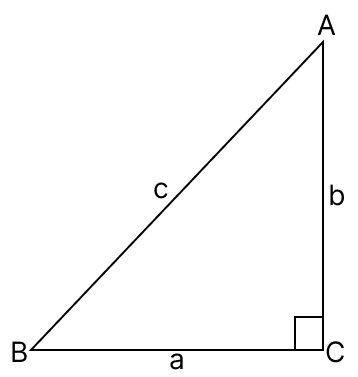
In △ABC, ∠C = 90°. Pythagoras Theorem, R.S. Aggarwal Mathematics Solutions ICSE Class 9.

Answer

By Pythagoras theorem,

⇒ Hypotenuse2 = Perpendicular2 + Base2

In △ ABC,

⇒ AB2 = AC2 + BC2

Given, BC = a, AC = b and AB = c

⇒ c2 = b2 + a2

(i) Given,

a = 8 cm and b = 6 cm

⇒ c2 = 62 + 82

⇒ c2 = 36 + 64

⇒ c2 = 100

⇒ c = 100\sqrt{100}

⇒ c = 10 cm

Hence, c = 10 cm.

(ii) Given,

c = 25 cm and b = 7 cm

⇒ 252 = 72 + a2

⇒ 625 = 49 + a2

⇒ a2 = 625 - 49

⇒ a2 = 576

⇒ a = 576\sqrt{576}

⇒ a = 24 cm

Hence, a = 24 cm.

(iii) Given,

c = 13 cm and a = 5 cm

⇒ 132 = b2 + 52

⇒ 169 = b2 + 25

⇒ b2 = 169 - 25

⇒ b2 = 144

⇒ b = 144\sqrt{144}

⇒ b = 12 cm

Hence, b = 12 cm.

Question 2

Length of the sides of triangles are given. Determine which of them is a right angled triangle. In case of right angled triangle determine the hypotences.

(i) 5 cm, 4 cm, 3 cm

(ii) 10 cm, 15 cm, 13 cm

(iii) 60 cm, 80 cm, 100 cm

Answer

Choose the greatest length. Check whether the square of greatest length is equal to the sum of squares of other two lengths.

(i) Here greatest length is 5 cm and other lengths are 3 cm, 4 cm.

Note that 52 = 25 and 32 + 42 = 9 + 16 = 25.

Thus, 52 = 32 + 42

Hence, the triangle with given lengths of sides is a right triangle.

(ii) Here greatest length is 15 cm and other lengths are 10 cm, 13 cm.

Note that 152 = 225 and 102 + 132 = 100 + 169 = 269.

Thus, 225 ≠ 269

Hence, the triangle with given lengths of sides is not a right triangle.

(iii) Here greatest length is 100 cm and other lengths are 80 cm, 60 cm.

Note that 1002 = 10000 and 802 + 602 = 6400 + 3600 = 10000

Thus, 10000 = 10000

Hence, the triangle with given lengths of sides is a right triangle.

Question 3

A rectangular field is 40 m long and 30 m broad. Find the length of its diagonal.

Answer
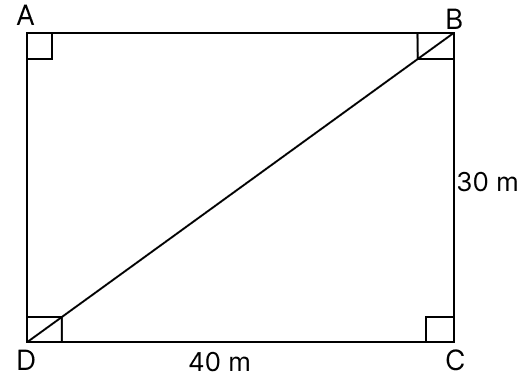
A rectangular field is 40 m long and 30 m broad. Find the length of its diagonal. Pythagoras Theorem, R.S. Aggarwal Mathematics Solutions ICSE Class 9.

Let, diagonal of the rectangle be BD.

BC = 30 m and CD = 40 m

By Pythagoras theorem,

Hypotenuse2 = Perpendicular2 + Base2

In right-angled triangle BCD,

⇒ BD2 = BC2 + CD2

⇒ BD2 = 302 + 402

⇒ BD2 = 900 + 1600

⇒ BD2 = 2500

⇒ BD = 2500\sqrt{2500}

⇒ BD = 50 m

Hence, the length of its diagonal is 50 m.

Question 4

A man goes 15 m due west and then 8 m due north. How far is he from the starting point?
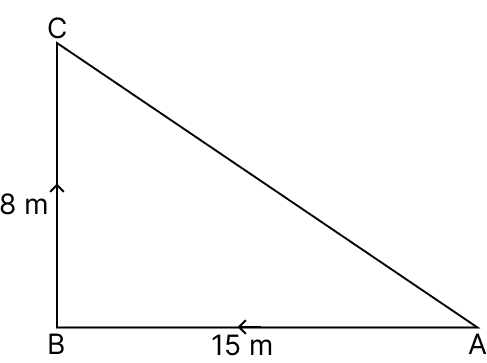
A man goes 15 m due west and then 8 m due north. How far is he from the starting point? Pythagoras Theorem, R.S. Aggarwal Mathematics Solutions ICSE Class 9.

Answer

By Pythagoras theorem,

Hypotenuse2 = Perpendicular2 + Base2

In triangle ABC,

⇒ AC2 = BC2 + AB2

⇒ AC2 = 82 + 152

⇒ AC2 = 64 + 225

⇒ AC2 = 289

⇒ AC = 289\sqrt{289}

⇒ AC = 17 m.

Hence, the man is 17 m far from the starting point.

Question 5

A ladder 17 m long reaches the window of a building 15 m above the ground. Find the distance of the foot of the ladder from the building.
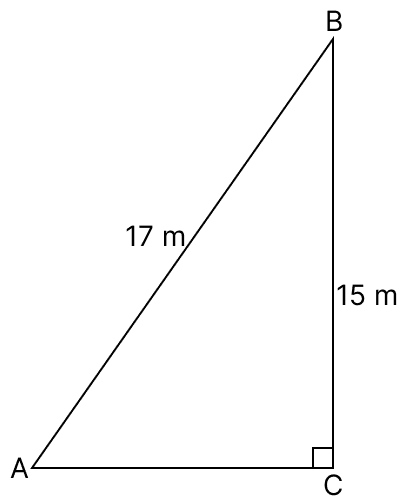
A ladder 17 m long reaches the window of a building 15 m above the ground. Find the distance of the foot of the ladder from the building. Pythagoras Theorem, R.S. Aggarwal Mathematics Solutions ICSE Class 9.

Answer

Let AB be the ladder, BC be the building and B be the window.

Then, AB = 17 m, BC = 15 m

AC be the distance of the foot of the ladder from the building.

By Pythagoras theorem,

Hypotenuse2 = Perpendicular2 + Base2

In triangle ABC,

⇒ AB2 = BC2 + AC2

⇒ 172 = 152 + AC2

⇒ 289 = 225 + AC2

⇒ AC2 = 289 - 225

⇒ AC2 = 64

⇒ AC = 64\sqrt{64}

⇒ AC = 8 m.

Hence, the distance of the foot of the ladder from the building is 8 m.

Question 6

A ladder 13 m long rests against a vertical wall. If the foot of the ladder is 5 m from the foot of the wall, find the distance of the other end of the ladder from the ground.

Answer
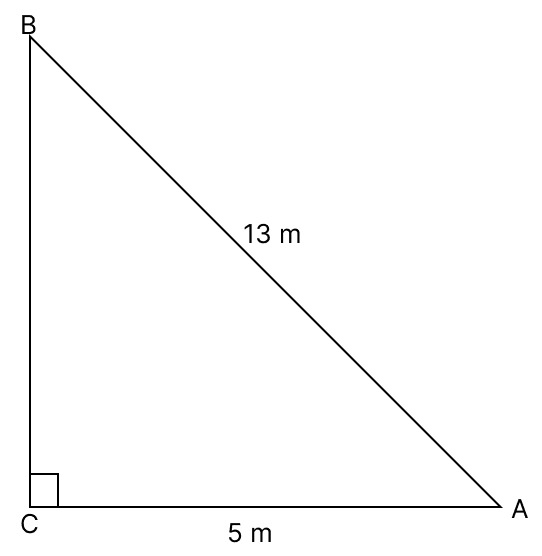
A ladder 13 m long rests against a vertical wall. If the foot of the ladder is 5 m from the foot of the wall, find the distance of the other end of the ladder from the ground. Pythagoras Theorem, R.S. Aggarwal Mathematics Solutions ICSE Class 9.

Let AB be the ladder, BC be the vertical wall and AC be the distance of the foot of the ladder from the wall.

Then, AB = 13 m, AC = 5 m

By Pythagoras theorem,

Hypotenuse2 = Perpendicular2 + Base2

In triangle ABC,

⇒ AB2 = BC2 + AC2

⇒ 132 = BC2 + 52

⇒ 169 = BC2 + 25

⇒ BC2 = 169 - 25

⇒ BC2 = 144

⇒ BC = 144\sqrt{144}

⇒ BC = 12 m.

Hence, the distance of the other end of the ladder from the ground is 12 m.

Question 7

A ladder 15 m long reaches a window which is 9 m above the ground on one side of the street. Keeping its foot at the same point, the ladder is turned to the other side of the street to reach a window 12 m high. Find the width of the street.
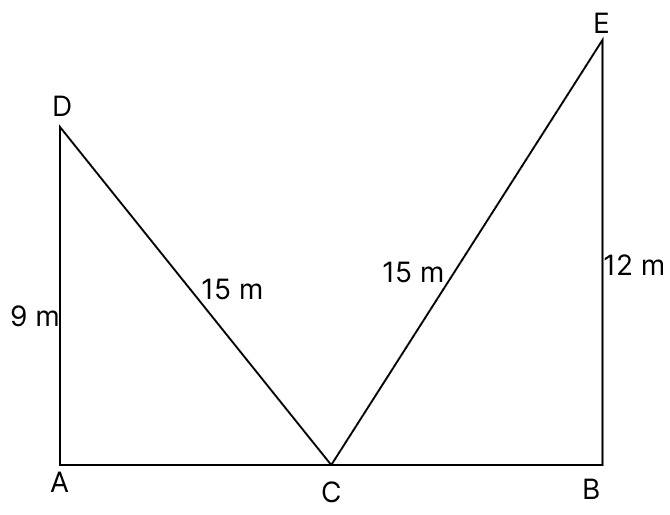
A ladder 15 m long reaches a window which is 9 m above the ground on one side of the street. Keeping its foot at the same point, the ladder is turned to the other side of the street to reach a window 12 m high. Find the width of the street. Pythagoras Theorem, R.S. Aggarwal Mathematics Solutions ICSE Class 9.

Answer

From figure,

Let width of the street be AB = AC + BC

Let CD and CE be the ladder at different positions.

By Pythagoras theorem,

Hypotenuse2 = Perpendicular2 + Base2

In triangle ADC,

⇒ CD2 = AD2 + AC2

⇒ 152 = 92 + AC2

⇒ 225 = 81 + AC2

⇒ AC2 = 225 - 81

⇒ AC2 = 144

⇒ AC = 144\sqrt{144}

⇒ AC = 12 m

In triangle BCE,

⇒ CE2 = BE2 + BC2

⇒ 152 = 122 + BC2

⇒ 225 = 144 + BC2

⇒ BC2 = 225 - 144

⇒ BC2 = 81

⇒ BC = 81\sqrt{81}

⇒ BC = 9 m

AB = AC + BC = 12 + 9 = 21 m.

Hence, the width of the street is 21 m.

Question 8

In the given figure, ABCD is a quadrilateral in which BC = 3 cm, AD = 13 cm, DC = 12 cm and ∠ABD = ∠BCD = 90°. Calculate the length of AB.
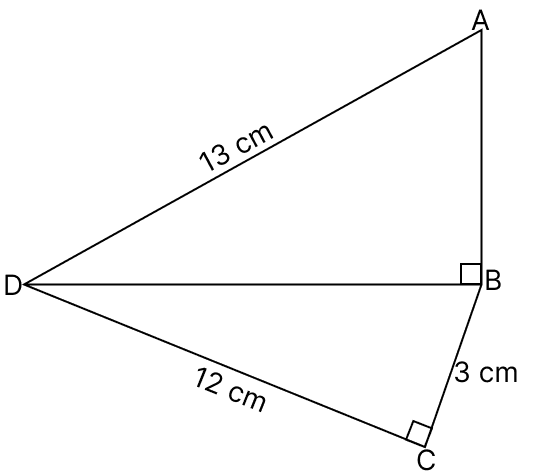
In the given figure, ABCD is a quadrilateral in which BC = 3 cm, AD = 13 cm, DC = 12 cm and ∠ABD = ∠BCD = 90°. Calculate the length of AB. Pythagoras Theorem, R.S. Aggarwal Mathematics Solutions ICSE Class 9.

Answer

In right angled triangle BCD,

By Pythagoras theorem,

Hypotenuse2 = Perpendicular2 + Base2

In triangle BCD,

⇒ BD2 = CD2 + BC2

⇒ BD2 = 122 + 32

⇒ BD2 = 144 + 9

⇒ BD2 = 153

⇒ BD = 153\sqrt{153} cm.

In triangle ABD,

⇒ AD2 = AB2 + BD2

⇒ 132 = AB2 + (153\sqrt{153})2

⇒ 169 = AB2 + 153

⇒ AB2 = 169 - 153

⇒ AB2 = 16

⇒ AB = 16\sqrt{16}

⇒ AB = 4 cm.

Hence, length of AB = 4 cm.

Question 9

In the given figure, ∠PSR = 90°, PQ = 10 cm, QS = 6 cm and RQ = 9 cm, calculate the length of PR.

In the given figure, ∠PSR = 90°, PQ = 10 cm, QS = 6 cm and RQ = 9 cm, calculate the length of PR. Pythagoras Theorem, R.S. Aggarwal Mathematics Solutions ICSE Class 9.
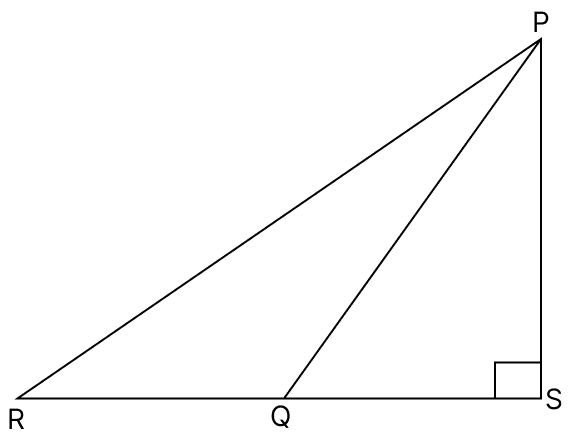
Answer

In right angled triangle PQS,

By Pythagoras theorem,

Hypotenuse2 = Perpendicular2 + Base2

⇒ PQ2 = PS2 + QS2

⇒ 102 = PS2 + 62

⇒ 100 = PS2 + 36

⇒ PS2 = 100 - 36

⇒ PS2 = 64

⇒ PS = 64\sqrt{64}

⇒ PS = 8 cm.

From figure,

RS = RQ + QS = 9 + 6 = 15 cm

In right angled △ PRS,

Hypotenuse2 = Perpendicular2 + Base2

⇒ PR2 = RS2 + PS2

⇒ PR2 = 152 + 82

⇒ PR2 = 225 + 64

⇒ PR2 = 289

⇒ PR = 289\sqrt{289}

⇒ PR = 17 cm.

Hence, the length of PR = 17 cm.

Question 10

In a rhombus PQRS, side PQ = 17 cm and diagonal PR = 16 cm. Calculate the area of the rhombus.
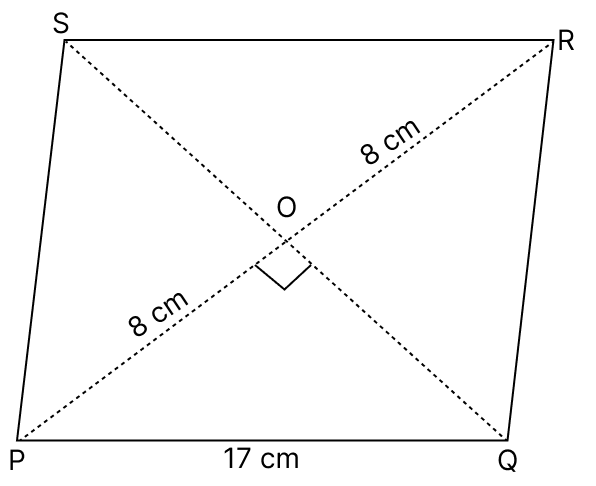
In a rhombus PQRS, side PQ = 17 cm and diagonal PR = 16 cm. Calculate the area of the rhombus. Pythagoras Theorem, R.S. Aggarwal Mathematics Solutions ICSE Class 9.

Answer

We know that,

The diagonals of a rhombus bisect each other at right angles.

From figure,

OP = OR = 8 cm

PQ = 17 cm

In right angled △ POQ,

Hypotenuse2 = Perpendicular2 + Base2

⇒ PQ2 = OP2 + OQ2

⇒ 172 = 82 + OQ2

⇒ 289 = 64 + OQ2

⇒ OQ2 = 289 - 64

⇒ OQ2 = 225

⇒ OQ = 225\sqrt{225}

⇒ OQ = 15 cm.

Since, OQ = OS = 15 cm (the diagonals of a rhombus bisect each other)

QS = OQ + OS = 15 + 15 = 30 cm

∴ Diagonals are PR = 16 cm and QS = 30 cm.

As we know,

Area of rhombus = 12\dfrac{1}{2} × Product of diagonals

= 12×(30×16)=12×480\dfrac{1}{2} \times (30 × 16) = \dfrac{1}{2} \times 480 = 240 cm2.

Hence, the area of rhombus = 240 cm2.

Question 11

From the given figure, find the area of trapezium ABCD.
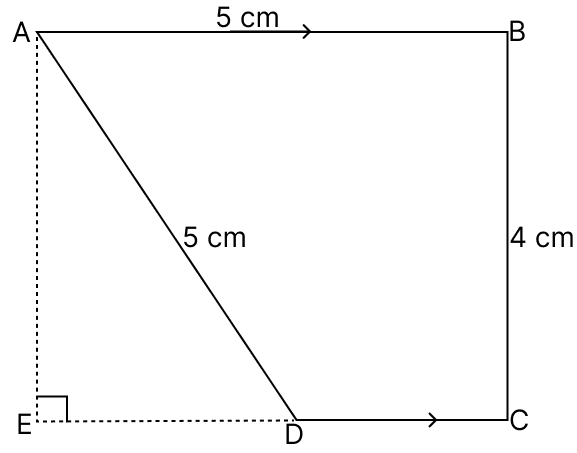
From the given figure, find the area of trapezium ABCD. Pythagoras Theorem, R.S. Aggarwal Mathematics Solutions ICSE Class 9.

Answer

From figure,

AB || DC

Distance between parallel sides, AE = BC = 4 cm

In right angled △ AED,

Hypotenuse2 = Perpendicular2 + Base2

⇒ AD2 = AE2 + ED2

⇒ 52 = 42 + ED2

⇒ 25 = 16 + ED2

⇒ ED2 = 25 - 16

⇒ ED2 = 9

⇒ ED = 9\sqrt{9}

⇒ ED = 3 cm.

∴ DC = EC - ED = 5 - 3 = 2 cm

As we know,

Area of trapezium = 12×(sum of parallel sides×distance between them)\dfrac{1}{2} \times (\text{sum of parallel sides} \times \text{distance between them})

=12×(AB + DC)×BC=12×(5+2)×4=12×7×4=7×2=14 cm2.= \dfrac{1}{2} \times (\text{AB + DC}) \times \text{BC} \\[1em] = \dfrac{1}{2} \times (5 + 2) \times 4 \\[1em] = \dfrac{1}{2} \times 7 \times 4 \\[1em] = 7 \times 2 \\[1em] = 14 \text{ cm}^2.

Hence, the area of trapezium ABCD is 14 cm2.

Question 12

The sides of a right triangle containing the right angle are 5x cm, (3x - 1) cm. If the area of the triangle be 60 cm260 \text{ cm}^2, calculate the length of the sides of the triangle.

Answer

Consider △ABC as a right angled triangle.
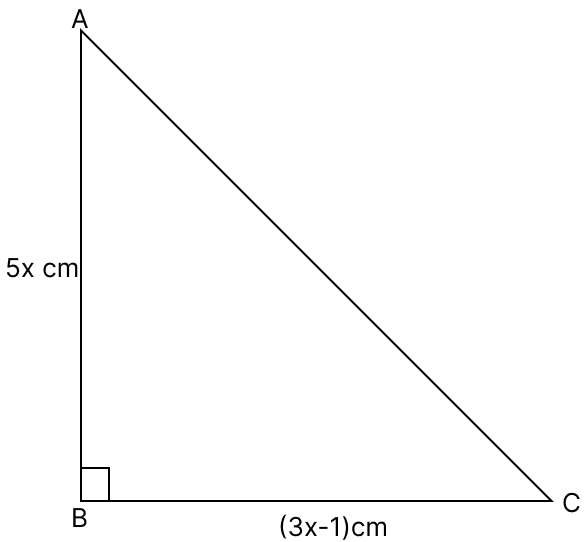
The sides of a right triangle containing the right angle are 5x cm, (3x - 1) cm. Pythagoras Theorem, R.S. Aggarwal Mathematics Solutions ICSE Class 9.

AB = 5x cm and BC = (3x - 1) cm

We know that,

Area of △ABC = 12{1}{2} × base × height = 12\dfrac{1}{2} × BC × AB

Substituting the values we get,

⇒ 60 = 12\dfrac{1}{2} × (3x - 1) × 5x

⇒ 120 = 5x(3x - 1)

⇒ 120 = 15x2 - 5x

⇒ 15x2 - 5x - 120 = 0

⇒ 5(3x2 - x - 24) = 0

⇒ 3x2 - x - 24 = 0

⇒ 3x2 - 9x + 8x - 24 = 0

⇒ 3x(x - 3) + 8(x - 3) = 0

⇒ (3x + 8)(x - 3) = 0

⇒ 3x + 8 = 0 or x - 3 = 0

⇒ 3x = -8 or x = 3

⇒ x = 83-\dfrac{8}{3} or x = 3.

Since, x cannot be negative as length of a side cannot be negative. So, x = 3.

AB = 5 × 3 = 15 cm

BC = (3 × 3 - 1) = 9 - 1 = 8 cm

In right angled △ABC,

Using Pythagoras theorem,

Hypotenuse2 = Perpendicular2 + Base2

⇒ AC2 = AB2 + BC2

Substituting the values we get,

⇒ AC2 = 152 + 82

⇒ AC2 = 225 + 64

⇒ AC2 = 289

⇒ AC = 289\sqrt{289}

⇒ AC = 17 cm.

Hence, the length of the sides of the triangle is 17 cm, 15 cm and 8 cm.

Question 13

Find the altitude of an equilateral triangle of side 5 3\sqrt{3} cm.

Answer

Find the altitude of an equilateral triangle of side 5. Pythagoras Theorem, R.S. Aggarwal Mathematics Solutions ICSE Class 9.

In △ ABC,

Draw altitude AD perpendicular to BC.

In an equilateral triangle, the altitude also acts as the median (bisecting the base).

∴ BD = 12\dfrac{1}{2} × BC = 12×53=532\dfrac{1}{2} \times 5\sqrt{3} = \dfrac{5\sqrt{3}}{2}

In right angled △ABD,

Using Pythagoras theorem,

Hypotenuse2 = Perpendicular2 + Base2

⇒ AB2 = AD2 + BD2

(53)2=AD2+(532)225×3=AD2+25×3475=AD2+754AD2=75754AD2=300754AD2=2254AD=2254AD=152AD=7.5 cm.\Rightarrow (5\sqrt{3})^2 = \text{AD}^2 + \Big(\dfrac{5\sqrt{3}}{2}\Big)^2 \\[1em] \Rightarrow 25 \times 3 = \text{AD}^2 + \dfrac{25 \times 3}{4} \\[1em] \Rightarrow 75 = \text{AD}^2 + \dfrac{75}{4} \\[1em] \Rightarrow \text{AD}^2 = 75 - \dfrac{75}{4} \\[1em] \Rightarrow \text{AD}^2 = \dfrac{300 - 75}{4} \\[1em] \Rightarrow \text{AD}^2 = \dfrac{225}{4} \\[1em] \Rightarrow \text{AD} = \sqrt{\dfrac{225}{4}} \\[1em] \Rightarrow \text{AD} = \dfrac{15}{2} \\[1em] \Rightarrow \text{AD} = 7.5 \text{ cm}.

Hence, the altitude is 7.5 cm.

Question 14

In a rhombus ABCD, prove that AC2 + BD2 = 4AB2.

Answer
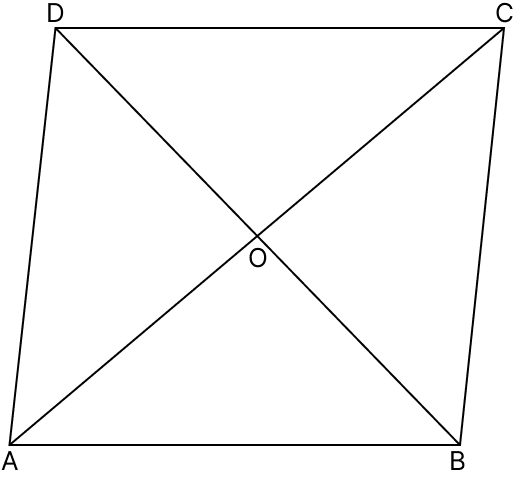
In a rhombus ABCD, prove that AC. Pythagoras Theorem, R.S. Aggarwal Mathematics Solutions ICSE Class 9.

In rhombus, AB = BC = CD = AD (All sides of a rhombus are equal)

Diagonal AC and BD intersect at point O.

Diagonals bisect each other at right angles.

So, AO = OC = 12\dfrac{1}{2} × AC and BO = OD = 12\dfrac{1}{2} × BD

In right angled △AOB,

Using Pythagoras theorem,

Hypotenuse2 = Perpendicular2 + Base2

⇒ AB2 = AO2 + BO2

AB2=(AC2)2+(BD2)2AB2=AC24+BD24AB2=AC2+BD24\Rightarrow \text{AB}^2 = \Big(\dfrac{\text{AC}}{2}\Big)^2 + \Big(\dfrac{\text{BD}}{2}\Big)^2 \\[1em] \Rightarrow \text{AB}^2 = \dfrac{\text{AC}^2}{4} + \dfrac{\text{BD}^2}{4} \\[1em] \Rightarrow \text{AB}^2 = \dfrac{\text{AC}^2 + \text{BD}^2}{4}

∴ 4AB2 = AC2 + BD2

Hence, proved that AC2 + BD2 = 4AB2.

Question 15

In △ABC, ∠B = 90° and D is the mid-point of BC. Prove that

(i) AC2 = AD2 + 3 CD2

(ii) BC2 = 4 (AD2 - AB2)
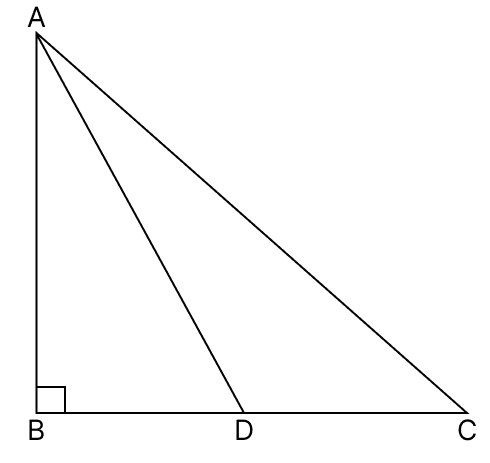
In △ABC, ∠B = 90° and D is the mid-point of BC. Prove that. Pythagoras Theorem, R.S. Aggarwal Mathematics Solutions ICSE Class 9.

Answer

(i) Given,

ABC is a triangle such that ∠ABC = 90°. D is the mid-point of BC.

In △ ABD, using Pythagoras theorem,

Hypotenuse2 = Base2 + Height2

⇒ AD2 = AB2 + BD2 ......(1)

Similarly, in △ ABC,

⇒ AC2 = AB2 + BC2

⇒ AC2 = AB2 + (BD + DC)2

⇒ AC2 = AB2 + BD2 + DC2 + 2 × BD × DC

As D is the midpoint of BC, BD = DC.

⇒ AC2 = AB2 + BD2 + CD2 + 2 × CD × CD

⇒ AC2 = AB2 + BD2 + CD2 + 2CD2

⇒ AC2 = AB2 + BD2 + 3CD2

Using equation (1), we get

⇒ AC2 = AD2 + 3CD2

Hence, proved that AC2 = AD2 + 3 CD2.

(ii) In △ ABD,

⇒ AD2 = AB2 + BD2

BD = BC2\dfrac{\text{BC}}{2}

AD2=AB2+(BC2)2AD2=AB2+BC24AD2AB2=BC24BC2=4(AD2AB2)\Rightarrow \text{AD}^2 = \text{AB}^2 + \Big(\dfrac{\text{BC}}{2}\Big)^2 \\[1em] \Rightarrow \text{AD}^2 = \text{AB}^2 + \dfrac{\text{BC}^2}{4} \\[1em] \Rightarrow \text{AD}^2 - \text{AB}^2 = \dfrac{\text{BC}^2}{4} \\[1em] \Rightarrow \text{BC}^2 = 4 (\text{AD}^2 - \text{AB}^2)

Hence, proved that BC2 = 4 (AD2 - AB2).

Question 16

Two poles of height 9 m and 14 m stand vertically on a plane ground. If the distance between their feet is 12 m, find the distance between their tops.

Answer

Let AB be the smaller pole and CD the bigger pole.
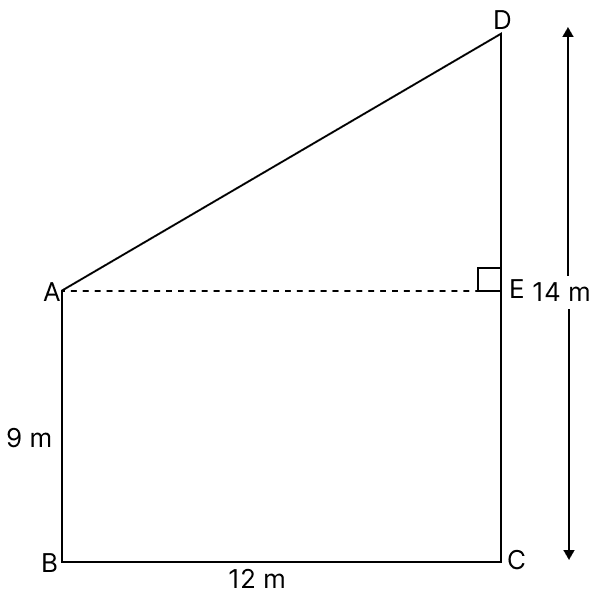
Two poles of height 9 m and 14 m stand vertically on a plane ground. If the distance between their feet is 12 m, find the distance between their tops. Pythagoras Theorem, R.S. Aggarwal Mathematics Solutions ICSE Class 9.

From figure,

⇒ CE = AB = 9 m and AE = BC = 12 m

⇒ CD = CE + ED

⇒ 14 = 9 + ED

⇒ ED = 14 - 9

⇒ ED = 5 m

From figure,

△ADE is right angled triangle.

By pythagoras theorem,

Hypotenuse2 = Base2 + Height2

⇒ AD2 = AE2 + ED2

⇒ AD2 = (12)2 + (5)2

⇒ AD2 = 144 + 25

⇒ AD2 = 169

⇒ AD = 169\sqrt{169}

⇒ AD = 13 m.

Hence, the distance between their tops is 13 m.

Question 17

In △ABC, if AB = AC and D is a point on BC. Prove that AB2 - AD2 = BD × CD.
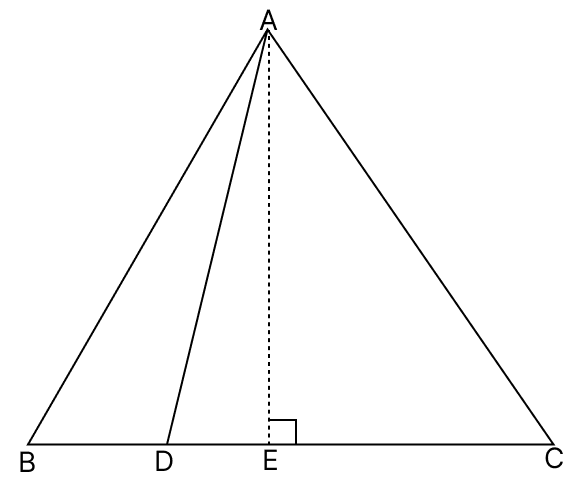
In △ABC, if AB = AC and D is a point on BC. Prove that AB. Pythagoras Theorem, R.S. Aggarwal Mathematics Solutions ICSE Class 9.

Answer

ABC is a triangle in which AB = AC and D is any point on BC.

In △ ABE and △ ACE,

⇒ AB = AC (Given)

⇒ AE = AE (Common)

⇒ ∠AEB = ∠AEC (both are 90°)

Using RHS congruency criterion,

△ ABE ≅ △ ACE

⇒ BE = CE (by C.P.C.T.)

In △ ABE, using Pythagorean theorem,

Hypotenuse2 = Base2 + Height2

⇒ AB2 = AE2 + BE2 ......(1)

In △ ADE, using Pythagorean theorem,

⇒ AD2 = AE2 + DE2 ......(2)

Subtracting equation (2) from (1), we get:

⇒ AB2 - AD2 = (AE2 + BE2) - (AE2 + DE2)

⇒ AB2 - AD2 = AE2 + BE2 - AE2 - DE2

⇒ AB2 - AD2 = BE2 - DE2

⇒ AB2 - AD2 = (BE - DE)(BE + DE)

⇒ AB2 - AD2 = (BE - DE)(CE + DE) [∴ BE = CE]

⇒ AB2 - AD2 = BD × CD

Hence, proved that AB2 - AD2 = BD × CD.

Multiple Choice Questions

Question 1

The lengths of the sides of some triangles in some unit are given below. Which of them is a right-angled triangle?

  1. 7, 9, 13

  2. 10, 24, 26

  3. 6, 8, 12

  4. 8, 12, 16

Answer

Choose the greatest length. Check whether the square of greatest length is equal to the sum of squares of other two lengths.

10, 24, 26

Here greatest length is 26 cm and other lengths are 24 cm, 10 cm.

Note that 262 = 676 and 242 + 102 = 576 + 100 = 676.

Thus, 262 = 242 + 102.

Thus, triangle with sides 10, 24, 26 form a right-angled triangle.

Hence, option 2 is the correct option.

Question 2

In △ABC, ∠B is a right angle. If D is the foot of the perpendicular drawn from B on AC, then:

  1. BC2 + CD2 = AC2

  2. AB2 - BC2 = AD2 - CD2

  3. BC2 - BD2 = AB2 - AD2

  4. None of these.

Answer

In △ABC, ∠B is a right angle. If D is the foot of the perpendicular drawn from B on AC, then: Pythagoras Theorem, R.S. Aggarwal Mathematics Solutions ICSE Class 9.

In △ ADB,

Using Pythagoras theorem,

Hypotenuse2 = Base2 + Height2

⇒ AB2 = BD2 + AD2

⇒ BD2 = AB2 - AD2 .....(1)

In △ BDC,

Using Pythagoras theorem,

⇒ BC2 = BD2 + CD2

⇒ BD2 = BC2 - CD2 ......(2)

Equating eq.(1) and (2), we get:

⇒ AB2 - AD2 = BC2 - CD2

⇒ AB2 - BC2 = AD2 - CD2.

Hence, option 2 is the correct option.

Question 3

In the adjoining figure, CD =

In the adjoining figure, CD.Pythagoras Theorem, R.S. Aggarwal Mathematics Solutions ICSE Class 9.
  1. 36 cm

  2. 40 cm

  3. 41 cm

  4. None of these

Answer

In the adjoining figure, CD.Pythagoras Theorem, R.S. Aggarwal Mathematics Solutions ICSE Class 9.

From figure,

⇒ BE = AD = 20 cm and AB = DE = 40 cm

⇒ CE = BC - BE

⇒ CE = 29 - 20

⇒ CE = 9 cm

From figure,

△ CDE is right angled triangle.

By pythagoras theorem,

Hypotenuse2 = Base2 + Height2

⇒ CD2 = DE2 + CE2

⇒ CD2 = 402 + 92

⇒ CD2 = 1600 + 81

⇒ CD2 = 1681

⇒ CD = 1681\sqrt{1681}

⇒ CD = 41 cm.

Hence, option 3 is the correct option.

Question 4

In the adjoining figure, AC =

In the adjoining figure, AC. Pythagoras Theorem, R.S. Aggarwal Mathematics Solutions ICSE Class 9.
  1. 17 cm

  2. 20 cm

  3. 22 cm

  4. 24 cm

Answer

In △ BCD,

By pythagoras theorem,

Hypotenuse2 = Base2 + Height2

⇒ CD2 = BD2 + BC2

⇒ 102 = BD2 + 82

⇒ 100 = BD2 + 64

⇒ BD2 = 100 - 64

⇒ BD2 = 36

⇒ BD = 36\sqrt{36}

⇒ BD = 6 cm

From figure,

AB = AD + BD = 9 + 6 = 15 cm

In △ ABC,

Using pythagoras theorem,

⇒ AC2 = AB2 + BC2

⇒ AC2 = 152 + 82

⇒ AC2 = 225 + 64

⇒ AC2 = 289

⇒ AC = 289\sqrt{289}

⇒ AC = 17 cm

Hence, option 1 is the correct option.

Question 5

The lengths of the diagonals of a rhombus are 5 cm and 12 cm. The length of each side of the rhombus is:

  1. 13 cm

  2. 6.5 cm

  3. 6.25 cm

  4. 5.25 cm

Answer

Let AC = 5 cm and BD = 12 cm.

The lengths of the diagonals of a rhombus are 5 cm and 12 cm. The length of each side of the rhombus is: Pythagoras Theorem, R.S. Aggarwal Mathematics Solutions ICSE Class 9.

We know that,

Diagonals of rhombus are perpendicular and bisect each other,

OB = 12\dfrac{1}{2} BD = 6 cm and AO = 12\dfrac{1}{2} AC = 2.5 cm.

In right triangle AOB,

By pythagoras theorem we get,

Hypotenuse2 = Base2 + Height2

⇒ AB2 = AO2 + OB2

⇒ AB2 = (2.5)2 + 62

⇒ AB2 = 6.25 + 36

⇒ AB2 = 42.25

⇒ AB = 42.25\sqrt{42.25} = 6.5 cm.

∴ The length of each side of the rhombus is 6.5 cm.

Hence, option 2 is the correct option.

Question 6

The diagonals AC and BD of a rhombus ABCD are of lengths 6 cm and 8 cm. The length of each side of the rhombus is :

  1. 3 cm

  2. 5 cm

  3. 7 cm

  4. 9 cm

Answer

Let AC = 6 cm and BD = 8 cm.

The diagonals AC and BD of a rhombus ABCD are of lengths 6 cm and 8 cm. The length of each side of the rhombus is : Pythagoras Theorem, R.S. Aggarwal Mathematics Solutions ICSE Class 9.

We know that,

Diagonals of rhombus are perpendicular and bisect each other,

OB = 12\dfrac{1}{2} BD = 4 cm and AO = 12\dfrac{1}{2} AC = 3 cm.

In right triangle AOB,

By pythagoras theorem we get,

Hypotenuse2 = Base2 + Height2

⇒ AB2 = AO2 + OB2

⇒ AB2 = 32 + 42

⇒ AB2 = 9 + 16

⇒ AB2 = 25

⇒ AB = 25\sqrt{25} = 5 cm.

∴ The length of each side of the rhombus is 5 cm.

Hence, option 2 is the correct option.

Question 7

The lengths of the adjacent sides of the right angle of a right-angled triangle are (x - 2) cm and 22x2\sqrt{2}x cm. If the length of the hypotenuse is 3 cm, then the value of x is :

  1. 1

  2. 2

  3. 3

  4. 4

Answer

The lengths of the adjacent sides of the right angle of a right-angled triangle. Pythagoras Theorem, R.S. Aggarwal Mathematics Solutions ICSE Class 9.

In right triangle ABC,

By pythagoras theorem we get,

Hypotenuse2 = Base2 + Height2

⇒ AC2 = BC2 + AB2

⇒ 32 = (x - 2)2 + (22x)2(2\sqrt{2}\text{x})^2

⇒ 9 = x2 + 4 - 4x + 4 × 2 x2

⇒ 9 = x2 + 4 - 4x + 8x2

⇒ 9x2 - 4x + 4 - 9 = 0

⇒ 9x2 - 4x - 5 = 0

⇒ 9x2 - 9x + 5x - 5 = 0

⇒ 9x(x - 1) + 5(x - 1) = 0

⇒ (9x + 5) = 0 or (x - 1) = 0

⇒ x = - 59\dfrac{5}{9} or x = 1

Since, length cannot be negative.

⇒ x = 1 cm.

Hence, option 1 is the correct option.

Question 8

The altitude of the equilateral triangle of side a units is :

  1. a32\dfrac{\text{a} \sqrt{3}}{2} units

  2. 3a2\dfrac{\sqrt{3 \text{a}}}{2} units

  3. 2a2\dfrac{\sqrt{2 \text{a}}}{2} units

  4. 3a2\dfrac{3 \text{a}}{2} units

Answer

Find the altitude of an equilateral triangle of side 5. Pythagoras Theorem, R.S. Aggarwal Mathematics Solutions ICSE Class 9.

In △ ABC,

AB = BC = AC = a units

Draw altitude AD perpendicular to BC.

In an equilateral triangle, the altitude also acts as the median (bisecting the base).

∴ BD = 12×BC=12×a=a2\dfrac{1}{2} \times BC = \dfrac{1}{2} \times a = \dfrac{\text{a}}{2}

In right angled △ABD,

Using Pythagoras theorem,

Hypotenuse2 = Perpendicular2 + Base2

⇒ AB2 = AD2 + BD2

a2=AD2+(a2)2AD2=a2a24AD2=4a2a24AD2=3a24AD=3a24AD=a32 units.\Rightarrow \text{a}^2 = \text{AD}^2 + \Big(\dfrac{\text{a}}{2}\Big)^2 \\[1em] \Rightarrow \text{AD}^2 = \text{a}^2 - \dfrac{\text{a}^2}{4} \\[1em] \Rightarrow \text{AD}^2 = \dfrac{4\text{a}^2 - \text{a}^2}{4} \\[1em] \Rightarrow \text{AD}^2 = \dfrac{3\text{a}^2}{4} \\[1em] \Rightarrow \text{AD} = \sqrt{\dfrac{3\text{a}^2}{4}} \\[1em] \Rightarrow \text{AD} = \dfrac{\text{a} \sqrt{3}}{2} \text{ units.}

Hence, option 1 is the correct option.

Question 9

ABD is a right-angled triangle, whose ∠D is the right angle. C is any point on the side BD. If AB = 8 cm, BC = 6 cm and AC = 3 cm, then the length of CD is :

  1. 17121\dfrac{7}{12} cm

  2. 71127\dfrac{1}{12} cm

  3. 122712\dfrac{2}{7} cm

  4. 121712\dfrac{1}{7} cm

Answer

ABD is a right-angled triangle, whose ∠D is the right angle. C is any point on the side BD. If AB = 8 cm, BC = 6 cm and AC = 3 cm, then the length of CD is. Pythagoras Theorem, R.S. Aggarwal Mathematics Solutions ICSE Class 9.

Let CD = x cm

BD = BC + CD = (6 + x) cm

In △ ABD, using Pythagorean theorem,

Hypotenuse2 = Base2 + Height2

⇒ AB2 = BD2 + AD2

⇒ 82 = (6 + x)2 + AD2

⇒ 64 - (6 + x)2 = AD2

⇒ AD2 = 64 - (6 + x)2

⇒ AD2 = 64 - (36 + x2 + 12x)

⇒ AD2 = 64 - 36 - x2 - 12x

⇒ AD2 = 28 - x2 - 12x .....(1)

In △ ADC, using Pythagorean theorem,

⇒ AC2 = CD2 + AD2

⇒ 32 = x2 + AD2

⇒ 9 = x2 + AD2

⇒ AD2 = 9 - x2 .....(2)

From eq.(1) and (2), we have :

⇒ 9 - x2 = 28 - x2 - 12x

⇒ 9 = 28 - 12x

⇒ 12x = 28 - 9

⇒ 12x = 19

⇒ x = 1912\dfrac{19}{12}

⇒ x = 17121\dfrac{7}{12} cm.

Hence, option 1 is the correct option.

Question 10

There are two buildings in two sides of a road. Keeping the foot of a ladder fixed at a point on the road, when it is placed on two buildings, then its top touches the buidings respectively at a height of 48 ft and 14 ft. If the length of the ladder is 50 ft, then the width of the road is :

  1. 56 ft

  2. 62 ft

  3. 66 ft

  4. 70 ft

Answer

There are two buildings in two sides of a road. Keeping the foot of a ladder fixed at a point on the road, when it is placed on two buildings, then its top touches the buidings respectively at a height of 48 ft and 14 ft. If the length of the ladder is 50 ft, then the width of the road is.Pythagoras Theorem, R.S. Aggarwal Mathematics Solutions ICSE Class 9.

Let width of the street be AB = AC + BC

Let CD and CE be the ladder at different positions.

By Pythagoras theorem,

Hypotenuse2 = Perpendicular2 + Base2

In triangle ADC,

⇒ CD2 = AD2 + AC2

⇒ 502 = 142 + AC2

⇒ 2500 = 196 + AC2

⇒ AC2 = 2500 - 196

⇒ AC2 = 2304

⇒ AC = 2304\sqrt{2304}

⇒ AC = 48 ft

In triangle BCE,

⇒ CE2 = BE2 + BC2

⇒ 502 = 482 + BC2

⇒ 2500 = 2304 + BC2

⇒ BC2 = 2500 - 2304

⇒ BC2 = 196

⇒ BC = 196\sqrt{196}

⇒ BC = 14 ft

AB = AC + BC = 48 + 14 = 62 ft.

Hence, option 2 is the correct option.

Case Study Based Questions

Question 1

An aeroplane (P) leaves an Airport (A) and flies towards north at 400 km/h. At the same time another aeroplane (Q) leaves the same airport and flies towards west at 300 km/h.

An aeroplane (P) leaves an Airport (A) and flies towards north at 400 km/h. At the same time another aeroplane (Q) leaves the same airport and flies towards west at 300 km/h. Pythagoras Theorem, R.S. Aggarwal Mathematics Solutions ICSE Class 9.

Based on this information, answer the following questions:

  1. Distance covered by aeroplane P in 1.5 hours is :
    (a) 600 km
    (b) 650 km
    (c) 700 km
    (d) 800 km

  2. Distance covered by aeroplane Q in 1.5 hours is :
    (a) 600 km
    (b) 550 km
    (c) 500 km
    (d) 450 km

  3. The distance between the two aeroplanes after a certain period of time is represented by the line segment :
    (a) AP
    (b) AQ
    (c) PQ
    (d) AS

  4. After 1.5 hours, which aeroplane travelled longer distance and by how much?
    (a) P, 150 km
    (b) Q, 150 km
    (c) P, 600 km
    (d) Q, 450 km

  5. After 1.5 hours, the distance between the two aeroplanes is :
    (a) 600 km
    (b) 650 km
    (c) 700 km
    (d) 750 km

Answer

1. Given, Speed of aeroplane P = 400 km/h

As we know,

Distance traveled = Speed × Time taken

= 400 × 1.5

= 600 km.

Hence, Option (a) is the correct option.

2. Given, Speed of aeroplane Q = 300 km/h

As we know,

Distance traveled = Speed × Time taken

= 300 × 1.5

= 450 km.

Hence, Option (d) is the correct option.

3. From figure,

Distance between the two aeroplanes after a certain period of time is represented by the line segment PQ.

Hence, Option (c) is the correct option.

4. From above,

Distance traveled by aeroplane P in 1.5 hours = 600 km

Distance traveled by aeroplane Q in 1.5 hours = 450 km

600 - 450 = 150 km

⇒ Aeroplane P traveled longer distance by 150 km.

Hence, Option (a) is the correct option.

5. Distance traveled by aeroplane P in 1.5 hours = 600 km

⇒ AP = 600 km

Distance traveled by aeroplane Q in 1.5 hours = 450 km

⇒ AQ = 450 km

From figure,

Let ∠A = 90°

By Pythagoras theorem,

Hypotenuse2 = Perpendicular2 + Base2

In triangle APQ,

⇒ PQ2 = AP2 + AQ2

⇒ PQ2 = 6002 + 4502

⇒ PQ2 = 360000 + 202500

⇒ PQ2 = 562500

⇒ PQ = 562500\sqrt{562500}

⇒ PQ = 750 km.

Hence, Option (d) is the correct option.

Assertion Reasoning Questions

Question 1

Assertion (A): In the figure, △ ABC is right angled at B.

Reason (R): In a right angled triangle, the square on the hypotenuse is equal to the sum of the other two sides.

In the figure, △ ABC is right angled at B. Pythagoras Theorem, R.S. Aggarwal Mathematics Solutions ICSE Class 9.
  1. A is true, R is false

  2. A is false, R is true

  3. Both A and R are true

  4. Both A and R are false.

Answer

We know that,

In a right angled triangle, the square on the hypotenuse is equal to the sum of the squares of the other two sides.

∴ Reason (R) is false.

From figure,

Choose the greatest length. Check whether the square of greatest length is equal to the sum of squares of other two lengths.

Here greatest length is 10 cm and other lengths are 8 cm, 6 cm.

Note that 102 = 100 and 82 + 62 = 64 + 36 = 100.

Thus, 102 = 82 + 62

⇒ Hypotenuse2 = Perpendicular2 + Base2

⇒ AC is the hypotenuse and triangle ABC is right angled at B.

∴ Assertion (A) is true.

Hence, Option 1 is the correct option.

Question 2

Assertion (A): In a right angled triangle, the longest side is called hypotenuse and the other two sides are called its legs. Also, the sum of lengths of legs is less than the length of the hypotenuse.

Reason (R): In a right angled triangle, the side opposite to the right angle is called its hypotenuse.

  1. A is true, R is false

  2. A is false, R is true

  3. Both A and R are true

  4. Both A and R are false.

Answer

In a right angled triangle, the longest side is called hypotenuse and the other two sides are called its legs. Also, the sum of any two sides is always greater than the third side.

∴ Assertion (A) is false.

In a right angled triangle, the side opposite to the right angle is called its hypotenuse.

∴ Reason (R) is true.

Hence, Option 2 is the correct option.

Competency Focused Questions

Question 1

The hypotenuse of a right triangle is 25 cm. If out of the two legs, one is longer than the other by 5 cm, then the sum of the lengths of the legs is:

  1. 30 cm

  2. 35 cm

  3. 40 cm

  4. 45 cm

Answer

The hypotenuse of a right triangle is 25 cm. If out of the two legs, one is longer than the other by 5 cm, then the sum of the lengths of the legs is: Pythagoras Theorem, R.S. Aggarwal Mathematics Solutions ICSE Class 9.

Let one leg = x cm and the other = (x + 5) cm

From figure,

AB = (x + 5) cm, BC = x cm and AC = 25 cm, ∠B = 90°

By Pythagoras theorem,

Hypotenuse2 = Perpendicular2 + Base2

In triangle ABC,

⇒ AC2 = AB2 + BC2

⇒ 252 = (x + 5)2 + x2

⇒ 625 = x2 + 25 + 10x + x2

⇒ 2x2 + 10x + 25 - 625 = 0

⇒ 2x2 + 10x - 600 = 0

⇒ 2(x2 + 5x - 300) = 0

⇒ x2 + 5x - 300 = 0

⇒ x2 - 15x + 20x - 300 = 0

⇒ x(x - 15) + 20(x - 15) = 0

⇒ (x + 20)(x - 15) = 0

⇒ x = -20 or x = 15

Since, length cannot be negative.

x = 15 cm.

Sum of the lengths = x + (x + 5) = 15 + (15 + 5) = 15 + 20 = 35 cm.

Hence, Option 2 is the correct option.

Question 2

An aeroplane leaves an airport and flies due North at 300 km/h. At the same time, another plane leaves the same airport and flies due West at 400 km/h. After 90 minutes, the distance between the two planes would be:

  1. 1000 km

  2. 900 km

  3. 800 km

  4. 750 km

Answer

An aeroplane leaves an airport and flies due North at 300 km/h. At the same time, another plane leaves the same airport and flies due West at 400 km/h. After 90 minutes, the distance between the two planes would be: Pythagoras Theorem, R.S. Aggarwal Mathematics Solutions ICSE Class 9.

Let aeroplane flying in north direction at 300 km/h be at point P after 1.5 hours and aeroplane flying in west direction at 400 km/h be at point Q after 1.5 hours.

Given, 90 minutes = 1.5 hours

Speed of aeroplane P = 300 km/h

As we know,

Distance traveled = Speed × Time taken

AP = 300 × 1.5 = 450 km.

Speed of aeroplane Q = 400 km/h

As we know,

Distance traveled = Speed × Time taken

AQ = 400 × 1.5 = 600 km.

From figure,

Let ∠A = 90°

By Pythagoras theorem,

Hypotenuse2 = Perpendicular2 + Base2

In triangle APQ,

⇒ PQ2 = AP2 + AQ2

⇒ PQ2 = 4502 + 6002

⇒ PQ2 = 202500 + 360000

⇒ PQ2 = 562500

⇒ PQ = 562500\sqrt{562500}

⇒ PQ = 750 km.

Hence, Option 4 is the correct option.

Question 3

For going to city B from city A, there is a route via city C such that AC ⟂ CB, AC = 2x km and CB = 2(x + 7) km.

It is proposed to construct a 26 km highway which directly connects the two cities A and B. Find how much distance will be saved in reaching city B from city A after the construction of the highway.

Answer

In the adjoining figure, in △ABC, AD is the median through A and E is the mid-point of AD. Pythagoras Theorem, R.S. Aggarwal Mathematics Solutions ICSE Class 9.

From figure,

Distance between two cities A and B = AB = 26 km

Since, AC ⟂ CB

∠A = 90°

By Pythagoras theorem,

Hypotenuse2 = Perpendicular2 + Base2

In triangle ABC,

⇒ AB2 = AC2 + CB2

⇒ 262 = (2x)2 + [2(x + 7)]2

⇒ 676 = 4x2 + 4(x + 7)2

⇒ 676 = 4x2 + 4(x2 + 49 + 14x)

⇒ 676 = 4x2 + 4x2 + 196 + 56x

⇒ 8x2 + 196 + 56x - 676 = 0

⇒ 8x2 + 56x - 480 = 0

⇒ 8(x2 + 7x - 60) = 0

⇒ x2 + 7x - 60 = 0

⇒ x2 + 12x - 5x - 60 = 0

⇒ x(x + 12) - 5(x + 12) = 0

⇒ (x - 5)(x + 12) = 0

⇒ x = 5 or x = -12.

Since, length cannot be negative.

x = 5

Distance traveled via city C = 2x + 2(x + 7) = 2x + 2x + 14 = 4x + 14 = 4 × 5 + 14 = 20 + 14 = 34 km.

Difference in distance traveled via city C and after construction of highway = 34 - 26 = 8 km.

Hence, 8 km distance will be saved in reaching city B from city A after the construction of the highway.

Question 4

A 5 m long ladder is placed leaning towards a vertical wall such that it reaches the wall at a point 4 m high. If the foot of the ladder is moved 1.6 m towards the wall, then find the distance by which the top of the ladder would slide upwards on the wall.

Answer

A 5 m long ladder is placed leaning towards a vertical wall such that it reaches the wall at a point 4 m high. If the foot of the ladder is moved 1.6 m towards the wall, then find the distance by which the top of the ladder would slide upwards on the wall. Pythagoras Theorem, R.S. Aggarwal Mathematics Solutions ICSE Class 9.

First ladder reaches at A, thus AB = 4 m and AC = 5 m.

Given,

Foot of the ladder is moved 1.6 m towards the wall

The distance by which the top of the ladder would slide upwards on the wall = AE

By Pythagoras theorem,

Hypotenuse2 = Perpendicular2 + Base2

In triangle ABC,

⇒ AC2 = AB2 + BC2

⇒ 52 = 42 + BC2

⇒ 25 = 16 + BC2

⇒ BC2 = 25 - 16

⇒ BC2 = 9

⇒ BC = 9\sqrt{9}

⇒ BC = 3 m

BD = BC - CD = 3 - 1.6 = 1.4 m

In triangle EBD,

Ladder ED = 5 m

⇒ ED2 = EB2 + BD2

⇒ 52 = EB2 + (1.4)2

⇒ 25 = EB2 + 1.96

⇒ EB2 = 25 - 1.96

⇒ EB2 = 23.04

⇒ EB = 23.04\sqrt{23.04}

⇒ EB = 4.8 m

From figure,

AE = EB - AB = 4.8 - 4 = 0.8 m

Hence, the distance by which the top of the ladder would slide upwards on the wall is 0.8 m.

Question 5

The diagram shows a nest of 4 squares set one within another. The side of the outer most square is 20 cm. The midpoints of the sides are joined to give a second square, and the process is repeated to give the third and fourth squares. Find the length of a side of the smallest square.

The hypotenuse of a right triangle is 25 cm. If out of the two legs, one is longer than the other by 5 cm, then the sum of the lengths of the legs is: Pythagoras Theorem, R.S. Aggarwal Mathematics Solutions ICSE Class 9.

Answer

The diagram shows a nest of 4 squares set one within another. The side of the outer most square is 20 cm. The midpoints of the sides are joined to give a second square, and the process is repeated to give the third and fourth squares. Find the length of a side of the smallest square.Pythagoras Theorem, R.S. Aggarwal Mathematics Solutions ICSE Class 9.

Given, squares are formed joining mid-points of square ABCD.

AE = AH = 12\dfrac{1}{2} × AB = 12\dfrac{1}{2} × 20 = 10 cm.

In square ABCD,

∠A = 90°

By Pythagoras theorem,

Hypotenuse2 = Perpendicular2 + Base2

In triangle AEH,

⇒ EH2 = AE2 + AH2

⇒ EH2 = 102 + 102

⇒ EH2 = 100 + 100

⇒ EH2 = 200

⇒ EH = 200=2×100\sqrt{200} = \sqrt{2 \times 100}

⇒ EH = 10210\sqrt{2} cm.

In square EFGH,

∠E = 90°

EM = EN = 12\dfrac{1}{2} × EH = 12×102=52 cm.\dfrac{1}{2} \times 10 \sqrt{2} = 5\sqrt{2} \text{ cm.}

By Pythagoras theorem,

In triangle EMN,

⇒ MN2 = EN2 + EM2

⇒ MN2 = (52)2+(52)2(5\sqrt{2})^2 + (5\sqrt{2})^2

⇒ MN2 = 50 + 50

⇒ MN2 = 100

⇒ MN = 100\sqrt{100}

⇒ MN = 10 cm.

In square MNOP,

∠M = 90°

IM = ML = 12×MN=12×10=5 cm.\dfrac{1}{2} × MN = \dfrac{1}{2} \times 10 = 5 \text{ cm.}

By Pythagoras theorem,

In triangle IML,

⇒ IL2 = IM2 + ML2

⇒ IL2 = 52 + 52

⇒ IL2 = 25 + 25

⇒ IL2 = 50

⇒ IL = 25×2\sqrt{25 \times 2}

⇒ IL = 525\sqrt{2} cm.

Hence, the length of a side of the smallest square is 525\sqrt{2} cm.

PrevNext