KnowledgeBoat Logo
|
OPEN IN APP

Chapter 13

Chord Properties of a Circle

Class - 9 RS Aggarwal Mathematics Solutions


Exercise 13

Question 1

A chord of length 16 cm is drawn in a circle of radius 10 cm. Calculate the distance of the chord from the centre of the circle.

Answer
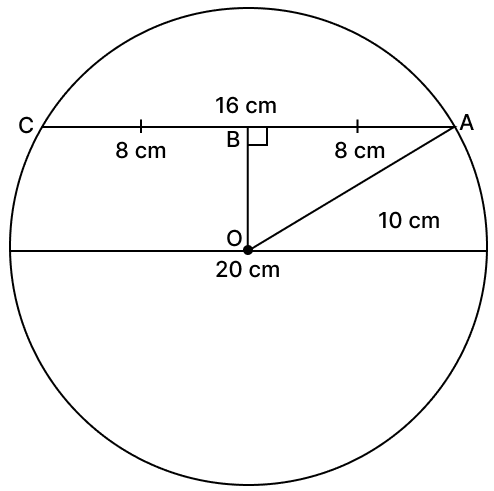
A chord of length 16 cm is drawn in a circle of radius 10 cm. Calculate the distance of the chord from the centre of the circle. Chord Properties of a Circle, R.S. Aggarwal Mathematics Solutions ICSE Class 9.

Given: Length of the chord AC = 16 cm.

Radius of the circle (r) = 10 cm

Diameter of the circle = 10 x 2 = 20 cm.

Draw OB ⊥ AC, where O is the center of the circle. Join OA.

B is the midpoint of AC, as OB is perpendicular to the chord AC.

AB = 12\dfrac{1}{2} AC

= 12×(16)\dfrac{1}{2} \times (16)

= 8 cm.

In Δ OAB, ∠B = 90°

Using Pythagoras theorem,

∴ OA2 = OB2 + AB2

⇒ (10)2 = OB2 + (8)2

⇒ 100 = OB2 + 64

⇒ OB2 = 100 - 64

⇒ OB2 = 36

⇒ OB = 36\sqrt{36}

⇒ OB = 6 cm.

Hence, the distance of the chord from the center of the circle is 6 cm.

Question 2

A circle of radius 2.5 cm has a chord of length 4.8 cm. Find the distance of the chord from the centre of the circle.

Answer
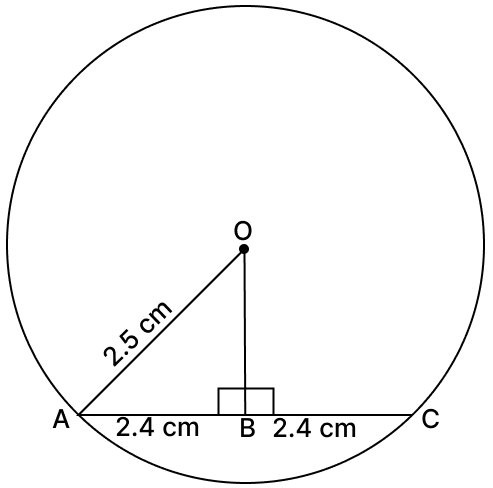
A circle of radius 2.5 cm has a chord of length 4.8 cm. Find the distance of the chord from the centre of the circle. Chord Properties of a Circle, R.S. Aggarwal Mathematics Solutions ICSE Class 9.

From figure,

Given: Length of the chord AC = 4.8 cm.

Radius of the circle (r) = 2.5 cm

Distance of the chord from the center of the circle = OB.

B is the midpoint of AC, as OB is perpendicular to the chord AC.

AB = 12\dfrac{1}{2} AC

= 12×(4.8)\dfrac{1}{2} \times (4.8)

= 2.4 cm.

In Δ OAB, ∠B = 90°

Using Pythagoras theorem,

∴ OA2 = OB2 + AB2

⇒ (2.5)2 = OB2 + (2.4)2

⇒ 6.25 = OB2 + 5.76

⇒ OB2 = 6.25 - 5.76

⇒ OB2 = 0.49

⇒ OB = 0.49\sqrt{0.49}

⇒ OB = 0.7 cm.

Hence, the distance of the chord from the center of the circle is 0.7 cm.

Question 3

The radius of a circle is 40 cm and the length of perpendicular drawn from its centre to chord is 24 cm. Find the length of chord.

Answer
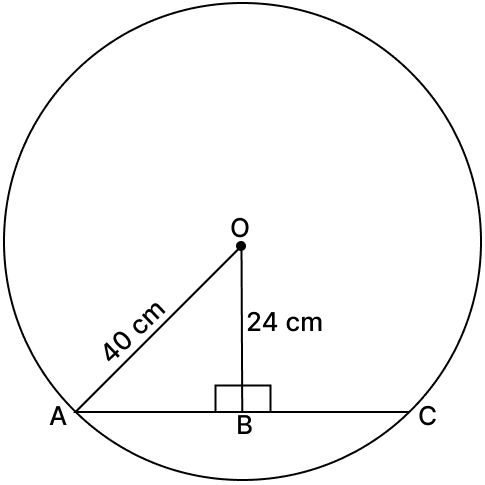
The radius of a circle is 40 cm and the length of perpendicular drawn from its centre to chord is 24 cm. Find the length of chord. Chord Properties of a Circle, R.S. Aggarwal Mathematics Solutions ICSE Class 9.

From figure,

Given: Radius of the circle (r) = 40 cm

AC is the chord and OB is the perpendicular distance from center.

B is the midpoint of AC, as OB is perpendicular to the chord AC.

AB = 12\dfrac{1}{2} AC

In Δ OAB, ∠B = 90°

Using Pythagoras theorem,

∴ OA2 = OB2 + AB2

⇒ (40)2 = (24)2 + AB2

⇒ 1600 = 576 + AB2

⇒ AB2 = 1600 - 576

⇒ AB2 = 1024

⇒ AB = 1024\sqrt{1024}

⇒ AB = 32 cm

Length of the chord = AC = 2(AB)

= 2(32)

= 64 cm.

Hence, the length of the chord is 64 cm.

Question 4

A chord of length 48 cm is drawn at a distance of 7 cm from centre of the circle. Calculate the radius of the circle.

Answer
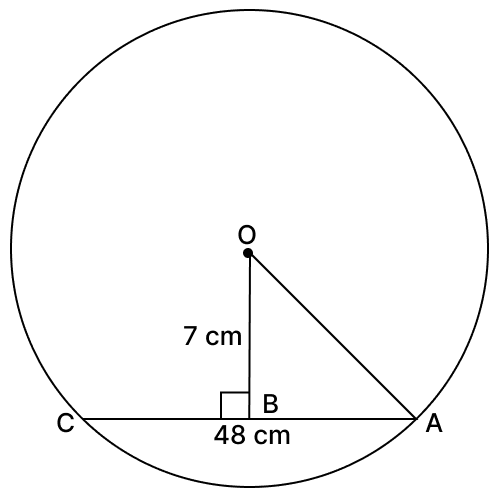
A chord of length 48 cm is drawn at a distance of 7 cm from centre of the circle. Calculate the radius of the circle. Chord Properties of a Circle, R.S. Aggarwal Mathematics Solutions ICSE Class 9.

From figure,

AC is the chord and OB is the perpendicular distance of chord from the center.

Length of the chord AC = 48 cm.

B is the midpoint of AC, as OB is perpendicular to the chord AC.

AB = 12\dfrac{1}{2} AC

= 12×48\dfrac{1}{2} \times 48

= 24 cm.

In Δ OAB, ∠B = 90°

Using Pythagoras theorem,

∴ OA2 = OB2 + AB2

⇒ OA2 = (7)2 + 242

⇒ OA2 = 49 + 576

⇒ OA2 = 625

⇒ OA = 625\sqrt{625} = 25 cm.

Hence, radius of circle is 25 cm.

Question 5

A chord of length 16 cm is at a distance of 15 cm from centre of the circle. Find the length of chord of same circle which is at 8 cm away from circle.

Answer
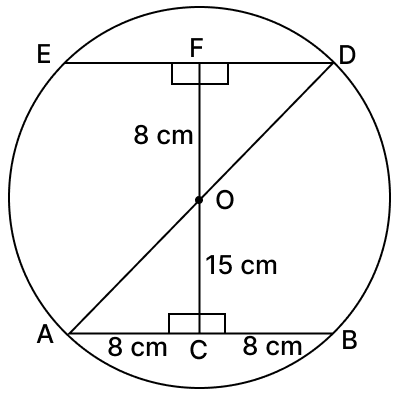
A chord of length 16 cm is at a distance of 15 cm from centre of the circle. Find the length of chord of same circle which is at 8 cm away from circle. Chord Properties of a Circle, R.S. Aggarwal Mathematics Solutions ICSE Class 9.

From figure,

AB is the chord of length 16 cm which is at a distance 15 cm from the center so OC = 15 cm.

Since, the perpendicular to a chord from the centre of the circle bisects the chord,

∴ CB = AC = 162\dfrac{16}{2} = 8 cm

In right angle triangle OAC,

⇒ OA2 = OC2 + AC2 (By pythagoras theorem)

⇒ OA2 = 152 + 82

⇒ OA2 = 225 + 64

⇒ OA2 = 289

⇒ OA = 289\sqrt{289} ​ ⇒ OA = 17 cm

Radius = 17 cm,

∴ OD = 17 cm.

From figure,

In right angle triangle ODF,

⇒ OD2 = OF2 + DF2 (By pythagoras theorem)

⇒ DF2 = OD2 - OF2

⇒ DF2 = 172 - 82

⇒ DF2 = 289 - 64 = 225

⇒ DF = 225\sqrt{225} = 15 cm.

Since, the perpendicular to a chord from the centre of the circle bisects the chord.

DF = FE = 15 cm

From figure,

DE = DF + FE = 15 cm + 15 cm = 30 cm.

Hence, the length of chord which is at a distance of 8 cm from the center of the circle = 30 cm.

Question 6

Two parallel chords of lengths of 30 cm and 16 cm are drawn on the opposite sides of the centre of a circle of radius 17 cm. Find the distance between chords.

Answer
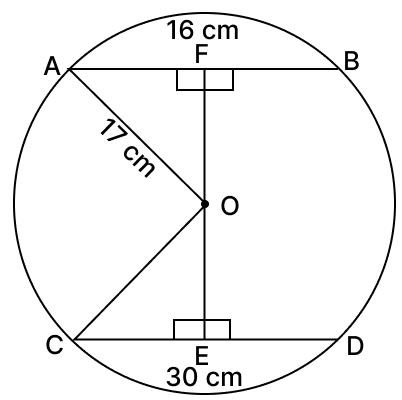
Two parallel chords of lengths of 30 cm and 16 cm are drawn on the opposite sides of the centre of a circle of radius 17 cm. Find the distance between chords. Chord Properties of a Circle, R.S. Aggarwal Mathematics Solutions ICSE Class 9.

Let AB and CD be chords of length 16 cm and 30 cm respectively.

From figure,

We know that,

Perpendicular from the center to the chord, bisects it.

∴ AF = AB2=162\dfrac{AB}{2} = \dfrac{16}{2} = 8 cm.

CE = CD2=302\dfrac{CD}{2} = \dfrac{30}{2} = 15 cm.

From figure,

OA = OC = radius = 17 cm.

In right-angled triangle OCE,

By pythagoras theorem,

⇒ Hypotenuse2 = Perpendicular2 + Base2

⇒ OC2 = OE2 + CE2

⇒ 172 = OE2 + 152

⇒ 289 = OE2 + 225

⇒ OE2 = 289 - 225

⇒ OE2 = 64

⇒ OE = 64\sqrt{64} = 8 cm.

In right-angled triangle OAF,

By pythagoras theorem,

⇒ Hypotenuse2 = Perpendicular2 + Base2

⇒ OA2 = OF2 + AF2

⇒ 172 = OF2 + 82

⇒ 289 = OF2 + 64

⇒ OF2 = 289 - 64

⇒ OF2 = 225

⇒ OF = 225\sqrt{225} = 15 cm.

From figure,

⇒ EF = OE + OF = 8 + 15 = 23 cm.

Hence, distance between the chords = 23 cm.

Question 7

Two parallel chords of lengths 80 cm and 18 cm are drawn on the same side of the centre of a circle of radius 41 cm. Find the distance between the chords.

Answer
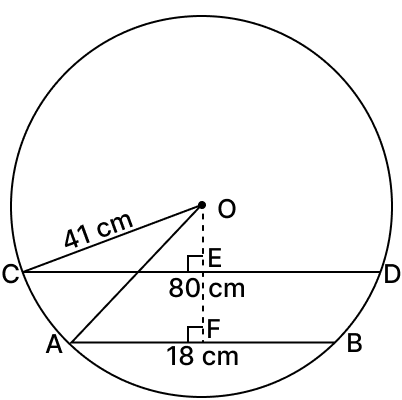
Two parallel chords of lengths 80 cm and 18 cm are drawn on the same side of the centre of a circle of radius 41 cm. Find the distance between the chords. Prove that. Chord Properties of a Circle, R.S. Aggarwal Mathematics Solutions ICSE Class 9.

Let AB = 18 cm and CD = 80 cm be chords on same side of the center of the circle.

OE ⊥ CD and OF ⊥ AB

We know that,

Perpendicular from the center to the chord, bisects it.

∴ AF = AB2=182\dfrac{AB}{2} = \dfrac{18}{2} = 9 cm.

CE = CD2=802\dfrac{CD}{2} = \dfrac{80}{2} = 40 cm.

From figure,

OA = OC = radius = 41 cm.

In right-angled triangle OCE,

By pythagoras theorem,

⇒ Hypotenuse2 = Perpendicular2 + Base2

⇒ OC2 = OE2 + CE2

⇒ 412 = OE2 + 402

⇒ 1681 = OE2 + 1600

⇒ OE2 = 1681 - 1600

⇒ OE2 = 81

⇒ OE = 81\sqrt{81} = 9 cm.

In right-angled triangle OAF,

By pythagoras theorem,

⇒ Hypotenuse2 = Perpendicular2 + Base2

⇒ OA2 = OF2 + AF2

⇒ 412 = OF2 + 92

⇒ 1681 = OF2 + 81

⇒ OF2 = 1681 - 81

⇒ OF2 = 1600

⇒ OF = 1600\sqrt{1600} = 40 cm.

From figure,

⇒ EF = OF - OE = 40 - 9 = 31 cm.

Hence, distance between the chords = 31 cm.

Question 8

Two parallel chords AB and CD are 3.9 cm apart and lie on the opposite sides of the centre of a circle. If AB = 1.4 cm and CD = 4 cm, find the radius of the circle.

Answer
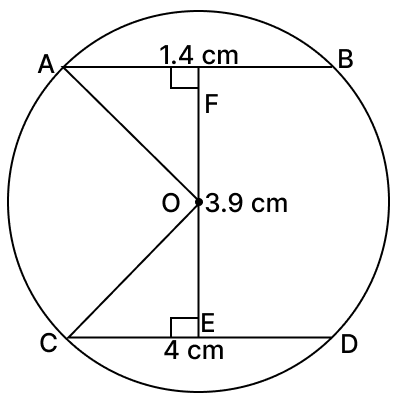
Two parallel chords AB and CD are 3.9 cm apart and lie on the opposite sides of the centre of a circle. If AB = 1.4 cm and CD = 4 cm, find the radius of the circle. Chord Properties of a Circle, R.S. Aggarwal Mathematics Solutions ICSE Class 9.

From figure,

AB = 1.4 cm and CD = 4 cm

OF ⊥ AB and OE ⊥ CD.

We know that,

Perpendicular from the center to the chord, bisects it.

∴ AF = AB2=1.42\dfrac{AB}{2} = \dfrac{1.4}{2} = 0.7 cm.

CE = CD2=42\dfrac{CD}{2} = \dfrac{4}{2} = 2 cm.

EF = 3.9 cm and OA = OC = r cm.

Let OE = x and OF = 3.9 - x

In right-angled triangle OCE,

By pythagoras theorem,

⇒ Hypotenuse2 = Perpendicular2 + Base2

⇒ OC2 = OE2 + CE2

⇒ OC2 = x2 + 22

⇒ OC2 = x2 + 4 .....(1)

In right-angled triangle OAF,

By pythagoras theorem,

⇒ Hypotenuse2 = Perpendicular2 + Base2

⇒ OA2 = OF2 + AF2

⇒ OA2 = (3.9 - x)2 + O.72

⇒ OA2 = (3.9 - x)2 + 0.49 ....(2)

From (1) and (2), we get :

⇒ x2 + 4 = (3.9 - x)2 + 0.49

⇒ x2 + 4 = x2 - 7.8x + 15.21 + 0.49

⇒ x2 + 4 = x2 - 7.8x + 15.7

⇒ 4 = 15.7 - 7.8x

⇒ 7.8x = 15.7 - 4

⇒ 7.8x = 11.7

⇒ x = 11.77.8\dfrac{11.7}{7.8}

⇒ x = 1.5

Substituting value of x in equation (1), we get :

⇒ OC2 = (1.5)2 + 4

⇒ OC2 = 2.25 + 4

⇒ OC2 = 6.25

⇒ OC = 6.25\sqrt{6.25} = 2.5 cm.

Hence, radius of the circle = 2.5 cm.

Question 9

AB and CD are two parallel chords of lengths 8 cm and 6 cm respectively. If they are 1 cm apart and lie on the same side of the centre of the circle, find the radius of the circle.

Answer
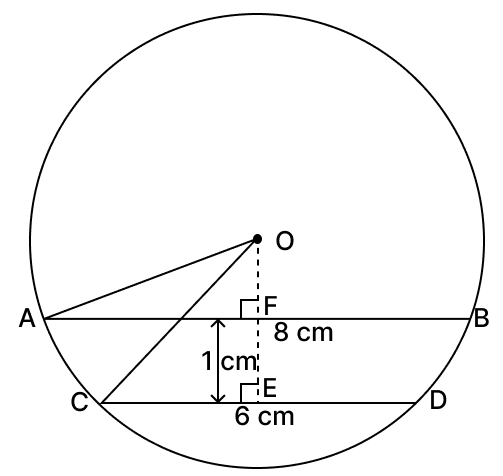
AB and CD are two parallel chords of lengths 8 cm and 6 cm respectively. If they are 1 cm apart and lie on the same side of the centre of the circle, find the radius of the circle. Chord Properties of a Circle, R.S. Aggarwal Mathematics Solutions ICSE Class 9.

AB = 8 cm and CD = 6 cm

OF ⊥ AB and OE ⊥ CD

We know that,

Perpendicular from the center to the chord, bisects it.

∴ AF = AB2=82\dfrac{AB}{2} = \dfrac{8}{2} = 4 cm.

CE = CD2=62\dfrac{CD}{2} = \dfrac{6}{2} = 3 cm.

EF = 1 cm and OA = OC = r cm.

Let OF = x and OE = x + 1

In right-angled triangle OCE,

By pythagoras theorem,

⇒ Hypotenuse2 = Perpendicular2 + Base2

⇒ OC2 = OE2 + CE2

⇒ r2 = (x + 1)2 + 32

⇒ r2 = (x + 1)2 + 9 .....(1)

In right-angled triangle OAF,

By pythagoras theorem,

⇒ Hypotenuse2 = Perpendicular2 + Base2

⇒ OA2 = OF2 + AF2

⇒ r2 = x2 + 42

⇒ r2 = x2 + 16 ....(2)

From (1) and (2),

⇒ x2 + 16 = (x + 1)2 + 9

⇒ x2 + 16 = x2 + 2x + 1 + 9

⇒ x2 + 16 = x2 + 2x + 10

⇒ 16 = 2x + 10

⇒ 2x = 16 - 10

⇒ 2x = 6

⇒ x = 62\dfrac{6}{2}

⇒ x = 3.

Substituting value of x in equation (2), we get :

⇒ r2 = 32 + 16

⇒ r2 = 9 + 16

⇒ r2 = 25

⇒ r = 25\sqrt{25} = 5 cm.

Hence, radius of the circle = 5 cm.

Question 10

PQR is an isosceles triangle inscribed in a circle. If PQ = PR = 25 cm and QR = 14 cm, calculate the radius of the circle to the nearest cm.

Answer
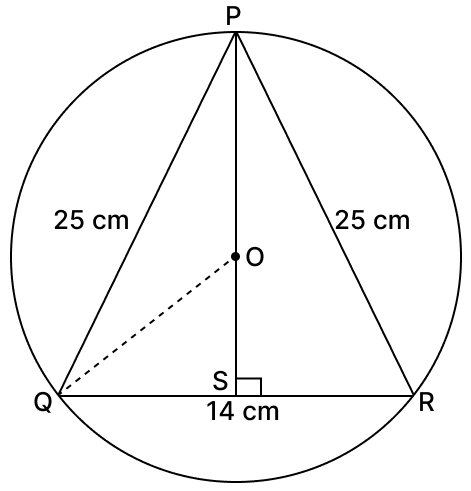
PQR is an isosceles triangle inscribed in a circle. If PQ = PR = 25 cm and QR = 14 cm, calculate the radius of the circle to the nearest cm. Chord Properties of a Circle, R.S. Aggarwal Mathematics Solutions ICSE Class 9.

Given,

PQ = PR = 25 cm

In an isosceles triangle, the perpendicular from a vertex between equal sides bisects the opposite side.

Thus,

S is the mid-point of QR.

∴ QS = QR2=142\dfrac{QR}{2} = \dfrac{14}{2} = 7 cm.

PS is perpendicular bisector of QR and perpendicular from center bisects the chord.

Thus, centre of the circle O lies on PS. Let radius of circle OQ be r.

In right-angled triangle PSQ,

By pythagoras theorem,

⇒ Hypotenuse2 = Perpendicular2 + Base2

⇒ PQ2 = PS2 + SQ2

⇒ 252 = PS2 + 72

⇒ 625 = PS2 + 49

⇒ PS2 = 625 - 49

⇒ PS2 = 576

⇒ PS = 576\sqrt{576} = 24 cm

OS = PS - OP = 24 - r

In right-angled triangle OSQ,

By pythagoras theorem,

⇒ Hypotenuse2 = Perpendicular2 + Base2

⇒ OQ2 = OS2 + SQ2

⇒ r2 = (24 - r)2 + 72

⇒ r2 = r2 - 48r + 576 + 49

⇒ 48r = 625

⇒ r = 62548\dfrac{625}{48} = 13.02 cm ≈ 13 cm

Hence, radius of the circle = 13 cm.

Question 11

An isosceles △ ABC is inscribed in a circle. If AB = AC = 12512\sqrt{5} cm and BC = 24 cm, find the radius of the circle.

Answer
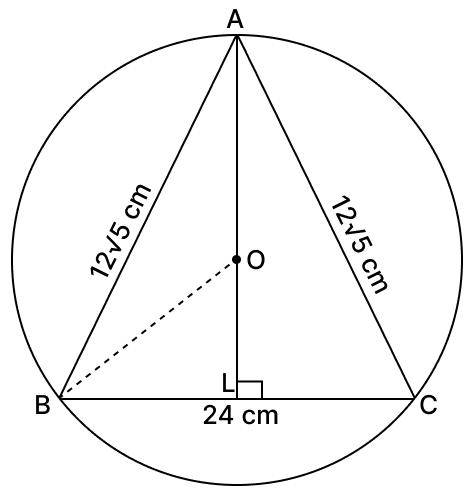
An isosceles △ ABC is inscribed in a circle. If AB = Ac 5 cm and BC = 24 cm, find the radius of the circle. Chord Properties of a Circle, R.S. Aggarwal Mathematics Solutions ICSE Class 9.

Given,

AB = AC = 12512\sqrt{5} cm

In an isosceles triangle, the perpendicular from a vertex between equal sides bisects the opposite side.

Thus,

L is the mid-point of BC.

∴ BL = BC2=242\dfrac{BC}{2} = \dfrac{24}{2} = 12 cm.

AL is perpendicular bisector of BC and perpendicular from center bisects the chord.

Thus, centre of the circle O lies on AL. Let radius of circle OB be r.

In right-angled triangle ALB,

By pythagoras theorem,

⇒ Hypotenuse2 = Perpendicular2 + Base2

⇒ AB2 = AL2 + BL2

⇒ (12512\sqrt{5})2 = AL2 + 122

⇒ 720 = AL2 + 144

⇒ AL2 = 720 - 144

⇒ AL2 = 576

⇒ AL = 576\sqrt{576} = 24 cm

OL = AL - AO = 24 - r

In right-angled triangle OBL,

By pythagoras theorem,

⇒ Hypotenuse2 = Perpendicular2 + Base2

⇒ OB2 = OL2 + BL2

⇒ r2 = (24 - r)2 + 122

⇒ r2 = r2 - 48r + 576 + 144

⇒ 48r = 720

⇒ r = 72048\dfrac{720}{48} = 15 cm

Hence, radius of the circle = 15 cm.

Question 12

An equilateral triangle of side 9 cm is inscribed in a circle. Find the radius of the circle.

Answer
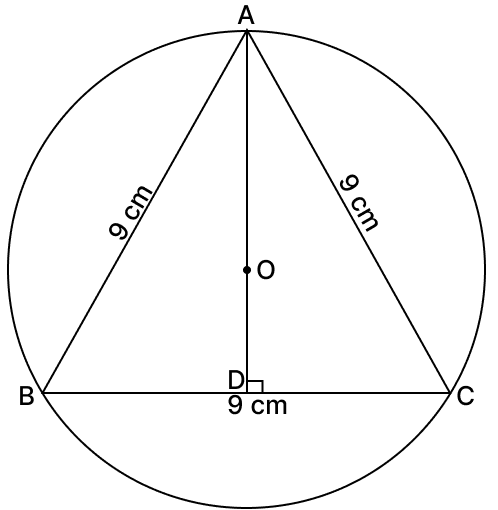
An equilateral triangle of side 9 cm is inscribed in a circle. Find the radius of the circle. Chord Properties of a Circle, R.S. Aggarwal Mathematics Solutions ICSE Class 9.

Let ABC be equilateral triangle inscribed in circle.

AB = BC = AC

Draw AD ⊥ BC.

Since, in an equilateral triangle the perpendicular from a vertex bisects the opposite side.

Thus,

D is the mid-point of BC.

∴ BD = BC2=92\dfrac{BC}{2} = \dfrac{9}{2} = 4.5 cm.

Since, the chord BC is bisected at point D, and perpendicular from center bisects the chord.

Centre of the circle O lies on AD. Let radius of circle (OA) be r.

In right-angled triangle ADB,

By pythagoras theorem,

⇒ Hypotenuse2 = Perpendicular2 + Base2

⇒ AB2 = AD2 + BD2

92=AD2+(92)281=AD2+(814)AD2=81814AD2=324814AD2=2434AD=2434=932.\Rightarrow 9^2 = AD^2 + \Big(\dfrac{9}{2}\Big)^2 \\[1em] \Rightarrow 81 = AD^2 + \Big(\dfrac{81}{4}\Big) \\[1em] \Rightarrow AD^2 = 81 - \dfrac{81}{4} \\[1em] \Rightarrow AD^2 = \dfrac{324 - 81}{4}\\[1em] \Rightarrow AD^2 = \dfrac{243}{4} \\[1em] \Rightarrow AD = \sqrt{\dfrac{243}{4}} = \dfrac{9\sqrt{3}}{2}.

We know that,

In an equilateral triangle, the centroid and circumcentre coincide.

Since AD is a median, and centroid divides median in 2:1 ratio,

AO : OD = 2 : 1

∴ Radius (AO) = 23×AD\dfrac{2}{3} \times AD

= 23×932=33\dfrac{2}{3} \times \dfrac{9\sqrt{3}}{2} = 3\sqrt3 cm.

Hence, the radius of the circle = 333\sqrt{3} cm.

Question 13

If a line l intersects two concentric circles at the points A, B, C and D, as shown in the figure, prove that AB = CD.
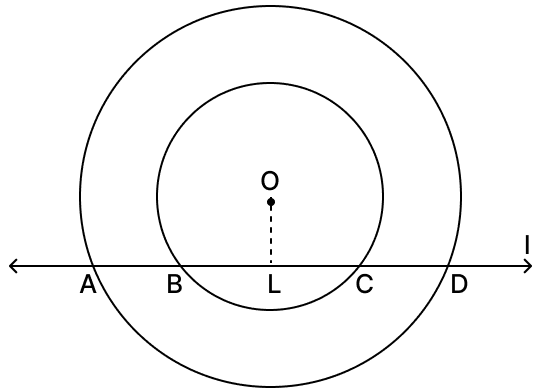
If a line l intersects two concentric circles at the points A, B, C and D, as shown in the figure, prove that AB = CD. Chord Properties of a Circle, R.S. Aggarwal Mathematics Solutions ICSE Class 9.

Answer

Since, the perpendicular to a chord from the centre of the circle bisects the chord,

So, in the smaller circle, L is mid-point of BC so,

BL = LC = x (let)

Similarly, in larger circle L is mid-point of AD so,

AL = LD = y (let)

From figure,

AB = AL - BL = (y - x)

CD = LD - LC = (y - x)

∴ AB = CD.

Hence, proved that AB = CD.

Question 14

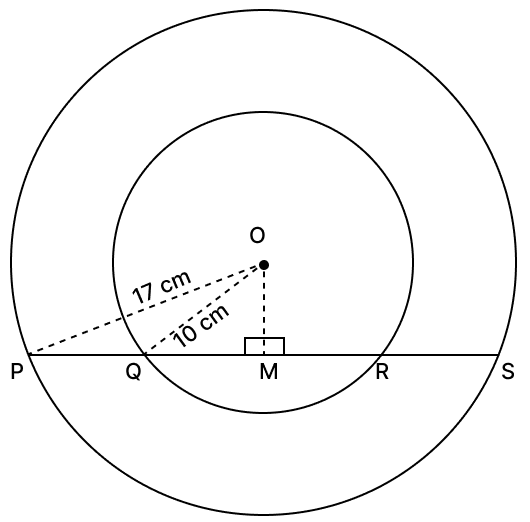
The radii of two concentric circles are 17 cm and 10 cm. A line segment PQRS cuts the larger circle at P and S and the smaller circle at Q and R. If QR = 12 cm, find the length PQ.

Answer

Draw OM ⊥ QR.

Since, perpendicular from center bisects the chord.

Thus, QM = QR2=122\dfrac{QR}{2} = \dfrac{12}{2} = 6 cm.

The radii of two concentric circles are 17 cm and 10 cm. A line segment PQRS cuts the larger circle at P and S and the smaller circle at Q and R. If QR = 12 cm, find the length PQ. Chord Properties of a Circle, R.S. Aggarwal Mathematics Solutions ICSE Class 9.

In right △OQM,

By pythagoras theorem,

⇒ OQ2 = OM2 + QM2

⇒ 102 = OM2 + 62

⇒ OM2 = 100 - 36

⇒ OM2 = 64

⇒ OM = 64\sqrt{64} = 8 cm.

In right △POM,

⇒ PO2 = OM2 + PM2

⇒ 172 = 82 + PM2

⇒ PM2 = 289 - 64

⇒ PM2 = 225

⇒ PM = 225\sqrt{225} = 15 cm.

From figure,

PQ = PM - QM = 15 - 6 = 9 cm.

Hence, PQ = 9 cm.

Question 15

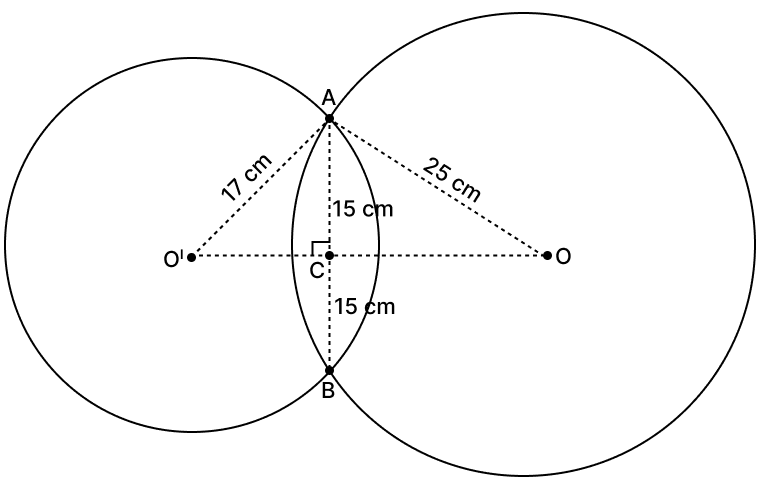
Two circles of radii 17 cm and 25 cm intersect each other at two points A and B. If the length of common chord AB of the circles is 30 cm, find the distance between the centres of the circles.

Answer

Since, the perpendicular to a chord from the centre of the circle bisects the chord,

∴ AC = CB = 302\dfrac{30}{2} = 15 cm

From figure,

Two circles of radii 17 cm and 25 cm intersect each other at two points A and B. If the length of common chord AB of the circles is 30 cm, find the distance between the centres of the circles. Chord Properties of a Circle, R.S. Aggarwal Mathematics Solutions ICSE Class 9.

In right triangle OAC,

⇒ OA2 = OC2 + AC2 (By pythagoras theorem)

⇒ 252 = OC2 + 152

⇒ 625 = OC2 + 225

⇒ OC2 = 400

⇒ OC = 400\sqrt{400} = 20 cm.

In right triangle O'AC,

⇒ O'A2 = O'C2 + AC2 (By pythagoras theorem)

⇒ 172 = O'C2 + 152

⇒ 289 = O'C2 + 225

⇒ O'C2 = 64

⇒ O'C = 64\sqrt{64} = 8 cm.

Distance between centers = OO' = OC + O'C = 20 + 8 = 28 cm.

Hence, distance between their centres = 28 cm.

Question 16

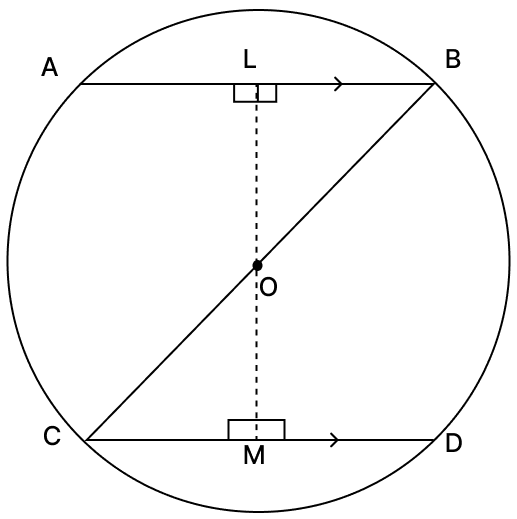
In the adjoining figure, BC is a diameter of a circle with centre O. If AB and CD are two chords such that AB ∥ CD, prove that AB = CD.
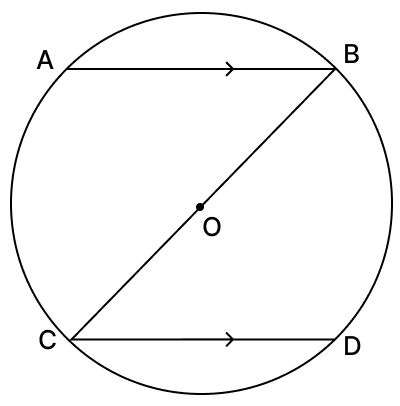
In the adjoining figure, BC is a diameter of a circle with centre O. If AB and CD are two chords such that AB ∥ CD, prove that AB = CD. Chord Properties of a Circle, R.S. Aggarwal Mathematics Solutions ICSE Class 9.

Answer

In the given figure, ABCD is a parallelogram and P is a point on BC. Prove that. Chord Properties of a Circle, R.S. Aggarwal Mathematics Solutions ICSE Class 9.

Draw LM through O perpendicular to AB and CD.

In △ OLB and △ OMC :

OB = OC [radii of same circle]

∠OLB = ∠OMC = 90°

∠OBL = ∠OCM [Alternate interior angles are equal]

∴ △ OLB ≅ △ OMC [By A.A.S. axiom]

Since the triangles are congruent, their corresponding parts are equal.

OL = OM

Chords equidistant from the center of a circle are equal in length.

∴ AB = CD.

Hence, proved that AB = CD.

Question 17

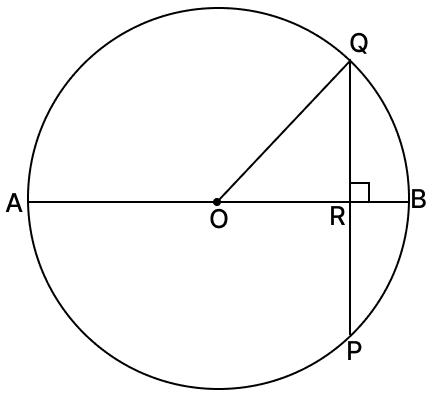
The adjoining figure shows a circle with centre O in which a diameter AB bisects the chord PQ at point R. If PR = RQ = 8 cm and RB = 4 cm, find the radius of the circle.
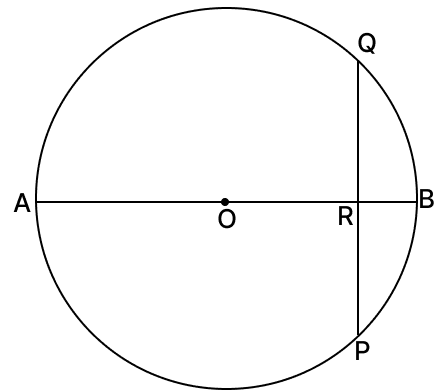
The adjoining figure shows a circle with centre O in which a diameter AB bisects the chord PQ at point R. If PR = RQ = 8 cm and RB = 4 cm, find the radius of the circle. Chord Properties of a Circle, R.S. Aggarwal Mathematics Solutions ICSE Class 9.

Answer

Join OQ.

The adjoining figure shows a circle with centre O in which a diameter AB bisects the chord PQ at point R. If PR = RQ = 8 cm and RB = 4 cm, find the radius of the circle. Chord Properties of a Circle, R.S. Aggarwal Mathematics Solutions ICSE Class 9.

Radius = OQ = OB = x (let)

⇒ OR = OB - RB = (x - 4) cm.

We know that,

A straight line drawn from the center of a circle to bisect a chord, is perpendicular to the chord.

Since, PR = QR, thus R is mid-point of PQ.

∴ OR ⊥ PQ

In right-angled triangle OQR,

By pythagoras theorem,

⇒ Hypotenuse2 = Perpendicular2 + Base2

⇒ OQ2 = OR2 + QR2

⇒ x2 = (x - 4)2 + 82

⇒ x2 = x2 + 42 - 2 × x × 4 + 64

⇒ x2 = x2 + 16 - 8x + 64

⇒ x2 - x2 + 8x = 80

⇒ 8x = 80

⇒ x = 808\dfrac{80}{8} = 10 cm.

Hence, radius of circle = 10 cm.

Question 18

In the adjoining figure, AB is a chord of a circle with centre O and BC is a diameter. If OD ⟂ AB, show that CA = 2OD and CA ∥ OD.
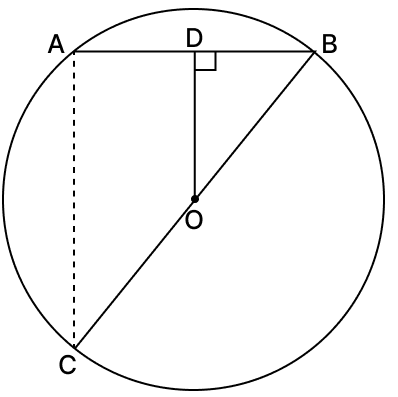
In the adjoining figure, AB is a chord of a circle with centre O and BC is a diameter. If OD ⟂ AB, show that CA = 2OD and CA ∥ OD. Chord Properties of a Circle, R.S. Aggarwal Mathematics Solutions ICSE Class 9.

Answer

Since, the perpendicular to a chord from the centre of the circle bisects the chord,

∴ AD = DB

We can say that D is mid-point of AB.

Since, BC is diameter and O is center so, OB = OC = radius.

We can say that O is mid-point of BC.

In △ABC,

Since, D is mid-point of AB and O is mid-point of BC.

By mid-point theorem,

⇒ OD || AC and OD = 12\dfrac{1}{2} AC

⇒ AC = 2OD.

Hence, proved that CA = 2OD and CA ∥ OD.

Question 19

In the adjoining figure, P is a point of intersection of two circles with centres C and D. If the straight line APB is parallel to CD, prove that AB = 2CD.
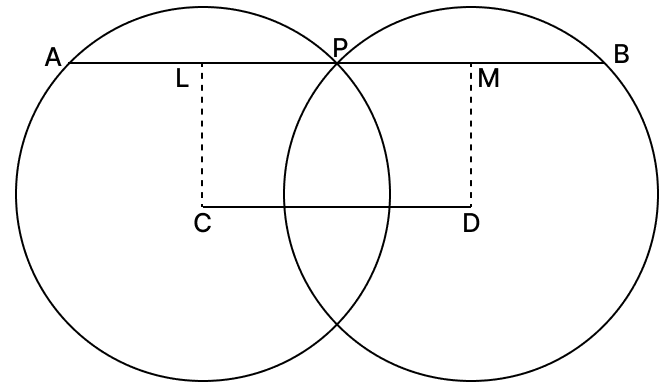
In the adjoining figure, P is a point of intersection of two circles with centres C and D. If the straight line APB is parallel to CD, prove that AB = 2CD. Chord Properties of a Circle, R.S. Aggarwal Mathematics Solutions ICSE Class 9.

Answer

From C draw CL perpendicular to AB and from D drawn DM perpendicular to AB.

From figure,

LCDM is a rectangle.

∴ ML = CD (Opposite sides of rectangle are equal).

Since, the perpendicular to a chord from the centre of the circle bisects the chord,

LP = 12\dfrac{1}{2} AP and MP = 12\dfrac{1}{2} PB

From figure,

LM = LP + PM

LM=12AP+12PBLM=12(AP+PB)LM=12ABCD=12ABAB=2CD.\Rightarrow LM = \dfrac{1}{2} AP + \dfrac{1}{2} PB \\[1em] \Rightarrow LM = \dfrac{1}{2} (AP + PB) \\[1em] \Rightarrow LM = \dfrac{1}{2} AB \\[1em] \therefore CD = \dfrac{1}{2} AB \\[1em] \Rightarrow AB = 2CD.

Hence, proved that AB = 2CD.

Question 20

If a diameter of a circle bisects each of the two chords of a circle, then prove that the chords are parallel.

Answer

Let diameter POQ bisect chords AB and CD at L and M respectively.
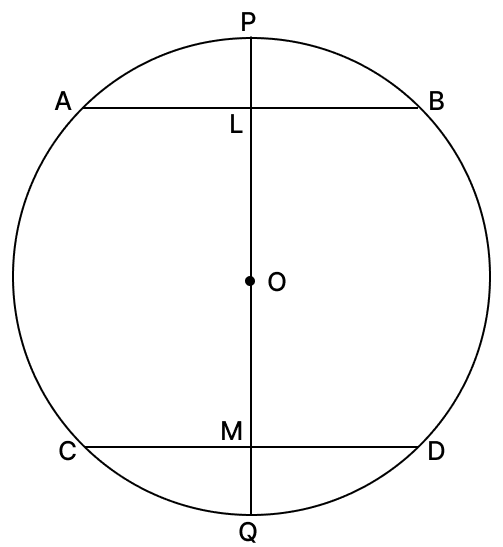
If a diameter of a circle bisects each of the two chords of a circle, then prove that the chords are parallel. Chord Properties of a Circle, R.S. Aggarwal Mathematics Solutions ICSE Class 9.

Then, OL ⟂ AB and OM ⟂ CD

∴ ∠ALO = ∠OMD = 90°

These two angles are alternate interior angles, where PQ is transversal intersecting chords AB and CD.

Since, these angles are equal

∴ AB ∥ CD.

Hence, the two chords are parallel.

Question 21

If two chords of a circle are equally inclined to the diameter through their point of intersection, prove that the chords are equal.

Answer

Let AB and AC be two chords.

AOD be a diameter such that ∠BAO = ∠CAO.

OL ⟂ AB and OM ⟂ AC.
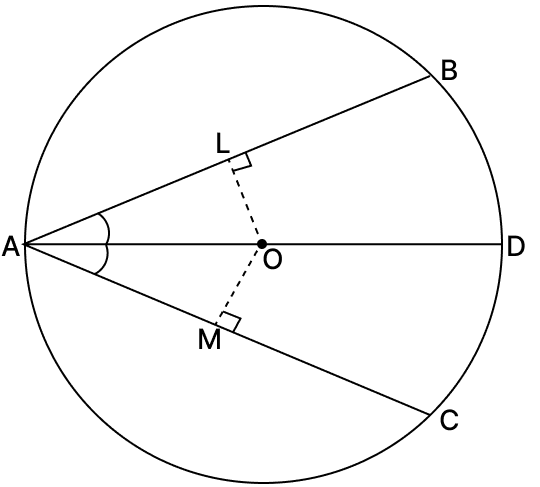
If two chords of a circle are equally inclined to the diameter through their point of intersection, prove that the chords are equal. Chord Properties of a Circle, R.S. Aggarwal Mathematics Solutions ICSE Class 9.

In △OLA and △OMA,

OA = OA [common side]

∠OLA = ∠OMA = 90°

∠LAO = ∠MAO [AO bisects ∠A]

∴ △OLA ≅ △OMA [By A.A.S. rule]

Then,

OL = OM (By C.P.C.T.C.)

AB = AC [Chords which are equidistant from centre are equal]

Hence, proved that the two chords are equal.

Question 22

Show that equal chords of a circle subtend equal angles at the centre of the circle.

Answer

Given: AB and CD are two equal chords of a circle with center O.
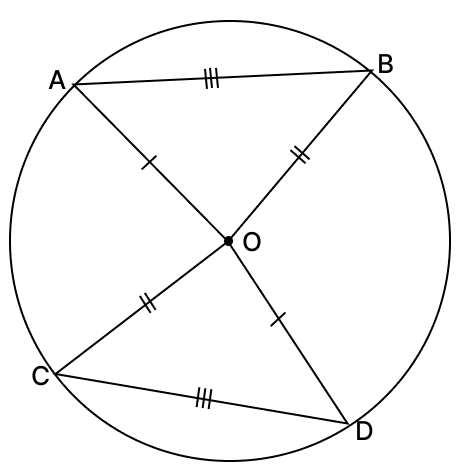
Show that equal chords of a circle subtend equal angles at the centre of the circle. Chord Properties of a Circle, R.S. Aggarwal Mathematics Solutions ICSE Class 9.

In Δ AOB and Δ COD,

OA = OC (Radii of a circle)

OB = OD (Radii of a circle)

AB = CD (Given)

By SSS congruency criterion,

Δ AOB ≅ Δ COD

∴ ∠AOB = ∠COD (By C.P.C.T.C.)

Hence, equal chords of a circle subtend equal angles at the centre.

Question 23

In the given figure, equal chords AB and CD of a circle with centre O cut at right angles at P. If L and M are mid-points of AB and CD respectively, prove that OLPM is a square.
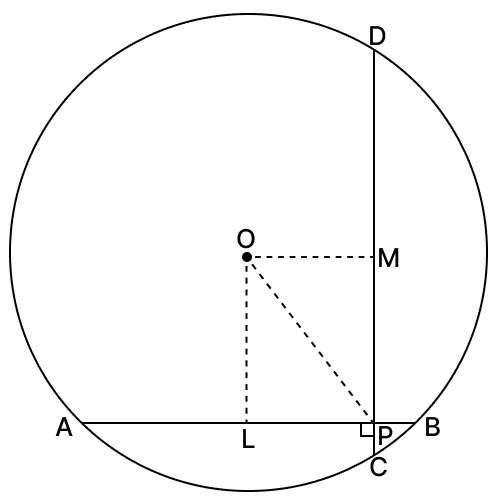
In the given figure, equal chords AB and CD of a circle with centre O cut at right angles at P. If L and M are mid-points of AB and CD respectively, prove that OLPM is a square. Chord Properties of a Circle, R.S. Aggarwal Mathematics Solutions ICSE Class 9.

Answer

In OLPM,

∠P = 90° (As chords intersect at right angles)

∠L = ∠M = 90° (Straight lines from center bisecting the chord are perpendicular to it.)

∠O = 360° - (∠L + ∠M + ∠P)

= 360° - (90° + 90° + 90°)

= 90°.

Since, equal chords are equidistant from center,

∴ OL = OM.

Since, all angles = 90° and adjacent sides are equal.

Thus, OLPM is a square.

Hence, proved that OLPM is a square.

Question 24

Prove that the perpendicular bisector of a chord of a circle always passes through the centre.
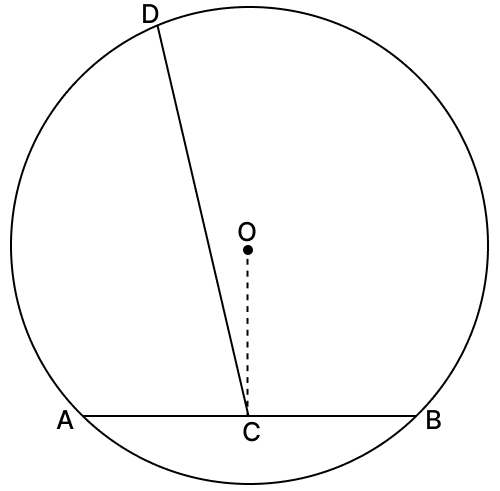
Prove that the perpendicular bisector of a chord of a circle always passes through the centre. Chord Properties of a Circle, R.S. Aggarwal Mathematics Solutions ICSE Class 9.

Answer

AB is a chord of a circle with centre O.

Let CD be the perpendicular bisector of AB.

∠ACD = 90° [CD ⊥ AB]

Line joining the center of a circle to the midpoint of a chord is perpendicular to the chord.

∠ACO = 90° [Since C is the midpoint of AB, OC ⊥ AB]

∴ ∠ACD = ∠ACO which is wrong

∴ CD must pass through O.

Hence, the perpendicular bisector of a chord of a circle always passes through the centre.

Question 25

AB and CD are two parallel chords of a circle and a line l is the perpendicular bisector of AB. Show that l is the perpendicular bisector of CD also.

Answer

We know that,

The perpendicular bisector of a chord passes through the centre of the circle.

∴ l bisects AB, l ⟂ AB
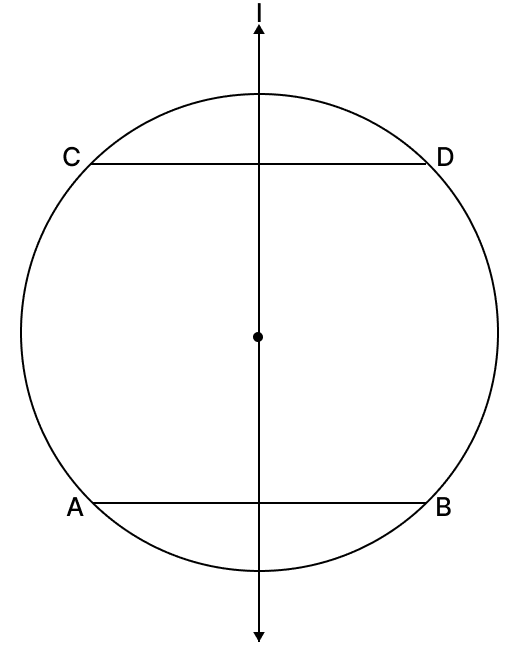
AB and CD are two parallel chords of a circle and a line l is the perpendicular bisector of AB. Show that l is the perpendicular bisector of CD also. Chord Properties of a Circle, R.S. Aggarwal Mathematics Solutions ICSE Class 9.

Given, AB ∥ CD

If a line is perpendicular to one of two parallel lines, it is also perpendicular to the other.

Now, l ⟂ AB and AB ∥ CD

∴ l ⟂ CD

So, l passes through the centre O and is perpendicular to CD, thus it must bisect CD.

Hence, l is the perpendicular bisector of CD.

Question 26

Prove that diameter of a circle perpendicular to one of the two parallel chords of a circle is perpendicular to the other and bisects it.

Answer
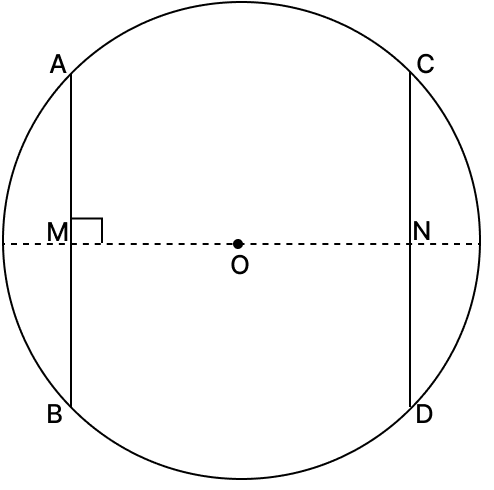
Prove that diameter of a circle perpendicular to one of the two parallel chords of a circle is perpendicular to the other and bisects it. Chord Properties of a Circle, R.S. Aggarwal Mathematics Solutions ICSE Class 9.

Since, AB || CD and ∠OMA = ∠OMB = 90°

From figure,

∠OMA = ∠OND = 90° (Alternate angles are equal)

∠OMB = ∠ONC = 90° (Alternate angles are equal)

∴ ON ⊥ CD or MN ⊥ CD

We know that,

The perpendicular to a chord from the center of the circle bisects the chord.

∴ NC = ND.

Hence, proved that diameter is perpendicular to other chord and bisects it.

Question 27

Prove that a diameter of a circle, which bisects a chord of the circle, also bisects the angle subtended by the chord at the centre of the circle.

Answer

Let POQ be a diameter, bisecting chord AB at L.

Join OA and OB
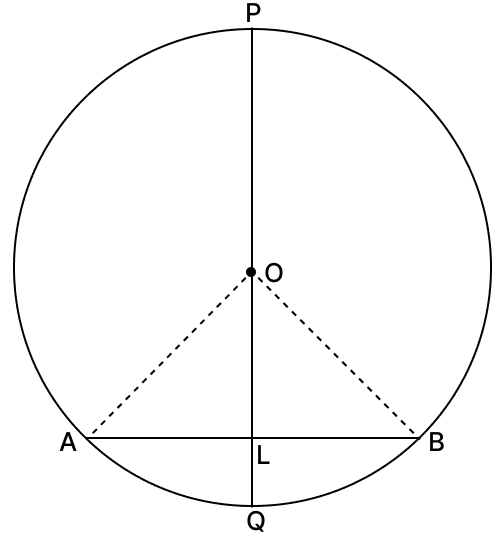
Prove that a diameter of a circle, which bisects a chord of the circle, also bisects the angle subtended by the chord at the centre of the circle. Chord Properties of a Circle, R.S. Aggarwal Mathematics Solutions ICSE Class 9.

In △OLA and △OLB:

OA = OB [Both are radii of the same circle]

AL = LB [PQ bisects the chord AB]

OL = OL [common side]

△OLA ≅ △OLB [By the SSS rule]

Since the triangles are congruent, their corresponding parts must be equal:

∠AOL = ∠BOL

This proves that the diameter PQ bisects ∠AOB, which is the angle subtended by the chord AB at the center O.

Hence, proved that the diameter also bisects the angle subtended by the chord at the centre.

Question 28

In the given figure, L and M are mid-points of two equal chords AB and CD of a circle with centre O. Prove that :

(i) ∠OLM = ∠OML

(ii) ∠ALM = ∠CML
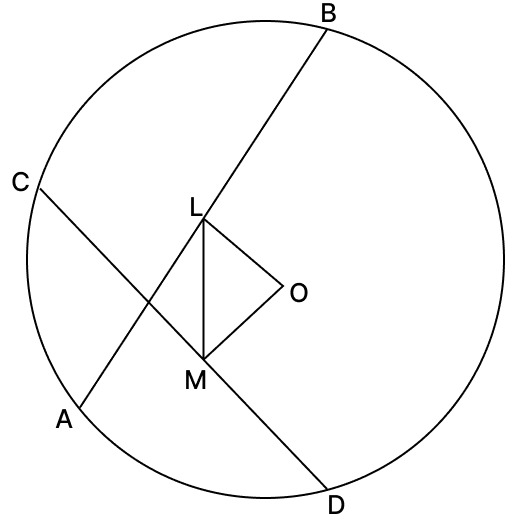
In the given figure, L and M are mid-points of two equal chords AB and CD of a circle with centre O. Chord Properties of a Circle, R.S. Aggarwal Mathematics Solutions ICSE Class 9.

Answer

(i) Given,

L and M are the mid-points of two equal chords AB and CD.

We know that,

A straight line drawn from the center of a circle to bisect a chord, which is not a diameter, is at right angles to the chord.

∴ OL ⊥ AB and OM ⊥ CD.

Since, AB and CD are equal chords and perpendicular drawn from center to equal chords are equal in length.

∴ OL = OM

Thus, in triangle OLM,

∴ ∠OLM = ∠OML (Angles opposite to equal sides are equal)

Hence, proved that ∠OLM = ∠OML.

(ii) We have,

∠OLM = ∠OML

∠OLA - ∠ALM = ∠OMC - ∠CML

Since, ∠OLA and ∠OMC both equal to 90°.

∴ ∠ALM = ∠CML.

Hence, proved that ∠ALM = ∠CML.

Question 29

In the given figure, AB and AC are equal chords of a circle with centre O and OP ⟂ AB, OQ ⟂ AC. Prove that PB = QC.
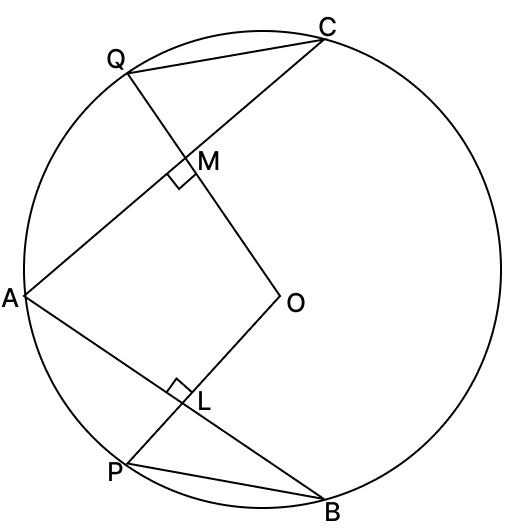
In the given figure, AB and AC are equal chords of a circle with centre O and OP ⟂ AB, OQ ⟂ AC. Prove that PB = QC. Prove that. Chord Properties of a Circle, R.S. Aggarwal Mathematics Solutions ICSE Class 9.

Answer

Let AB = AC = x.

Given,

OM ⊥ AC and OL ⊥ AB.

Since, the perpendicular to a chord from the centre of the circle bisects the chord.

∴ AM = MC = x2\dfrac{x}{2}

and

AL = LB = x2\dfrac{x}{2}

∴ MC = LB ......(1)

Since, equal chords of a circle are equidistant from the centre,

∴ OM = OL = y (let).

Let radius of circle be r.

From figure,

OQ = OP = r

QM = OQ - OM = r - y

PL = OP - OL = r - y

∴ QM = PL .....(2)

In △QMC and △PLB,

MC = LB [From (1)]

QM = PL [From (2)]

∠QMC = ∠PLB (Both equal to 90°)

△QMC ≅ △PLB by SAS axiom.

∴ PB = QC (By C.P.C.T.)

Hence, proved that PB = QC.

Question 30

In an equilateral triangle, prove that the centroid and the circumcentre of the triangle coincide.

Answer

AD, BE and CF are medians of the triangle.

Let G be the centroid of triangle ABC.

Triangle ABC is an equilateral triangle,

∴ AB = BC = CA and ∠ABC = ∠BAC = ∠BCA = 60°
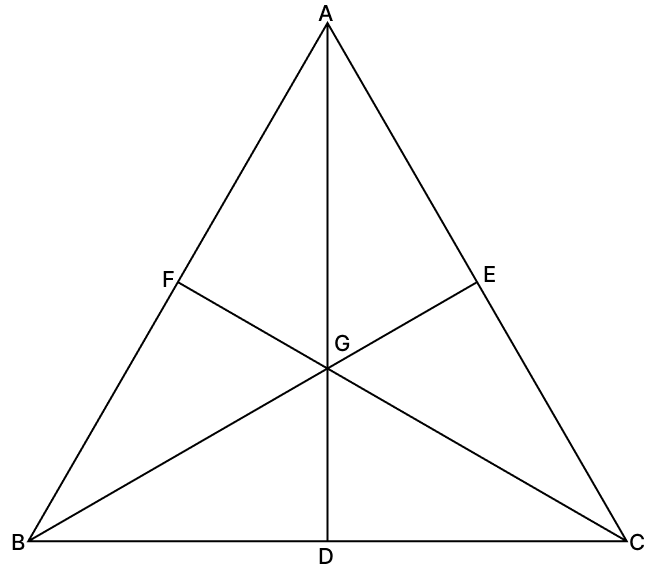
In an equilateral triangle, prove that the centroid and the circumcentre of the triangle coincide. Chord Properties of a Circle, R.S. Aggarwal Mathematics Solutions ICSE Class 9.

In △BFC and △BEC,

⇒ BC = BC (Common Side)

⇒ ∠FBC = ∠ECB = 60°.

⇒ BF = EC (As F is mid-point of AB and E is mid-point of AC and AB = AC.)

△BFC ≅ △BEC (By SAS axiom)

∴ BE = CF (By C.P.C.T.) .....(1)

Now, in △ABE and △ABD,

AB = AB (Common Side)

∠BAE = ∠ABD = 60°

BD = AE (As D is mid-point of BC and E is mid-point of AC and BC = AC.)

△ABE ≅ △ABD (By SAS axiom.)

∴ BE = AD (By C.P.C.T.) ......(2)

From equation 1 and 2, we get:

⇒ AD = BE = CF

23AD=23BE=23CF\dfrac{2}{3} AD = \dfrac{2}{3} BE = \dfrac{2}{3} CF

We know that the centroid of the triangle divides the median in a 2 : 1 ratio.

∴ GA = GB = GC.

So, we can say that G is equidistant from the three vertices A. B and C.

G is circumcentre of ΔABC.

Hence, proved that the centroid and circumcentre are coincident.

Multiple Choice Questions

Question 1

If a chord is at a distance of 8 cm from the centre of the circle of radius 17 cm, then the length of the chord will be :

  1. 15 cm

  2. 20 cm

  3. 30 cm

  4. 45 cm

Answer

If a chord is at a distance of 8 cm from the centre of the circle of radius 17 cm, then the length of the chord will be. Chord Properties of a Circle, R.S. Aggarwal Mathematics Solutions ICSE Class 9.

Let the chord be AB and the perpendicular from the center O meet the chord at M.

In the right-angled triangle △OMA:

Using the Pythagorean theorem:

OA2 = AM2 + OM2

172 = AM2 + 82

289 = AM2 + 64

AM2 = 289 - 64

AM2 = 225

AM = 225\sqrt{225} = 15 cm

Since the perpendicular from the center bisects the chord.

Length of chord = 2 × AM = 30 cm.

Hence, option 3 is the correct option.

Question 2

A chord of length 40 cm is drawn at a distance of 15 cm from the centre of a circle, then the radius of the circle will be :

  1. 12 cm

  2. 15 cm

  3. 17 cm

  4. 25 cm

Answer

A chord of length 40 cm is drawn at a distance of 15 cm from the centre of a circle, then the radius of the circle will be. Chord Properties of a Circle, R.S. Aggarwal Mathematics Solutions ICSE Class 9.

Let the chord be AB and the perpendicular from the center O meet the chord at M.

Since the perpendicular from the center bisects the chord AB.

AM = AB2=402\dfrac{AB}{2} = \dfrac{40}{2} = 20 cm

In the right-angled triangle △OMA:

Using the Pythagorean theorem:

OA2 = AM2 + OM2

OA2 = 202 + 152

OA2 = 225 + 400

OA2 = 625

OA = 625\sqrt{625} = 25 cm.

Hence, option 4 is the correct option.

Question 3

In the figure, O is the centre of the circle and AC = BC = 3.5 cm. ∠ACO will be :

In the figure, O is the centre of the circle and AC = BC = 3.5 cm. ∠ACO will be. Chord Properties of a Circle, R.S. Aggarwal Mathematics Solutions ICSE Class 9.
  1. 60°

  2. 80°

  3. 90°

  4. 100°

Answer

The line joining the centre of a circle to the midpoint of a chord is perpendicular to the chord.

Since,

AC = BC [C is the midpoint of AB]

O is the centre.

Thus, OC is perpendicular to AB.

∠ACO = 90°.

Hence, option 3 is the correct option.

Question 4

In the figure, O is the centre of the circle and OP = OQ and CD = 6 cm. The length of AB is :

In the figure, O is the centre of the circle and OP = OQ and CD = 6 cm. The length of AB is. Chord Properties of a Circle, R.S. Aggarwal Mathematics Solutions ICSE Class 9.
  1. 6 cm

  2. 12 cm

  3. 3 cm

  4. 5 cm

Answer

Given,

OP = OQ

CD = 6 cm

Chords equidistant from the centre of a circle are equal.

AB = CD

∴ AB = 6 cm

Hence, option 1 is the correct option.

Question 5

A chord of length 70 cm is drawn in a circle of radius 37 cm. The distance of the chord from the centre of the circle is :

  1. 20 cm

  2. 15 cm

  3. 14 cm

  4. 12 cm

Answer

A chord of length 70 cm is drawn in a circle of radius 37 cm. The distance of the chord from the centre of the circle is. Chord Properties of a Circle, R.S. Aggarwal Mathematics Solutions ICSE Class 9.

Let the chord be AB and the perpendicular from the center O meet the chord at M.

Since the perpendicular from the center bisects the chord AB.

AM = 702\dfrac{70}{2} = 35 cm

In the right-angled triangle △OMA:

Using the Pythagorean theorem:

OA2 = AM2 + OM2

372 = 352 + OM2

OM2 = 1369 - 1225

OM2 = 144

OM = 144\sqrt{144} = 12 cm.

Hence, option 4 is the correct option.

Case Study Based Questions

Question 1

Case Study: There is a circular park in a colony. The diameter of the park is 40 m. Three poles A, B and C have been eracted at equal distances on the boundary of the park. These poles have been connected with each other using straight wires, as shown in the figure.

There is a circular park in a colony. The diameter of the park is 40 m. Three poles A, B and C have been eracted at equal distances on the boundary of the park. These poles have been connected with each other using straight wires, as shown in the figure. Chord Properties of a Circle, R.S. Aggarwal Mathematics Solutions ICSE Class 9.

Based on this information, answer the following questions:

1. The circumference of the circular park is :
(a) 125.6 m
(b) 130 m
(c) 251.2 m
(d) 257.2 m

2. A child cycles along the boundary of the park in clockwise direction. The distance covered by the child in going from B to C is :
(a) 41.8 m
(b) 83.7 m
(c) 20.9 m
(d) 125.6 m

3. ABC is :
(a) a scalene triangle
(b) a right triangle
(c) an equilateral triangle
(d) an isosceles triangle

4. If we draw perpendicular from B on AC, then it will pass through : (a) centre of the circle
(b) circumcentre of the circle
(c) centroid of the circle
(d) all the above

5. The length of the piece of wire used to connect any two poles is :
(a) 20 m
(b) 203\sqrt{3} m
(c) 202\sqrt{2} m
(d) 603\sqrt{3} m

Answer

1. Given,

d = 40 m

r = 402\dfrac{40}{2} = 20 m

The circumference of the circular park is = 2πr

= 2 × 227\dfrac{22}{7} × 20

= 125.6 m

Hence, option (a) is the correct option.

2. Since poles A, B, and C are at equal distances on the boundary, they divide the total circumference into three equal arcs.

The distance along the boundary (arc BC) = Circumference3=125.63\dfrac{\text{Circumference}}{3} = \dfrac{125.6}{3} = 41.8 m

From the figure, going clockwise from B to C means the child travels the major arc, not the minor arc.

Major arc = Total circumference − minor arc

= 125.6 − 41.87 = 83.73 m

Hence, option (b) is the correct option.

3. Poles A, B, and C are at equal distances on the boundary.

Since, arc BA = arc AC = arc CB.

This means the chords AB, BC, and CA are equal in length.

A triangle with three equal sides is an equilateral triangle.

Hence, option (c) is the correct option.

4. In an equilateral triangle, the perpendicular bisector, median, and altitude are all the same line.

Thus, perpendicular from B on AC, will pass through the center, centroid and circumcenter of the circle.

Hence, option (d) is the correct option.

5. Radius of inscribed circle = 20 m

The relationship between the side of an equilateral triangle and the circumradius is:

Side length = r3=203.r\sqrt3 = 20\sqrt3.

Hence, option (b) is the correct option.

Assertion–Reason Questions

Question 1

Assertion (A): In the figure, AB and AC are equal chords of a circle with centre O. If OD = 4 cm, then OE is also 4 cm.

Reason (R): Equal chords of a circle are equidistant from the centre.

  1. A is true, R is false

  2. A is false, R is true

  3. Both A and R are true

  4. Both A and R are false

In the figure, AB and AC are equal chords of a circle with centre O. If OD = 4 cm, then OE is also 4 cm. Chord Properties of a Circle, R.S. Aggarwal Mathematics Solutions ICSE Class 9.

Answer

We know that,

Equal chords of a circle are equidistant from the centre.

Reason (R) is true.

Since, AB = AC [Chords of circle are equal]

∴ OD = OE = 4 cm

Assertion (A) is true.

Both A and R are true.

Hence, option 3 is the correct option.

Question 2

Assertion (A): Longer is the chord, longer is its distance from the centre.

Reason (R): Chords of a circle that are equidistant from the centre of the circle are parallel to each other.

  1. A is true, R is false

  2. A is false, R is true

  3. Both A and R are true

  4. Both A and R are false

Answer

The longer the chord, the closer it is to the center.

The shorter the chord, the farther it is from the center.

Assertion (A) is false.

If two chords are equidistant from the center, they must be equal in length, but they do not have to be necessarily parallel.

Reason (R) is false.

Both A and R are false.

Hence, option 4 is the correct option.

Question 3

Assertion (A): Equal chords of a circle subtend equal angles at the centre of the circle.

Reason (R): One and only one circle can be drawn passing through three points.

  1. A is true, R is false

  2. A is false, R is true

  3. Both A and R are true

  4. Both A and R are false

Answer

Let AB and CD are two equal chords of a circle with center O.

Equal chords of a circle subtend equal angles at the centre of the circle. Chord Properties of a Circle, R.S. Aggarwal Mathematics Solutions ICSE Class 9.

In Δ AOB and Δ COD,

OA = OC (Radii of a circle)

OB = OD (Radii of a circle)

AB = CD (Given)

By SSS congruency criterion,

Δ AOB ≅ Δ COD

Using corresponding parts of congruent triangles,

∠AOB = ∠COD

Assertion (A) is true.

Through three non-collinear points, exactly one circle can pass.

Through three collinear points, no circle can be drawn.

Reason (R) is false.

A is true, R is false.

Hence, option 1 is the correct option.

Competency Focused Questions

Question 1

Two chords of a circle of lengths 10 cm and 8 cm are at the distances of 6 cm and 5 cm respectively from the centre. This statement is :

  1. True

  2. False

  3. Can't say anything

  4. Data inadequate

Answer

The statement is false because there is an inverse relationship between the chord length and its distance from the center :

The longer the chord, the closer it is to the center.

The shorter the chord, the farther it is from the center.

Hence, option 2 is the correct option.

Question 2

The radius of a circle is 13 cm and length of chord is 10 cm. The shortest distance between chord and the centre is:

  1. 12 cm

  2. 15 cm

  3. 16 cm

  4. 18 cm

Answer

Let AB be chord of length = 10 cm

The radius of a circle is 13 cm and length of chord is 10 cm. The shortest distance between chord and the centre is. Chord Properties of a Circle, R.S. Aggarwal Mathematics Solutions ICSE Class 9.

Radius OA = 13 cm

Let OD be the perpendicular distance from the center to the chord, it bisects the chord into two equal parts:

AD = DB = 102\dfrac{10}{2} = 5 cm

In triangle OAD,

According to the Pythagorean Theorem:

OA2 = OD2 + AD2

132 = OD2 + 52

169 = OD2 + 25

OD2 = 169 - 25

OD2 = 144

OD = 144\sqrt{144} = 12 cm

The shortest distance between the chord and the center is 12 cm.

Hence, option 1 is the correct option.

Question 3

In the circle, chord AB of length 12 cm is bisected by diameter CD at P, so that CP = 3 cm. Radius of the circle is:

In the circle, chord AB of length 12 cm is bisected by diameter CD at P, so that CP = 3 cm. Radius of the circle is. Chord Properties of a Circle, R.S. Aggarwal Mathematics Solutions ICSE Class 9.
  1. 5.2 cm

  2. 6.5 cm

  3. 7.5 cm

  4. 8.3 cm

Answer

In the circle, chord AB of length 12 cm is bisected by diameter CD at P, so that CP = 3 cm. Radius of the circle is. Chord Properties of a Circle, R.S. Aggarwal Mathematics Solutions ICSE Class 9.

Given,

Chord AB = 12 cm

CD bisects chord AB at P

AP = PB = 122\dfrac{12}{2} = 6 cm

CP = 3 cm

OC = OA = R

OP = OC - CP = R - 3

In triangle OPA,

Apply the Pythagorean Theorem :

OA2 = OP2 + AP2

R2 = (R - 3)2 + 62

R2 = R2 - 6R + 9 + 36

R2 = R2 - 6R + 45

6R = 45

R = 456\dfrac{45}{6} = 7.5 cm

Hence, option 3 is the correct option.

Question 4

Three friends Amit, Vinay and Sukrit are playing a game by standing on a circle of radius 5 m drawn in a park. Amit throws a ball to Vinay, Vinay to Sukrit, Sukrit to Amit. If the distance between Amit and Vinay and between Vinay and Sukrit is 6 m each, what is the distance between Amit and Sukrit?

Answer

Three friends Amit, Vinay and Sukrit are playing a game by standing on a circle of radius 5 m drawn in a park. Amit throws a ball to Vinay, Vinay to Sukrit, Sukrit to Amit. If the distance between Amit and Vinay and between Vinay and Sukrit is 6 m each, what is the distance between Amit and Sukrit. Chord Properties of a Circle, R.S. Aggarwal Mathematics Solutions ICSE Class 9.

Let the center of the circular park be O and positions of Amit, Vinay and Sukrit be A, V and S respectively.

The radius of the circle is 5 m.

AV = VS = 6 m

Draw VM ⊥ AS.

In an isosceles triangle, the perpendicular from a vertex between equal sides bisects the opposite side.

∴ AM = MS

Thus,

Let OM = x m and MS = y m

VM = OV - OM = (5 - x) m.

In right-angled triangle VMS,

⇒ VS2 = VM2 + MS2

⇒ 62 = (5 - x)2 + y2

⇒ 36 = (5 - x)2 + y2

⇒ y2 = 36 - (5 - x)2 ....(1)

In right-angled triangle OMS,

⇒ OS2 = OM2 + MS2

⇒ 52 = x2 + y2

⇒ y2 = 25 - x2....(2)

From (1) and (2), we get :

⇒ 25 - x2 = 36 - (5 - x)2

⇒ 25 - x2 = 36 - (25 - 10x + x2)

⇒ 25 - x2 = 36 - 25 + 10x - x2

⇒ 25 - x2 = 36 - 25 + 10x - x2

⇒ 25 = 11 + 10x

⇒ 10x = 14

⇒ x = 1.4

Substituting value of x in equation (2):

⇒ y2 = 25 - (1.4)2

⇒ y2 = 23.04

⇒ y = 23.04\sqrt{23.04} = 4.8 m

From figure,

⇒ AS = MS + AM

⇒ AS = 2MS

⇒ AS = 2(4.8) = 9.6 m

Hence, the distance between Amit and Sukrit is 9.6 m.

Question 5

Show that the diameter is the greatest chord of a circle.

Answer

Show that the diameter is the greatest chord of a circle. Chord Properties of a Circle, R.S. Aggarwal Mathematics Solutions ICSE Class 9.

Let AB be a diameter of the circle and O be the centre.

By definition, it passes through the center, so AB = OA + OB = r + r = 2r.

Let CD be any other chord of the circle that does not pass through the center.

∴ OC = OD = r

The sum of the lengths of any two sides must be greater than the length of the third side.

OC + OD > CD

2r > CD

AB > CD

This proves the length of the diameter is always greater than the length of any other chord that does not pass through the center.

Hence, the diameter is the greatest chord of a circle.

PrevNext