
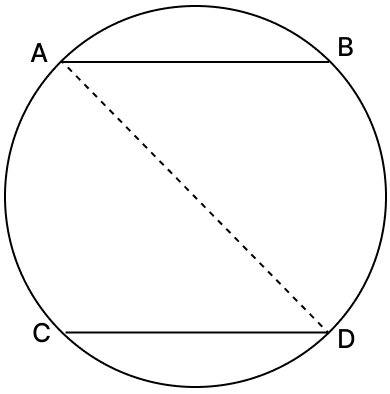
In the given figure, arc AC and arc BD are two equal arcs of a circle. Prove that chord AB and chord CD are parallel.
Answer
We know that,
If two arcs are equal, they subtend equal angles at centre, thus they will also subtend equal angle at the circumference.
⇒ ∠CDA = ∠BAD
These angles are alternate interior angles formed by transversal AD with lines CD and AB.
⇒ AB ∥ CD.
Hence, proved that chord AB and chord CD are parallel.
Prove that the angle subtended at the centre of a circle is bisected by the radius passing through the mid-point of the arc.
Answer
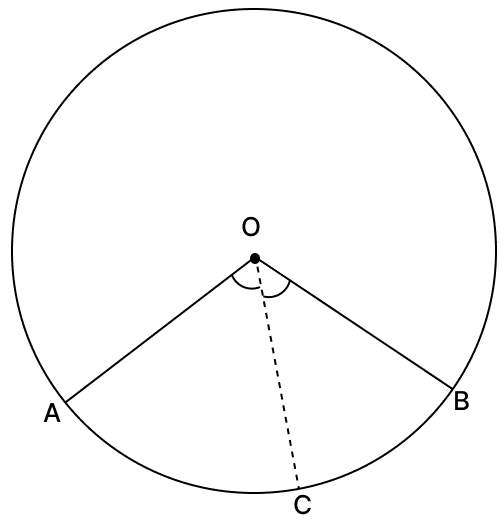
Let C be the mid-point of arc AB.
∴ AC = BC.
Since, equal arcs subtend equal angles at center.
∴ ∠AOC = ∠BOC.
Hence, proved that the angle subtended at the centre of a circle is bisected by the radius passing through the mid-point of the arc.
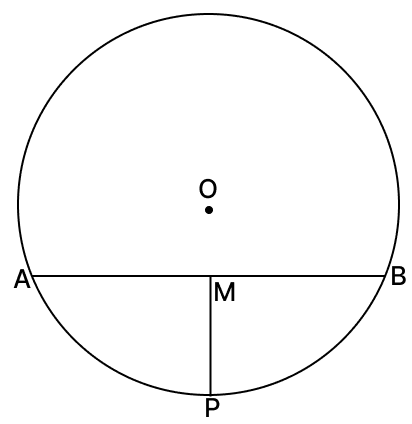
In the given figure, P is the mid-point of arc APB and M is the mid-point of chord AB of a circle with centre O. Prove that:
(i) PM ⟂ AB
(ii) PM produced will pass through the centre O
(iii) PM produced will bisect the major arc AB.
Answer
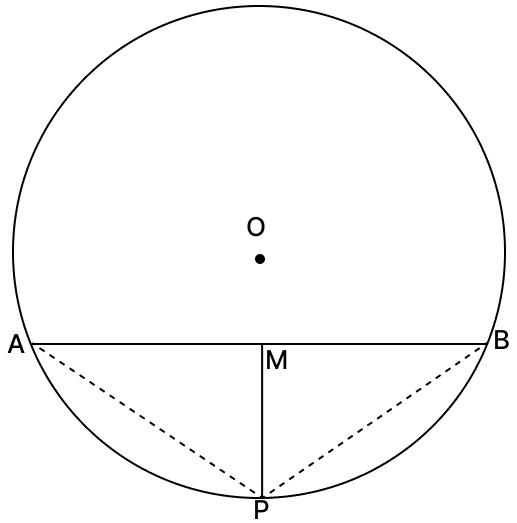
(i) Given,
P is the mid-point of arc APB.
Thus, arc AP = arc PB.
We know that,
Equal arcs subtends equal chords.
Thus,
chord AP = chord PB.
In triangle APB,
AP = PB
Thus, APB is an isosceles triangle.
In an isosceles triangle the median drawn from common vertex to opposite side is also perpendicular.
Thus, PM ⊥ AB.
Hence, proved that PM ⟂ AB.
(ii) The perpendicular bisector of any chord of a circle passes through the centre.
Hence, proved that PM produced will pass through the centre O.
(iii) A line through the centre and the mid-point of a chord will also bisect the corresponding arc.
Since, M is the mid-point of chord AB and PM passes through center O.
Hence, proved that PM produced will bisect the major arc AB.
Prove that in a cyclic trapezium, the non-parallel sides are equal.
Answer
Let ABCD be the cyclic trapezium in which AB || DC, AC and BD are the diagonals.
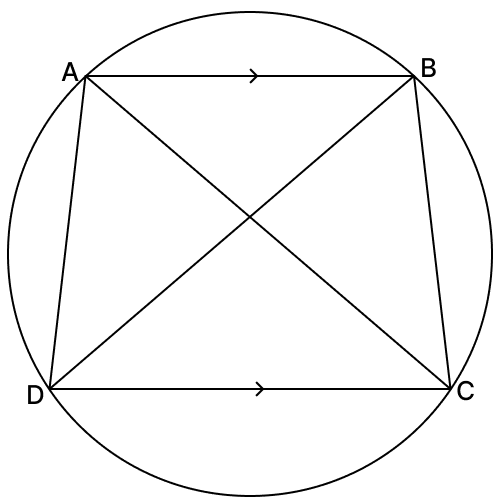
It's seen that chord AD subtends ∠ABD and chord BC subtends ∠BDC at the circumference of the circle.
But, ∠ABD = ∠BDC [Alternate angles are equal]
∴ Chord AD must be equal to chord BC [As equal chord subtends equal angles at circumference]
⇒ AD = BC.
Hence, proved that in a cyclic trapezium, the non-parallel sides are equal.
If P is a point on a circle with centre O. If P is equidistant from the two radii OA and OB, prove that arc AP = arc PB.
Answer
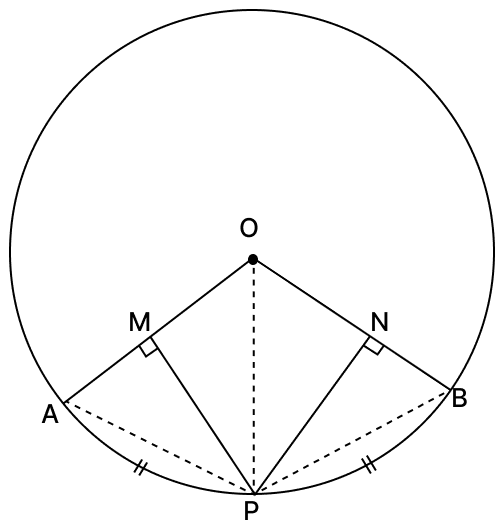
In △ OMP and △ ONP,
⇒ ∠OMP = ∠ONP = 90°
⇒ OP = OP (Hypotenuse)
⇒ PM = PN (Given)
∴ △ OMP ≅ △ ONP
Since, the triangles are congruent, their corresponding parts are equal.
∠MOP = ∠NOP
∠AOP = ∠BOP
Equal angles at the centre of a circle subtend equal arcs.
∴ arc AP = arc PB.
Hence, proved that arc AP = arc PB.
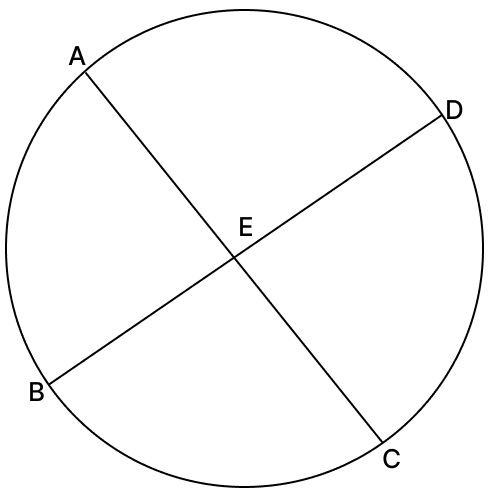
In the given figure, two chords AC and BD of a circle intersect at E. If arc AB = CD, prove that : BE = EC and AE = ED.
Answer
Join AB and CD.
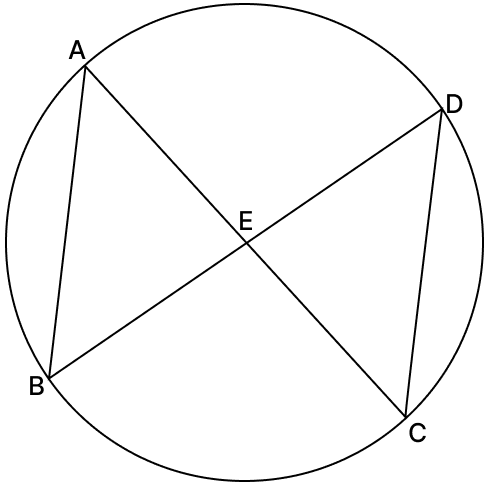
Given, arc AB = arc CD.
Since, equal arcs subtend equal chords.
⇒ chord AB = chord CD
In △ AEB and △ DEC,
⇒ AB = CD (Proved above)
⇒ ∠BAE = ∠CDE (Angles in the same segment subtended by arc BC)
⇒ ∠ABE = ∠DCE (Angles in the same segment subtended by arc AD).
By ASA Congruence,
∴ △ AEB ≅ △ DEC
Since corresponding parts of congruent triangles are equal.
⇒ BE = EC and AE = ED.
Hence, proved that BE = EC and AE = ED.
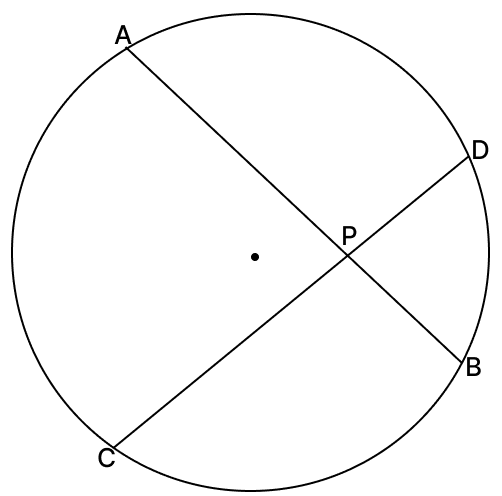
In the given figure, two chords AB and CD of a circle intersect at a point P.
If AB = CD, prove that: arc AD = arc CB.
Answer
In a circle, if two chords are equal, then their corresponding arcs are also equal.
Given,
⇒ chord AB = chord CD
⇒ arc AB = arc CD
From figure,
⇒ Minor arc AB = Minor arc CD
⇒ Minor arc AB - Minor arc BD = Minor arc CD - Minor arc BD
⇒ Minor arc AD = Minor arc CB
⇒ arc AD = arc CB.
Hence, proved that arc AD = arc CB.
If two sides of a cyclic quadrilateral are parallel, prove that:
(i) its other two sides are equal,
(ii) its diagonals are equal.
Answer
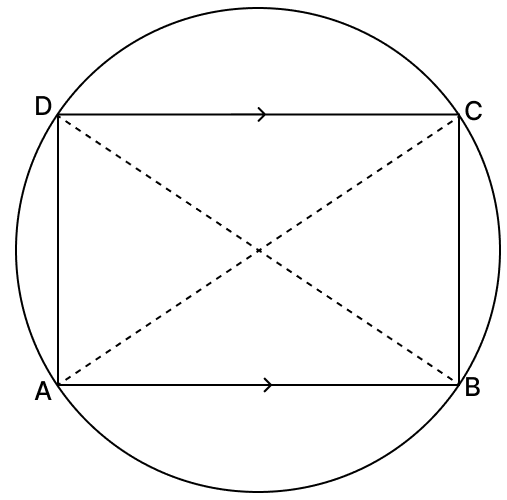
(i) Let ABCD be a cyclic quadrilateral in which AB || DC. AC and BD are its diagonals.
As, AB || DC (given)
∠DCA = ∠CAB [Alternate angles are equal]
Chord AD subtends ∠DCA and chord BC subtends ∠CAB at the circumference of the circle.
We know that,
Equal chords subtend equal angles at the circumference of a circle.
∴ chord AD = chord BC or AD = BC.
Hence, proved that AD = BC.
(ii) From figure,
⇒ ∠A + ∠C = 180° [As, sum of opposite angles in a cyclic quadrilateral = 180°]
Also,
⇒ ∠B + ∠C = 180° [Sum of co-interior angles = 180° (As, AB || CD)]
∴ ∠B + ∠C = ∠A + ∠C
⇒ ∠B = ∠A
In △ ACB and △ BDA,
⇒ AB = AB [Common side]
⇒ ∠B = ∠A [Proved above]
⇒ BC = AD [Proved above]
Hence, by SAS criterion of congruence.
△ ACB ≅ △ BDA
∴ AC = BD [By C.P.C.T.]
Hence, proved that diagonals are equal.
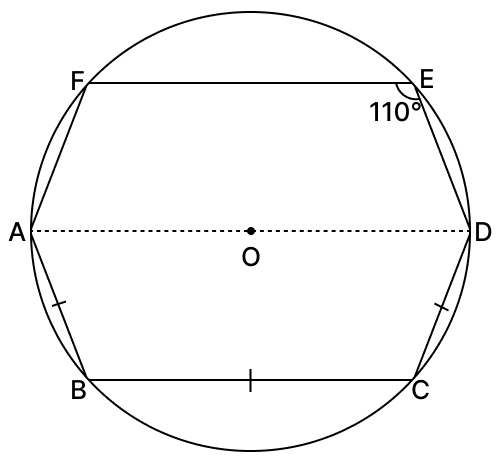
In the given figure, AB, BC and CD are equal chords of a circle with centre O and AD is a diameter. If ∠DEF = 110°, find :
(i) ∠AEF
(ii) ∠FAB
Answer
Join AE, OB and OC.
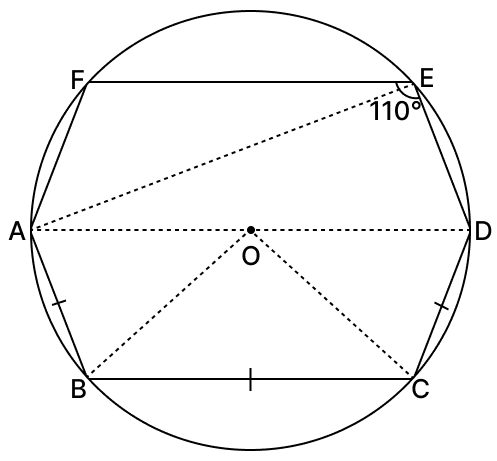
(i) As AOD is the diameter.
∠AED = 90° [Angle in a semi-circle is a right angle]
But, given ∠DEF = 110°
So,
∠AEF = ∠DEF - ∠AED = 110° - 90° = 20°.
Hence, ∠AEF = 20°.
(ii) Also given, Chord AB = Chord BC = Chord CD
So,
∠AOB = ∠BOC = ∠COD [Equal chords subtends equal angles at the centre]
From figure,
⇒ ∠AOB + ∠BOC + ∠COD = 180° [AOD is a straight line]
⇒ ∠AOB = ∠BOC = ∠COD = = 60°
Now, in △ OAB we have,
OA = OB [Radii of same circle]
So, ∠OAB = ∠OBA [Angles opposite to equal sides are equal]
In △ OAB,
⇒ ∠OAB + ∠OBA + ∠AOB = 180° [By angle sum property of triangle]
⇒ ∠OAB + ∠OBA + 60° = 180°
⇒ ∠OAB + ∠OBA = 180° - 60° = 120°.
Since, ∠OAB = ∠OBA
∴ ∠OAB = ∠OBA = = 60°.
Now, in cyclic quadrilateral ADEF,
⇒ ∠DEF + ∠DAF = 180° [As sum of opposite angles in cyclic quadrilateral = 180°]
⇒ ∠DAF = 180° - ∠DEF
⇒ ∠DAF = 180° - 110° = 70°.
From figure,
∠FAB = ∠DAF + ∠OAB = 70° + 60° = 130°.
Hence, ∠FAB = 130°.
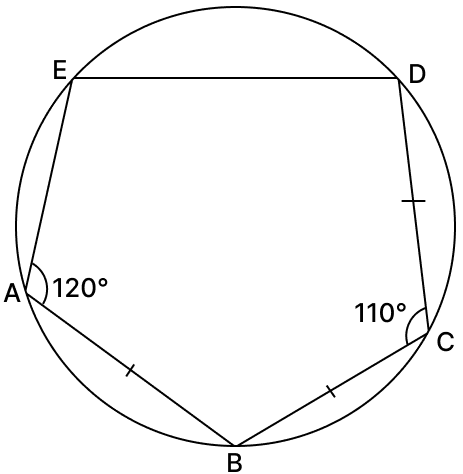
In the given figure, ABCDE is a pentagon inscribed in a circle. If AB = BC = CD, ∠BCD = 110° and ∠BAE = 120°, find :
(i) ∠ABC
(ii) ∠CDE
(iii) ∠AED
(iv) ∠EAD
Answer
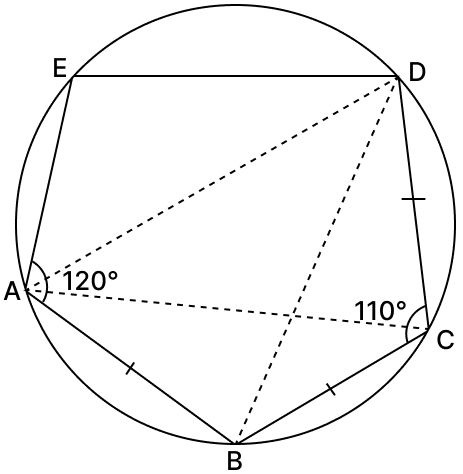
Join AD, AC and BD.
We know that,
In the same circle, equal chords cut off equal arcs.
Since, chord AB = chord CD
Thus, arc AB = arc CD.
We know that,
Equal chords subtend equal angles at the circumference of the same circle.
Thus,
∠ACB = ∠DAC
Since, these are alternate angles as well thus, AD must be parallel to BC.
Since, in quadrilateral ABCD, AD // BC and non parallel sides AB = DC.
Thus, ABCD is an isosceles trapezium.
In an isosceles trapezium,
Base angles are equal.
Thus, ∠ABC = ∠BCD = 110°.
ABCD is a cyclic quadrilateral.
⇒ ∠BCD + ∠BAD = 180° (Sum of opposite angles = 180°)
⇒ 110° + ∠BAD = 180°
⇒ ∠BAD = 180° - 110°
⇒ ∠BAD = 70°.
Given, ∠BAE = 120°
From figure,
⇒ ∠EAD = ∠BAE - ∠BAD = 120° - 70° = 50°.
In triangle ABC,
AB = BC
⇒ ∠BAC = ∠BCA = x (let) (Angles opposite to equal sides are equal)
By angle sum property of triangle,
⇒ ∠ABC + ∠BAC + ∠BCA = 180°
⇒ 110° + x + x = 180°
⇒ 2x = 180° - 110°
⇒ 2x = 70°
⇒ x = 35°.
Thus, ∠BAC = 35°.
Since, equal chords subtends equal angles at the circumference of the same circle.
Since, chord BC = chord CD. Thus,
∠CBD = ∠BAC = 35°.
Also,
∠CBD = ∠ADB = 35° (Alternate angles are equal)
In triangle ABD,
⇒ ∠ABD + ∠ADB + ∠BAD = 180°
⇒ ∠ABD + 35° + 70° = 180°
⇒ ∠ABD + 105° = 180°
⇒ ∠ABD = 180° - 105° = 75°.
In cyclic quadrilateral ABDE,
⇒ ∠ABD + ∠AED = 180° (Sum of opposite angles = 180°)
⇒ 75° + ∠AED = 180°
⇒ ∠AED = 180° - 75° = 105°.
In triangle CBD,
BC = CD
⇒ ∠CDB = ∠CBD = 35° (Angles opposite to equal sides are equal)
In cyclic quadrilateral ABDE,
⇒ ∠BAE + ∠BDE = 180° (Sum of opposite angles = 180°)
⇒ 120° + ∠BDE = 180°
⇒ ∠BDE = 180° - 120° = 60°.
From figure,
∠CDE = ∠CDB + ∠BDE = 35° + 60° = 95°.
(i) Hence, ∠ABC = 110°.
(ii) Hence, ∠CDE = 95°.
(iii) Hence, ∠AED = 105°.
(iv) Hence, ∠EAD = 50°.
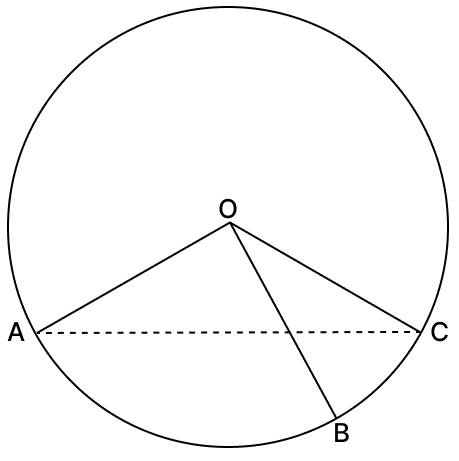
In the given figure, arc AB = twice arc BC and ∠AOB = 80°. Find:
(i) ∠BOC
(ii) ∠OAC
Answer
(i) We know that,
Ratio of the angles subtended by the chords on the center is equal to the ratio of the chords.
Hence, ∠BOC = 40°.
(ii) Join AC.
From figure,
⇒ ∠AOC = ∠AOB + ∠BOC = 80° + 40° = 120°.
In △ OAC,
⇒ OA = OC (Radius of same circle)
⇒ ∠OCA = ∠OAC = x (let) [Angle opposite to equal sides are equal]
By angle sum property of triangle,
⇒ ∠OAC + ∠OCA + ∠AOC = 180°
⇒ x + x + 120° = 180°
⇒ 2x + 120° = 180°
⇒ 2x = 180° - 120°
⇒ 2x = 60°
⇒ x =
⇒ x = 30°
⇒ ∠OAC = 30°.
Hence, ∠OAC = 30°.