
The lengths of the sides of some triangles in some unit are given below. Which of them is a right-angled triangle?
7, 9, 13
10, 24, 26
6, 8, 12
8, 12, 16
Answer
Choose the greatest length. Check whether the square of greatest length is equal to the sum of squares of other two lengths.
10, 24, 26
Here greatest length is 26 cm and other lengths are 24 cm, 10 cm.
Note that 262 = 676 and 242 + 102 = 576 + 100 = 676.
Thus, 262 = 242 + 102.
Thus, triangle with sides 10, 24, 26 form a right-angled triangle.
Hence, option 2 is the correct option.
In △ABC, ∠B is a right angle. If D is the foot of the perpendicular drawn from B on AC, then:
BC2 + CD2 = AC2
AB2 - BC2 = AD2 - CD2
BC2 - BD2 = AB2 - AD2
None of these.
Answer
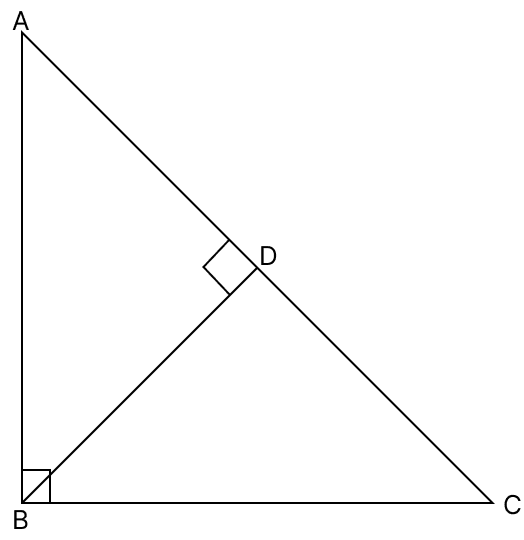
In △ ADB,
Using Pythagoras theorem,
Hypotenuse2 = Base2 + Height2
⇒ AB2 = BD2 + AD2
⇒ BD2 = AB2 - AD2 .....(1)
In △ BDC,
Using Pythagoras theorem,
⇒ BC2 = BD2 + CD2
⇒ BD2 = BC2 - CD2 ......(2)
Equating eq.(1) and (2), we get:
⇒ AB2 - AD2 = BC2 - CD2
⇒ AB2 - BC2 = AD2 - CD2.
Hence, option 2 is the correct option.
In the adjoining figure, CD =
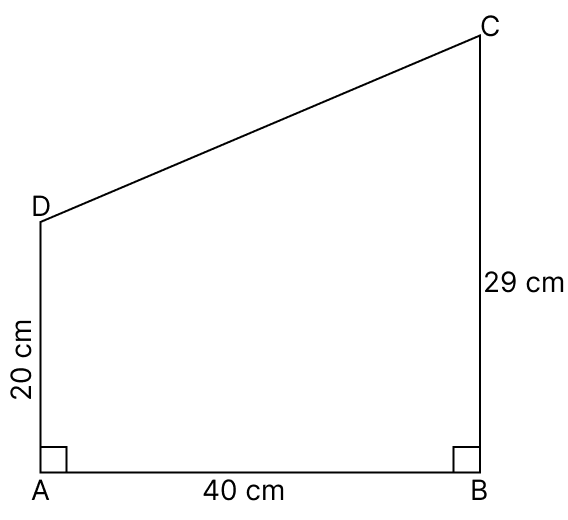
36 cm
40 cm
41 cm
None of these
Answer
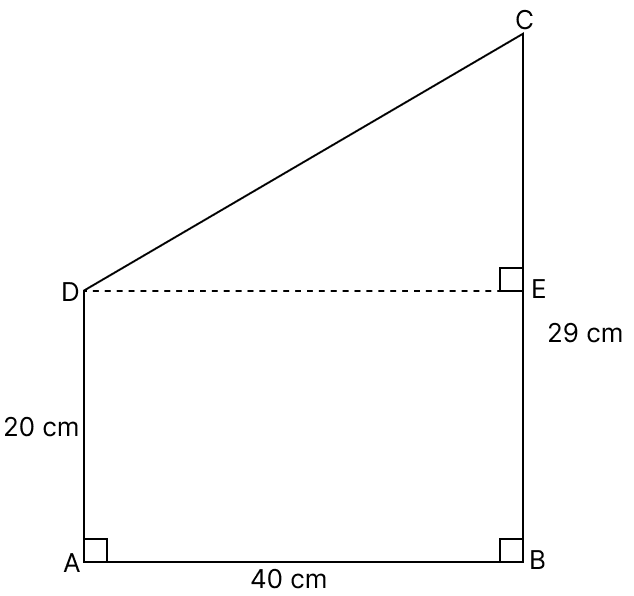
From figure,
⇒ BE = AD = 20 cm and AB = DE = 40 cm
⇒ CE = BC - BE
⇒ CE = 29 - 20
⇒ CE = 9 cm
From figure,
△ CDE is right angled triangle.
By pythagoras theorem,
Hypotenuse2 = Base2 + Height2
⇒ CD2 = DE2 + CE2
⇒ CD2 = 402 + 92
⇒ CD2 = 1600 + 81
⇒ CD2 = 1681
⇒ CD =
⇒ CD = 41 cm.
Hence, option 3 is the correct option.
In the adjoining figure, AC =
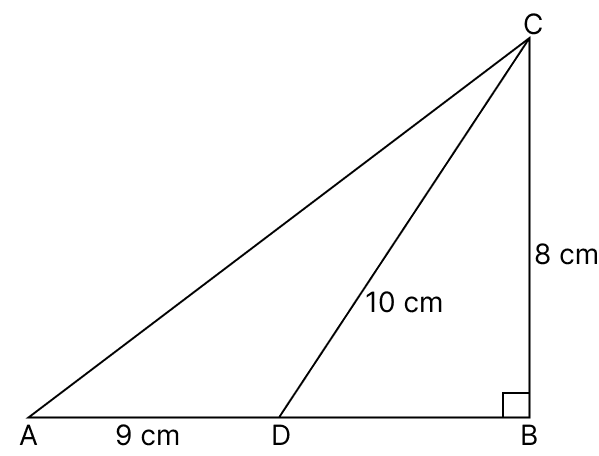
17 cm
20 cm
22 cm
24 cm
Answer
In △ BCD,
By pythagoras theorem,
Hypotenuse2 = Base2 + Height2
⇒ CD2 = BD2 + BC2
⇒ 102 = BD2 + 82
⇒ 100 = BD2 + 64
⇒ BD2 = 100 - 64
⇒ BD2 = 36
⇒ BD =
⇒ BD = 6 cm
From figure,
AB = AD + BD = 9 + 6 = 15 cm
In △ ABC,
Using pythagoras theorem,
⇒ AC2 = AB2 + BC2
⇒ AC2 = 152 + 82
⇒ AC2 = 225 + 64
⇒ AC2 = 289
⇒ AC =
⇒ AC = 17 cm
Hence, option 1 is the correct option.
The lengths of the diagonals of a rhombus are 5 cm and 12 cm. The length of each side of the rhombus is:
13 cm
6.5 cm
6.25 cm
5.25 cm
Answer
Let AC = 5 cm and BD = 12 cm.
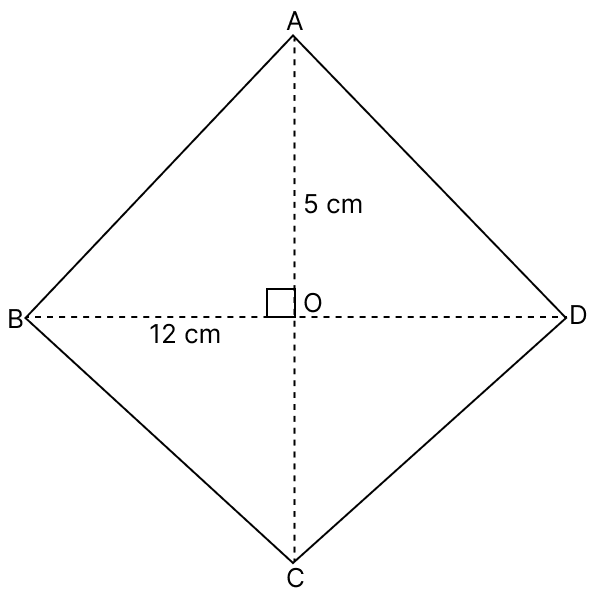
We know that,
Diagonals of rhombus are perpendicular and bisect each other,
OB = BD = 6 cm and AO = AC = 2.5 cm.
In right triangle AOB,
By pythagoras theorem we get,
Hypotenuse2 = Base2 + Height2
⇒ AB2 = AO2 + OB2
⇒ AB2 = (2.5)2 + 62
⇒ AB2 = 6.25 + 36
⇒ AB2 = 42.25
⇒ AB = = 6.5 cm.
∴ The length of each side of the rhombus is 6.5 cm.
Hence, option 2 is the correct option.
The diagonals AC and BD of a rhombus ABCD are of lengths 6 cm and 8 cm. The length of each side of the rhombus is :
3 cm
5 cm
7 cm
9 cm
Answer
Let AC = 6 cm and BD = 8 cm.
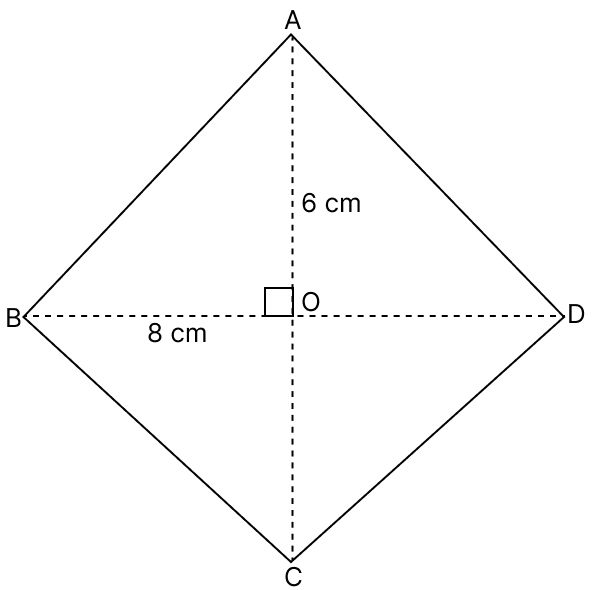
We know that,
Diagonals of rhombus are perpendicular and bisect each other,
OB = BD = 4 cm and AO = AC = 3 cm.
In right triangle AOB,
By pythagoras theorem we get,
Hypotenuse2 = Base2 + Height2
⇒ AB2 = AO2 + OB2
⇒ AB2 = 32 + 42
⇒ AB2 = 9 + 16
⇒ AB2 = 25
⇒ AB = = 5 cm.
∴ The length of each side of the rhombus is 5 cm.
Hence, option 2 is the correct option.
The lengths of the adjacent sides of the right angle of a right-angled triangle are (x - 2) cm and cm. If the length of the hypotenuse is 3 cm, then the value of x is :
1
2
3
4
Answer
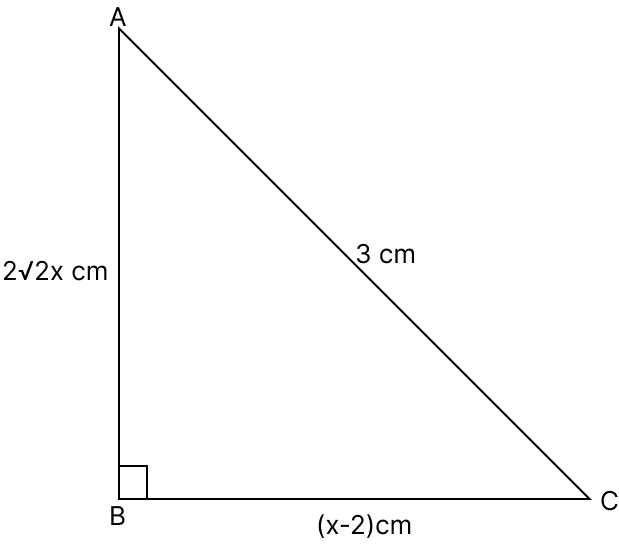
In right triangle ABC,
By pythagoras theorem we get,
Hypotenuse2 = Base2 + Height2
⇒ AC2 = BC2 + AB2
⇒ 32 = (x - 2)2 +
⇒ 9 = x2 + 4 - 4x + 4 × 2 x2
⇒ 9 = x2 + 4 - 4x + 8x2
⇒ 9x2 - 4x + 4 - 9 = 0
⇒ 9x2 - 4x - 5 = 0
⇒ 9x2 - 9x + 5x - 5 = 0
⇒ 9x(x - 1) + 5(x - 1) = 0
⇒ (9x + 5) = 0 or (x - 1) = 0
⇒ x = - or x = 1
Since, length cannot be negative.
⇒ x = 1 cm.
Hence, option 1 is the correct option.
The altitude of the equilateral triangle of side a units is :
units
units
units
units
Answer
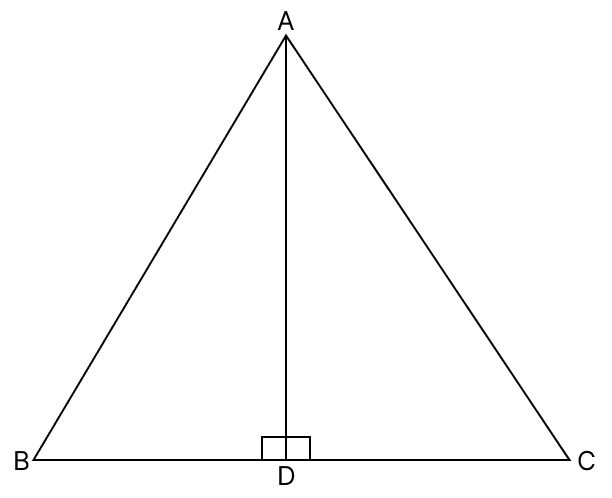
In △ ABC,
AB = BC = AC = a units
Draw altitude AD perpendicular to BC.
In an equilateral triangle, the altitude also acts as the median (bisecting the base).
∴ BD =
In right angled △ABD,
Using Pythagoras theorem,
Hypotenuse2 = Perpendicular2 + Base2
⇒ AB2 = AD2 + BD2
Hence, option 1 is the correct option.
ABD is a right-angled triangle, whose ∠D is the right angle. C is any point on the side BD. If AB = 8 cm, BC = 6 cm and AC = 3 cm, then the length of CD is :
cm
cm
cm
cm
Answer
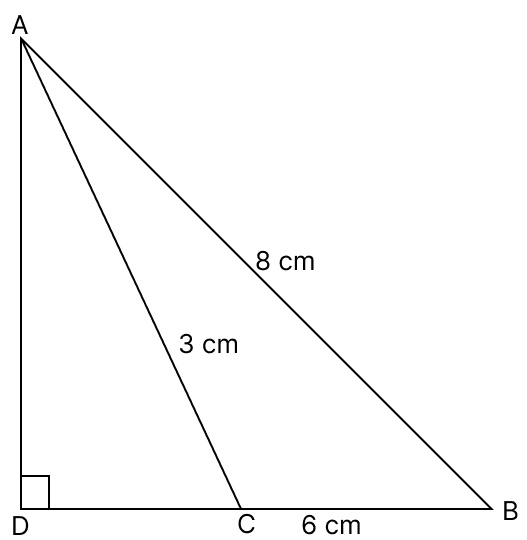
Let CD = x cm
BD = BC + CD = (6 + x) cm
In △ ABD, using Pythagorean theorem,
Hypotenuse2 = Base2 + Height2
⇒ AB2 = BD2 + AD2
⇒ 82 = (6 + x)2 + AD2
⇒ 64 - (6 + x)2 = AD2
⇒ AD2 = 64 - (6 + x)2
⇒ AD2 = 64 - (36 + x2 + 12x)
⇒ AD2 = 64 - 36 - x2 - 12x
⇒ AD2 = 28 - x2 - 12x .....(1)
In △ ADC, using Pythagorean theorem,
⇒ AC2 = CD2 + AD2
⇒ 32 = x2 + AD2
⇒ 9 = x2 + AD2
⇒ AD2 = 9 - x2 .....(2)
From eq.(1) and (2), we have :
⇒ 9 - x2 = 28 - x2 - 12x
⇒ 9 = 28 - 12x
⇒ 12x = 28 - 9
⇒ 12x = 19
⇒ x =
⇒ x = cm.
Hence, option 1 is the correct option.
There are two buildings in two sides of a road. Keeping the foot of a ladder fixed at a point on the road, when it is placed on two buildings, then its top touches the buidings respectively at a height of 48 ft and 14 ft. If the length of the ladder is 50 ft, then the width of the road is :
56 ft
62 ft
66 ft
70 ft
Answer
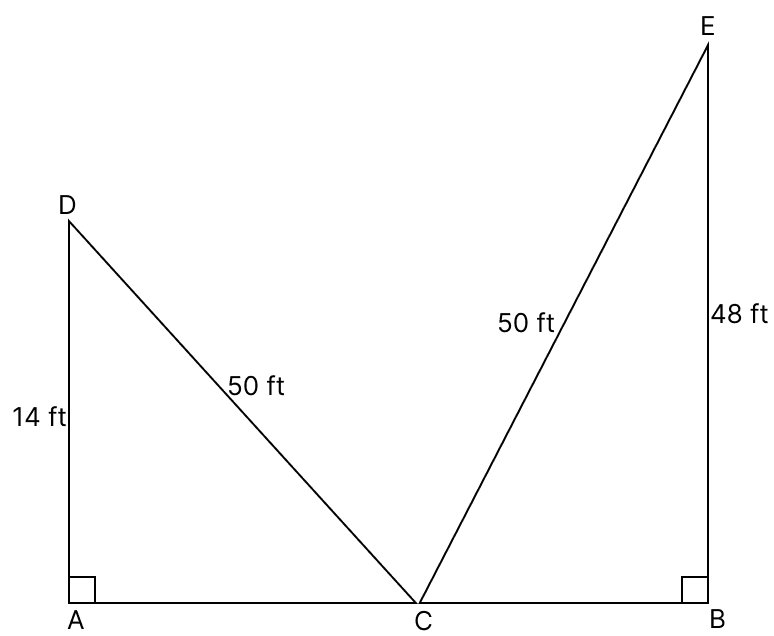
Let width of the street be AB = AC + BC
Let CD and CE be the ladder at different positions.
By Pythagoras theorem,
Hypotenuse2 = Perpendicular2 + Base2
In triangle ADC,
⇒ CD2 = AD2 + AC2
⇒ 502 = 142 + AC2
⇒ 2500 = 196 + AC2
⇒ AC2 = 2500 - 196
⇒ AC2 = 2304
⇒ AC =
⇒ AC = 48 ft
In triangle BCE,
⇒ CE2 = BE2 + BC2
⇒ 502 = 482 + BC2
⇒ 2500 = 2304 + BC2
⇒ BC2 = 2500 - 2304
⇒ BC2 = 196
⇒ BC =
⇒ BC = 14 ft
AB = AC + BC = 48 + 14 = 62 ft.
Hence, option 2 is the correct option.