
In a △ABC, AB = AC and ∠B = 50°. Then ∠A =
50°
80°
100°
105°
Answer
In △ABC,
AB = AC
⇒ ∠B = ∠C = 50° (Angles opposite to equal sides in a triangle are equal)
By angle sum property of triangle,
⇒ ∠A + ∠B + ∠C = 180°
⇒ ∠A + 50° + 50° = 180°
⇒ ∠A + 100° = 180°
⇒ ∠A = 180° - 100°
⇒ ∠A = 80°.
Hence, option 2 is the correct option.
In a △PQR, ∠Q = 50°, ∠R = 65° and QR = 4 cm. Then PQ =
6 cm
5 cm
4 cm
3 cm
Answer
In △PQR,
By angle sum property of triangle,
⇒ ∠P + ∠Q + ∠R = 180°
⇒ ∠P + 50° + 65° = 180°
⇒ ∠P + 115° = 180°
⇒ ∠P = 180° - 115°
⇒ ∠P = 65°
Since, ∠P = ∠R = 65°
⇒ PQ = QR = 4 cm (Sides opposite to equal angles in a triangle are equal)
Hence, option 3 is the correct option.
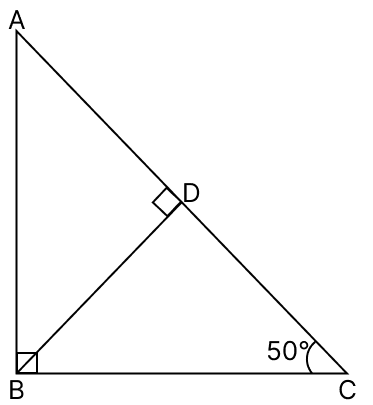
In the adjoining figure, ∠ABC = 90°, ∠BCA = 50° and BD ⊥ AC. Then ∠ABD =
30°
40°
50°
60°
Answer
In △ABC,
By angle sum property of triangle,
⇒ ∠A + ∠B + ∠C = 180°
⇒ ∠A + 90° + 50° = 180°
⇒ ∠A + 140° = 180°
⇒ ∠A = 180° - 140°
⇒ ∠A = 40°.
In △ABD,
By angle sum property of triangle,
⇒ ∠A + ∠ABD + ∠D = 180°
⇒ 40° + ∠ABD + 90° = 180°
⇒ ∠ABD + 130° = 180°
⇒ ∠ABD = 180° - 130°
⇒ ∠ABD = 50°.
Hence, option 3 is the correct option.
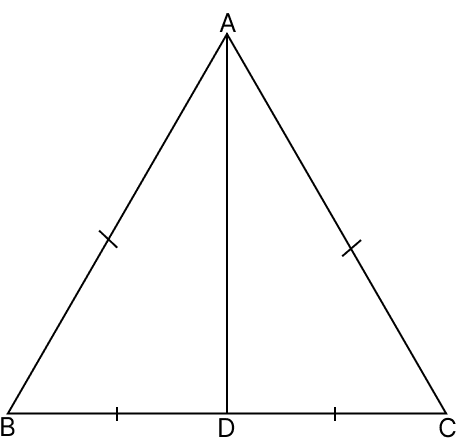
In the adjoining figure, AB = AC and BD = CD. Then, ∠ADC =
60°
75°
90°
100°
Answer
In △ABD and △ACD,
⇒ AD = AD (Common side)
⇒ BD = CD (Given)
⇒ AB = AC (Given)
∴ △ABD ≅ △ACD (By S.S.S axiom)
⇒ ∠ADB = ∠ADC = x (let) (Corresponding parts of congruent triangles are equal)
From figure,
⇒ ∠ADB + ∠ADC = 180° (Linear pair)
⇒ x + x = 180°
⇒ 2x = 180°
⇒ x =
⇒ x = 90°
⇒ ∠ADB = ∠ADC = 90°.
Hence, option 3 is the correct option.
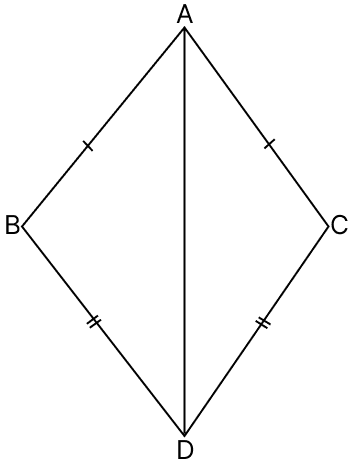
In the adjoining figure, AB = AC, BD = CD, ∠BAD = 32°, ∠BDC = 56°, ∠CAD = 2x° and ∠BDA = (x + y)°. The values of x and y will be :
x = 10, y = 16
x = 16, y = 12
x = 18, y = 8
x = 12, y = 16
Answer
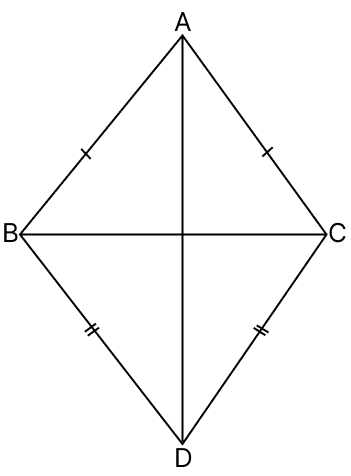
Join BC.
In △BDC,
BD = DC
∠DBC = ∠DCB = a (let)
∴ ∠DBC + ∠DCB + ∠BDC = 180°
⇒ a + a + 56° = 180°
⇒ 2a = 180° - 56°
⇒ 2a = 124°
⇒ a =
⇒ a = 62°
⇒ ∠DBC = ∠DCB = 62°
In △ABC,
AB = AC
∠ABC = ∠ACB
∠ABD = ∠ABC + ∠DBC ....(1)
∠ACD = ∠ACB + ∠DCB
⇒ ∠ACD = ∠ABC + ∠DBC ....(2)
From eq.(1) and (2), we have :
⇒ ∠ABD = ∠ACD
In △ABC,
∴ ∠A + ∠ABC + ∠ACB = 180°
⇒ ∠BAD + ∠CAD + ∠ABC + ∠ABC = 180°
⇒ 32° + 2x° + 2∠ABC = 180°
⇒ 2∠ABC = 180° - 32° - 2x°
⇒ 2∠ABC = 148° - 2x°
⇒ ∠ABC = 74° - x°
Substituting value of ∠ABC in eq.(1):
⇒ ∠ABD = ∠ABC + ∠DBC
⇒ ∠ABD = 74° - x° + 62°
⇒ ∠ABD = 136° - x°
In △ABD,
⇒ ∠ABD + ∠BAD + ∠BDA = 180°
⇒ 136° - x° + 32° + x° + y° = 180°
⇒ 168° + y° = 180°
⇒ y° = 180° - 168°
⇒ y° = 12°
⇒ y = 12.
In an isosceles triangle BDC,
BD = CD
We know that,
Perpendicular drawn from the vertex of an isosceles triangle bisects the base.
⇒ ∠DOB = ∠DOC = 90°
In △DOB,
⇒ ∠DBO + ∠DOB + ∠BDO = 180°
⇒ 62° + 90° + x° + y° = 180°
⇒ 152° + x° + 12° = 180°
⇒ 164° + x° = 180°
⇒ x° = 180° - 164°
⇒ x° = 16°
⇒ x = 16.
Hence, option 2 is the correct option.
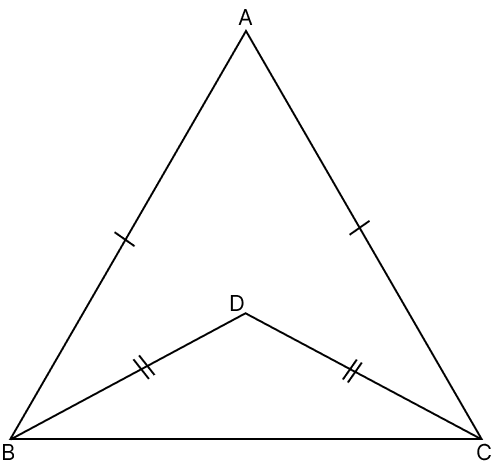
In the figure, AB = AC and DB = DC. ∠ABD : ∠ACD is :
1 : 2
2 : 1
1 : 1
1 : 3
Answer
In △ABC,
AB = AC
⇒ ∠B = ∠C = x ....(1) (let) (Angles opposite to equal sides in a triangle are equal)
In △BDC,
BD = CD
⇒ ∠DBC = ∠DCB = y ....(2) (let) (Angles opposite to equal sides in a triangle are equal)
Subtracting eq.(2) from (1), we have :
⇒ ∠B - ∠DBC = ∠C - ∠DCB
⇒ ∠ABD = ∠ACD
⇒ ∠ABD : ∠ACD = 1 : 1.
Hence, option 3 is the correct option.
In right triangles ABC and DEF, if hypotenuse AB = EF and side AC = DE, then △ABC is congruent to:
△FED
△EFD
△DEF
△FDE
Answer
In △ABC and △EFD,
⇒ AB = EF (Given)
⇒ AC = DE (Given)
⇒ ∠C = ∠D (Both equal to 90°)
∴ △ABC ≅ △EFD (By R.H.S axiom)
Hence, option 2 is the correct option.
ABC is a right angled triangle whose hypotenuse is AC. If AB : BC = 3 : 4, then the smallest angle of the triangle is :
∠A
∠B
∠C
None of these
Answer
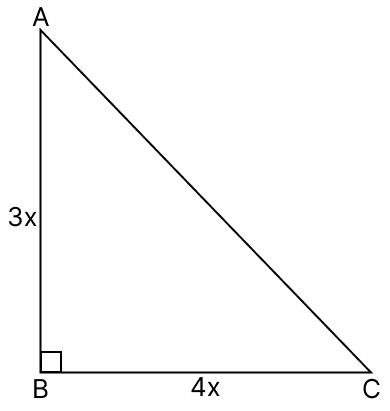
In △ABC,
Given,
AB : BC = 3 : 4
Let, AB = 3x and BC = 4x
By pythagoras theorem,
⇒ AC2 = AB2 + BC2
⇒ AC2 = (3x)2 + (4x)2
⇒ AC2 = 9x2 + 16x2
⇒ AC2 = 25x2
⇒ AC =
⇒ AC = 5x.
We know that,
The shortest angle of a triangle has the shortest side opposite to it.
Since, side AB is shortest, thus ∠C is the shortest angle.
Hence, option 3 is the correct option.
If a, b, c be the lengths of the sides of a triangle, then :
a = b + c
a < b + c
a > b + c
a < b - c
Answer
We know that,
The sum of lengths of any two sides of a triangle must be greater than the third side.
⇒ a < b + c
Hence, option 2 is the correct option.
In a △ABC, AB > BC > CA. Then :
AB - BC < CA
AB - BC > CA
AB + BC < CA
None of these
Answer
We know that,
Difference between any two sides of a triangle must be less than the third side.
In △ABC,
AB - BC < CA
Hence, option 1 is the correct option.
In a △ABC, ∠A = 40° and ∠B = 60°. The longest side of the triangle is:
AB
BC
CA
None of these
Answer
In △ABC,
By angle sum property of triangle,
⇒ ∠A + ∠B + ∠C = 180°
⇒ 40° + 60° + ∠C = 180°
⇒ ∠C + 100° = 180°
⇒ ∠C = 180° - 100°
⇒ ∠C = 80°
We know that,
The longest side of a triangle has the largest angle opposite to it.
Since, angle C is the greatest, thus AB is longest side of the triangle.
Hence, option 1 is the correct option.
In a △ABC, AB = 6 cm, BC = 7 cm and CA = 8 cm. The smallest angle of the triangle is :
∠A
∠B
∠C
None of these
Answer
We know that,
The smallest angle of a triangle has the smallest side opposite to it.
Since, AB is the smallest side thus ∠C is the smallest angle of the triangle.
Hence, option 3 is the correct option.
In a △ABC, 2∠A = 3∠B and ∠C = 100°. The correct ascending order of sides of the triangle is :
AC < BC < AB
BC < AC < AB
AB < AC < AB
BC < AB < AC
Answer
Given,
2∠A = 3∠B
⇒ ∠A : ∠B = 3 : 2
⇒ ∠A = 3x° and ∠B = 2x°
In △ABC,
By angle sum property of triangle,
⇒ ∠A + ∠B + ∠C = 180°
⇒ 3x° + 2x° + 100° = 180°
⇒ 5x° = 180° - 100°
⇒ 5x° = 80°
⇒ x° =
⇒ x° = 16°
⇒ ∠A = 3x° = 3 × 16° = 48°
⇒ ∠B = 2x° = 2 × 16° = 32°
We know that,
The longest side of a triangle has the largest angle opposite to it.
Since, C is the largest angle, thus AB is longest side of the triangle.
The shortest side of a triangle has the smallest angle opposite to it.
Since, B is the smallest angle, thus AC is smallest side of the triangle.
∴ AC < BC < AB.
Hence, option 1 is the correct option.
The angles of a triangle are 5(x - 4)°, (4x + 5)° and (x + 25)°, then the value of x is :
17
18
19
21
Answer
By angle sum property of triangle,
⇒ 5(x - 4)° + (4x + 5)° + (x + 25)° = 180°
⇒ 5x° - 20° + 4x° + 5° + x° + 25° = 180°
⇒ 10x° + 10° = 180°
⇒ 10x° = 180° - 10°
⇒ 10x° = 170°
⇒ x° =
⇒ x° = 17°
⇒ x = 17.
Hence, option 1 is the correct option.
In △ABC, AB > AC and D is any point on BC, then, AB is :
< DC
< AD
= BC
> AD
Answer
In △ABC,
We know that,
The larger angle of a triangle has the longer side opposite to it.
⇒ AB > AC
⇒ ∠ACB > ∠ABC ....(1)
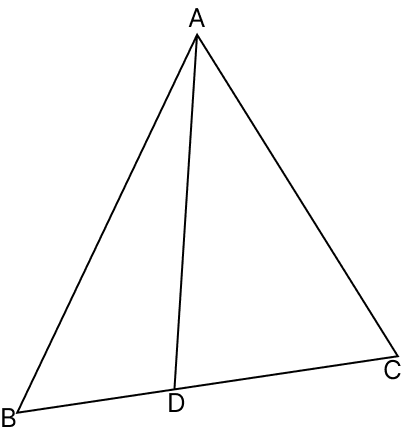
From figure,
⇒ ∠ADB > ∠ACD (exterior angle of a triangle is greater than interior opposite angle)
⇒ ∠ADB > ∠ACB ....(2)
From eq.(1) and (2), we have:
⇒ ∠ADB > ∠ABC
⇒ ∠ADB > ∠ABD
⇒ AB > AD (larger angle of a triangle has the larger side opposite to it).
Hence, option 4 is the correct option.