
In a △PQR, ∠P = 50° and ∠R = 70°. Name :
(i) the shortest side
(ii) the longest side of the triangle
Answer
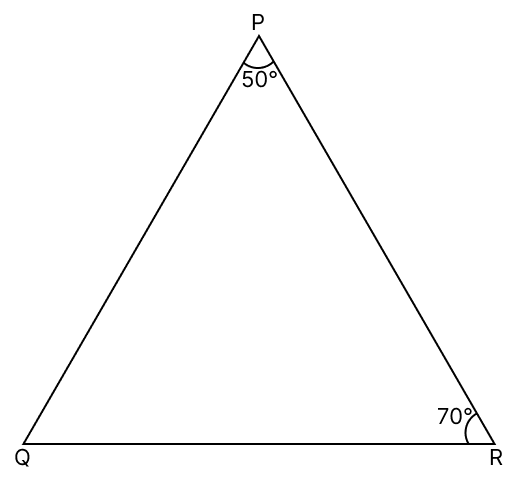
We know that,
Sum of angles of triangle = 180°
∴ ∠P + ∠Q + ∠R = 180°
⇒ 50° + ∠Q + 70° = 180°
⇒ ∠Q + 120° = 180°
⇒ ∠Q = 180° - 120°
⇒ ∠Q = 60°.
(i) We know that side opposite to the smallest angle is smallest side.
Since, P is the smallest angles,
∴ QR is shortest side of the triangle.
Hence, shortest side of the triangle PQR is QR.
(ii) We know that side opposite to the greatest angle is greatest side.
Since, R is the greatest angle,
∴ PQ is longest side of the triangle.
Hence, longest side of the triangle PQR is PQ.
In a △LMN, if ∠M = 90°, name the longest side of the triangle.
Answer
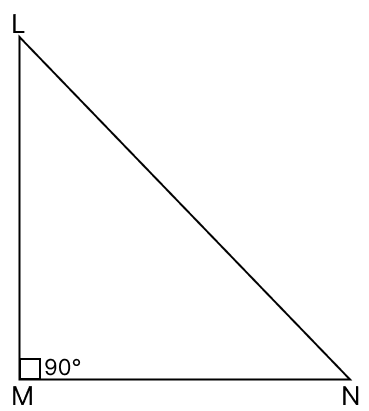
We know that,
Sum of angles of triangle = 180°
∴ ∠L + ∠M + ∠N = 180°
⇒ ∠L + 90° + ∠N = 180°
⇒ ∠L + ∠N = 180° - 90°
⇒ ∠L + ∠N = 90°
∴ ∠M > ∠L and ∠M > ∠N.
We know that side opposite to the greatest angle is greatest side.
∴ LN is longest side of the triangle.
Hence, LN is the longest side of the triangle.
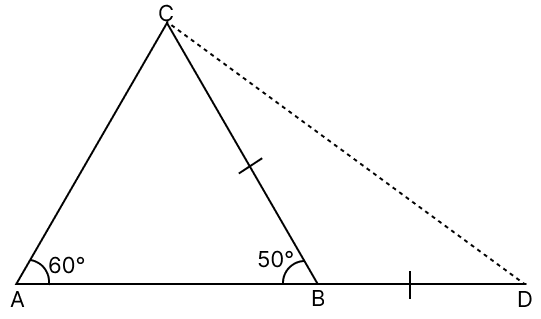
In the given figure, side AB of △ABC is produced to D such that BD = BC. If ∠A = 60° and ∠B = 50°, prove that :
(i) AD > CD
(ii) AD > AC
Answer
We know that,
Sum of angles of triangle = 180°
∴ ∠A + ∠B + ∠C = 180°
⇒ 60° + 50° + ∠C = 180°
⇒ 110° + ∠C = 180°
⇒ ∠C = 180° - 110°
⇒ ∠C = 70°.
From figure,
⇒ ∠CBD + ∠CBA = 180° (linear pair)
⇒ ∠CBD + 50° = 180°
⇒ ∠CBD = 180° - 50°
⇒ ∠CBD = 130°
In △BDC,
BD = BC
∴ ∠BDC = ∠BCD = x (let)
Sum of angles of triangle = 180°
∴ ∠BDC + ∠BCD + ∠CBD = 180°
⇒ x + x + 130° = 180°
⇒ 2x = 180° - 130°
⇒ 2x = 50°
⇒ x =
⇒ x = 25°
∴ ∠BDC = ∠BCD = 25°
From figure,
⇒ ∠ACD = ∠C + ∠BCD = 70° + 25° = 95°
(i) In △ADC,
We know that side opposite to the greatest angle is greatest side.
Since, ∠ACD is greatest,
∴ AD is longest side of the triangle.
⇒ AD > CD
Hence, proved that AD > CD.
(ii) Since, AD is greatest side of triangle ADC,
∴ AD > AC
Hence, proved that AD > AC.
In a right angled triangle, prove that the hypotenuse is the longest side.
Answer
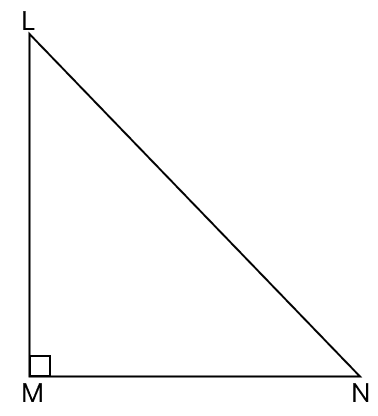
Let LMN be a right angled triangle, ∠M = 90°
We know that,
Sum of angles of triangle = 180°
∴ ∠L + ∠M + ∠N = 180°
⇒ ∠L + 90° + ∠N = 180°
⇒ ∠L + ∠N = 180° - 90°
⇒ ∠L + ∠N = 90°
∴ ∠M > ∠L and ∠M > ∠N.
We know that, side opposite to the greatest angle is longest side.
∴ Hypotenuse LN, is the longest side of the triangle.
Hence, proved that hypotenuse is the longest side of the right angled triangle.
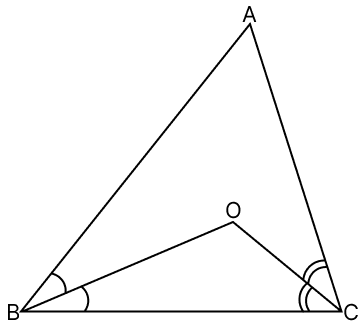
In the given figure, AB > AC. If BO and CO are the bisectors of ∠B and ∠C respectively, prove that BO > CO.
Answer
Given,
BO and CO are the bisectors of ∠B and ∠C respectively.
⇒ ∠ABO = ∠OBC and ∠ACO = ∠OCB
Given,
AB > AC
We know that angle opposite to the greater side is greater.
∴ ∠ACB > ∠ABC
⇒ ∠ACO + ∠OCB > ∠ABO + ∠OBC
⇒ ∠OCB + ∠OCB > ∠OBC + ∠OBC (∵ ∠ABO = ∠OBC and ∠ACO = ∠OCB)
⇒ 2∠OCB > 2∠OBC
⇒ ∠OCB > ∠OBC
In △BOC,
We know that side opposite to the greater angle is greater.
⇒ BO > CO.
Hence, proved that BO > CO.
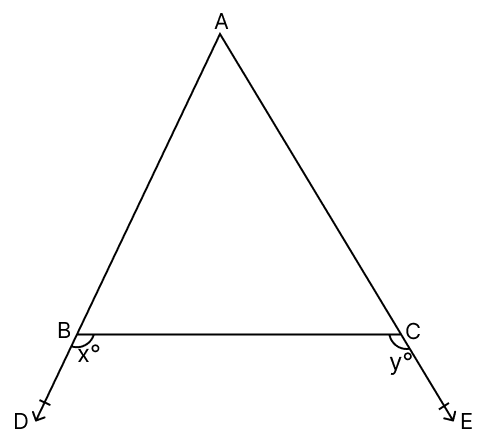
In the given figure, sides AB and AC of △ABC have been produced to D and E respectively. If ∠CBD = x° and ∠BCE = y° such that x > y, show that AB > AC.
Answer
Given,
x > y
⇒ ∠CBD > ∠BCE
⇒ 180° - ∠CBD < 180° - ∠BCE
⇒ ∠ABC < ∠ACB
⇒ AC < AB (If two angles of a triangle are unequal, the greater angle has the greater side opposite to it)
⇒ AB > AC.
Hence, proved that AB > AC.
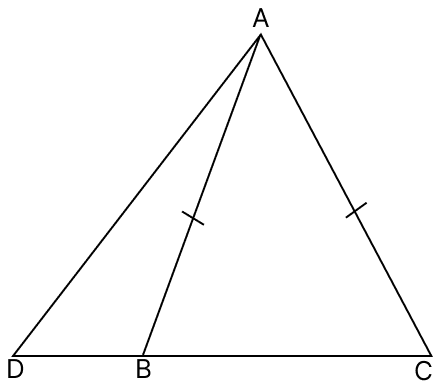
In the given figure, sides AB = AC. Show that AD > AB.
Answer
In △ABC,
⇒ ∠ABC = ∠ACB [As, AC = AB and angle opposite to equal sides are equal]
We know that,
In an isosceles triangle, the base angles are acute as only one obtuse angle can exist in a triangle.
∴ ∠ABC and ∠ACB are acute angles.
From figure,
DBC is a straight line.
⇒ ∠ABD + ∠ABC = 180° [Linear pair]
⇒ ∠ABD = 180° - ∠ABC
Since, ∠ABC is an acute angle thus, ∠ABD is an obtuse angle.
∴ In △ABD, ∠ABD is the largest angle.
∴ ∠ABD > ∠ADB
∴ AD > AB (If two angles of a triangle are unequal, the greater angle has the greater side opposite to it.)
Hence, proved that AD > AB.
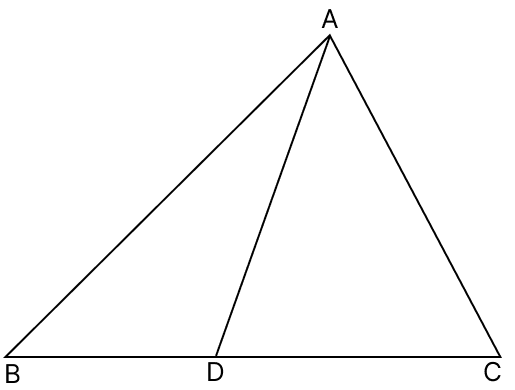
In the adjoining figure, AB > AC and D is any point on BC. Show that AB > AD
Answer
Given,
AB > AC
∴ ∠ACB > ∠ABC (As angle opposite to greater side is greater)
From figure,
∠ADB = ∠ACD + ∠DAC (As exterior angle is equal to sum of two opposite interior angles)
⇒ ∠ADB > ∠ACD
⇒ ∠ADB > ∠ACB
⇒ ∠ADB > ∠ABC [∵ ∠ACB > ∠ABC]
⇒ ∠ADB > ∠ABD
∴ AB > AD (As side opposite to greater angle is greater)
Hence, proved that AB > AD.
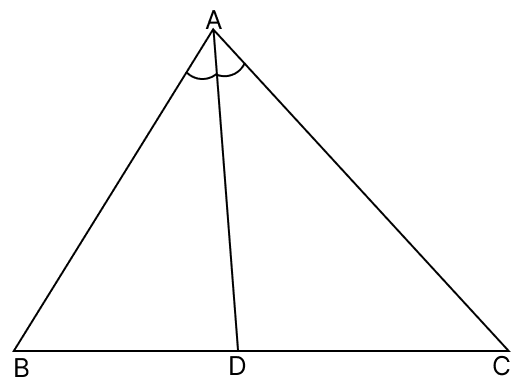
In the adjoining figure, AC > AB and AD is the bisector of ∠A. Show that : ∠ADC > ∠ADB
Answer
We know that,
In a triangle an exterior angle is equal to the sum of two opposite interior angles.
In △ADC,
⇒ ∠ADB = ∠CAD + ∠C .....(1)
In △ADB,
⇒ ∠ADC = ∠BAD + ∠B .....(2)
In △ABC,
⇒ AC > AB (Given)
⇒ ∠B > ∠C [If two sides of a triangle are unequal, the greater side has the greater angle opposite to it.]
Since, AD is the bisector of angle A.
∴ ∠BAD + ∠B > ∠CAD + ∠C ......(3)
From eq.(1), (2) and (3), we get:
⇒ ∠ADC > ∠ADB
Hence, proved that ∠ADC > ∠ADB.
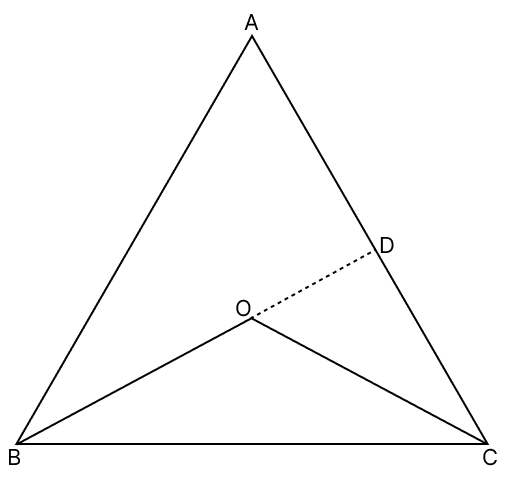
In the adjoining figure, in △ABC, O is any point in its interior. Show that: OB + OC < AB + AC
Answer
We know that,
In a triangle, sum of any two sides is always greater than the third side.
In △ABD,
⇒ AB + AD > BD
⇒ AB + AD > OB + OD .....(1)
In △COD,
⇒ OD + DC > OC .....(2)
Adding eq.(1) and (2), we have:
⇒ AB + AD + OD + DC > OB + OD + OC
⇒ AB + (AD + DC) > OB + OC
⇒ AB + AC > OB + OC
⇒ OB + OC < AB + AC.
Hence, proved that OB + OC < AB + AC.
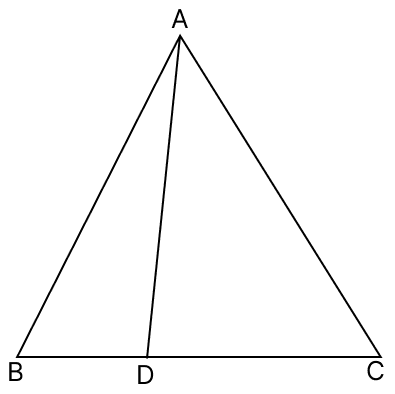
In △ABC, D is any point on BC. Prove that : AB + BC + AC > 2 AD.
Answer
We know that,
In a triangle, sum of any two sides is always greater than the third side.
In △ABD,
⇒ AB + BD > AD .....(1)
In △ACD,
⇒ AC + CD > AD .....(2)
Adding eq.(1) and (2), we have :
⇒ AB + BD + AC + CD > AD + AD
⇒ AB + (BD + CD) + AC > 2AD
⇒ AB + BC + AC > 2AD.
Hence, proved that AB + BC + AC > 2AD.
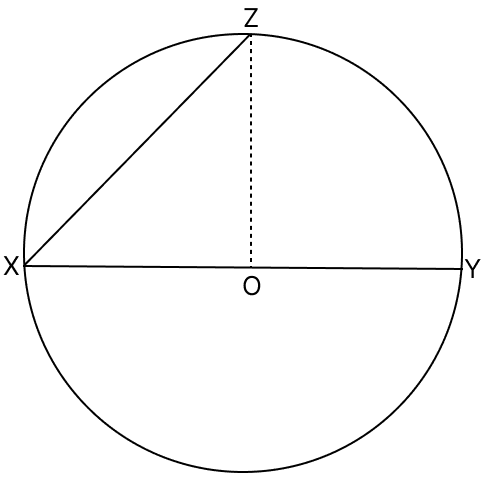
In the adjoining figure, O is the centre of a circle, XY is a diameter and XZ is a chord. Prove that XY > XZ.
Answer
From figure,
OX = OZ = OY [Radius of same circle]
We know that,
In a triangle, sum of any two sides is always greater than the third side.
In △XOZ,
⇒ OX + OZ > XZ
⇒ OX + OY > XZ (∵ OZ = OY)
⇒ XY > XZ
Hence, proved that XY > XZ.
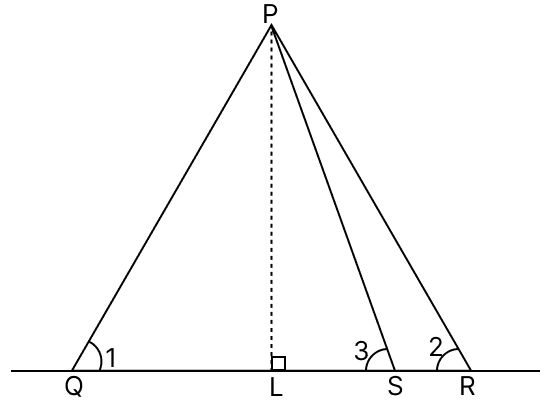
In the adjoining figure, PL ⊥ QR; LQ = LS and LR > LQ. Show that PR > PQ.
Answer
In △PLQ and △PLS,
LQ = LS (Given)
PL = PL (Common)
∠PLQ = ∠PLS (Both are equal to 90°)
△PLQ ≅ △PLS (By S.A.S axiom)
We know that corresponding parts of congruent triangles are equal.
∠1 = ∠3
In △PRS,
∠3 > ∠2 (As exterior angle is greater than each interior opposite angle)
∴ ∠1 > ∠2
⇒ PR > PQ (As side opposite to greater angle is greater)
Hence, proved that PR > PQ.
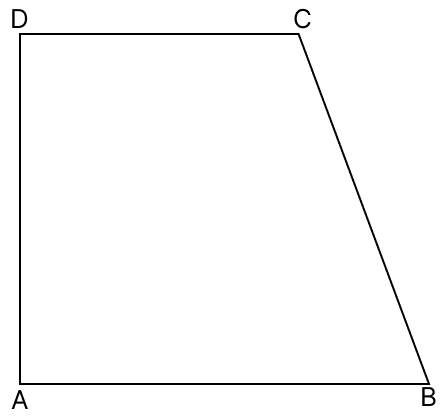
In the adjoining quadrilateral ABCD, AB is the longest side and DC is the shortest side. Prove that :
(i) ∠C > ∠A
(ii) ∠D > ∠B
Answer
(i) Given,
In quadrilateral ABCD,
AB is the longest sides and DC is the shortest side.
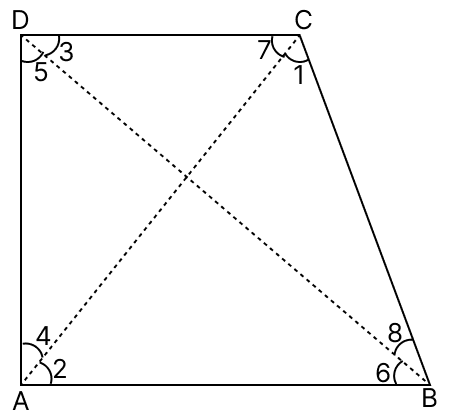
Join BD and AC.
In △ABC,
⇒ AB > BC
∴ ∠1 > ∠2 .....(1) [If two sides of a triangle are unequal, the greater side has the greater angle opposite to it]
In △ADC,
⇒ AD > DC
∴ ∠7 > ∠4 .....(2) [If two sides of a triangle are unequal, the greater side has the greater angle opposite to it]
Adding eq.(1) and (2), we get:
⇒ ∠1 + ∠7 > ∠2 + ∠4
⇒ ∠C > ∠A
Hence, proved that ∠C > ∠A.
(ii) In △ABD,
⇒ AB > AD
∴ ∠5 > ∠6 .....(1) [If two sides of a triangle are unequal, the greater side has the greater angle opposite to it]
In △BDC,
⇒ BC > CD
∴ ∠3 > ∠8 .....(2) [If two sides of a triangle are unequal, the greater side has the greater angle opposite to it]
Adding eq.(1) and (2), we get:
⇒ ∠5 + ∠3 > ∠6 + ∠8
⇒ ∠D > ∠B
Hence, proved that ∠D > ∠B.
Can you construct a △ABC in which AB = 5 cm, BC = 4 cm and AC = 9 cm? Give reason.
Answer
Let ABC be the triangle.
AB = 5 cm, BC = 4 cm, AC = 9 cm.
We know that,
In a triangle, sum of any two sides is greater than the third side.
AB + BC = 5 + 4 = 9 cm is equal to third side AC = 9 cm.
Hence, we cannot construct a triangle using given sides.
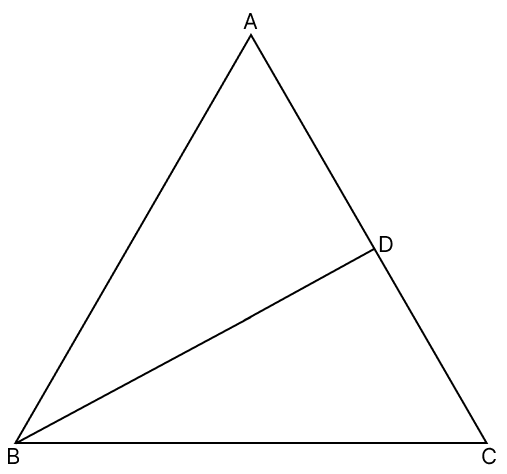
In the adjoining figure, △ABC is equilateral and D is any point on AC. Prove that:
(i) BD > AD
(ii) BD > DC
Answer
(i) Since, ABC is an equilateral triangle.
∴ ∠A = ∠B = ∠C = 60°
In △ ABD,
∠ABD = ∠B - ∠DBC
∴ ∠ABD < ∠B
∴ ∠ABD < ∠A (Since, ∠B = ∠A)
∴ AD < BD or BD > AD [If two angles of a triangle are unequal, the greater angle has the greater side opposite to it]
Hence, proved that BD > AD.
(ii) In △ BDC,
∠DBC = ∠B - ∠ABD
∴ ∠DBC < ∠B
∴ ∠DBC < ∠C (∵ ∠B = ∠C)
∴ DC < BD or BD > DC [If two angles of a triangle are unequal, the greater angle has the greater side opposite to it]
Hence, proved that BD > DC.
If O is any point inside △ABC, prove that ∠BOC > ∠A.
Answer
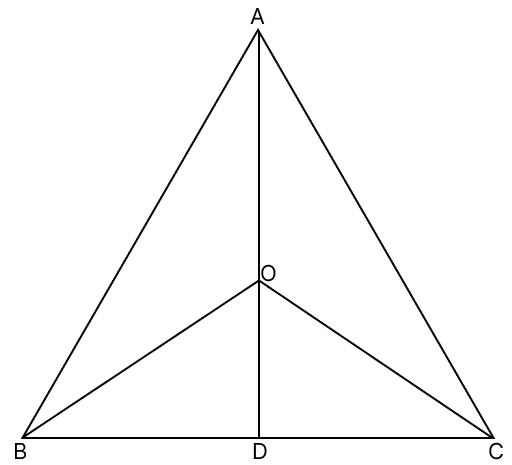
Join OA, OB and OC, produce OA to meet BC at D.
In △AOB,
∠BOD > ∠BAO .....(1) (Exterior angle is greater than interior opposite angle)
In △AOC,
∠COD > ∠CAO .....(2) (Exterior angle is greater than interior opposite angle)
Adding eq.(1) and (2), we have:
∠BOD + ∠COD > ∠BAO + ∠CAO
⇒ ∠BOC > ∠BAC
⇒ ∠BOC > ∠A.
Hence, proved that ∠BOC > ∠A.
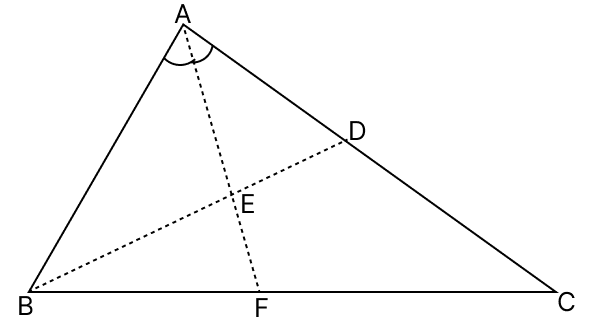
In the given figure, AD = AB and AE bisects ∠A. Prove that:
(i) BE = ED
(ii) ∠ABD > ∠BCA
Answer
In △ABE and △ADE,
⇒ AE = AE (Common side)
⇒ AB = AD (Given)
⇒ ∠BAE = ∠DAE (∵ AE bisects ∠A)
∴ △ABE ≅ △ADE (By S.A.S axiom)
(i) Since, △ABE ≅ △ADE
We know that,
Corresponding parts of congruent triangle are equal.
∴ BE = ED
Hence, proved that BE = ED.
(ii) Since, △ABE ≅ △ADE
We know that,
Corresponding parts of congruent triangle are equal.
∴ ∠ABE = ∠ADE
⇒ ∠ABD = ∠ADB
From figure,
⇒ ∠BDA > ∠BCA (∵ Exterior angle is greater than interior opposite angle)
⇒ ∠ABD > ∠BCA
Hence, proved that ∠ABD > ∠BCA.
The sides AB and AC of △ABC are produced to D and E respectively and the bisectors of ∠CBD and ∠BCE meet at O. If AB > AC, prove that OC > OB.
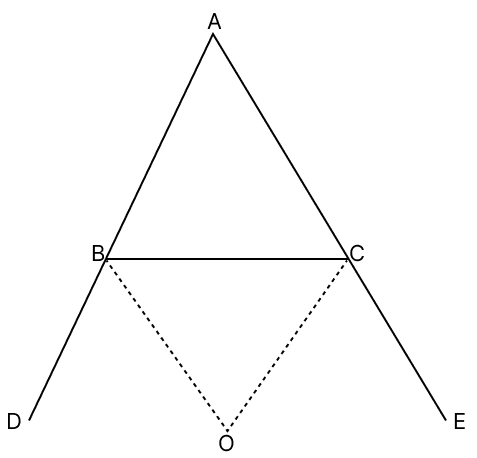
Answer
In △ABC,
AB > AC
⇒ ∠ACB > ∠ABC
∠ACB + ∠BCE = 180° .....(1) [Linear pair]
∠ABC + ∠CBD = 180° .....(2) [Linear pair]
Adding eq.(1) and (2), we have:
∠ACB + ∠BCE = ∠ABC + ∠CBD
Since, ∠ACB > ∠ABC
⇒ ∠BCE < ∠CBD
⇒ ∠BCE < ∠CBD
⇒ ∠BCO < ∠CBO
⇒ ∠CBO > ∠BCO
∴ OC > OB.
Hence, proved that OC > OB.
In △ABC, AB = 7.5 cm, BC = 6.2 cm and AC = 5.4 cm. Name :
(i) the least angle
(ii) the greatest angle of the triangle
Answer
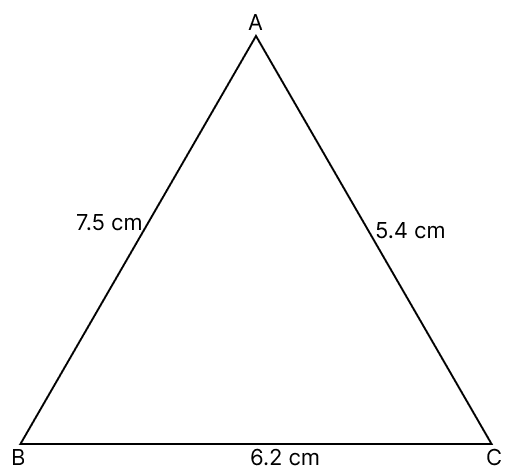
(i) In △ABC,
We know that,
The smallest side of a triangle has the smallest angle opposite to it.
Since, AC is the shortest side.
∴ ∠B is the least angle.
Hence, ∠B is the least angle.
(ii) In △ABC,
We know that,
The largest side of a triangle has the largest angle opposite to it.
Since, AB is the largest side.
∴ ∠C is the greatest angle.
Hence, ∠C is the greatest angle.
In the given figure, AD bisects ∠A. If ∠B = 60°, ∠C = 40°, then arrange AB, BD and DC in ascending order of their lengths.
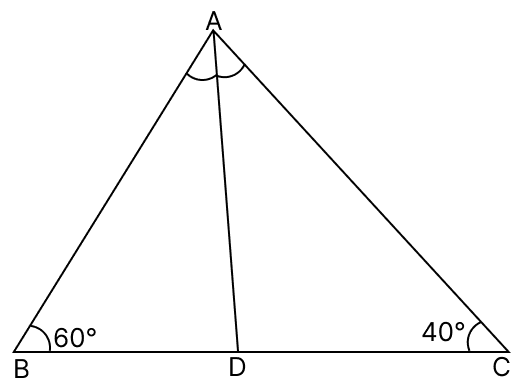
Answer
Given,
AD bisects ∠A.
⇒ ∠BAD = ∠CAD = x (let)
In △ABC,
By angle sum property of triangle,
⇒ ∠A + ∠B + ∠C = 180°
⇒ ∠A + 60° + 40° = 180°
⇒ ∠A + 100° = 180°
⇒ ∠A = 180° - 100°
⇒ ∠A = 80°
⇒ ∠BAD + ∠CAD = 80°
⇒ x + x = 80°
⇒ 2x = 80°
⇒ x =
⇒ x = 40°
⇒ ∠BAD = ∠CAD = 40°
In △ABD,
By angle sum property of triangle,
⇒ ∠BAD + ∠B + ∠ADB = 180°
⇒ 40° + 60° + ∠ADB = 180°
⇒ 100° + ∠ADB = 180°
⇒ ∠ADB = 180° - 100°
⇒ ∠ADB = 80°
We know that,
In a triangle larger angle has larger side opposite to it.
Since,
∠ADB > ∠ABD > ∠BAD
∴ AB > AD > BD .......(1)
From figure,
⇒ ∠ADB + ∠ADC = 180° (Linear pair)
⇒ 80° + ∠ADC = 180°
⇒ ∠ADC = 180° - 80°
⇒ ∠ADC = 100°
Since,
⇒ ∠DAC = ∠ACD (Both equal to 40°)
∴ AD = DC (Sides opposite to equal angles are equal)
Substituting value of AD in equation (1), we get :
⇒ AB > DC > BD
⇒ BD < DC < AB.
Hence, BD < DC < AB.
In the given figure, ∠ABC = 66°, ∠DAC = 38°. CE is perpendicular to AB and AD is perpendicular to BC. Prove that: CP > AP.
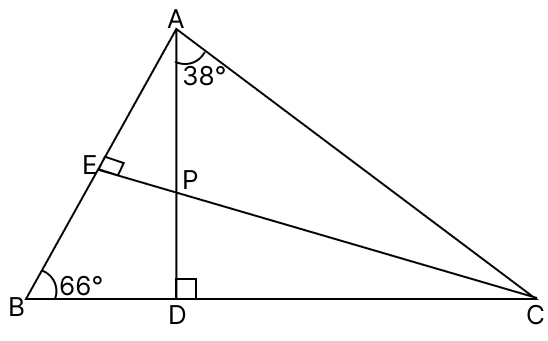
Answer
In △ABD,
By angle sum property of triangle,
⇒ ∠ABD + ∠ADB + ∠BAD = 180°
⇒ 66° + 90° + ∠BAD = 180°
⇒ ∠BAD + 156° = 180°
⇒ ∠BAD = 180° - 156°
⇒ ∠BAD = 24°
In △AEP,
By angle sum property of triangle,
⇒ ∠AEP + ∠APE + ∠BAD = 180°
⇒ 90° + ∠APE + 24° = 180°
⇒ ∠APE + 114° = 180°
⇒ ∠APE = 180° - 114°
⇒ ∠APE = 66°
From figure,
∠APE + ∠APC = 180° (Linear pair)
⇒ 66° + ∠APC = 180°
⇒ ∠APC = 180° - 66°
⇒ ∠APC = 114°
In △APC,
By angle sum property of triangle,
⇒ ∠APC + ∠ACP + ∠PAC = 180°
⇒ 114° + ∠ACP + 38° = 180°
⇒ ∠ACP + 152° = 180°
⇒ ∠ACP = 180° - 152°
⇒ ∠ACP = 28°
We know that,
The shortest side of a triangle has the shortest angle opposite to it.
⇒ AP < CP
⇒ CP > AP.
Hence, proved that CP > AP.