
In a △ABC, AB = AC and ∠A = 50°, find ∠B and ∠C.
Answer
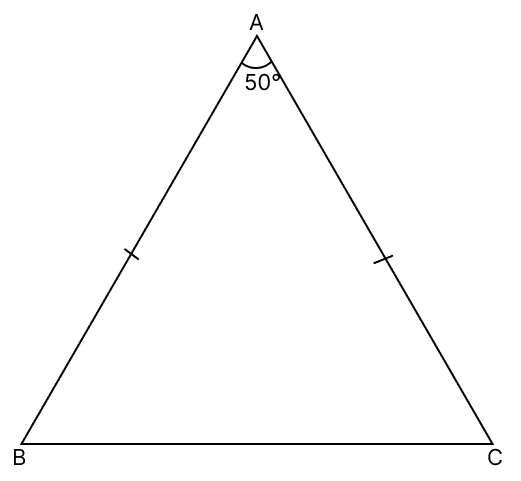
In △ABC,
AB = AC
⇒ ∠B = ∠C = a (let) [Angles opposite to equal sides are equal]
By angle sum property of a triangle,
⇒ ∠A + ∠B + ∠C = 180°
⇒ 50° + a + a = 180°
⇒ 2a = 180° - 50°
⇒ 2a = 130°
⇒ a =
⇒ a = 65°.
⇒ ∠B = ∠C = 65°
Hence, ∠B = ∠C = 65°.
In a △ABC, BC = AC and ∠B = 64°, find ∠C.
Answer
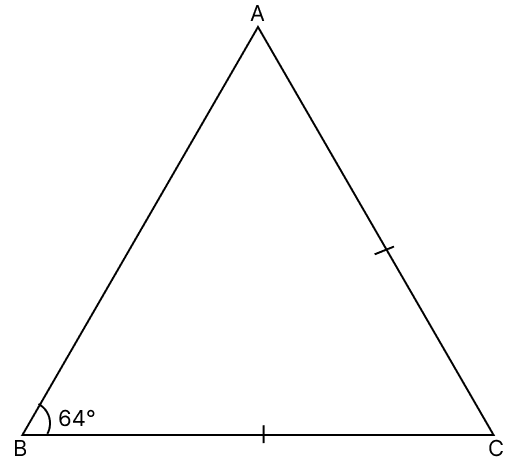
In △ABC,
BC = AC
⇒ ∠B = ∠A = 64° [Angles opposite to equal sides are equal]
By angle sum property of a triangle,
⇒ ∠A + ∠B + ∠C = 180°
⇒ 64° + 64° + ∠C = 180°
⇒ 128° + ∠C = 180°
⇒ ∠C = 180° - 128°
⇒ ∠C = 52°.
Hence, ∠C = 52°.
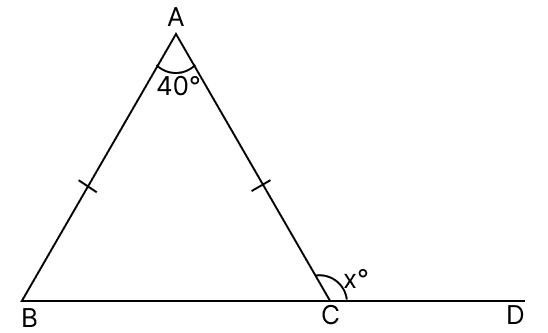
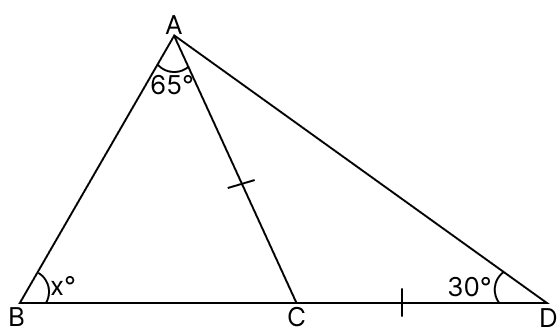
In each of the following figures, find the value of x :
(i)
(ii)
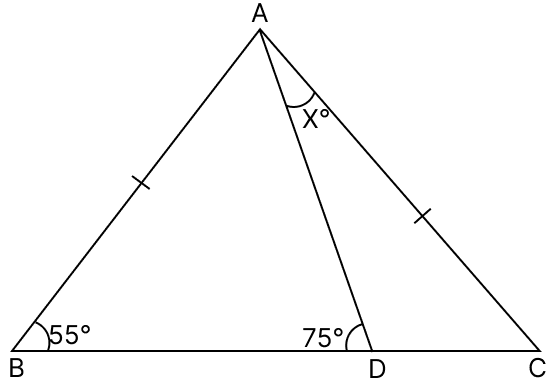
(iii)
Answer
(i) From figure,
∠A = 40°
In △ABC,
AB = AC
⇒ ∠C = ∠B = z (let) (Angles opposite to equal sides are equal)
By angle sum property of triangle,
⇒ ∠A + ∠B + ∠C = 180°
⇒ 40° + z + z = 180°
⇒ 2z = 180° - 40°
⇒ 2z = 140°
⇒ z =
⇒ z = 70°
⇒ ∠C = ∠B = 70°.
From figure,
⇒ ∠C + ∠ACD = 180° (Linear pair)
⇒ 70° + x° = 180°
⇒ x° = 180° - 70°
⇒ x° = 110°
⇒ x = 110.
Hence, the value of x = 110.
(ii) From figure,
In △CAD,
⇒ AC = CD
⇒ ∠CDA = ∠CAD = 30° (Angles opposite to equal sides are equal)
In △ABD,
By angle sum property of triangle,
⇒ ∠DBA + ∠BAD + ∠BDA = 180°
⇒ x° + ∠BAC + ∠CAD + ∠BDA = 180°
⇒ x° + 65° + 30° + 30° = 180°
⇒ x° + 125° = 180°
⇒ x° = 180° - 125°
⇒ x° = 55°
⇒ x = 55.
Hence, the value of x = 55.
(iii) In △ABC,
AB = AC
⇒ ∠ABC = ∠ACB = 55° (Angles opposite to equal sides in a triangle are equal)
In △ABD,
By angle sum property of triangle,
⇒ ∠ABD + ∠BDA + ∠BAD = 180°
⇒ 55° + 75° + ∠BAD = 180°
⇒ 130° + ∠BAD = 180°
⇒ ∠BAD = 180° - 130°
⇒ ∠BAD = 50°.
In △ABC,
By angle sum property of triangle,
⇒ ∠ABC + ∠ACB + ∠BAC = 180°
⇒ 55° + 55° + ∠BAD + ∠CAD = 180°
⇒ 55° + 55° + 50° + x° = 180°
⇒ 160° + x° = 180°
⇒ x° = 180° - 160°
⇒ x° = 20°
⇒ x = 20.
Hence, value of x = 20.
In each of the following figures, find the value of x :
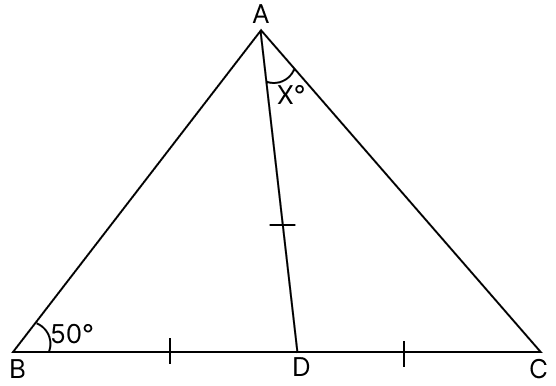
(i)
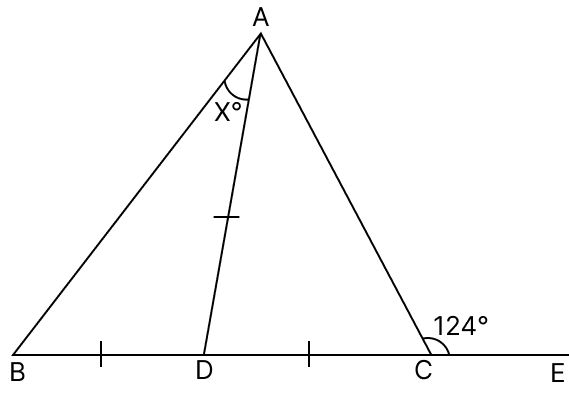
(ii)
Answer
(i) In △ABD,
AD = BD
⇒ ∠ABD = ∠BAD = 50° (Angles opposite to equal sides in a triangle are equal)
By angle sum property of triangle,
⇒ ∠ABD + ∠BAD + ∠BDA = 180°
⇒ 50° + 50° + ∠BDA = 180°
⇒ 100° + ∠BDA = 180°
⇒ ∠BDA = 180° - 100°
⇒ ∠BDA = 80°.
In △ADC,
AD = CD
⇒ ∠DAC = ∠DCA = x° (Angles opposite to equal side in a triangle are equal)
⇒ ∠BDA + ∠CDA = 180° (Linear pair)
⇒ 80° + ∠CDA = 180°
⇒ ∠CDA = 180° - 80°
⇒ ∠CDA = 100°
By angle sum property of triangle,
⇒ ∠DAC + ∠DCA + ∠CDA = 180°
⇒ x° + x° + 100° = 180°
⇒ 2x° = 180° - 100°
⇒ 2x° = 80°
⇒ x° =
⇒ x° = 40°
⇒ x = 40.
Hence, the value of x = 40.
(ii) From figure,
⇒ ∠ACE + ∠ACD = 180°
⇒ 124° + ∠ACD = 180°
⇒ ∠ACD = 180° - 124°
⇒ ∠ACD = 56°.
In △ADC,
AD = CD
⇒ ∠DAC = ∠ACD = 56° (Angles opposite to equal sides in a triangle are equal)
By angle sum property of triangle,
⇒ ∠DAC + ∠ACD + ∠CDA = 180°
⇒ 56° + 56° + ∠CDA = 180°
⇒ 112° + ∠CDA = 180°
⇒ ∠CDA = 180° - 112°
⇒ ∠CDA = 68°.
From figure,
⇒ ∠CDA + ∠BDA = 180° (Linear pair)
⇒ 68° + ∠BDA = 180°
⇒ ∠BDA = 180° - 68°
⇒ ∠BDA = 112°.
In △ABD,
AD = BD
⇒ ∠DBA = ∠BAD = x° (Angles opposite to equal sides in a triangle are equal)
By angle sum property of triangle,
⇒ ∠DBA + ∠BAD + ∠BDA = 180°
⇒ x° + x° + 112° = 180°
⇒ 2x° = 180° - 112°
⇒ 2x° = 68°
⇒ x° =
⇒ x° = 34°
⇒ x = 34.
Hence, the value of x = 34.
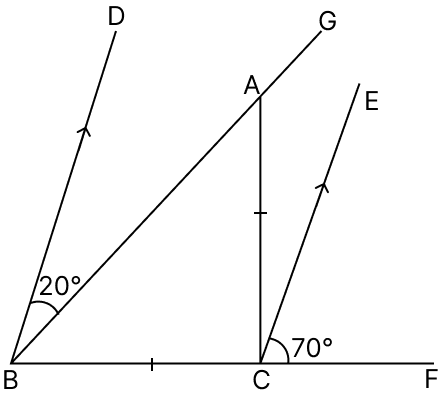
In the given figure, BD || CE; AC = BC, ∠ABD = 20° and ∠ECF = 70°. Find ∠GAC.
Answer
From figure,
BF is the transversal on parallel lines BD and CE.
⇒ ∠DBC = ∠ECF = 70° (Corresponding angles are equal)
⇒ ∠DBC = 70°
⇒ ∠DBA + ∠ABC = 70°
⇒ 20° + ∠ABC = 70°
⇒ ∠ABC = 70° - 20°
⇒ ∠ABC = 50°.
In △ABC,
AC = BC
⇒ ∠ABC = ∠BAC = 50° (Angles opposite to equal sides in a triangle are equal)
⇒ ∠BAC + ∠GAC = 180° (Linear pair)
⇒ 50° + ∠GAC = 180°
⇒ ∠GAC = 180° - 50°
⇒ ∠GAC = 130°.
Hence, ∠GAC = 130°.
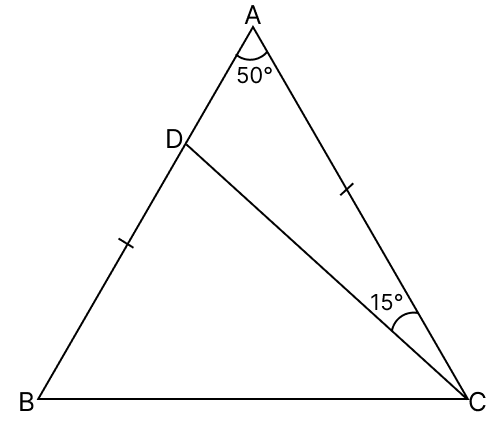
In the given figure, AB = AC; ∠A = 50° and ∠ACD = 15°. Show that BC = CD.
Answer
In △ACD,
By angle sum property of triangle,
⇒ ∠ACD + ∠CDA + ∠DAC = 180°
⇒ 15° + ∠CDA + 50° = 180°
⇒ ∠CDA + 65° = 180°
⇒ ∠CDA = 180° - 65°
⇒ ∠CDA = 115°.
From figure,
⇒ ∠CDA + ∠BDC = 180° (Linear pair)
⇒ 115° + ∠BDC = 180°
⇒ ∠BDC = 180° - 115°
⇒ ∠BDC = 65° .....(1)
In △ABC,
AB = BC
⇒ ∠ABC = ∠ACB = x° (Angles opposite to equal sides in a triangle are equal)
By angle sum property of triangle,
⇒ ∠ABC + ∠ACB + ∠BAC = 180°
⇒ x° + x° + 50° = 180°
⇒ 2x° = 180° - 50°
⇒ 2x° = 130°
⇒ x° =
⇒ x° = 65°
⇒ ∠ABC = ∠ACB = 65° ....(2)
From eq.(1) and (2), we have :
⇒ ∠BDC = ∠ABC = 65°
Since,
⇒ ∠DBC = ∠ABC
Thus,
⇒ ∠DBC = ∠BDC
Thus, in triangle DBC,
⇒ BC = CD (Sides opposite to equal angles in a triangle are equal)
Hence, proved that BC = CD.
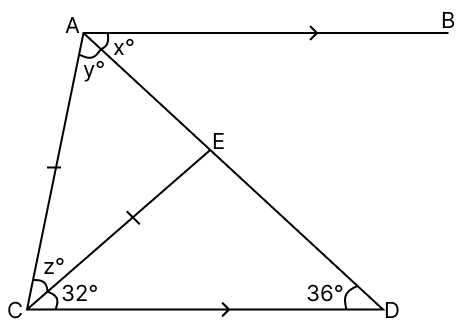
In the given figure, AB || CD and CA = CE. Find the values of x, y and z.
Answer
In △CED,
By angle sum property of triangle,
⇒ ∠ECD + ∠CDE + ∠DEC = 180°
⇒ 32° + 36° + ∠DEC = 180°
⇒ 68° + ∠DEC = 180°
⇒ ∠DEC = 180° - 68°
⇒ ∠DEC = 112°.
From figure,
⇒ ∠DEC + ∠AEC = 180° (Linear pair)
⇒ 112° + ∠AEC = 180°
⇒ ∠AEC = 180° - 112°
⇒ ∠AEC = 68°.
Given,
CA = CE
⇒ ∠EAC = ∠AEC = y° = 68° (Angles opposite to equal sides in a triangle are equal)
⇒ y = 68.
In △CEA,
By angle sum property of triangle,
⇒ ∠EAC + ∠AEC + ∠ECA = 180°
⇒ 68° + 68° + z° = 180°
⇒ 136° + z° = 180°
⇒ z° = 180° - 136°
⇒ z° = 44°
⇒ z = 44.
From figure,
∠BAD = ∠ADC (ALternate pair of angles between parallel lines AB and CD)
⇒ x° = 36°
⇒ x = 36.
Hence, the values of x = 36, y = 68 and z = 44.
If the base of an isosceles triangle is produced on both sides, prove that the exterior angles so formed are equal to each other.
Answer
Let ABC be an isosceles triangle with AB = AC.
Base BC is produced at points E, D respectively.
AB = AC
⇒ ∠ABC = ∠ACB = x (let) (Angles opposite to equal sides in a triangle are equal)
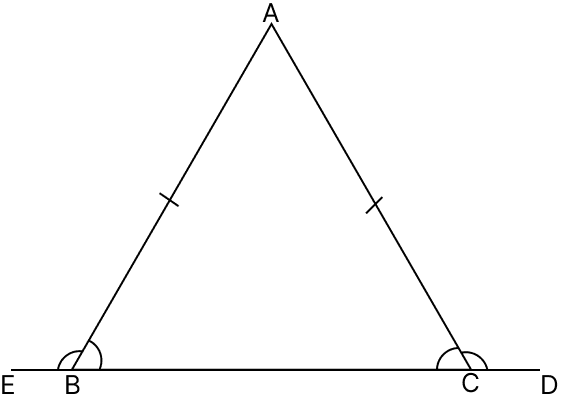
From figure,
⇒ ∠ACD + ∠ACB = 180° (Linear pair)
⇒ ∠ACD + x = 180°
⇒ ∠ACD = 180° - x ....(1)
From figure,
⇒ ∠ABE + ∠ABC = 180° (Linear pair)
⇒ ∠ABE + x = 180°
⇒ ∠ABE = 180° - x ....(2)
From eq.(1) and (2), we have:
⇒ ∠ABE = ∠ACD
Hence, proved that the exterior angles so formed are equal to each other.
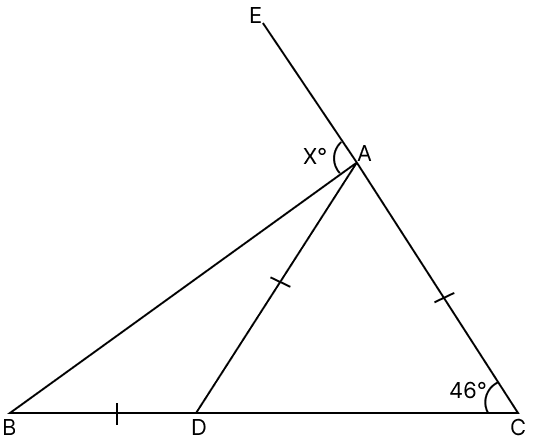
In the given figure, side CA of △ABC has been produced to E. If AC = AD = BD; ∠ACD = 46° and ∠BAE = x°; find the value of x.
Answer
Given,
AD = AC
In △ADC,
⇒ ∠ACD = ∠ADC = 46° (Angles opposite to equal sides in a triangle are equal)
By angle sum property of triangle,
⇒ ∠ACD + ∠ADC + ∠CAD = 180°
⇒ 46° + 46° + ∠CAD = 180°
⇒ 92° + ∠CAD = 180°
⇒ ∠CAD = 180° - 92°
⇒ ∠CAD = 88°.
From figure,
⇒ ∠ADB + ∠ADC = 180° (Linear pair)
⇒ ∠ADB + 46° = 180°
⇒ ∠ADB = 180° - 46°
⇒ ∠ADB = 134°.
In △ABD,
AD = BD
⇒ ∠DAB = ∠DBA = z (let) (Angles opposite to equal sides are equal)
By angle sum property of triangle,
⇒ ∠ADB + ∠DAB + ∠DBA = 180°
⇒ 134° + z + z = 180°
⇒ 2z = 180° - 134°
⇒ 2z = 46°
⇒ z =
⇒ z = 23°.
⇒ ∠DAB = ∠DBA = 23°
From figure,
⇒ ∠CAD + ∠DAB + ∠BAE = 180° (Linear pair)
⇒ 88° + 23° + x° = 180°
⇒ 111° + x° = 180°
⇒ x° = 180° - 111°
⇒ x° = 69°
⇒ x = 69.
Hence, the value of x = 69.
In the given figure, CA = CD = BD; ∠DBC = 35° and ∠DCA = x°. Find the value of x.
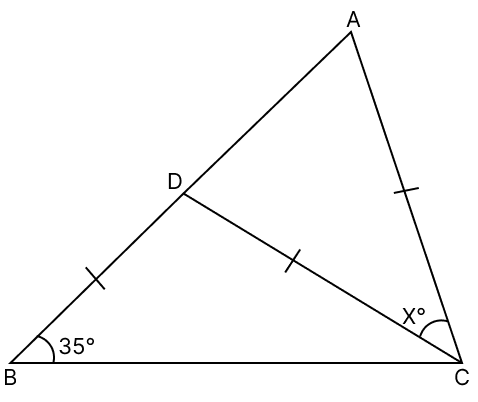
Answer
In △BDC,
BD = CD
⇒ ∠DBC = ∠DCB = 35° (Angles opposite to equal sides in a triangle are equal)
By angle sum property of triangle,
⇒ ∠DBC + ∠DCB + ∠BDC = 180°
⇒ 35° + 35° + ∠BDC = 180°
⇒ 70° + ∠BDC = 180°
⇒ ∠BDC = 180° - 70°
⇒ ∠BDC = 110°.
From figure,
⇒ ∠BDC + ∠ADC = 180° (Linear pair)
⇒ 110° + ∠ADC = 180°
⇒ ∠ADC = 180° - 110°
⇒ ∠ADC = 70°
In △ADC,
CA = CD
⇒ ∠ADC = ∠CAD = 70° (Angles opposite to equal sides are equal)
By angle sum property of triangle,
⇒ ∠ADC + ∠CAD + ∠ACD = 180°
⇒ 70° + 70° + x° = 180°
⇒ 140° + x° = 180°
⇒ x° = 180° - 140°
⇒ x° = 40°
⇒ x = 40.
Hence, the value of x = 40.
In the given figure, △ABC is an equilateral triangle whose base BC is produced to D such that BC = CD. Calculate :
(i) ∠ACD
(ii) ∠ADC
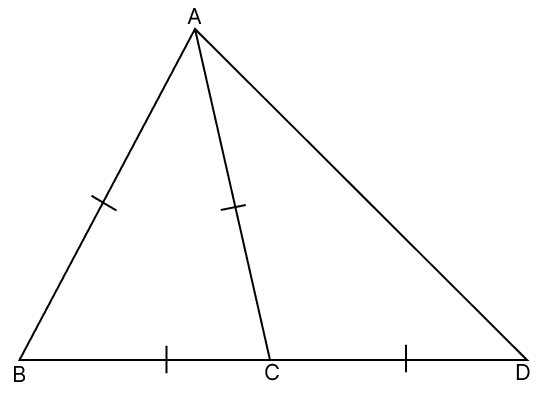
Answer
(i) Given, △ABC is an equilateral triangle.
∠BAC = ∠ACB = ∠ABC = 60°
From figure,
⇒ ∠ACB + ∠ACD = 180° (Linear pair)
⇒ 60° + ∠ACD = 180°
⇒ ∠ACD = 180° - 60°
⇒ ∠ACD = 120°.
Hence, ∠ACD = 120°.
(ii) In △ACD,
AC = CD
⇒ ∠CAD = ∠ADC = x (let) (Angles opposite to equal sides in a triangle are equal)
By angle sum property of triangle,
⇒ ∠CAD + ∠ADC + ∠ACD = 180°
⇒ x + x + 120° = 180°
⇒ 2x = 180° - 120°
⇒ 2x = 60°
⇒ x =
⇒ x = 30°
⇒ ∠CAD = ∠ADC = 30°.
Hence, ∠ADC = 30°.
In the given figure, AB = AD; CB = CD; ∠A = 42° and ∠C = 108°, find ∠ABC.
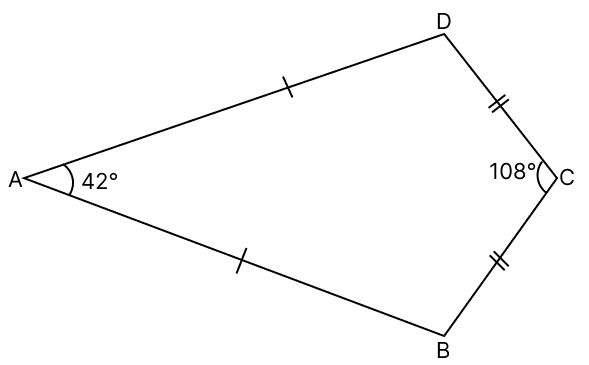
Answer
Join BD.
In △ABD,
AB = AD
⇒ ∠ABD = ∠ADB = x (let) (Angles opposite to equal sides in a triangle are equal)
By angle sum property of triangle,
⇒ ∠BAD + ∠ABD + ∠ADB = 180°
⇒ 42° + x + x = 180°
⇒ 2x = 180° - 42°
⇒ 2x = 138°
⇒ x =
⇒ x = 69°
⇒ ∠ABD = ∠ADB = 69°.
In △BCD,
CB = CD
⇒ ∠CBD = ∠CDB = y (let) (Angles opposite to equal sides in a triangle are equal)
By angle sum property of triangle,
⇒ ∠BCD + ∠CBD + ∠CDB = 180°
⇒ 108° + y + y = 180°
⇒ 2y = 180° - 108°
⇒ 2y = 72°
⇒ y =
⇒ y = 36°
⇒ ∠CBD = ∠CDB = 36°
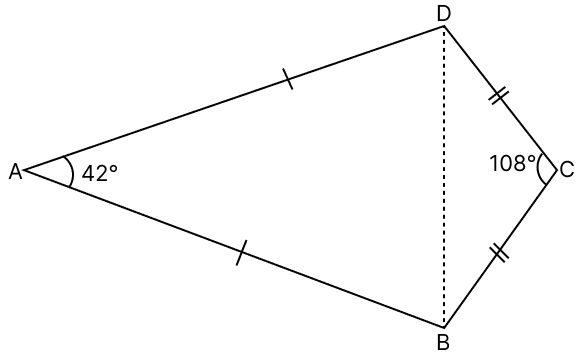
From figure,
∠ABC = ∠ABD + ∠CBD = 69° + 36° = 105°.
Hence, ∠ABC = 105°.
In the given figure, side BA of △ABC has been produced to D such that CD = CA and side CB has been produced to E. If ∠BAC = 106° and ∠ABE = 128°, find ∠BCD.
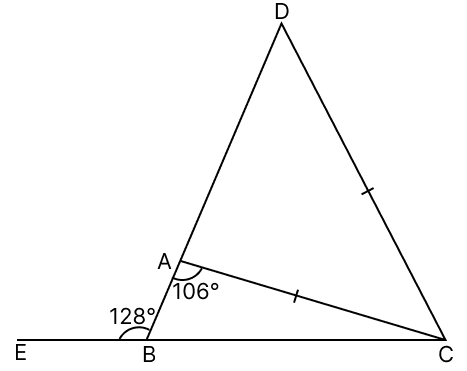
Answer
From figure,
⇒ ∠ABE + ∠ABC = 180° (Linear pair)
⇒ 128° + ∠ABC = 180°
⇒ ∠ABC = 180° - 128°
⇒ ∠ABC = 52°
In △ABC,
By angle sum property of triangle,
⇒ ∠ABC + ∠BAC + ∠ACB = 180°
⇒ 52° + 106° + ∠ACB = 180°
⇒ 158° + ∠ACB = 180°
⇒ ∠ACB = 180° - 158°
⇒ ∠ACB = 22°.
From figure,
⇒ ∠BAC + ∠CAD = 180° (Linear pair)
⇒ 106° + ∠CAD = 180°
⇒ ∠CAD = 180° - 106°
⇒ ∠CAD = 74°.
Given,
CD = CA
⇒ ∠CAD = ∠CDA = 74° (Angles opposite to equal sides in a triangle are equal)
In triangle CAD,
By angle sum property of triangle,
⇒ ∠ACD + ∠CAD + ∠CDA = 180°
⇒ ∠ACD + 74° + 74° = 180°
⇒ ∠ACD + 148° = 180°
⇒ ∠ACD = 180° - 148°
⇒ ∠ACD = 32°.
From figure,
∠BCD = ∠ACB + ∠ACD
= 22° + 32°
= 54°.
Hence, ∠BCD = 54°.
In the given figure, AB = BC and AC = CD. Show that: ∠BAD : ∠ADB = 3 : 1
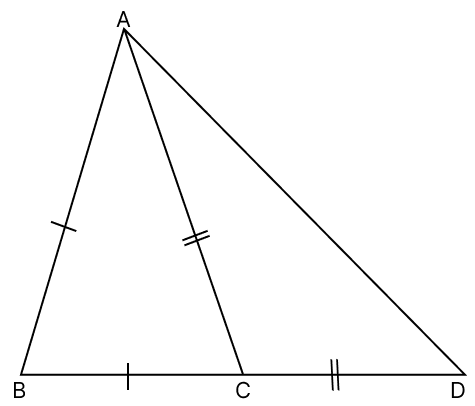
Answer
In △ABC,
AB = BC
⇒ ∠BAC = ∠ACB = x (let) (Angles opposite to equal sides in a triangle are equal)
In △ACD,
AC = CD
⇒ ∠CAD = ∠ADC = y (let) (Angles opposite to equal sides in a triangle are equal)
From figure,
⇒ ∠ACB + ∠ACD = 180° (Linear pair)
⇒ x + ∠ACD = 180°
⇒ ∠ACD = 180° - x
In △ACD,
By angle sum property of triangle,
⇒ ∠CAD + ∠ADC + ∠ACD = 180°
⇒ y + y + (180° - x) = 180°
⇒ 2y + 180° - x = 180°
⇒ 2y - x = 0
⇒ 2y = x
From figure,
∠BAD = ∠BAC + ∠CAD
⇒ ∠BAD = x + y
⇒ ∠BAD = 2y + y
⇒ ∠BAD = 3y
⇒ ∠BAD = 3∠ADC
From figure,
⇒ ∠ADC = ∠ADB
Thus,
⇒ ∠BAD = 3∠ADB
⇒
Hence, proved that ∠BAD : ∠ADB = 3 : 1.
Show that the perpendiculars drawn from the extremities of the base of an isosceles triangle to the opposite sides are equal.
Answer
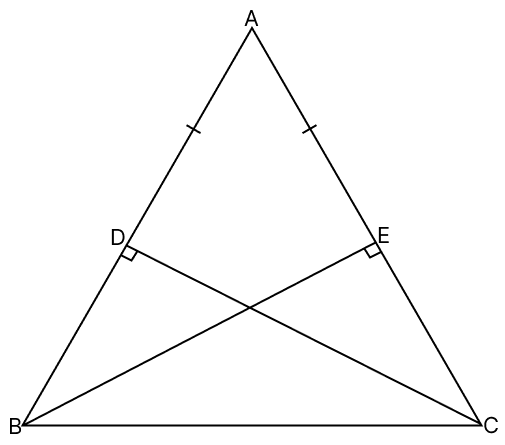
Let ABC be an isosceles triangle with AB = AC.
CD and BE are perpendiculars drawn from extremities of base BC.
In △ADC and △AEB,
⇒ AC = AB (Given)
⇒ ∠AEB = ∠ADC (Both equal to 90°)
⇒ ∠A = ∠A (Common angle)
∴ △ADC ≅ △AEB (By A.A.S axiom)
⇒ BE = CD (Corresponding parts of congruent triangles are equal)
Hence, the perpendiculars drawn from the extremities of the base of an isosceles triangle to the opposite sides are equal.
In a △ABC, AB = AC. If the bisectors of ∠B and ∠C meet AC and AB at points D and E respectively, show that :
(i) △DBC ≅ △ECB
(ii) BD = CE
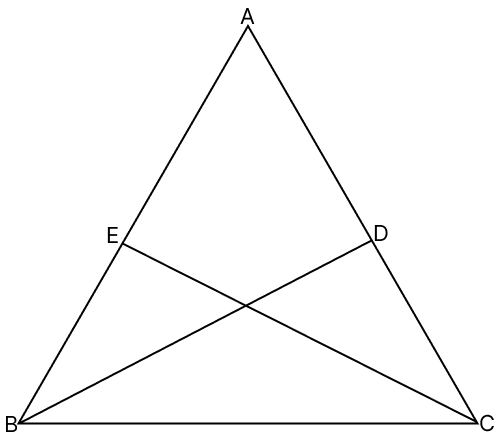
Answer
In △ABC,
AB = AC
⇒ ∠ABC = ∠ACB (Angles opposite to equal sides in a triangle are equal)
Given,
∠ABD = ∠DBC (DB is bisector of ∠B) ....(1)
∠ACE = ∠ECB (CE is bisector of ∠C) ....(2)
Since, ∠ABC = ∠ACB, from eq.(1) and (2), we have:
⇒ ∠ABD = ∠DBC = ∠ACE = ∠ECB
(i) In △ECB and △DBC,
⇒ BC = BC (Common side)
⇒ ∠ECB = ∠DBC (Proved above)
⇒ ∠EBC = ∠DCB (As, ∠ABC = ∠ACB)
∴ △ECB ≅ △DBC (By A.S.A. axiom)
Hence, proved that △ECB ≅ △DBC.
(ii) Since, △ECB ≅ △DBC
BD = CE (Corresponding parts of congruent triangles are equal)
Hence, proved that BD = CE.
In an isosceles triangle, prove that the altitude from the vertex bisects the base.
Answer
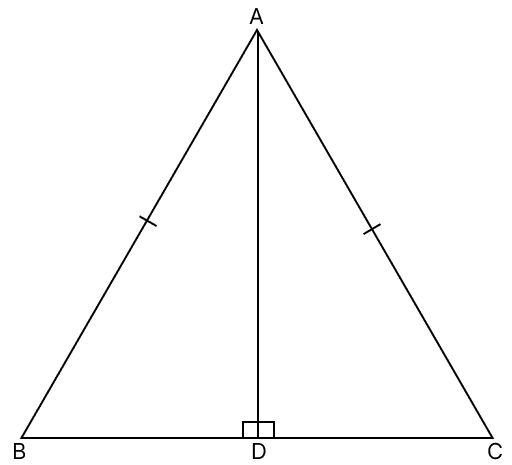
Let ABC be an isosceles triangle with AB = AC.
Let AD be a perpendicular from vertex A to base BC.
In △ADB and △ADC,
⇒ AD = AD (Common side)
⇒ AB = AC (Given)
⇒ ∠ADB = ∠ADC (Each equal to 90°)
∴ △ADB ≅ △ADC (By R.H.S axiom)
∴ DB = DC (Corresponding parts of congruent triangles are equal)
Hence, proved that the altitude from the vertex in an isosceles triangle bisects the base.
If the altitude from one vertex of a triangle bisects the opposite side, prove that the triangle is isosceles.
Answer
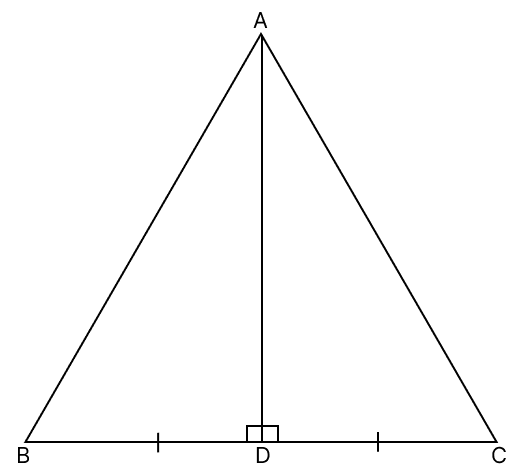
Let ABC be a triangle.
Let AD be a perpendicular from vertex A to base BC, which bisects it, i.e. DB = DC.
In △ADB and △ADC,
⇒ AD = AD (Common side)
⇒ BD = DC (Given)
⇒ ∠ADB = ∠ADC (Each equal to 90°)
∴ △ADB ≅ △ADC (By S.A.S. axiom)
∴ AB = AC (Corresponding parts of congruent triangles are equal)
∴ Triangle ABC is an isosceles triangle.
Hence, proved that the triangle is isosceles, if the altitude from one vertex of a triangle bisects the opposite side.
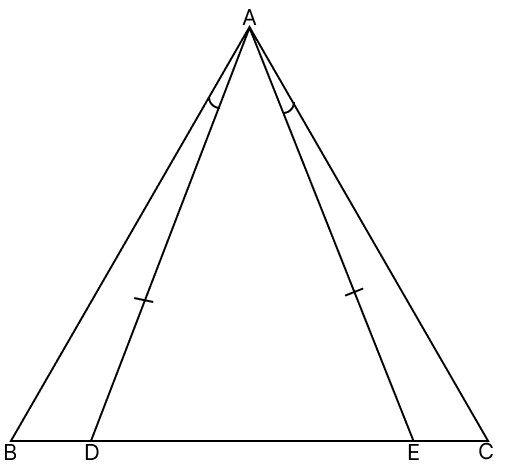
In the given figure, AD = AE and ∠BAD = ∠CAE. Prove that : AB = AC.
Answer
In △ADE,
AD = AE
⇒ ∠ADE = ∠AED (Angles opposite to equal sides in atriangle are equal)
From figure,
⇒ ∠ADE + ∠ADB = 180° (Linear pair)
⇒ ∠ADB = 180° - ∠ADE ....(1)
⇒ ∠AED + ∠AEC = 180° (Linear pair)
⇒ ∠AEC = 180° - ∠AED
⇒ ∠AEC = 180° - ∠ADE ....(2) (∵ ∠ADE = ∠AED)
From eq.(1) and (2), we have:
⇒ ∠AEC = ∠ADB
In △ABD and △ACE,
⇒ AD = AE (Given)
⇒ ∠ADB = ∠AEC (Proved above)
⇒ ∠BAD = ∠CAE (Given)
∴ △ABD ≅ △ACE (By A.S.A axiom)
⇒ AB = AC (Corresponding parts of congruent triangles are equal)
Hence, proved that AB = AC.
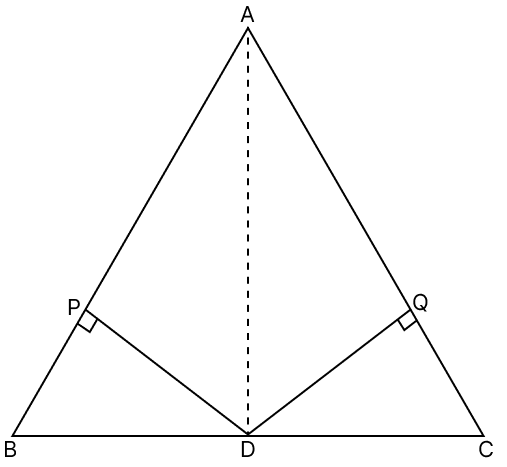
In the given figure, AB = AC; D is the mid-point of BC; DP ⊥ BA and DQ ⊥ CA. Prove that:
(i) DP = DQ
(ii) AP = AQ
(iii) AD bisects ∠A
Answer
(i) In △ABC,
⇒ AB = AC (Given)
∴ ∠B = ∠C (Angles opposite to equal sides in a triangle are equal)
In △PDB and △QDC,
⇒ BD = CD (D is mid-point of BC)
⇒ ∠B = ∠C (Proved above)
⇒ ∠P = ∠Q (Both equal to 90°)
∴ △PDB ≅ △QDC (By A.A.S axiom)
⇒ DP = DQ (Corresponding parts of congruent triangles are equal)
Hence, proved that DP = DQ.
(ii) Since, △PDB ≅ △QDC
∴ BP = QC = y (let) (Corresponding parts of congruent triangles are equal)
⇒ AB = AC = x (let)
From figure,
⇒ AP = AB - BP = x - y ...(1)
⇒ AQ = AC - QC = x - y ...(2)
From eq.(1) and (2) we have :
∴ AP = AQ.
Hence, proved that AP = AQ.
(iii) In △ABD and △ACD,
⇒ AB = AC (Given)
⇒ BD = CD (Given)
⇒ AD = AD (Common side)
∴ △ABD ≅ △ACD (By S.S.S axiom)
⇒ ∠BAD = ∠CAD (Corresponding parts of congruent triangles are equal)
Hence, proved that AD bisects ∠A.
In the given figure, AB = AC. If BO and CO, the bisectors of ∠B and ∠C respectively meet at O and BC is produced to D, prove that ∠BOC = ∠ACD.
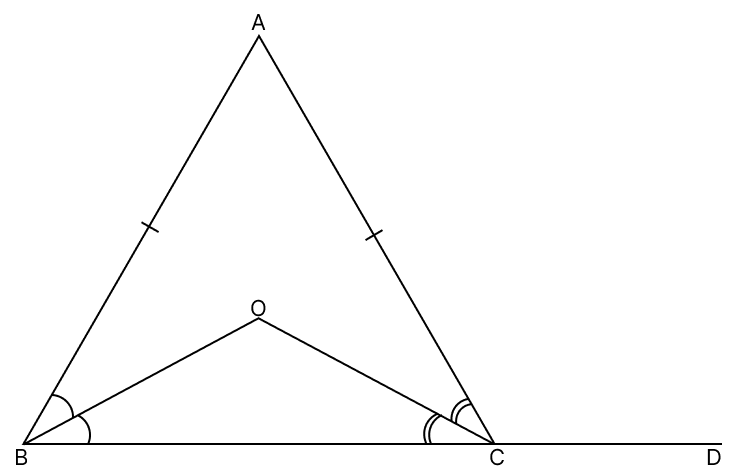
Answer
In △ABC,
AB = AC
⇒ ∠B = ∠C = x (let) (Angles opposite to equal sides in a triangle are equal)
From figure,
∠B = ∠ABO + ∠OBC
⇒ x = ∠OBC + ∠OBC (∵ ∠ABO = ∠OBC, as OB is the bisector of angle B)
⇒ x = 2∠OBC
⇒ ∠OBC = ....(1)
From figure,
∠C = ∠ACO + ∠OCB
⇒ x = ∠OCB + ∠OCB (∵ ∠ACO = ∠OCB, as OC is bisector of angle C)
⇒ x = 2∠OCB
⇒ ∠OCB = ....(2)
From eq.(1) and (2), we have :
⇒ ∠OCB = ∠OBC
In △BOC,
By angle sum property of triangle,
⇒ ∠OCB + ∠OBC + ∠BOC = 180°
⇒ + ∠BOC = 180°
⇒ x + ∠BOC = 180°
⇒ ∠BOC = 180° - x ....(3)
From figure,
⇒ ∠ACB + ∠ACD = 180° (Linear pair)
⇒ ∠ACO + ∠OCB + ∠ACD = 180°
⇒ + ∠ACD = 180° (∵ ∠ACO = ∠OCB)
⇒ x + ∠ACD = 180°
⇒ ∠ACD = 180° - x ....(4)
From eq.(3) and (4), we have:
⇒ ∠BOC = ∠ACD
Hence, proved that ∠BOC = ∠ACD.
Prove that the bisectors of the base angles of an isosceles triangle are equal.
Answer
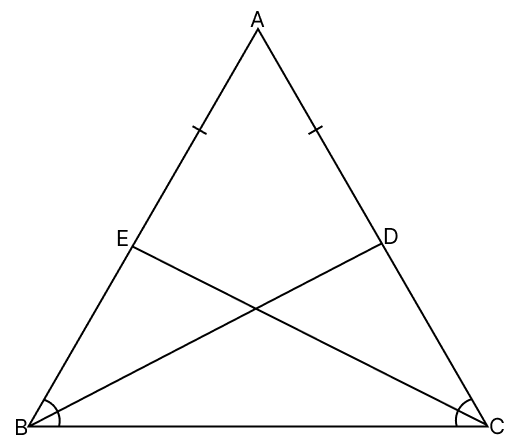
Let ABC be an isosceles triangle with AB = AC.
⇒ ∠B = ∠C (Angles opposite to equal sides in a triangle are equal)
CE and BD are the bisectors of angles ∠C and ∠B respectively to sides AB and AC respectively.
⇒ ∠ABD = ∠DBC and ∠ACE = ∠ECB
Since, angles B and C are equal, thus their half will also be equal.
⇒ ∠ABD = ∠DBC = ∠ACE = ∠ECB
In △AEC and △ADB,
⇒ AC = AB (Given)
⇒ ∠A = ∠A (Common angle)
⇒ ∠ACE = ∠ABD (Proved above)
∴ △AEC ≅ △ADB (By A.S.A axiom)
⇒ CE = BD (Corresponding parts of congruent triangles are equal.)
Hence, the bisectors of the base angles of an isosceles triangle are equal.
In the given figure, AB = AC and side BA has been produced to D. If AE is the bisector of ∠CAD, prove that AE || BC
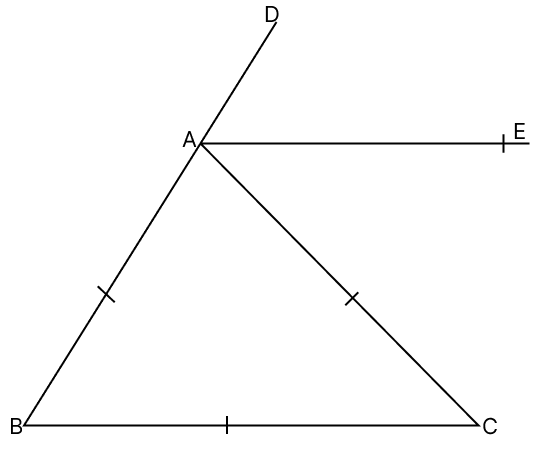
Answer
From figure,
△ABC is an equilateral triangle.
⇒ ∠BAC = ∠ACB = ∠ABC = 60°
Given,
AE is the bisector of ∠CAD
⇒ ∠CAE = ∠DAE = x (let)
From figure,
⇒ ∠BAC + ∠DAE + ∠CAE = 180° (Linear pair)
⇒ 60° + x + x = 180°
⇒ 2x = 180° - 60°
⇒ 2x = 120°
⇒ x =
⇒ x = 60°
⇒ ∠CAE = ∠DAE = 60°
∴ ∠CAE = ∠ACB = 60°
From figure,
∠CAE and ∠ACB are alternate angles between lines BC and AE and are equal.
Hence, proved that AE || BC.
In the given figure, AD is the internal bisector of ∠A and CE || DA. If CE meets BA produced at E, prove that △CAE is isosceles.
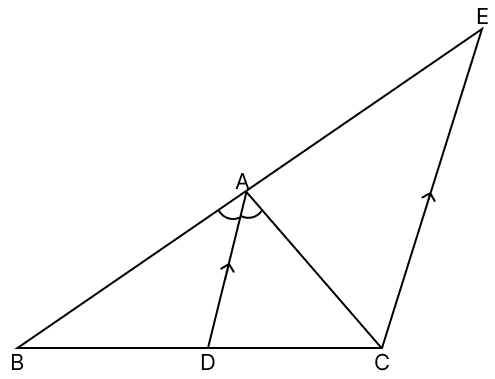
Answer
Given,
CE || AD
BE is the transversal.
From figure,
⇒ ∠DAC = ∠ACE ...(1) (Alternate angles are equal)
⇒ ∠BAD = ∠CEA (Corresponding angles are equal)
But, ∠BAD = ∠DAC (as AD is bisector of ∠BAC)
⇒ ∠DAC = ∠CEA ....(2)
From eq.(1) and (2), we have:
∴ ∠ACE = ∠CEA
AE = AC (Sides opposite to equal angles in a triangle are equal)
∴ △CAE is isosceles triangle.
Hence, proved that △CAE is isosceles.
In the adjoining figure, AB = AC. If DB ⊥ BC and EC ⊥ BC, prove that :
(i) BD = CE
(ii) AD = AE
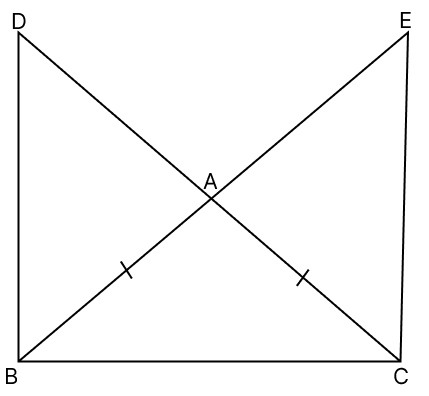
Answer
In △ABC,
AB = AC
⇒ ∠ABC = ∠ACB = x (let) (Angles opposite to equal sides in a triangle are equal)
Given, DB ⊥ BC, ∠DBC = 90°.
From figure,
⇒ ∠DBC = ∠DBA + ∠ABC
⇒ 90° = ∠DBA + x
⇒ ∠DBA = 90° - x .....(1)
Given, EC ⊥ BC, ∠ECB = 90°.
From figure,
⇒ ∠ECB = ∠ECA + ∠ACB
⇒ 90° = ∠ECA + x
⇒ ∠ECA = 90° - x .....(2)
From eq.(1) and (2), we have:
⇒ ∠DBA = ∠ECA
In △ABD and △ACE,
⇒ AB = AC (Given)
⇒ ∠DBA = ∠ECA (Proved above)
⇒ ∠DAB = ∠CAE (Vertically opposite angles are equal)
∴ △ABD ≅ △ACE (By A.S.A axiom)
(i) Since, △ABD ≅ △ACE
⇒ BD = CE (Corresponding parts of congruent triangles are equal)
Hence, proved that BD = CE.
(ii) Since, △ABD ≅ △ACE
⇒ AD = AE (Corresponding parts of congruent triangles are equal)
Hence, proved that AD = AE.
In the given figure, △ABC is an equilateral triangle and BC is produced to D such that BC = CD. Prove that AD ⊥ AB.
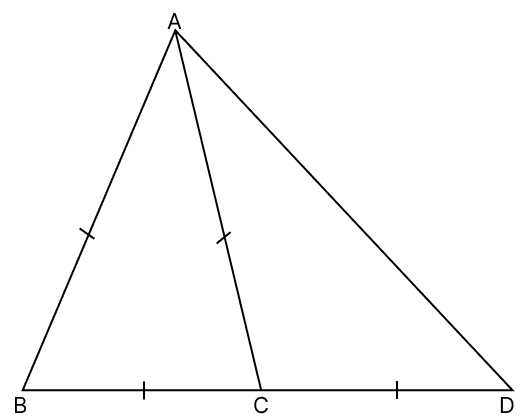
Answer
Given,
△ABC is an equilateral triangle.
⇒ ∠ABC = ∠ACB = ∠BAC = 60°
From figure,
⇒ ∠ACB + ∠ACD = 180° (Linear pair)
⇒ 60° + ∠ACD = 180°
⇒ ∠ACD = 180° - 60°
⇒ ∠ACD = 120°.
In △CAD,
CA = CD (As, BC = CD and BC = CA)
⇒ ∠CAD = ∠CDA = x (let) (Angles opposite to equal sides are equal)
By angle sum property of triangle,
⇒ ∠CAD + ∠CDA + ∠ACD = 180°
⇒ x + x + 120° = 180°
⇒ 2x = 180° - 120°
⇒ 2x = 60°
⇒ x =
⇒ x = 30°
⇒ ∠CAD = ∠CDA = 30°
From figure,
⇒ ∠BAD = ∠BAC + ∠CAD = 60° + 30° = 90°.
Hence, proved that AD ⊥ AB.
In the given figure, AC is the bisector of ∠A. If AB = AC, AD = CD and ∠ABC = 75°, find the values of x and y.
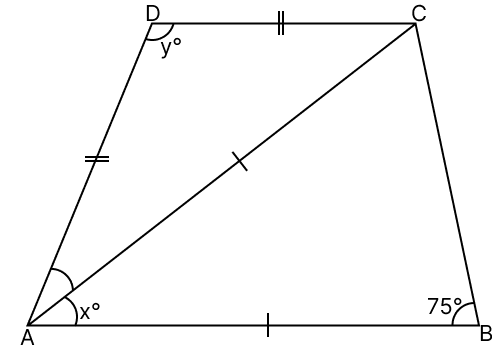
Answer
In △ABC,
AB = AC
⇒ ∠ABC = ∠ACB = 75° (Angles opposite to equal sides in a triangle are equal)
By angle sum property of triangle,
⇒ ∠ABC + ∠ACB + ∠BAC = 180°
⇒ 75° + 75° + x° = 180°
⇒ 150° + x° = 180°
⇒ x° = 180° - 150°
⇒ x° = 30°
⇒ x = 30.
Given,
AC is the bisector to ∠A
⇒ ∠DAC = ∠BAC = x° = 30°
In △ADC,
AD = CD
⇒ ∠DAC = ∠DCA = 30° (Angles opposite to equal sides are equal)
By angle sum property of triangle,
⇒ ∠DAC + ∠DCA + ∠ADC = 180°
⇒ 30° + 30° + y° = 180°
⇒ 60° + y° = 180°
⇒ y° = 180° - 60°
⇒ y° = 120°
⇒ y = 120.
Hence, the values of x = 30 and y = 120.