
The number of rounds that a wheel of diameter m will make in going 4 km is :
1600
1800
1900
2000
Answer
Given,
Diameter of wheel (d) = m
Distance = 4 km = 4000 m.
Distance covered in 1 round = Circumference
= 2πr
= πd
=
= 2 m.
Number of rounds =
=
= 2000.
Hence, option 4 is the correct option.
Four circular cardboard pieces, each of radius 7 cm are placed in such a way that each piece touches two other pieces. The area of the space enclosed by the four pieces is :
42 cm2
40 cm2
21 cm2
18 cm2
Answer
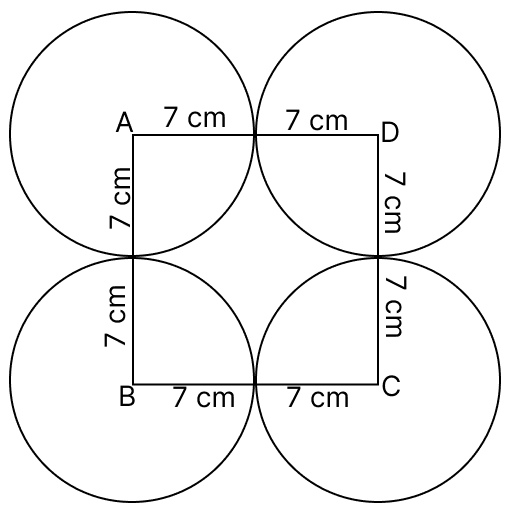
Given,
Radius = 7 cm
From figure,
Distance between centres of two touching circles = 2r = 2 × 7 = 14 cm.
So side of the square : AB = BC = CD = DA = 14 cm.
Area of square = (side)2
= (14)2 = 196 cm2.
At each corner of the square there is a quarter circle of radius 7 cm.
Four quarter circles together make one full circle.
Area of one full circle = πr2
= × 72
= 22 × 7 = 154 cm2.
Area of enclosed space = Area of square - Area of four quarter circles
= 196 - 154
= 42 cm2.
Hence, option 1 is the correct option.
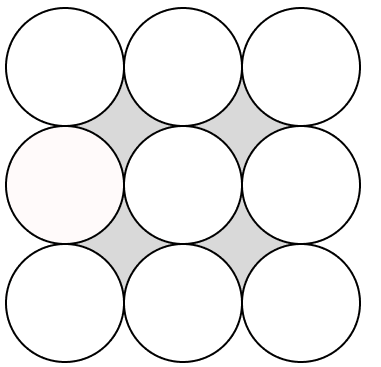
In the figure, if the radius of each circle is 5 cm, then area of the shaded region is :
(400 - 50π) cm2
(400 + 100π) cm2
(400 - 100π) cm2
231 cm2
Answer
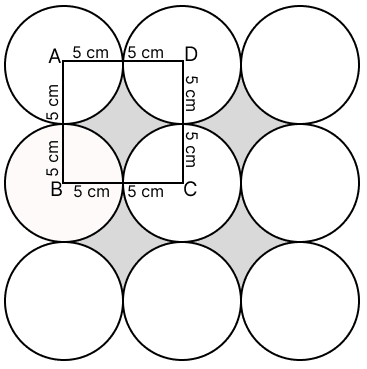
There are 9 equal circles each with radius = 5 cm.The shaded region is the space between the four middle touching circles.
The centres of a the four middle circles form a square.
Diameter = 2r = 2 × 5 = 10 cm
Side of a square = 10 cm.
Area of square = (side)2
= 102 = 100 cm2.
Inside the square there are 4 quarter circles, which together to form one full circle of radius 5 cm.
∴ Area of circle = πr2
= π × 52 = 25π.
Area of one shaded region = 100 - 25π.
∴ For 4 identical shaded region
Total area = 4(100 - 25π)
= 400 - 100π cm2.
Hence, option 3 is the correct option.
If sum of the areas of two circles with radii r1 and r2 is equal to the area of circle of radius r, then :
r = r1 + r2
r > r1 + r2
r2 < r12 + r22
r2 = r12 + r22
Answer
Given,
Sum of the areas of two circles with radii r1 and r2 is equal to the area of circle of radius r.
π(r1)2 + π(r2)2 = πr2
r12 + r22 = r2
Hence, option 4 is the correct option.
Area of sector of central angle 200° of a circle is 770 cm2. The length of the corresponding arc of this sector is :
cm
cm
76 cm
cm
Answer
Given,
Area of sector = 770 cm2
Central angle = 200°
We know that,
Calculating the arc length :
Hence, option 2 is the correct option.
Check whether the following statement is true or false. Justify your answer.
If the length of an arc of a circle of radius r is equal to that of an arc of a circle of radius 2r, then the angle of the corresponding sector of the first circle is double the angle of the corresponding sector of the other circle.
Answer
We know that,
Arc length = × 2πr
Let L1 and L2 be the arc length of first circle and second circle and θ1 and θ2 be the central angle of the sector for the first circle and second circle respectively.
Arc length for first circle (L1) = × 2πr
Arc length for second circle (L2) = × 2π(2r)
L2 = × 4πr
According to question :
L1 = L2
× 4πr
2θ1 = 4θ2
θ1 = 2θ2
∴ Angle of the corresponding sector of the first circle is double the angle of the corresponding sector of the other circle.
Hence, the statement is True.
In the figure, a circle is inscribed in a square of side 5 cm and another circle is circumscribing the square. Find the ratio of the area of the outer circle to that of the inner circle.
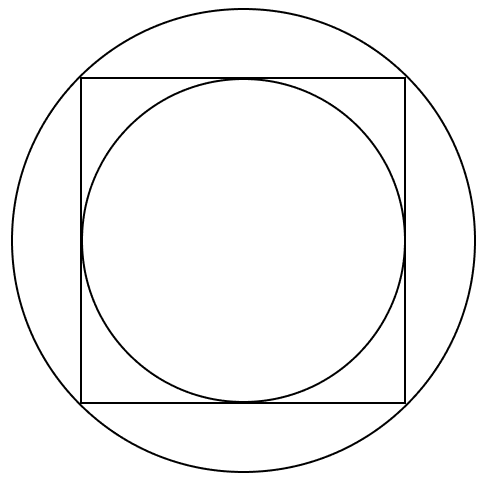
Answer
Given,
Side of square = 5 cm.
Let A1 and A2 be the areas of the inner and outer circle respectively.
Inner circle (inscribed in the square):
Diameter of the circle = side of the square
Diameter = 5 cm
So, radius = = 2.5 cm.
Area of inner circle (A1) = πr2
= π(2.5)2
= 6.25π cm2
Outer circle (circumscribing the square)
Diameter of the outer circle = Diagonal of the square
Diameter of the outer circle = cm.
Radius of the outer circle =
Area of outer circle (A2) = πr2
=
= π ×
= 12.5π cm2.
Ratio of areas :
Outer area : Inner area
A2 : A1
12.5π : 6.25π
2 : 1.
Hence, ratio = 2 : 1.