
is same as:
Answer
Rationalising the denominator by multiplying the numerator and denominator by , we get :
Hence, option 2 is the correct option.
If a + b = 16, a - b = 2, then ab =
48
56
63
65
Answer
We know that,
⇒ 4ab = (a + b)2 - (a - b)2
Substituting values we get :
⇒ 4ab = (16)2 - (2)2
⇒ 4ab = 256 - 4
⇒ 4ab = 252
⇒ ab = 63.
Hence, option 3 is the correct option.
x3 - y3 is equal to:
(x + y)(x2 + y2 + xy)
(x - y)(x2 + y2 + xy)
(x + y)(x2 + y2 - xy)
(x - y)(x2 - y2 + xy)
Answer
We know that, the standard identity for the difference of cubes is :
⇒ x3 - y3 = (x - y)(x2 + xy + y2)
∴ x3 - y3 = (x - y)(x2 + y2 + xy).
Hence, option 2 is the correct option.
(-27)2/3 is equal to:
9
12
21
-9
Answer
Solving the given expression :
Hence, option 1 is the correct option.
If log8 x = , then the value of x is:
1
2
3
4
Answer
Given,
⇒ log8 x =
Writing in exponential form, we get :
Hence, option 4 is the correct option.
In a triangle ABC, ∠A = 60° and ∠B = 40°. Then:
BC > AC
BC < AC
BC = AC
none of these
Answer
Given,
In △ABC, ∠A = 60° and ∠B = 40°.
We know that, the side opposite to the greater angle is longer.
Side BC is opposite to ∠A and side AC is opposite to ∠B.
Since ∠A > ∠B (60° > 40°), the side opposite to ∠A is longer than the side opposite to ∠B.
⇒ BC > AC.
Hence, option 1 is the correct option.
In △ABC, DE ∥ BC and D is the mid-point of AB. If DE = 2.5 cm, then BC is equal to:
2.5 cm
5 cm
6 cm
6.5 cm
Answer
Given,
In △ABC, DE ∥ BC and D is the mid-point of AB. DE = 2.5 cm.
Since D is the mid-point of AB and DE ∥ BC, by the converse of mid-point theorem, E is the mid-point of AC and DE = BC.
⇒ BC = 2 × DE
⇒ BC = 2 × 2.5
⇒ BC = 5 cm.
Hence, option 2 is the correct option.
Area of a parallelogram is equal to:
base × height
base × height
base × height
base × height
Answer
We know that, the area of a parallelogram is given by the product of its base and the corresponding height.
∴ Area of parallelogram = base × height.
Hence, option 4 is the correct option.
In 1 - 10, 11 - 20, 21 - 30 ........, the class mark of second class interval is:
16
15
15.5
20
Answer
The second class interval is 11 - 20.
By formula,
Class mark =
Substituting values we get :
Hence, option 3 is the correct option.
The median of first 9 odd natural numbers is:
9
8.5
8
7.5
Answer
The first 9 odd natural numbers are 1, 3, 5, 7, 9, 11, 13, 15 and 17.
Here, the number of observations n = 9, which is odd.
By formula,
Median = observation
Substituting values we get :
Hence, option 1 is the correct option.
The area of an equilateral triangle is cm2. The height of the triangle is:
12 cm
9 cm
cm
6 cm
Answer
Let the side of the equilateral triangle be a cm.
By formula,
Area of equilateral triangle =
Substituting values we get :
By formula,
Height of equilateral triangle =
Substituting values we get :
Hence, option 4 is the correct option.
Each side of a square formed by a wire is 11 cm. The area of the circle that can be formed by this wire is:
154 cm2
150 cm2
140 cm2
110 cm2
Answer
The wire forms a square of side 11 cm, so its total length equals the perimeter of the square.
Length of wire = 4 × 11 = 44 cm
When the same wire is bent into a circle, this length becomes the circumference of the circle.
⇒ 2πr = 44
⇒ r = = 7 cm.
Now, the area of the circle is:
Area = πr2 = × 72 = 22 × 7 = 154 cm2
Hence, option 1 is the correct option.
The length of the diagonal of a cube is cm. Volume of the cube is:
54 cm3
cm3
cm3
cm3
Answer
Given, the length of the diagonal of the cube is cm.
Let the edge of cube is a cm, the length of the diagonal of a cube = .
By formula,
Volume of cube = a3
Substituting values we get :
Hence, option 3 is the correct option.
The value of sin230° + cos230° + tan245° is:
1
2
3
4
Answer
We know that,
⇒ sin230° + cos230° = 1 and tan2 45° = 1.
Substituting these values, we get :
= 1 + (1)2
= 1 + 1
= 2.
Hence, option 2 is the correct option.
Assertion (A): The distance between the points A(-4, 2) and B(1, 6) is given by units = units
Reason (R): The distance between the point P(x1, y1) and Q(x2, y2) is given by PQ =
A is true, R is false
A is false, R is true
Both A and R are true
Both A and R are false.
Answer
The correct distance formula between points P(x1, y1) and Q(x2, y2) is :
⇒ PQ =
The formula given in Reason (R) is incorrect, so Reason (R) is false.
Using the correct formula, the distance between A(-4, 2) and B(1, 6) :
The Assertion uses the coordinates incorrectly and gives , whereas the correct distance is . So, Assertion (A) is false.
∴ Both A and R are false.
Hence, option 4 is the correct option.
Solve the system of equations 2x - 3y + 8 = 0, 3x + y + 1 = 0 by the method of cross multiplication.
Answer
Given equations,
⇒ 2x - 3y + 8 = 0 ......... (1)
⇒ 3x + y + 1 = 0 ......... (2)
Comparing with a1x + b1y + c1 = 0 and a2x + b2y + c2 = 0, we get :
a1 = 2, b1 = -3, c1 = 8 and a2 = 3, b2 = 1, c2 = 1.
By cross multiplication method,
⇒
Substituting values we get :
Taking , we get :
⇒ x = = -1.
Taking , we get :
⇒ y = = 2.
Hence, x = -1 and y = 2.
Show that the quadrilateral formed by joining the mid-points of the pairs of adjacent sides of a square is a square.
Answer
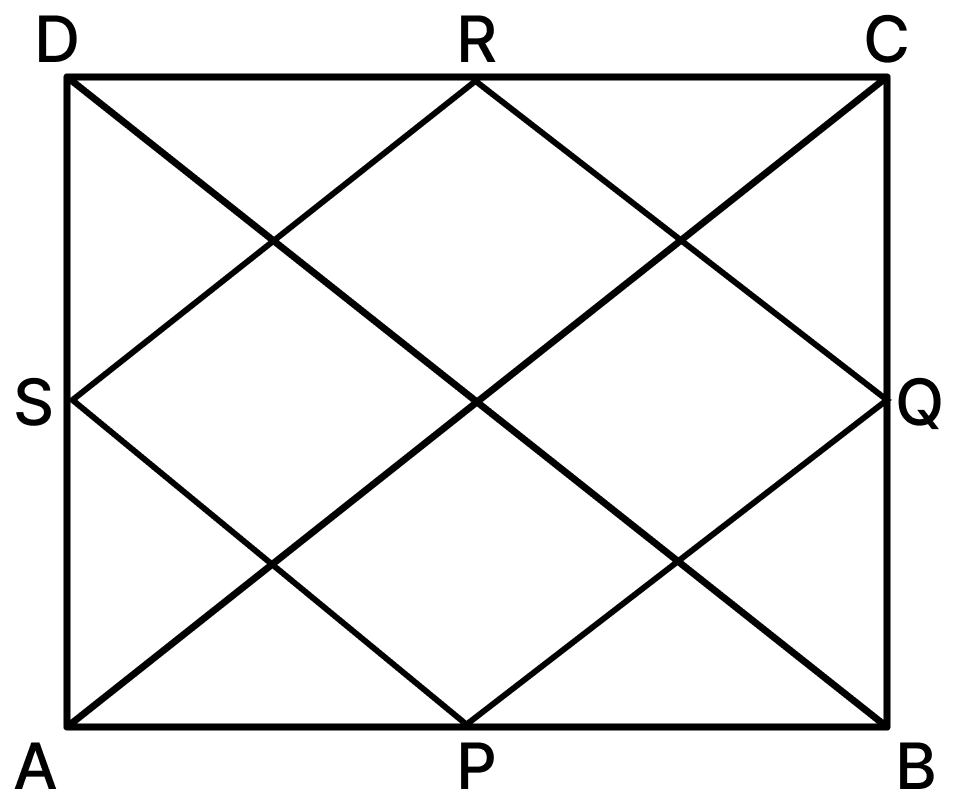
Given,
ABCD is a square in which P, Q, R and S are the mid-points of sides AB, BC, CD and DA respectively.
In a square, the diagonals are equal, so AC = BD.
Let AC = BD = x
By mid-point theorem, the line segment joining the mid-points of two sides of a triangle is parallel to the third side and equal to half of it.
In △ABC, P and Q are the mid-points of AB and BC respectively.
By mid-point theorem,
⇒ PQ ∥ AC and PQ = ......... (1)
In △ADC, S and R are the mid-points of DA and CD respectively.
⇒ SR ∥ AC and SR = ......... (2)
In △ABD, S and P are the mid-points of AD and AB respectively.
⇒ SP ∥ BD and PS = .......(3)
In △BCD, Q and R are the mid-points of BC and DC respectively.
⇒ QR ∥ BD and QR = ......... (4)
From equations (1), (2), (3) and (4), we get :
⇒ PQ = SR = PS = QR.
So, all four sides of PQRS are equal.
Also, the diagonals of a square are perpendicular to each other, so AC ⊥ BD. Since PQ ∥ AC and PS ∥ BD, we have PQ ⊥ PS, i.e. ∠SPQ = 90°.
Since all sides of PQRS are equal and one angle is 90°, PQRS is a square.
Hence, proved that the quadrilateral formed is a square.
The value of a machine depreciates at the rate of % per annum. It was purchased 3 years ago. If its present value is ₹62500, find its purchase price.
Answer
Given,
Rate of depreciation (r) = % per annum.
Time = 3 years and present value = ₹62500.
Let the purchase price be ₹P.
By formula,
Present value =
Substituting values we get :
Hence, the purchase price of the machine = ₹1,08,000.
Find three rational numbers between and 1.
Answer
We have to find three rational numbers between and 1.
We can write and 1 with a common denominator. Since we need 3 numbers, we multiply numerator and denominator by a number greater than (3 + 1) = 4.
Writing both with denominator 8 :
⇒ .
The rational numbers between .
∴ Three rational numbers between .
Hence, three rational numbers between .
If (a + b + c) = 15 and (ab + bc + ca) = 74, find the value of (a2 + b2 + c2).
Answer
Given,
(a + b + c) = 15 and (ab + bc + ca) = 74.
We know that,
⇒ (a + b + c)2 = a2 + b2 + c2 + 2(ab + bc + ca)
Rearranging, we get :
⇒ a2 + b2 + c2 = (a + b + c)2 - 2(ab + bc + ca)
Substituting values we get :
⇒ a2 + b2 + c2 = (15)2 - 2(74)
= 225 - 148
= 77.
Hence, the value of (a2 + b2 + c2) = 77.
Draw the frequency polygon representing the following frequency distribution.
| Class-interval | Frequency |
|---|---|
| 30 – 34 | 12 |
| 35 – 39 | 16 |
| 40 – 44 | 20 |
| 45 – 49 | 8 |
| 50 – 54 | 10 |
| 55 – 59 | 4 |
Answer
Adjustment factor
Since the class-intervals are in the inclusive form, we first convert them to the continuous (exclusive) form by subtracting 0.5 from each lower limit and adding 0.5 to each upper limit. We then find the class mark (mid-value) of each class.
| Class-interval | Frequency |
|---|---|
| 24.5 – 29.5 | 0 |
| 29.5 – 34.5 | 12 |
| 34.5 – 39.5 | 16 |
| 39.5 – 44.5 | 20 |
| 44.5 – 49.5 | 8 |
| 49.5 – 54.5 | 10 |
| 54.5 – 59.5 | 4 |
| 59.5 - 64.5 | 0 |
By formula,
Class mark =
| Class-interval | Class mark | Frequency |
|---|---|---|
| 24.5 – 29.5 | 27 | 0 |
| 29.5 – 34.5 | 32 | 12 |
| 34.5 – 39.5 | 37 | 16 |
| 39.5 – 44.5 | 42 | 20 |
| 44.5 – 49.5 | 47 | 8 |
| 49.5 – 54.5 | 52 | 10 |
| 54.5 – 59.5 | 57 | 4 |
| 59.5 - 64.5 | 62 | 0 |
Steps of Construction:
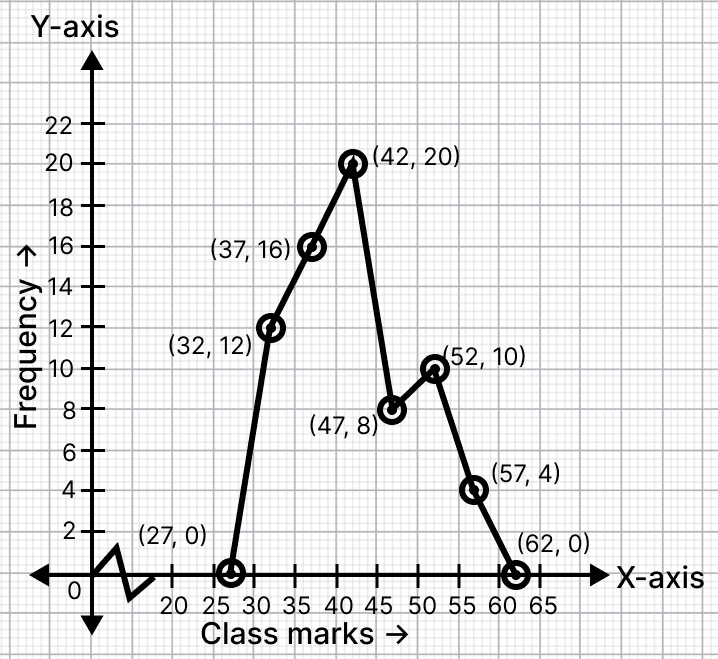
On a graph paper, mark class-marks along x-axis and frequencies along y-axis.
Since, the scale on x-axis starts at 20, a kink is shown near the origin on x-axis to indicate that the graph is drawn to scale beginning at 20.
Take 1 cm along the x-axis = 5 units.
Take 1 cm along the y-axis = 2 units.
On the graph, mark points taking values of class-marks along x-axis and the values of their corresponding frequencies along y-axis.
Plot the points (27, 0), (32, 12), (37, 16), (42, 20), (47, 8), (52, 10), (57, 4) and (62, 0), taking the class marks along the x-axis and the corresponding frequencies along the y-axis. The classes 24.5 - 29.5 and 59.5 - 64.5 with frequency 0 are taken at both the ends to complete the polygon.
Join the consecutive points in order by straight line segments to obtain the required frequency polygon.
At what rate per cent per annum will a sum of ₹4000 yield ₹1324 as compound interest in 3 years?
Answer
Given,
Principal (P) = ₹4000, Compound Interest (C.I.) = ₹1324 and Time (n) = 3 years.
By formula,
Amount = Principal + Compound Interest
⇒ A = 4000 + 1324 = ₹5324.
By formula,
Amount =
Substituting values we get :
Hence, the required rate of interest = 10% per annum.
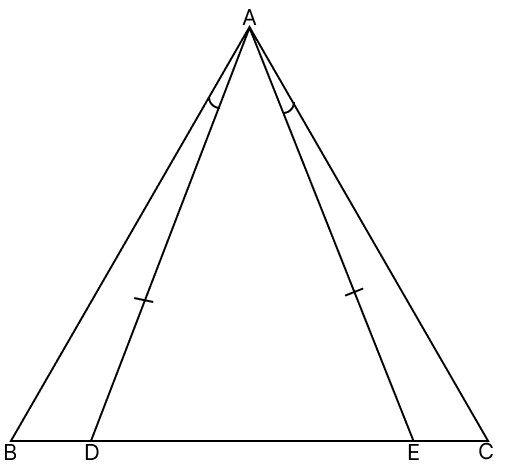
In the given figure, AD = AE and ∠BAD = ∠CAE. Prove that: AB = AC
Answer
Given,
AD = AE and ∠BAD = ∠CAE.
Since AD = AE, in △ADE the angles opposite to equal sides are equal.
⇒ ∠ADE = ∠AED .........(1)
Now, ∠ADB and ∠ADE are angles on a straight line, and ∠AEC and ∠AED are angles on a straight line.
⇒ ∠ADB = 180° - ∠ADE ......... (2)
⇒ ∠AEC = 180° - ∠AED ......... (3)
From equations (1), (2) and (3), we get :
⇒ ∠ADB = ∠AEC ......... (4)
Given, ∠BAD = ∠CAE.
Adding ∠DAE to both sides, we get :
⇒ ∠BAD + ∠DAE = ∠CAE + ∠DAE
⇒ ∠BAE = ∠CAD ......... (5)
Now, in △ABD and △ACE :
⇒ ∠BAD = ∠CAE [Given]
⇒ AD = AE [Given]
⇒ ∠ADB = ∠AEC [From equation (4)]
∴ △ABD ≅ △ACE [By ASA congruence criterion]
⇒ AB = AC [By C.P.C.T.]
Hence, proved that AB = AC.
Verify that: cos 60° = (1 - 2 sin230°) = (2 cos230° - 1)
Answer
We know that,
⇒ cos 60° = , sin 30° = and cos 30° = .
Solving the first expression (1 - 2 sin230°) :
Solving the second expression (2 cos230° - 1) :
Since cos 60° = , all three are equal.
Hence, verified that cos 60° = (1 - 2 sin230°) = (2 cos230° - 1).
Factorise: x4 + 4.
Answer
Solving the given expression by adding and subtracting 4x2 :
Using the identity a2 - b2 = (a + b)(a - b), we get :
Hence, x4 + 4 = (x2 + 2x + 2)(x2 - 2x + 2).
If log 2 = 0.3010, find the value of .
Answer
Solving the given expression :
Using the quotient and product rules of logarithms, we get :
Hence, the value of the given expression = 0.3010.
The diagonal of a cube is cm. Find its surface area and volume.
Answer
Given,
Diagonal of the cube = cm.
Let the edge of the cube be a cm.
By formula,
Diagonal of cube =
Substituting values we get :
By formula,
Surface area of cube = 6a2
Substituting values we get :
By formula,
Volume of cube = a3
Substituting values we get :
= 4096 cm3.
Hence, the surface area = 1536 cm2 and the volume = 4096 cm3.
A copper wire when bent in the form of an equilateral triangle has an area of cm2. If the same wire is bent into the form of a circle, find the area enclosed by the wire.
Answer
Given,
Area of the equilateral triangle = cm2.
Let the side of the equilateral triangle be a cm.
By formula,
Area of equilateral triangle =
Substituting values we get :
∴ Length of the wire = perimeter of the triangle = 3a = 3 × 22 = 66 cm.
When the same wire is bent into a circle, the circumference of the circle = 66 cm.
By formula,
Circumference = 2πr
Substituting values we get :
By formula,
Area of circle = πr2
Substituting values we get :
Hence, the area enclosed by the wire when bent into a circle = 346.5 cm2.
Simplify:
Answer
Let a = .
Then .
So the given expression becomes :
⇒ (a - b)(a2 + ab + b2) [since the middle term 1 = ab]
We know that, the identity for the difference of cubes is :
⇒ (a - b)(a2 + ab + b2) = a3 - b3
Substituting back the values of a and b, we get :
Hence, the simplified value = .
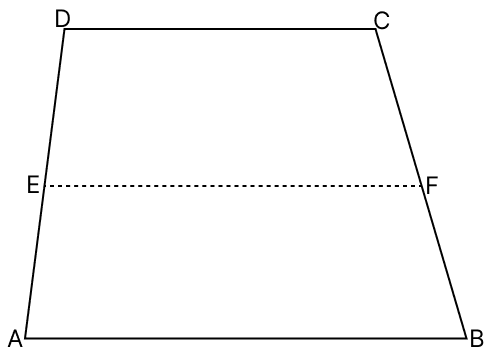
In the adjoining figure, ABCD is a trapezium in which AB ∥ DC and E is the mid-point of AD. If EF ∥ AB meets BC at F, show that F is the mid-point of BC.
Answer
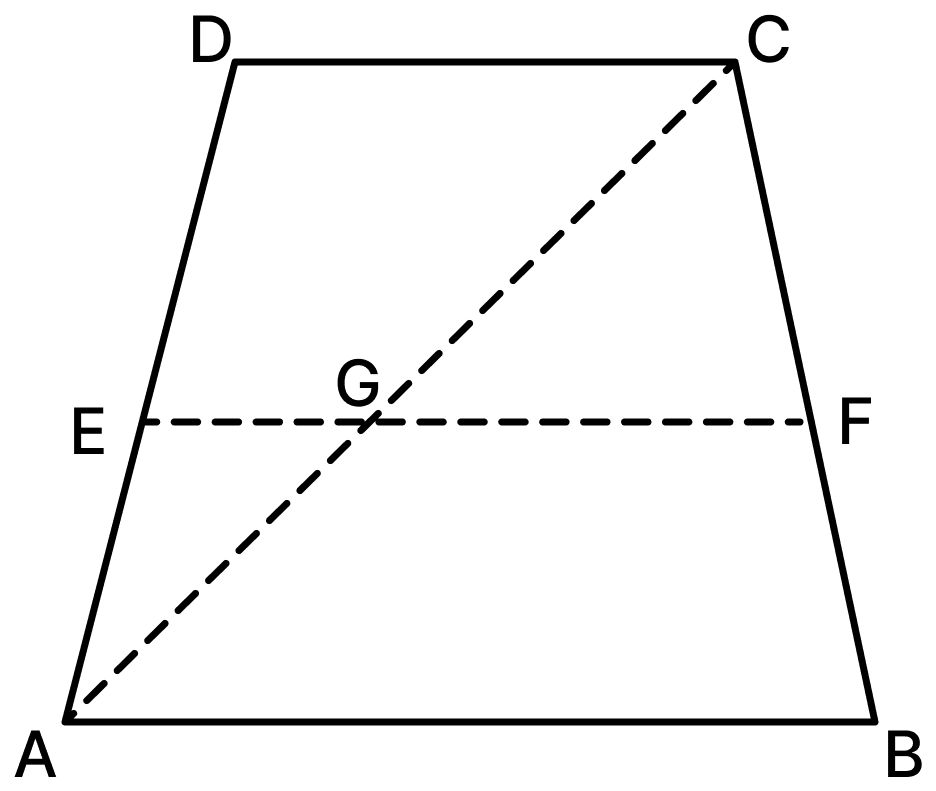
Given,
ABCD is a trapezium in which AB ∥ DC, E is the mid-point of AD and EF ∥ AB.
To prove : F is the mid-point of BC.
Construction : Join the diagonal AC, which meets EF at point G.
Since AB ∥ DC and EF ∥ AB, we have EF ∥ DC as well.
In △ADC, E is the mid-point of AD and EG ∥ DC.
By converse of mid-point theorem, which states that if a line passes through the midpoint of one side of a triangle and is parallel to another side, it will bisect the third side.
G is the mid-point of AC.
⇒ AG = GC
In △CAB, G is the mid-point of AC and GF ∥ AB.
By converse of mid-point theorem, F is the mid-point of BC.
Hence, proved that F is the mid-point of BC.
Show that the line segment joining the mid-points of a pair of opposite sides of a parallelogram, divides it into two equal parallelograms.
Answer
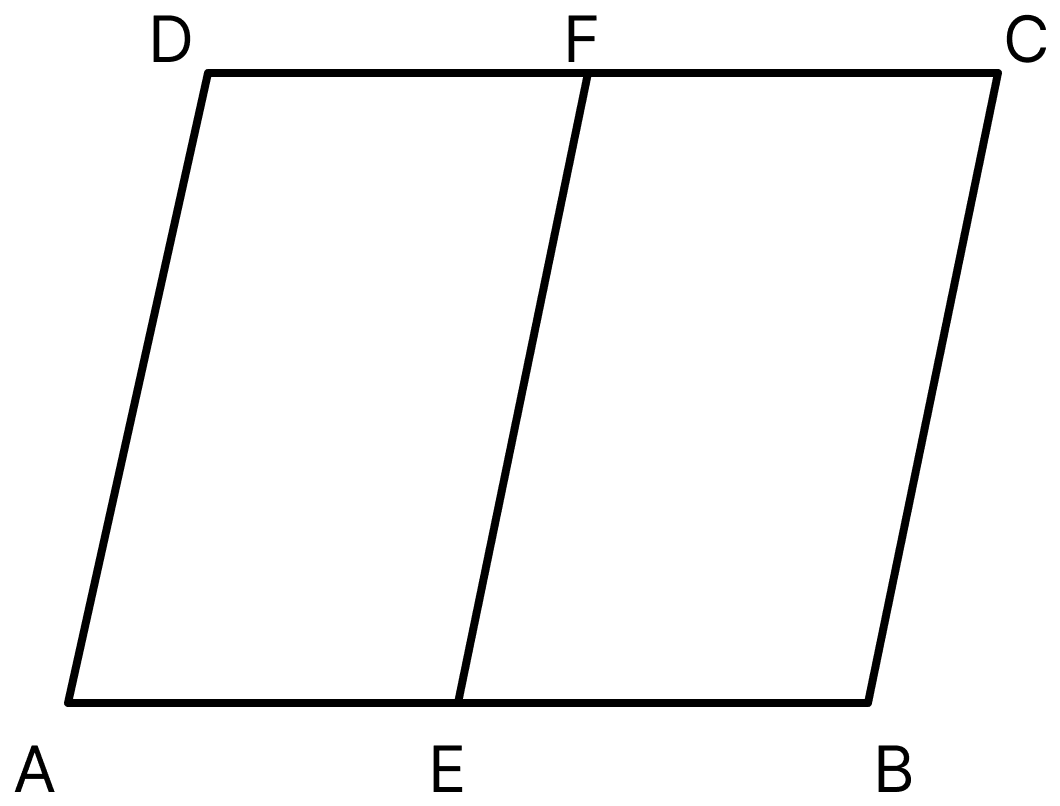
Given,
ABCD is a parallelogram in which E and F are the mid-points of the opposite sides AB and DC respectively. EF is joined.
Since ABCD is a parallelogram, AB ∥ DC and AB = DC.
So, AE ∥ DF. Also, E and F are mid-points, so AE = DC.
Since AB = DC,
⇒ AE = DF.
Since AE ∥ DF and AE = DF, AEFD is a parallelogram.
As, ABCD is a parallelogram, AB ∥ DC and AB = DC.
So, EB ∥ FC. Also, E and F are mid-points, so EB = DC.
Since AB = DC,
⇒ EB = FC
Since EB ∥ FC and EB = FC, EBCF is a parallelogram.
We know that, parallelograms on equal bases and between the same parallels are equal in area.
Now, parallelograms AEFD and EBCF have equal bases (AE = EB) and lie between the same parallels AB and DC.
⇒ ar(AEFD) = ar(EBCF).
Hence, proved that the line segment joining the mid-points of a pair of opposite sides of a parallelogram, divides it into two equal parallelograms.
Solve the simultaneous equations graphically:
x + y = 1 and 3x + 2y = 6
Answer
First Equation : x + y = 1
Step 1 :
Give at least three suitable values to the variable x and find the corresponding values of y.
Let x = 1, then y = 0
Let x = 0, then y = 1
Let x = 4, then y = -3
Step 2 :
Make a table for the corresponding values of x and y: :
| x | y |
|---|---|
| 1 | 0 |
| 0 | 1 |
| 4 | -3 |
Step 3 :
Plot the points (1, 0), (0, 1), (4, -3) on a graph paper and then draw a straight line passing through the points plotted on the graph.
Second Equation : 3x + 2y = 6
Step 1 :
Give at least three suitable values to the variable x and find the corresponding values of y.
Let x = 0, then y = 3
Let x = 2, then y = 0
Let x = 4, then y = -3
Step 2 :
Make a table for the corresponding values of x and y: :
| x | y |
|---|---|
| 0 | 3 |
| 2 | 0 |
| 4 | -3 |
Step 3 :
Plot the points (0, 3), (2, 0), (4, -3) on a graph paper and then draw a straight line passing through the points plotted on the graph.
On the same graph paper, draw the graph for each given equation.
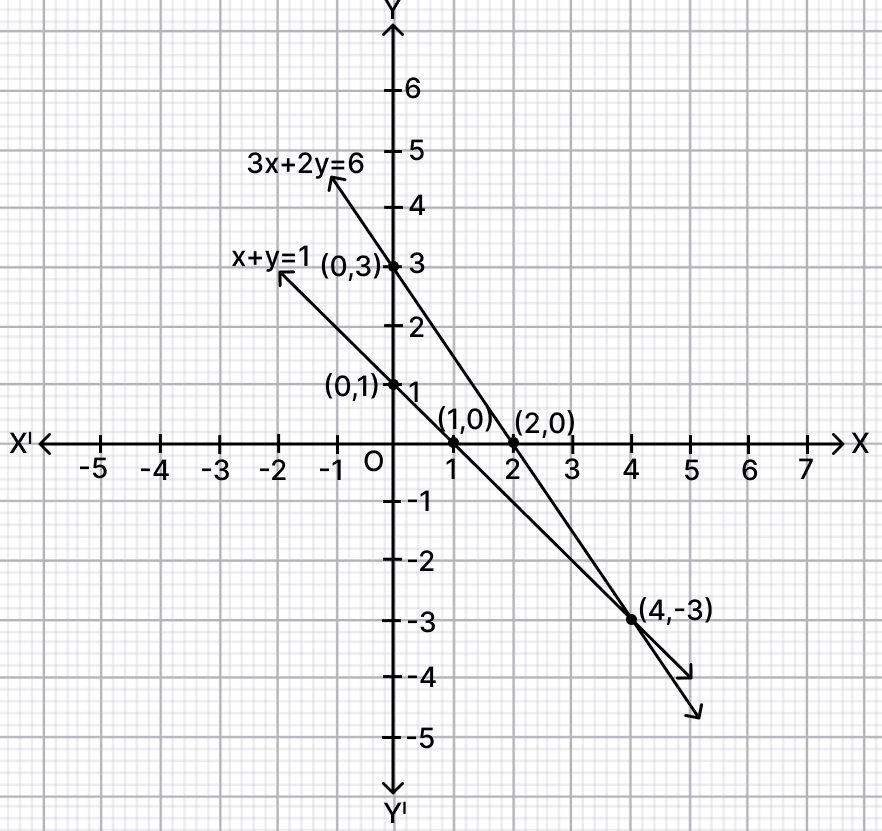
Both the straight lines drawn meet at a point. As it is clear from the graph, co-ordinates of the common point are (4, -3).
Hence, x = 4, y = -3.
Find 9 rational numbers between 0 and 0.1.
Answer
We have to find 9 rational numbers between 0 and 0.1.
We can write 0 and 0.1 as 0.00 and 0.10 respectively.
The rational numbers lying between 0.00 and 0.10 are :
⇒ 0.01, 0.02, 0.03, 0.04, 0.05, 0.06, 0.07, 0.08 and 0.09.
Hence, 9 rational numbers between 0 and 0.1 are 0.01, 0.02, 0.03, 0.04, 0.05, 0.06, 0.07, 0.08 and 0.09.
In the given figure, ABCD is a rectangle whose diagonals intersect at O. Diagonal AC is produced to E and ∠ECD = 140°. Find the angles of △OAB.
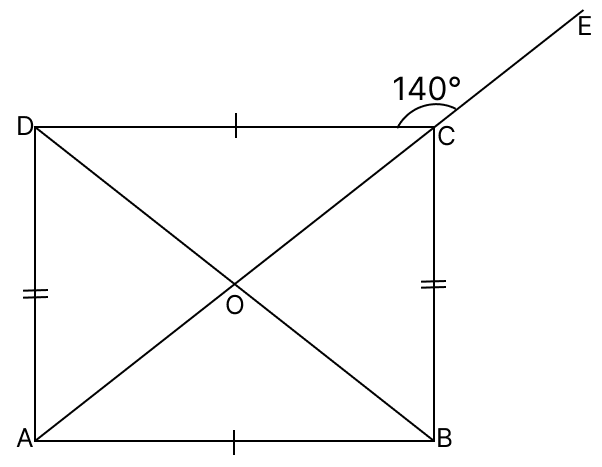
Answer
Given,
ABCD is a rectangle whose diagonals intersect at O. AC is produced to E and ∠ECD = 140°.
Since ∠DCA and ∠ECD form a linear pair,
⇒ ∠DCA = 180° - ∠ECD
⇒ ∠DCA = 180° - 140°
⇒ ∠DCA = 40°.
We know that, the diagonals of a rectangle are equal and bisect each other.
∴ OC = OD, which makes △OCD isosceles.
⇒ ∠ODC = ∠OCD = 40°.
In △OCD, by angle sum property,
⇒ ∠COD = 180° - ∠OCD - ∠ODC
⇒ ∠COD = 180° - 40° - 40°
⇒ ∠COD = 100°.
Since ∠AOB and ∠COD are vertically opposite angles,
⇒ ∠AOB = ∠COD = 100°.
In △OAB, OA = OB (halves of equal diagonals), so △OAB is isosceles.
⇒ ∠OAB = ∠OBA.
By angle sum property,
⇒ ∠OAB + ∠OBA + ∠AOB = 180°
⇒ 2∠OAB + 100° = 180°
⇒ 2∠OAB = 80°
⇒ ∠OAB = 40°.
∴ ∠OAB = ∠OBA = 40° and ∠AOB = 100°.
Hence, the angles of △OAB are ∠OAB = 40°, ∠OBA = 40° and ∠AOB = 100°.
Find the area of a rhombus one side of which measures 20 cm and one of whose diagonals is 24 cm.
Answer
Given,
Side of the rhombus = 20 cm and one diagonal = 24 cm.
We know that, the diagonals of a rhombus bisect each other at right angles.
Let the diagonals be d1 = 24 cm and d2.
Half of the first diagonal = = 12 cm.
In the right-angled triangle formed by half the diagonals and a side, by Pythagoras theorem :
∴ d2 = 2 × 16 = 32 cm.
By formula,
Area of rhombus =
Substituting values we get :
Hence, the area of the rhombus = 384 cm2.
An isosceles △ABC is inscribed in a circle. If AB = AC = cm and BC = 24 cm, find the radius of the circle.
Answer
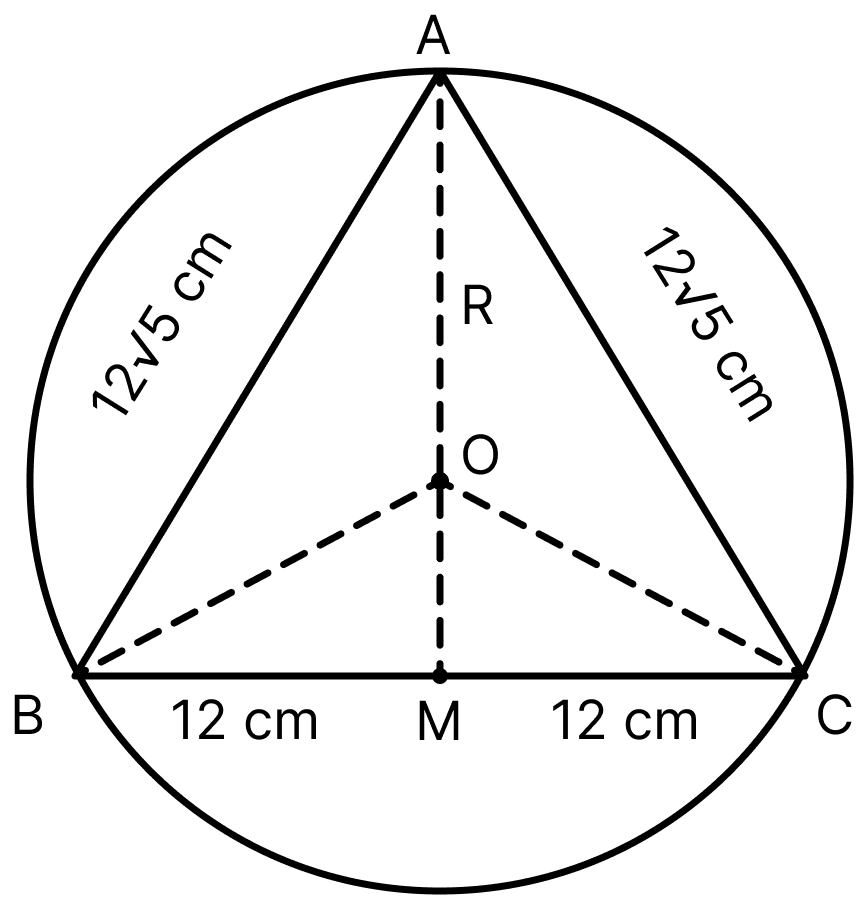
Given,
In the isosceles △ABC inscribed in a circle, AB = AC = cm and BC = 24 cm.
Let O be the centre of the circle and let AM be the perpendicular from A to BC, meeting BC at M. Since the triangle is isosceles, AM passes through the centre O and bisects BC.
∴ BM = = 12 cm.
In right-angled △AMB,
By Pythagoras theorem,
⇒ (AB)2 = (AM)2 + (BM)2
⇒ (AM)2 = (AB)2 - (BM)2
Let the radius of the circle be R cm. Then OA = OB = R, and OM = AM - OA = (24 - R) cm.
In right-angled △OMB, by Pythagoras theorem,
Hence, the radius of the circle = 15 cm.
If O is any point inside △ABC, prove that ∠BOC > ∠A.
Answer
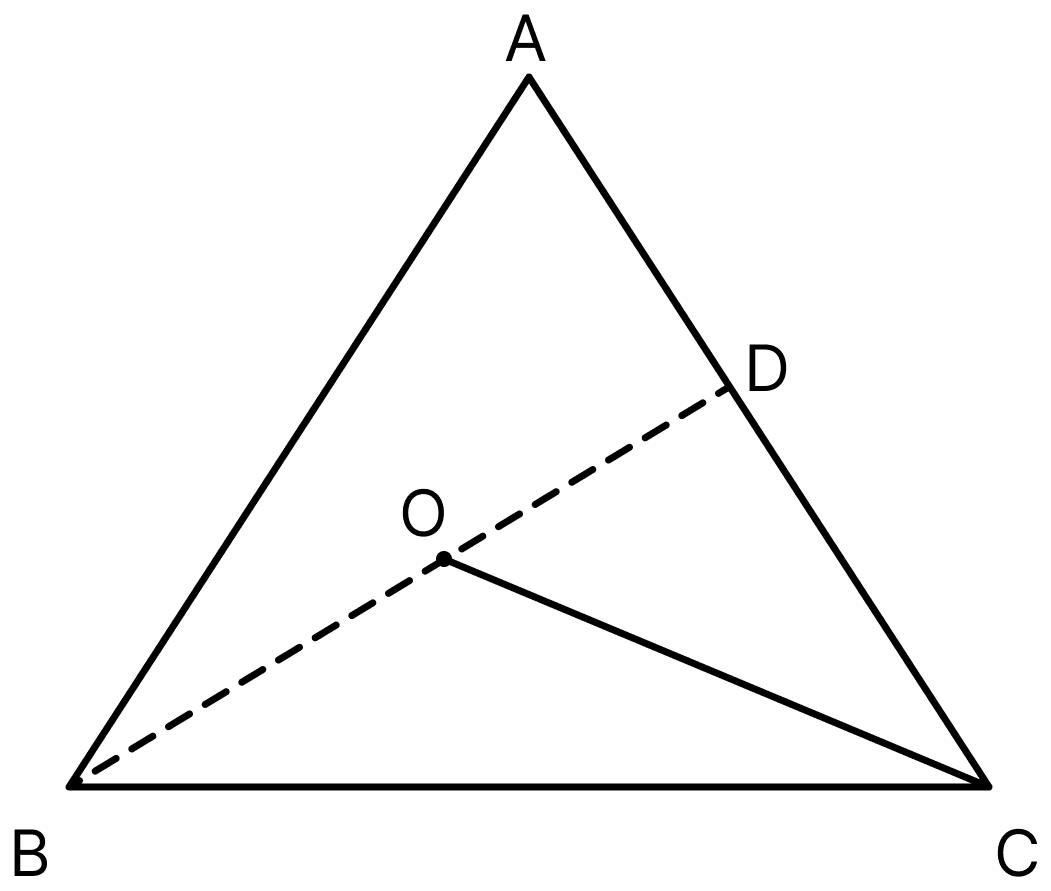
Given,
O is any point inside △ABC.
To prove : ∠BOC > ∠A.
Join BO and produce it to meet AC at point D.
We know that, an exterior angle of a triangle is greater than each of its interior opposite angles.
In △ABD, ∠BDC is an exterior angle.
⇒ ∠BDC > ∠A ......... (1)
In △ODC, ∠BOC is an exterior angle.
⇒ ∠BOC > ∠BDC ......... (2)
From equations (1) and (2), we get :
⇒ ∠BOC > ∠BDC > ∠A
⇒ ∠BOC > ∠A.
Hence, proved that ∠BOC > ∠A.
From the given figure, find the area of trapezium ABCD.
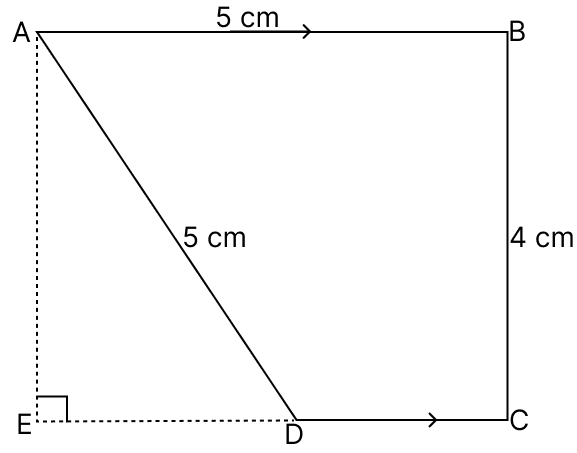
Answer
From the given figure, ABCD is a trapezium in which AB and DC are the two parallel sides and the perpendicular distance between them is the height.
As, AED is a right angled triangle, right angled at E;
By Pythagoras theorem;
⇒ (AD)2 = (AE)2 + (ED)2
⇒ (ED)2 = (AD)2 - (AE)2
⇒ (ED)2 = 52 - 42
⇒ (ED)2 = 25 - 16
⇒ (ED)2 = 9
⇒ ED =
⇒ ED = 3 cm
Now, DC = EC - ED
DC = 5 - 3 = 2 cm
By formula,
⇒ Area of trapezium ABCD = 14 cm2.
Hence, the area of trapezium ABCD = 14 cm2.
In the given figure, two chords AB and CD of a circle intersect at a point P. If AB = CD, prove that: arc AD = arc CB.
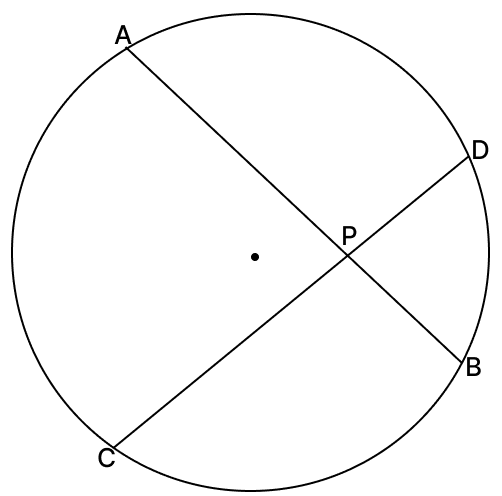
Answer
Given,
Two chords AB and CD of a circle intersect at point P and AB = CD.
To prove : arc AD = arc CB.
We know that, equal chords of a circle subtend equal arcs.
Since AB = CD,
⇒ arc AB = arc CD ......... (1)
The arc AB can be written as the sum of arc AD and arc DB.
⇒ arc AB = arc AD + arc DB ......... (2)
The arc CD can be written as the sum of arc CB and arc BD.
⇒ arc CD = arc CB + arc BD ......... (3)
Substituting equations (2) and (3) in equation (1), we get :
⇒ arc AD + arc DB = arc CB + arc BD
Since arc DB = arc BD, subtracting it from both sides, we get :
⇒ arc AD = arc CB.
Hence, proved that arc AD = arc CB.
Following data gives the number of children in 40 families:
1, 2, 6, 5, 1, 3, 2, 6, 2, 3, 4, 2, 0, 4, 4, 3, 2, 2, 0, 0, 1, 2, 2, 4, 4, 3, 2, 1, 0, 5, 1, 2, 4, 3, 4, 1, 1, 6, 2, 2
Represent it in the form of a frequency distribution.
Answer
Counting the number of times each value (number of children) occurs in the data, we get the following frequency distribution :
| Number of children | Tally marks | Frequency (Number of families) |
|---|---|---|
| 0 | |||| | 4 |
| 1 | 7 | |
| 2 | 12 | |
| 3 | 5 | |
| 4 | 7 | |
| 5 | || | 2 |
| 6 | ||| | 3 |
| Total | 40 |
Hence, the required frequency distribution is represented as shown above.
In a rectangle ABCD, AB = 12 cm and ∠BAC = 30°. Calculate the lengths of side BC and diagonal AC.
Answer
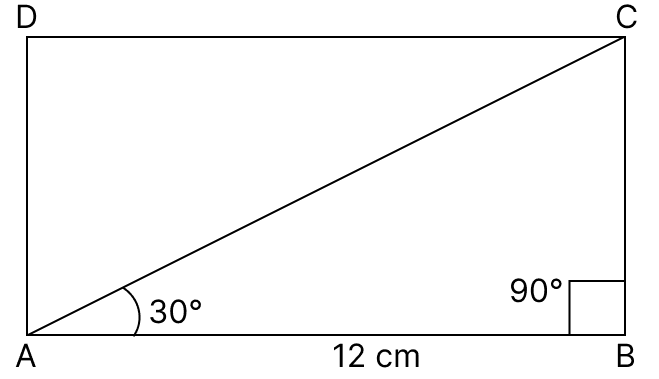
Given,
In rectangle ABCD, AB = 12 cm and ∠BAC = 30°.
Since ABCD is a rectangle, ∠ABC = 90°. So △ABC is right-angled at B, with AC as the diagonal (hypotenuse).
In right-angled △ABC,
By formula,
tan(∠BAC) =
Substituting values we get :
By formula,
cos(∠BAC) =
Substituting values we get :
Hence, the length of side BC = cm and the length of diagonal AC = cm.