
as a vulgar fraction becomes:
Answer
Let x = = 0.23333......... (1)
Multiplying equation (1) by 10, we get :
⇒ 10x = 2.3333......... (2)
Multiplying equation (1) by 100, we get :
⇒ 100x = 23.3333......... (3)
Subtracting equation (2) from equation (3), we get :
⇒ 100x - 10x = 23.3333... - 2.3333...
⇒ 90x = 21
⇒ x = .
Hence, option 4 is the correct option.
(2 - a)(6 - a) is equal to:
a2 - 8a + 12
a2 + 8a - 12
a2 + 8a + 12
a2 - 12a + 8
Answer
Solving the given expression :
⇒ (2 - a)(6 - a)
⇒ 2(6 - a) - a(6 - a)
⇒ 12 - 2a - 6a + a2
⇒ a2 - 8a + 12.
Hence, option 1 is the correct option.
7 - 12x - 4x2 is equal to:
(1 + 2x)(7 + 2x)
(1 - 2x)(2x - 7)
(1 - 2x)(7 + 2x)
(1 - 2x)(2x + 7)
Answer
Factorising the given expression :
⇒ 7 - 12x - 4x2
⇒ 7 - 14x + 2x - 4x2
⇒ 7(1 - 2x) + 2x(1 - 2x)
⇒ (1 - 2x)(7 + 2x).
Hence, option 3 is the correct option.
(0.01)-1/2 is equal to:
10
1
0.1
Answer
Solving the given expression :
Hence, option 1 is the correct option.
log2x 2x is equal to:
1
0
-1
not defined
Answer
We know that, the logarithm of a number to its own base is 1.
i.e. loga a = 1.
∴ log2x 2x = 1.
Hence, option 1 is the correct option.
In △ABC, BC = AC and ∠B = 64°, then the measure of ∠C is:
64°
60°
52°
50°
Answer
Given,
In △ABC, BC = AC.
We know that, angles opposite to equal sides are equal.
Since BC = AC, the angles opposite to them are equal.
⇒ ∠A = ∠B = 64°
In △ABC, by angle sum property,
⇒ ∠A + ∠B + ∠C = 180°
⇒ 64° + 64° + ∠C = 180°
⇒ ∠C = 180° - 128°
⇒ ∠C = 52°.
Hence, option 3 is the correct option.
The sides of a rectangular field are 30 m and 40 m. The length of its diagonal is:
50 m
60 m
65 m
70 m
Answer
Given,
Sides of the rectangular field = 30 m and 40 m.
By Pythagoras theorem,
Diagonal =
Substituting values we get :
Hence, option 1 is the correct option.
In a parallelogram:
opposite sides are equal
opposite angles are equal
both (a) and (b)
none of these
Answer
In a parallelogram, both pairs of opposite sides are equal and both pairs of opposite angles are equal.
∴ Both the statements (a) and (b) are true.
Hence, option 3 is the correct option.
A circle of radius 2.5 cm has a chord of length 4.8 cm. The distance of the chord from the centre of the circle is:
1 cm
0.8 cm
0.7 cm
0.5 cm
Answer
Given,
Radius (r) = 2.5 cm and length of chord = 4.8 cm.
We know that, the perpendicular from the centre to a chord bisects the chord.
∴ Half the length of chord = = 2.4 cm.
By Pythagoras theorem,
Distance of chord from centre =
Substituting values we get :
Hence, option 3 is the correct option.
The mean of first five multiples of 7 is:
20
21
22
23
Answer
The first five multiples of 7 are 7, 14, 21, 28 and 35.
By formula,
Mean =
Substituting values we get :
Hence, option 2 is the correct option.
The area of a triangle with base 18 cm and height 15 cm is:
120 cm2
125 cm2
130 cm2
135 cm2
Answer
Given,
Base = 18 cm and height = 15 cm.
By formula,
Area of triangle =
Substituting values we get :
Hence, option 4 is the correct option.
The perimeter of a semi-circular protractor is 32.4 cm. The radius of the protractor is:
6 cm
6.1 cm
6.3 cm
7 cm
Answer
Let the radius of the protractor be r cm.
The perimeter of a semi-circular protractor = πr + 2r = r(π + 2)
=
Substituting values we get :
Hence, option 3 is the correct option.
The length of the longest rod that can be placed in a room measuring 12 m × 9 m × 8 m is:
17 m
20 m
21 m
29 m
Answer
Given,
Dimensions of the room = 12 m × 9 m × 8 m.
The longest rod that can be placed in a room is along the diagonal of the cuboid.
By formula,
Length of diagonal =
Substituting values we get :
Hence, option 1 is the correct option.
The value of sin230° + cos230° is:
0
1
-1
not defined
Answer
We know that, for any angle θ,
⇒ sin2θ + cos2θ = 1.
∴ sin230° + cos230° = 1.
Hence, option 2 is the correct option.
Assertion (A): The perpendicular distance of the point P(3, 5) from x-axis is 5.
Reason (R): x-coordinate of a point gives its perpendicular distance from x-axis.
A is true, R is false
A is false, R is true
Both A and R are true
Both A and R are false.
Answer
The perpendicular distance of a point from the x-axis is given by the absolute value of its y-coordinate.
For point P(3, 5), the y-coordinate is 5.
∴ Perpendicular distance from x-axis = 5. So, Assertion (A) is true.
The x-coordinate of a point gives its perpendicular distance from the y-axis, not the x-axis. So, Reason (R) is false.
∴ A is true but R is false.
Hence, option 1 is the correct option.
If a pair of opposite sides of a cyclic quadrilateral are equal, prove that its diagonals are equal.
Answer
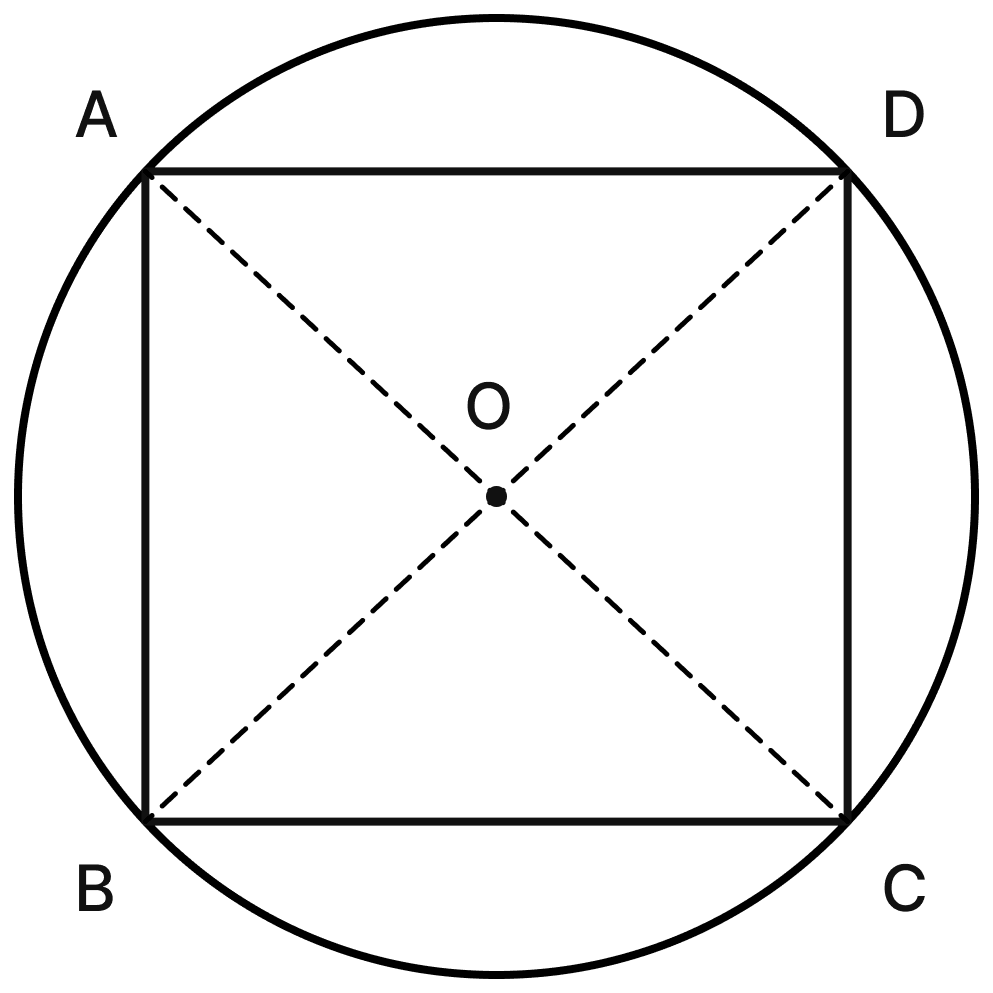
Let ABCD be a cyclic quadrilateral in which the opposite sides AB and CD are equal, i.e. AB = CD.
To prove : AC = BD.
We know that, equal chords of a circle subtend equal arcs.
Since AB = CD,
⇒ arc AB = arc CD ......... (1)
Adding arc BC to both sides of equation (1), we get :
⇒ arc AB + arc BC = arc CD + arc BC
⇒ arc ABC = arc DCB
We know that, equal arcs of a circle have equal chords.
The chord of arc ABC is AC and the chord of arc DCB is DB.
⇒ AC = DB.
Hence, proved that the diagonals AC and BD are equal.
Calculate the amount and the compound interest on ₹50,000 for 2 years 5 months at 12% per annum, compounded annually.
Answer
Given,
Principal (P) = ₹50000, Rate (r) = 12% p.a., Time = 2 years 5 months.
First we find the amount for 2 years (compounded annually).
By formula,
Amount =
Substituting values we get :
Now, for the remaining 5 months, the principal becomes ₹62720.
By formula,
Simple Interest =
For 5 months, time = year.
Substituting values we get :
∴ Final Amount = 62720 + 3136 = ₹65856.
By formula,
Compound Interest = Amount - Principal
Substituting values we get :
⇒ C.I. = 65856 - 50000 = ₹15856.
Hence, the amount = ₹65,856 and the compound interest = ₹15,856.
Prove that: .
Answer
Solving L.H.S.,
We know that,
⇒ sin(90° - A) = cos A
⇒ cos(90° - A) = sin A
Substituting these values in L.H.S., we get :
Since, L.H.S. = R.H.S.
Hence, proved that .
Show that is irrational.
Answer
Let us assume, to the contrary, that is rational.
Then, can be written in the form , where a and b are co-prime integers and b ≠ 0.
⇒
Squaring both sides, we get :
So, 3 divides a2, which means 3 divides a.
Let a = 3c for some integer c.
Substituting a = 3c in equation (1), we get :
⇒ (3c)2 = 3b2
⇒ 9c2 = 3b2
⇒ b2 = 3c2
So, 3 divides b2, which means 3 divides b.
Thus, 3 divides both a and b. But this contradicts the fact that a and b are co-prime.
This contradiction has arisen because of our incorrect assumption that is rational.
Hence, is irrational.
If , show that .
Answer
Given,
⇒
Taking square root on both sides, we get :
⇒ ......... (1) or ......... (2)
We know that,
⇒
Substituting value from equation (1), we get :
Substituting value from equation (2), we get :
Hence, proved that .
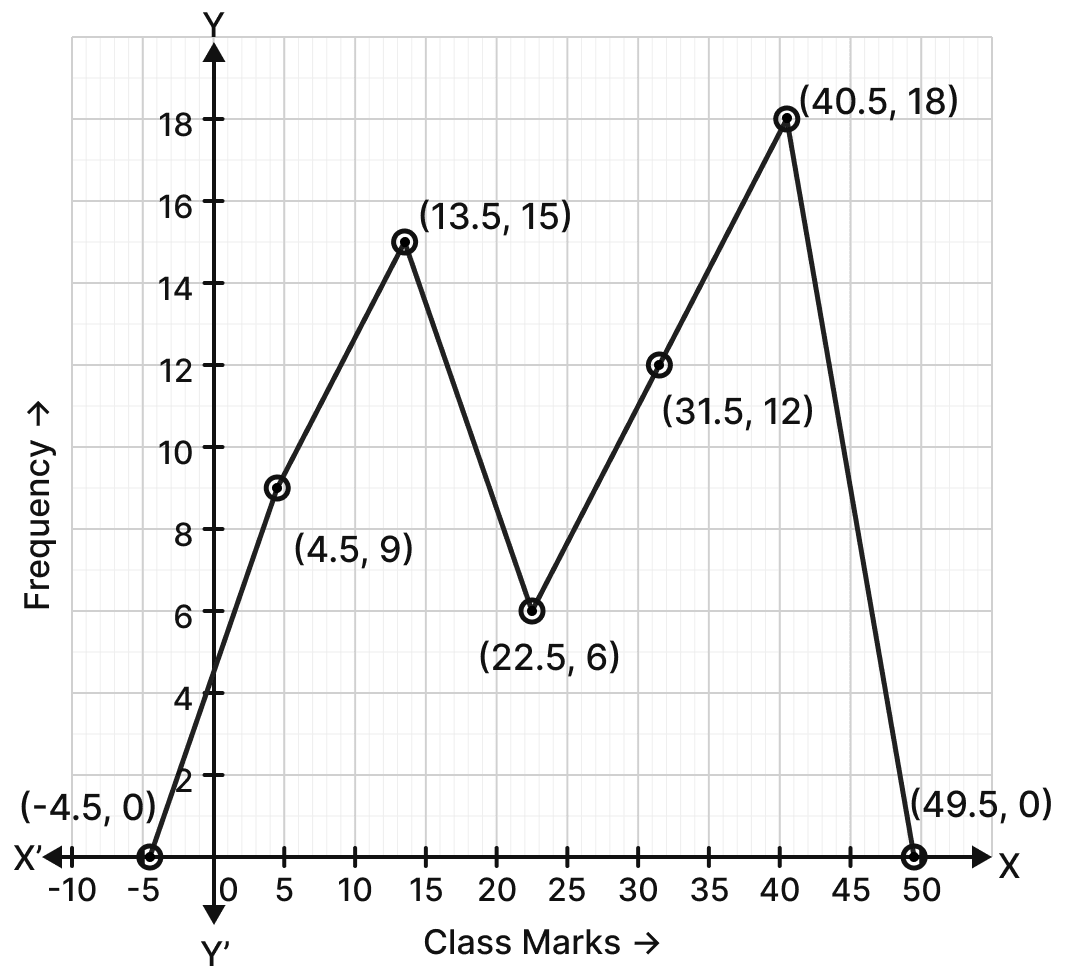
Draw a frequency polygon to represent the following data:
| Class-interval | Frequency |
|---|---|
| 0 – 9 | 9 |
| 9 – 18 | 15 |
| 18 – 27 | 6 |
| 27 – 36 | 12 |
| 36 – 45 | 18 |
Answer
| Class-interval | Class mark | Frequency |
|---|---|---|
| -9 – 0 | -4.5 | 0 |
| 0 – 9 | 4.5 | 9 |
| 9 – 18 | 13.5 | 15 |
| 18 – 27 | 22.5 | 6 |
| 27 – 36 | 31.5 | 12 |
| 36 – 45 | 40.5 | 18 |
| 45 – 54 | 49.5 | 0 |
Steps:
Find the class mark (mid-value) of each class.
Class mark =
On a graph paper, mark class-marks along x-axis and frequencies along y-axis.
Take 1 cm along the x-axis = 5 units.
Take 1 cm along the y-axis = 2 units.
On the graph, mark points taking values of class-marks along x-axis and the values of their corresponding frequencies along y-axis.
Plot the points (-4.5, 0), (4.5, 9), (13.5, 15), (22.5, 6), (31.5, 12), (40.5, 18) and (49.5, 0). The classes -9 - 0 and 45 - 54 with frequency 0 are taken at both the ends to complete the polygon.
Join the plotted points in order by straight line segments to obtain the required frequency polygon.
If a and b are rational numbers and , find the values of a and b.
Answer
Given,
⇒
Rationalising the denominator of L.H.S. by multiplying the numerator and denominator by (2 + √3), we get :
Comparing with , we get :
⇒ a = 7 and b = 4.
Hence, a = 7 and b = 4.
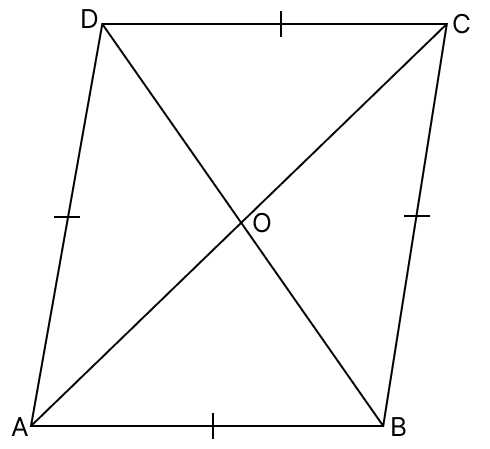
In the adjoining figure, ABCD is a rhombus whose diagonals intersect at O. If ∠OAB : ∠OBA = 2 : 3, find the angles of △OAB.
Answer
Given,
ABCD is a rhombus whose diagonals intersect at O and ∠OAB : ∠OBA = 2 : 3.
We know that, the diagonals of a rhombus bisect each other at right angles.
∴ ∠AOB = 90°.
Let ∠OAB = 2x and ∠OBA = 3x.
In △OAB, by angle sum property,
⇒ ∠OAB + ∠OBA + ∠AOB = 180°
⇒ 2x + 3x + 90° = 180°
⇒ 5x = 90°
⇒ x = 18°.
∴ ∠OAB = 2x = 2 × 18° = 36°.
∴ ∠OBA = 3x = 3 × 18° = 54°.
Hence, the angles of △OAB are ∠OAB = 36°, ∠OBA = 54° and ∠AOB = 90°.
A rectangular plot 30 m long and 18 m wide is to be covered with grass leaving 2.5 m all around it. Find the area to be laid with grass.
Answer
Given,
Length of the rectangular plot = 30 m and width = 18 m.
A margin of 2.5 m is left all around the plot.
∴ Length of the inner grassy region = 30 - 2(2.5) = 30 - 5 = 25 m.
∴ Width of the inner grassy region = 18 - 2(2.5) = 18 - 5 = 13 m.
By formula,
Area = length × width
Substituting values we get :
Hence, the area to be laid with grass = 325 m2.
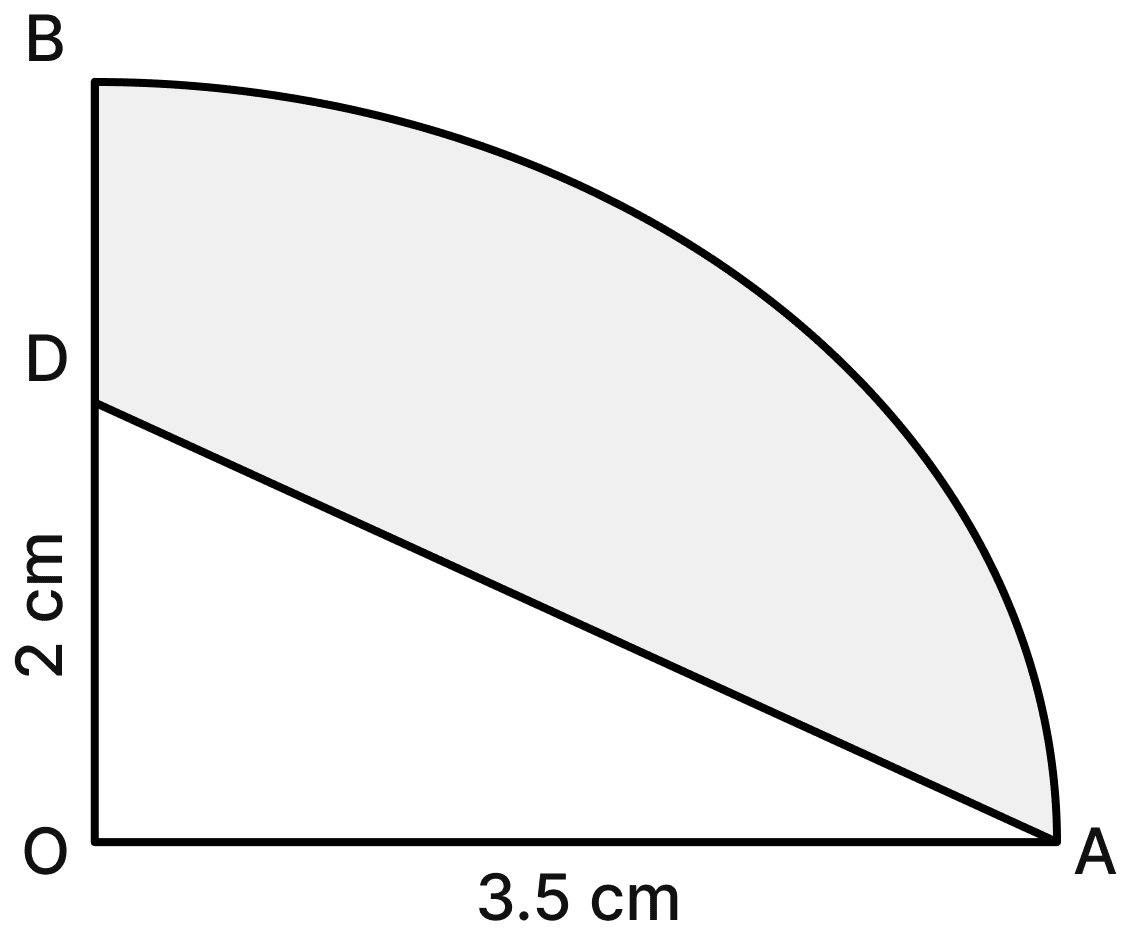
In the figure alongside, OAB is a quadrant of a circle. The radius OA = 3.5 cm and OD = 2 cm. Calculate the area of the shaded portion. .
Answer
Given,
OAB is a quadrant of a circle with radius OA = 3.5 cm and OD = 2 cm.
The shaded portion is the area of the quadrant excluding the triangle OAD, where OA is the radius and OD is the base of the triangle.
By formula,
Area of quadrant =
Substituting values we get :
Area of △OAD =
Substituting values we get :
∴ Area of shaded portion = Area of quadrant - Area of △OAD
⇒ Area of shaded portion = 9.625 - 3.5 = 6.125 cm2.
Hence, the area of the shaded portion = 6.125 cm2.
If a, b, c are positive real numbers, show that: .
Answer
Solving L.H.S.,
Since, L.H.S. = R.H.S.
Hence, proved.
Prove that the figure obtained by joining the mid-points of the adjacent sides of a quadrilateral is a parallelogram.
Answer
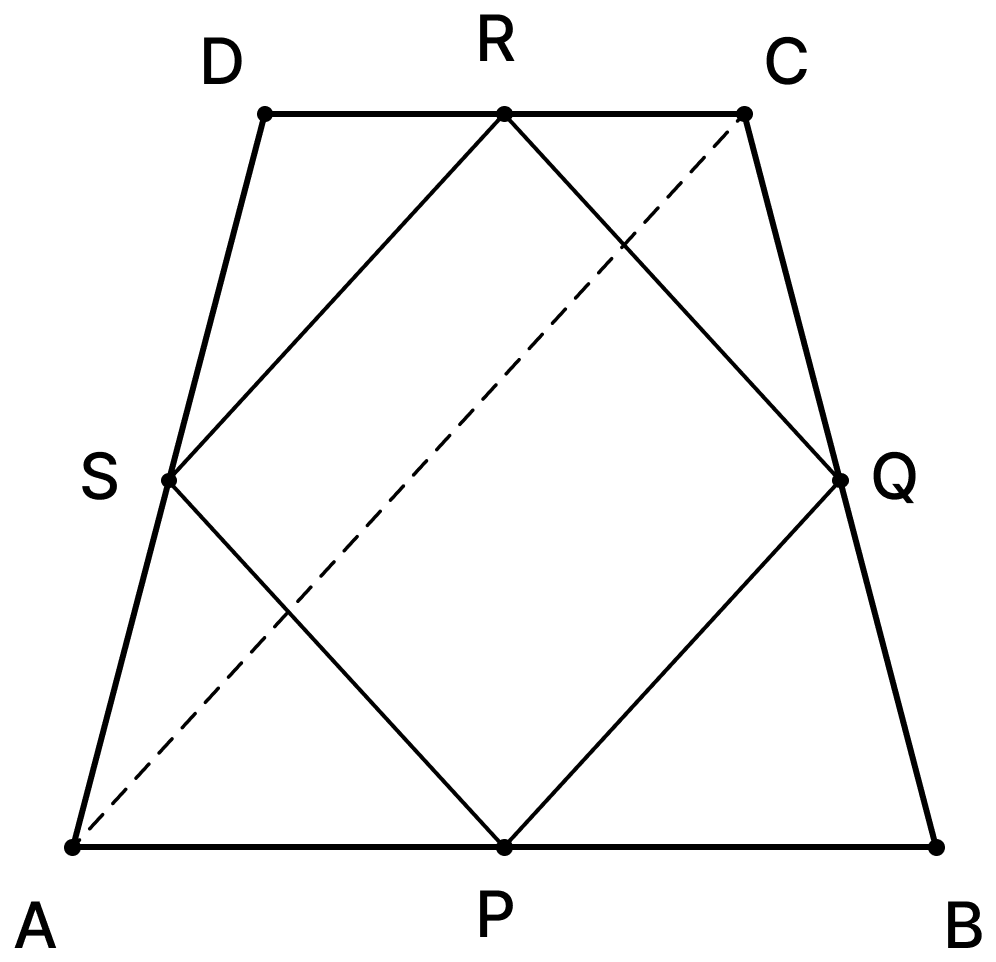
Given,
ABCD is a quadrilateral in which P, Q, R and S are the mid-points of sides AB, BC, CD and DA respectively.
To prove : PQRS is a parallelogram.
Construction : Join the diagonal AC.
In △ABC, P and Q are the mid-points of AB and BC respectively.
By mid-point theorem,
⇒ PQ ∥ AC and PQ = AC ......... (1)
In △ADC, S and R are the mid-points of DA and CD respectively.
By mid-point theorem,
⇒ SR ∥ AC and SR = AC ......... (2)
From equations (1) and (2), we get :
⇒ PQ ∥ SR and PQ = SR.
Since one pair of opposite sides of quadrilateral PQRS is equal and parallel, PQRS is a parallelogram.
Hence, proved that the figure obtained by joining the mid-points of the adjacent sides of a quadrilateral is a parallelogram.
Factorise: x3 - 6x2 + 12x - 7
Answer
Let p(x) = x3 - 6x2 + 12x - 7.
By trial, substituting x = 1, we get :
= 1 - 6 + 12 - 7
= 0.
Since p(1) = 0, (x - 1) is a factor of p(x).
Dividing p(x) by (x - 1),
∴ x3 - 6x2 + 12x - 7 = (x - 1)(x2 - 5x + 7).
Hence, x3 - 6x2 + 12x - 7 = (x - 1)(x2 - 5x + 7).
If log10 y + 2 log10 x = 2, express y in terms of x.
Answer
Given,
⇒ log10 y + 2 log10 x = 2
Using the power rule of logarithms, 2 log10 x = log10 x2.
⇒ log10 y + log10 x2 = 2
Using the product rule of logarithms,
⇒ log10 (yx2) = 2
Writing in exponential form,
⇒ yx2 = 102
⇒ yx2 = 100
⇒ y = .
Hence, y = .
A metal cube of edge 12 cm is melted and formed into three smaller cubes. If the edges of two smaller cubes are 6 cm and 8 cm, find the edge of third smaller cube.
Answer
Given,
Edge of the large cube = 12 cm.
Edges of two smaller cubes = 6 cm and 8 cm.
Let the edge of the third smaller cube be a cm.
Since the large cube is melted and recast into three smaller cubes, the volume remains the same.
⇒ Volume of large cube = Sum of volumes of three smaller cubes
By formula,
Volume of cube = (edge)3
Substituting values we get :
Hence, the edge of the third smaller cube = 10 cm.
In the given figure, PQRS and PXYZ are two parallelograms of equal area. Prove that: YR ∥ QZ.
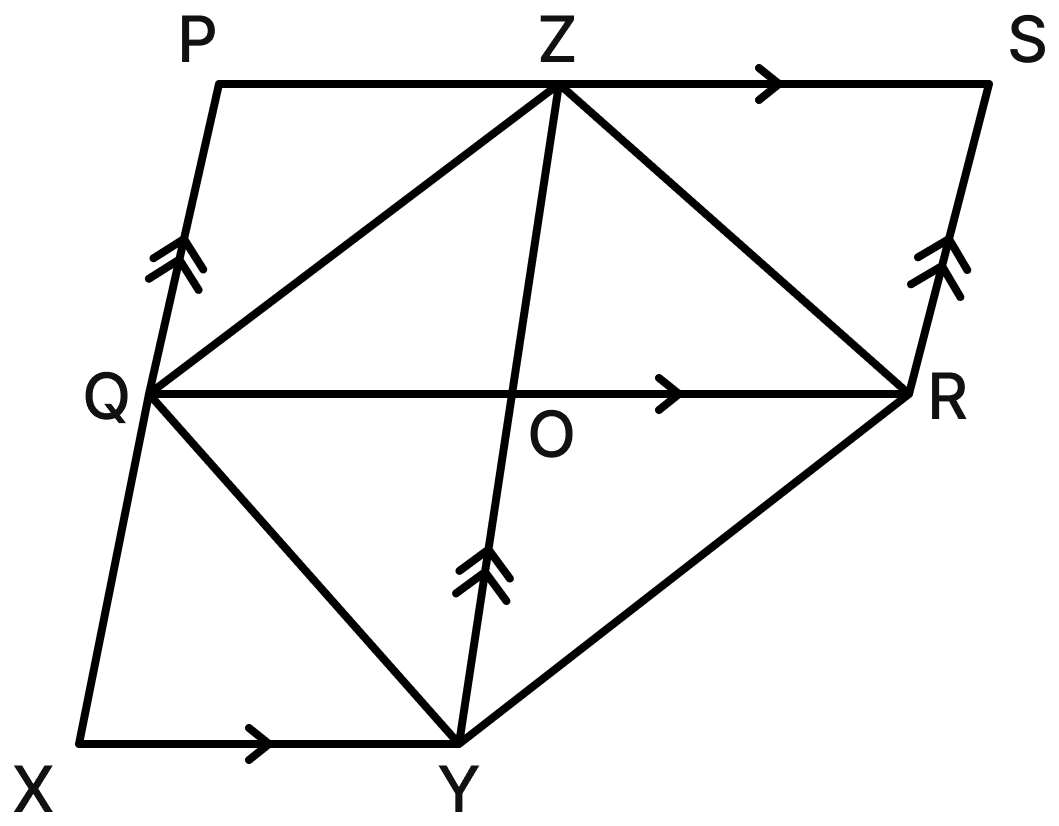
Answer
Given,
PQRS and PXYZ are two parallelograms of equal area.
To prove: YR ∥ QZ.
Since the two parallelograms have equal areas,
ar(PQRS) = ar(PXYZ).
Subtracting the area of the common quadrilateral PQOZ from both sides, we get:
⇒ ar(PQRS) − ar(PQOZ) = ar(PXYZ) − ar(PQOZ)
⇒ ar(ZORS) = ar(QXYO).
Let,
ar(ZORS) = ar(QXYO) = x.
Since QX lies on PX, OY lies on ZY and PX ∥ ZY,
⇒ QX ∥ OY.
Also, QO lies on QR, XY ∥ PZ and QR ∥ PS, where P, Z and S are collinear.
⇒ QO ∥ XY.
Therefore, QXYO is a parallelogram.
Similarly, ZO lies on ZY, RS ∥ PQ and PQ lies on PX.
Since PX ∥ ZY,
⇒ ZO ∥ RS.
Also, OR lies on QR, ZS lies on PS and QR ∥ PS.
⇒ OR ∥ ZS.
Therefore, ZORS is a parallelogram.
The diagonal QY divides parallelogram QXYO into two triangles of equal area.
⇒ ar(△QOY) = ar(QXYO)
⇒ ar(△QOY) = .
Similarly, the diagonal RZ divides parallelogram ZORS into two triangles of equal area.
⇒ ar(△ROZ) = ar(ZORS)
⇒ ar(△ROZ) = .
Therefore,
⇒ ar(△QOY) = ar(△ROZ).
Adding ar(△ORY) to both sides, we get:
⇒ ar(△QOY) + ar(△ORY) = ar(△ROZ) + ar(△ORY)
⇒ ar(△QYR) = ar(△ZYR).
The triangles QYR and ZYR are on the same base YR, lie on the same side of YR and have equal areas.
Therefore, they lie between the same parallels.
∴ YR ∥ QZ.
Hence, proved that YR ∥ QZ.
If the length and breadth of a room are increased by 1 m each, its area is increased by 21 m2. If the length is increased by 1 m and breadth decreased by 1 m, the area is decreased by 5 m2. Find the area of the room.
Answer
Let the length of the room be l m and the breadth be b m.
∴ Original area = lb m2.
According to the first condition, when length and breadth are each increased by 1 m :
⇒ (l + 1)(b + 1) = lb + 21
⇒ lb + l + b + 1 = lb + 21
⇒ l + b = 20 ......... (1)
According to the second condition, when length is increased by 1 m and breadth decreased by 1 m :
⇒ (l + 1)(b - 1) = lb - 5
⇒ lb - l + b - 1 = lb - 5
⇒ -l + b = -4
⇒ l - b = 4 ......... (2)
Adding equations (1) and (2), we get :
⇒ 2l = 24
⇒ l = 12.
Substituting l = 12 in equation (1), we get :
⇒ 12 + b = 20
⇒ b = 8.
∴ Area of the room = lb = 12 × 8 = 96 m2.
Hence, the area of the room = 96 m2.
Three years ago, the population of a city was 50000. If the annual increase during three successive years be 5%, 8% and 10% respectively, find the present population of the city.
Answer
Given,
Population three years ago = 50000.
Annual increase during three successive years = 5%, 8% and 10%.
By formula,
Present population =
Substituting values we get :
Hence, the present population of the city = 62,370.
In the given figure: AY ⊥ ZY and BY ⊥ XY such that AY = ZY and BY = XY. Prove that AB = ZX.
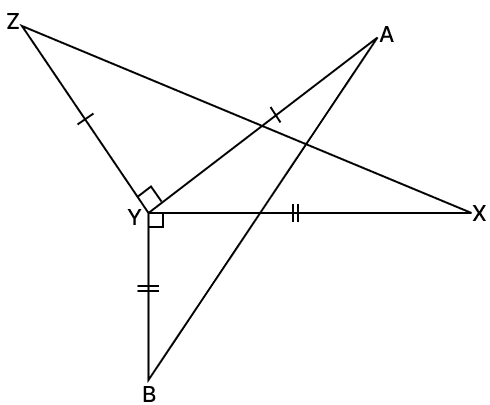
Answer
Given,
AY ⊥ ZY, BY ⊥ XY, AY = ZY and BY = XY.
Since AY ⊥ ZY, ∠AYZ = 90°.
Since BY ⊥ XY, ∠BYX = 90°.
∴ ∠AYZ = ∠BYX ......... (1)
Adding ∠AYX to both sides of equation (1), we get :
⇒ ∠AYZ + ∠AYX = ∠BYX + ∠AYX
⇒ ∠ZYX = ∠AYB ......... (2)
Now, in △ZYX and △AYB :
⇒ ZY = AY [Given]
⇒ ∠ZYX = ∠AYB [From equation (2)]
⇒ XY = BY [Given]
∴ △ZYX ≅ △AYB [By SAS congruence criterion]
⇒ ZX = AB [By C.P.C.T.]
Hence, proved that AB = ZX.
If 13 sin θ = 5, find the value of .
Answer
Given,
⇒ 13 sin θ = 5
⇒ sin θ = .
We know that, sin θ = .
∴ perpendicular = 5 and hypotenuse = 13.
By Pythagoras theorem,
∴ cos θ = and tan θ = .
Substituting these values in the given expression, we get :
Hence, the value of .
Two parallel chords of lengths 30 cm and 16 cm are drawn on the opposite sides of the centre of a circle of radius 17 cm. Find the distance between the chords.
Answer
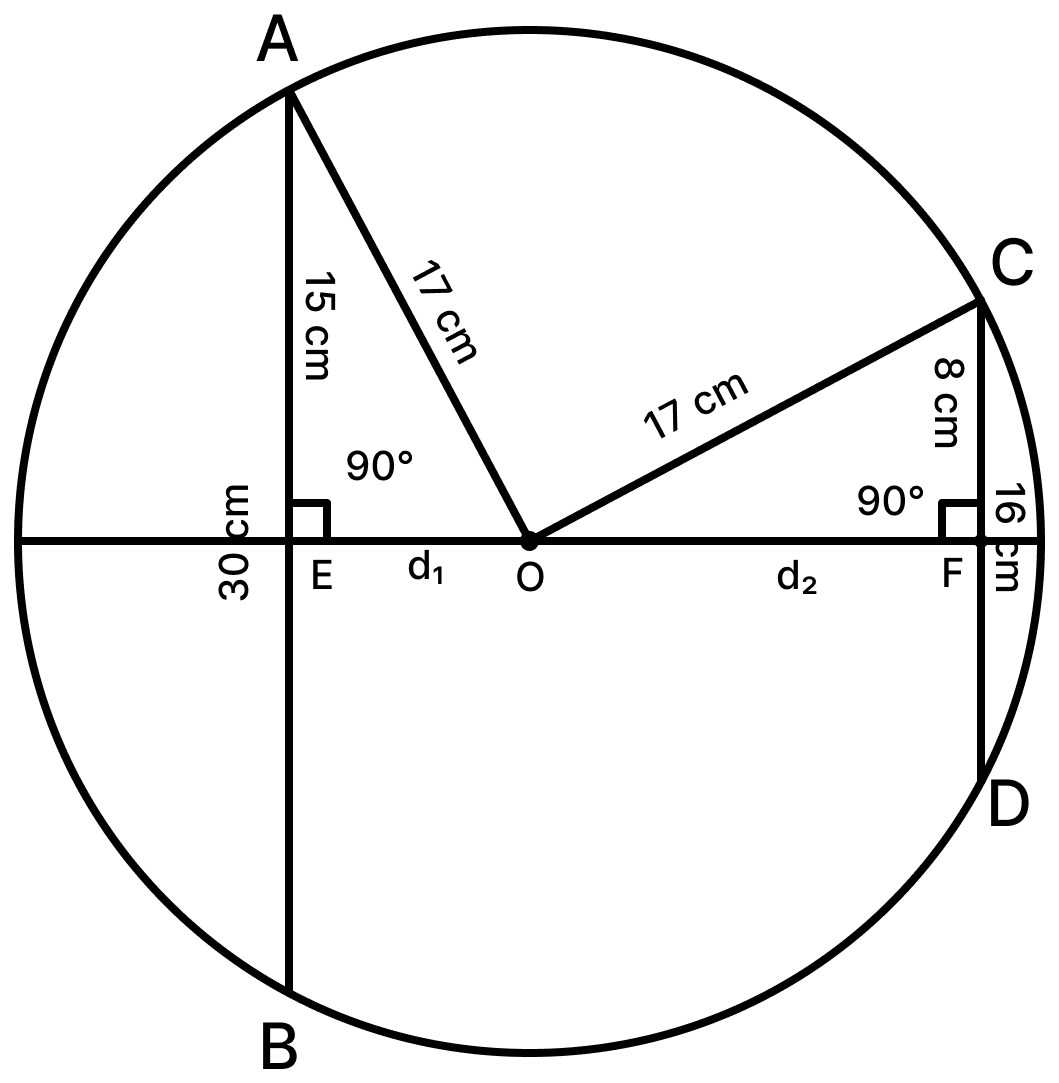
Given,
Radius of the circle (r) = 17 cm.
AB and CD are two chords with the lengths AB = 30 cm and CD = 16 cm, lying on opposite sides of the centre.
We know that, the perpendicular from the centre to a chord bisects the chord.
OE is perpendicular to AB,
AE = EB = = 15 cm.
Let distance of this chord from centre be d1.
In right triangle AEO,
By Pythagoras theorem,
⇒ AO2 = AE2 + EO2
⇒ EO2 = AO2 - AE2
⇒ (d1)2 = (17)2 - (15)2
OF is perpendicular to CD.
CF = DF = = 8 cm.
Let distance of this chord from centre be d2
In right triangle CFO,
By Pythagoras theorem,
⇒ OC2 = CF2 + OF2
⇒ OF2 = OC2 - CF2
⇒ (d2)2 = (17)2 - (8)2
Since the chords lie on opposite sides of the centre, the distance between them = d1 + d2.
⇒ Distance between the chords = 8 + 15 = 23 cm.
Hence, the distance between the chords = 23 cm.
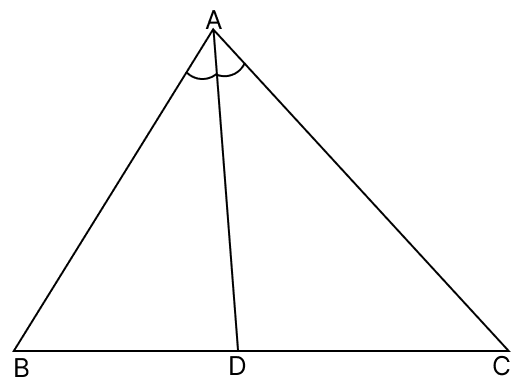
In the adjoining figure, AC > AB and AD is the bisector of ∠A. Show that: ∠ADC > ∠ADB.
Answer
Given,
In △ABC, AC > AB and AD is the bisector of ∠A.
To prove : ∠ADC > ∠ADB.
Since AC > AB, the angle opposite to the larger side is larger.
⇒ ∠B > ∠C ......... (1)
Since AD is the bisector of ∠A,
⇒ ∠BAD = ∠CAD ......... (2)
In △ABD, by angle sum property,
⇒ ∠ADB = 180° - ∠B - ∠BAD ......... (3)
In △ACD, by angle sum property,
⇒ ∠ADC = 180° - ∠C - ∠CAD ......... (4)
From equation (2), ∠BAD = ∠CAD.
From equation (1), ∠B > ∠C, so -∠B < -∠C.
∴ From equations (3) and (4), since ∠B > ∠C,
⇒ 180° - ∠C - ∠CAD > 180° - ∠B - ∠BAD
⇒ ∠ADC > ∠ADB.
Hence, proved that ∠ADC > ∠ADB.
In the given figure, ∠PSR = 90°, PQ = 10 cm, QS = 6 cm and RQ = 9 cm, calculate the length of PR.

Answer
Given,
∠PSR = 90°, PQ = 10 cm, QS = 6 cm and RQ = 9 cm, where Q lies on SR.
In right-angled △PSQ, by Pythagoras theorem,
Since Q lies on SR,
⇒ SR = QS + RQ = 6 + 9 = 15 cm.
In right-angled △PSR, by Pythagoras theorem,
Hence, the length of PR = 17 cm.
Find the point on the x-axis, which is equidistant from the points A(2, -5) and B(-2, 9).
Answer
Let the required point on the x-axis be P(x, 0), since the y-coordinate of any point on the x-axis is 0.
Given, P is equidistant from A(2, -5) and B(-2, 9).
⇒ PA = PB
⇒ PA2 = PB2
By distance formula,
Expanding both sides, we get :
∴ The required point is (-7, 0).
Hence, the point on the x-axis equidistant from A and B is (-7, 0).
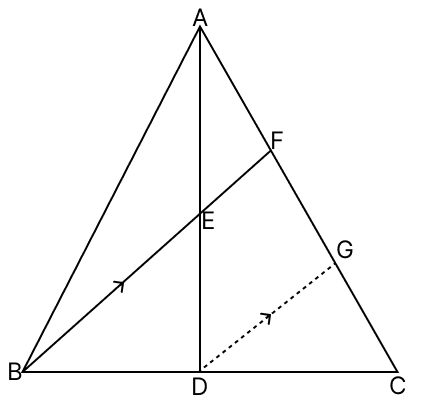
In the adjoining figure, in △ABC, AD is the median through A and E is the mid-point of AD. If BE produced meets AC in F, prove that AF = AC.
Answer
Given,
In △ABC, AD is the median through A and E is the mid-point of AD. BE produced meets AC in F.
To prove : AF = AC.
Construction : Through D, draw DG ∥ BF, meeting AC at G.
In △ADG, E is the mid-point of AD and EF ∥ DG.
By converse of mid-point theorem, F is the mid-point of AG.
⇒ AF = FG ......... (1)
In △BCF, D is the mid-point of BC and DG ∥ BF.
By converse of mid-point theorem, G is the mid-point of CF.
⇒ FG = GC ......... (2)
From equations (1) and (2), we get :
⇒ AF = FG = GC ......... (3)
Now, AC = AF + FG + GC.
From equation (3), AC = AF + AF + AF = 3 AF.
⇒ AF = AC.
Hence, proved that AF = AC.
Construct a frequency table for the following ages (in years) of 30 students using equal class-intervals, one of them being 9 - 12, where 12 is not included.
18, 12, 7, 6, 11, 15, 21, 9, 8, 13, 15, 17, 22, 19, 14, 21, 23, 8, 12, 17, 15, 6, 18, 23, 22, 16, 9, 21, 11, 16
Answer
Given, one class-interval is 9 - 12, so the class size = 12 - 9 = 3.
Since 12 is not included, we use the exclusive method of classification.
The minimum value is 6 and the maximum value is 23, so the classes are 6 - 9, 9 - 12, 12 - 15, 15 - 18, 18 - 21 and 21 - 24.
Counting the number of observations falling in each class, we get the following frequency table :
| Class-interval (Age in years) | Tally marks | Frequency |
|---|---|---|
| 6 – 9 | 5 | |
| 9 – 12 | IIII | 4 |
| 12 – 15 | IIII | 4 |
| 15 – 18 | 7 | |
| 18 – 21 | III | 3 |
| 21 – 24 | 7 | |
| Total | 30 |
Hence, the required frequency table is constructed as shown above.