
as a vulgar fraction becomes:
Answer
Let x = = 2.5555......... (1)
Since one digit is repeating, multiply both sides by 10.
⇒ 10x = 25.5555......... (2)
Subtracting equation (1) from equation (2), we get :
⇒ 10x - x = 25.5555... - 2.5555...
⇒ 9x = 23
⇒ x = .
Hence, option 3 is the correct option.
₹5000 were invested at 8% p.a. compounded semi-annually for 1 year. The amount so obtained is:
₹5408
₹5450
₹5470
₹5510
Answer
Given,
Principal (P) = ₹5000, Rate (r) = 8% p.a., Time = 1 year.
Since interest is compounded semi-annually,
Rate per half year = = 4% and number of conversion periods (n) = 2.
By formula,
Amount (A) =
Substituting values we get :
Hence, option 1 is the correct option.
If is equal to:
4
7
Answer
Given,
⇒
Adding 2 on both the sides, we get :
Hence, option 3 is the correct option.
If x - 2y = 2 and 3x + y = 13, then (x + y) is:
5
4
-5
3
Answer
Given,
⇒ x - 2y = 2 ......... (1)
⇒ 3x + y = 13 ......... (2)
From equation (1),
⇒ x = 2 + 2y ......... (3)
Substituting value of x from equation (3) in equation (2), we get :
⇒ 3(2 + 2y) + y = 13
⇒ 6 + 6y + y = 13
⇒ 7y = 13 - 6
⇒ 7y = 7
⇒ y = 1.
Substituting y = 1 in equation (3), we get :
⇒ x = 2 + 2(1) = 4.
∴ x + y = 4 + 1 = 5.
Hence, option 1 is the correct option.
If 3-3m = 9, then the value of m is:
Answer
Given,
⇒ 3-3m = 9
⇒ 3-3m = 32
Since the bases are equal, the exponents are equal.
⇒ -3m = 2
⇒ m = .
Hence, option 1 is the correct option.
The value of is:
Answer
Solving the given expression :
Hence, option 3 is the correct option.
The point of intersection of the altitudes of a triangle is called its:
circumcentre
orthocentre
centroid
incentre
Answer
The point of intersection of the three altitudes of a triangle is called the orthocentre of the triangle.
Hence, option 2 is the correct option.
In a right triangle ABC, right angled at B, if AB = 12 cm and AC = 37 cm, then BC =
35 cm
30 cm
26 cm
25 cm
Answer
Given,
In right triangle ABC, right angled at B, AB = 12 cm and AC = 37 cm.
By Pythagoras theorem,
⇒ AC2 = AB2 + BC2
⇒ (37)2 = (12)2 + BC2
⇒ 1369 = 144 + BC2
⇒ BC2 = 1369 - 144
⇒ BC2 = 1225
⇒ BC =
⇒ BC = 35 cm.
Hence, option 1 is the correct option.
If an angle of a parallelogram is two-thirds of its adjacent angle, then the smaller of these angles is:
70°
71°
72°
108°
Answer
Let the larger angle of the parallelogram be x.
Then the smaller angle = x.
We know that, the sum of two adjacent angles of a parallelogram is 180°.
⇒ x + x = 180°
⇒ = 180°
⇒ = 180°
⇒ 5x = 540°
⇒ x = 108°.
∴ Smaller angle = = 72°.
Hence, option 3 is the correct option.
The chords AB and CD of a circle are such that, AB = CD and AB is at a distance of 4 cm from the centre. The distance of CD from the centre of the circle is:
8 cm
6 cm
5 cm
4 cm
Answer
We know that,
Equal chords of a circle are equidistant from the centre.
Since AB = CD and AB is at a distance of 4 cm from the centre, CD is also at a distance of 4 cm from the centre.
Hence, option 4 is the correct option.
The class intervals of a frequency distribution are 1—10, 11—20, 21—30, ......., the class size is:
9
10
9.5
10.5
Answer
The given class intervals are in inclusive form. Converting the first class 1 — 10 to the exclusive (continuous) form, its true lower limit = 0.5 and true upper limit = 10.5.
∴ Class size = true upper limit - true lower limit = 10.5 - 0.5 = 10.
Hence, option 2 is the correct option.
The mean of first 10 prime numbers is:
12.9
11.2
10.8
10.7
Answer
The first 10 prime numbers are 2, 3, 5, 7, 11, 13, 17, 19, 23, 29.
By formula,
Hence, option 1 is the correct option.
The height of an equilateral triangle is cm. Area of the triangle is:
36 cm2
cm2
cm2
cm2
Answer
Let the side of the equilateral triangle be a.
By formula,
Height of an equilateral triangle =
Substituting values we get :
By formula,
Area of an equilateral triangle =
Substituting values we get :
Hence, option 2 is the correct option.
The circumference of a circle is 88 cm. Area of the circle is:
600 cm2
605 cm2
610 cm2
616 cm2
Answer
Let the radius of the circle be r.
By formula,
Circumference of a circle = 2πr
Substituting values we get :
By formula,
Area of a circle = πr2
Substituting values we get :
Hence, option 4 is the correct option.
Assertion (A): If sin A = , then tan A =
Reason (R):
sin θ = and tan θ =
A is true, R is false
A is false, R is true
Both A and R are true
Both A and R are false.
Answer
Given, sin A = .
So, perpendicular = 3 and hypotenuse = 4.
By Pythagoras theorem,
⇒ base =
⇒ base =
⇒ base =
⇒ base = .
∴ tan A = .
∴ Assertion (A) is true.
Also, sin θ = and tan θ = are the correct trigonometric ratios.
∴ Reason (R) is true.
∴ Both A and R are true.
Hence, option 3 is the correct option.
The points A(3, 2), B(0, 5) and D(0, -1) are the three vertices of a square ABCD. Plot these points on a graph paper and hence find the co-ordinates of the vertex C.
Answer
Let the coordinates of the vertex C be (x, y).
We know that,
The diagonals of a square bisect each other. So, the mid-point of diagonal AC is the same as the mid-point of diagonal BD.
By mid-point formula,
Mid-point =
Mid-point of BD :
Mid-point of AC :
⇒
Equating the mid-points of AC and BD, we get :
⇒
⇒ 3 + x = 0 and 2 + y = 4
⇒ x = -3 and y = 2.
∴ Coordinates of vertex C = (-3, 2).
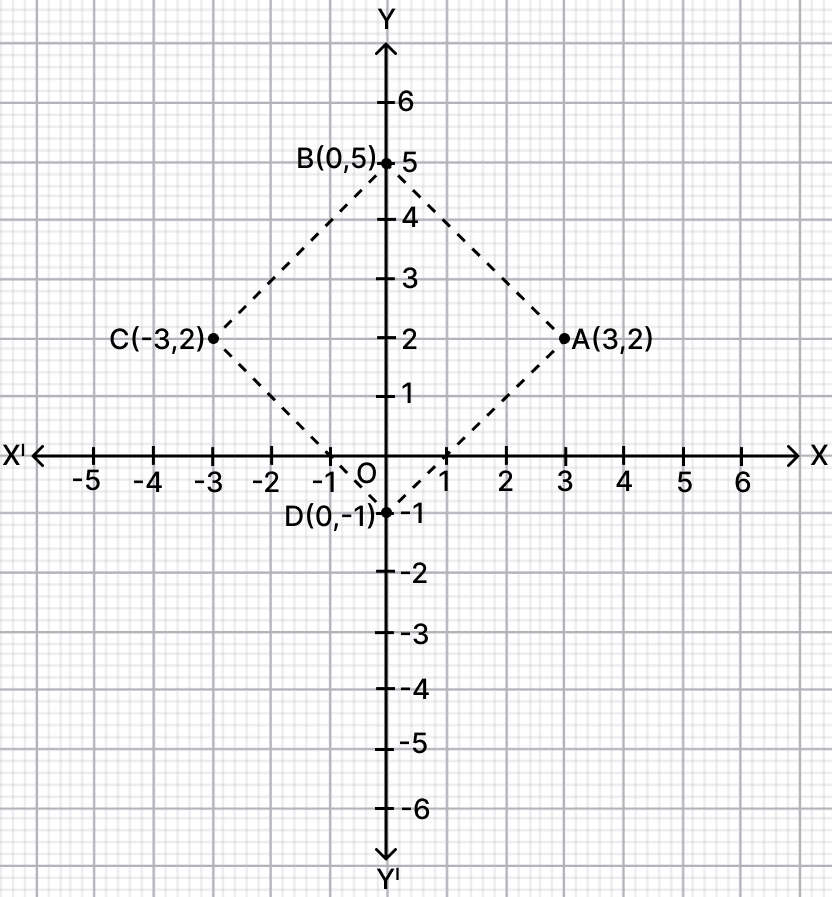
Hence, the coordinates of the vertex C are (-3, 2).
If D, E, F are respectively the mid-points of the sides AB, BC and CA of an equilateral triangle ABC, prove that △DEF is also an equilateral triangle.
Answer
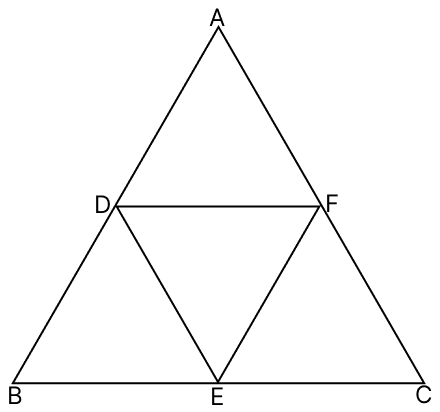
Given,
In equilateral triangle ABC, D, E and F are the mid-points of sides AB, BC and CA respectively.
So, AB = BC = CA = x ......... (1)
By mid-point theorem, the line segment joining the mid-points of two sides of a triangle is parallel to the third side and equal to half of it.
In △ABC, D and F are the mid-points of AB and CA respectively.
⇒ DF = ......... (2)
In △ABC, D and E are the mid-points of AB and BC respectively.
⇒ DE = ......... (3)
In △ABC, E and F are the mid-points of BC and CA respectively.
⇒ EF = ......... (4)
From equations (2), (3) and (4), we get :
⇒ DE = EF = DF = .
Since all the three sides of △DEF are equal, △DEF is an equilateral triangle.
Hence, proved that △DEF is also an equilateral triangle.
The class marks of a frequency distribution are 28, 34, 40, 46, 52. Find the class-size and all the class-intervals.
Answer
Given,
Class marks = 28, 34, 40, 46, 52.
By formula,
Class size = difference between two consecutive class marks
⇒ Class size = 34 - 28 = 6.
We know that,
Lower limit of a class = class mark -
Upper limit of a class = class mark +
So, half of the class size = = 3.
For class mark 28 : class-interval = (28 - 3) to (28 + 3) = 25 - 31
For class mark 34 : class-interval = (34 - 3) to (34 + 3) = 31 - 37
For class mark 40 : class-interval = (40 - 3) to (40 + 3) = 37 - 43
For class mark 46 : class-interval = (46 - 3) to (46 + 3) = 43 - 49
For class mark 52 : class-interval = (52 - 3) to (52 + 3) = 49 - 55
Hence, class-size = 6 and the class-intervals are 25 - 31, 31 - 37, 37 - 43, 43 - 49 and 49 - 55.
Prove that is irrational.
Answer
Let us assume, to the contrary, that is rational.
So, we can find two integers a and b (b ≠ 0) such that :
⇒ , where a and b are co-prime (have no common factor other than 1).
Squaring both the sides, we get :
⇒
⇒ a2 = 2b2 ......... (1)
⇒ 2 divides a2.
⇒ 2 divides a. ......... (2)
So, we can write a = 2c for some integer c.
Substituting a = 2c in equation (1), we get :
⇒ (2c)2 = 2b2
⇒ 4c2 = 2b2
⇒ b2 = 2c2
⇒ 2 divides b2.
⇒ 2 divides b. ......... (3)
From statements (2) and (3), 2 is a common factor of both a and b.
But this contradicts the fact that a and b are co-prime.
This contradiction has arisen because of our incorrect assumption that is rational.
Hence, is irrational.
If (a2 + b2 + c2) = 125 and (ab + bc + ca) = 50, find the value of (a + b + c).
Answer
Given,
a2 + b2 + c2 = 125 and ab + bc + ca = 50.
By formula,
(a + b + c)2 = a2 + b2 + c2 + 2(ab + bc + ca)
Substituting values we get :
⇒ (a + b + c)2 = 125 + 2 × 50
⇒ (a + b + c)2 = 125 + 100
⇒ (a + b + c)2 = 225
⇒ a + b + c =
⇒ a + b + c = ± 15.
Hence, (a + b + c) = ± 15.
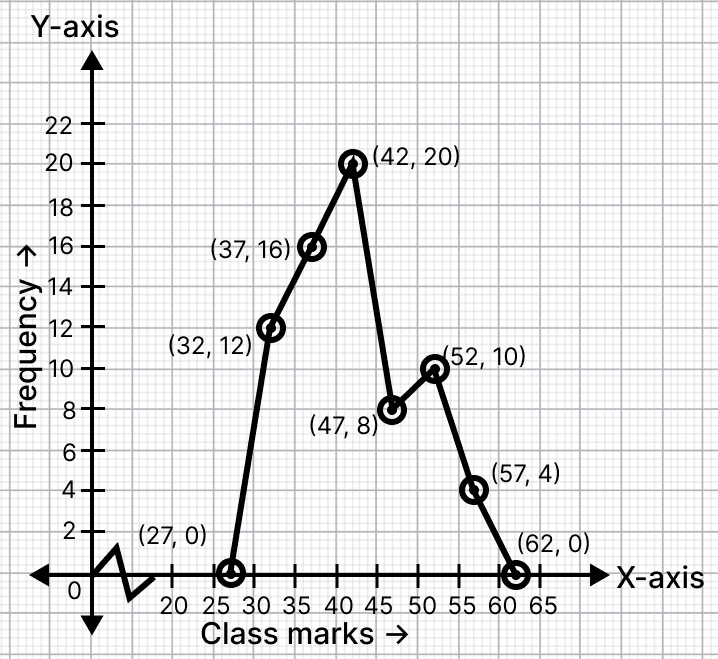
Draw the frequency polygon representing the following frequency distribution.
| Class-interval | Frequency |
|---|---|
| 30 – 34 | 12 |
| 35 – 39 | 16 |
| 40 – 44 | 20 |
| 45 – 49 | 8 |
| 50 – 54 | 10 |
| 55 – 59 | 4 |
Answer
Adjustment factor
Since the class-intervals are in the inclusive form, we first convert them to the continuous (exclusive) form by subtracting 0.5 from each lower limit and adding 0.5 to each upper limit. We then find the class mark (mid-value) of each class.
| Class-interval | Frequency |
|---|---|
| 24.5 – 29.5 | 0 |
| 29.5 – 34.5 | 12 |
| 34.5 – 39.5 | 16 |
| 39.5 – 44.5 | 20 |
| 44.5 – 49.5 | 8 |
| 49.5 – 54.5 | 10 |
| 54.5 – 59.5 | 4 |
| 59.5 - 64.5 | 0 |
By formula,
Class mark =
| Class-interval | Class mark | Frequency |
|---|---|---|
| 24.5 – 29.5 | 27 | 0 |
| 29.5 – 34.5 | 32 | 12 |
| 34.5 – 39.5 | 37 | 16 |
| 39.5 – 44.5 | 42 | 20 |
| 44.5 – 49.5 | 47 | 8 |
| 49.5 – 54.5 | 52 | 10 |
| 54.5 – 59.5 | 57 | 4 |
| 59.5 - 64.5 | 62 | 0 |
Steps of Construction:
On a graph paper, mark class-marks along x-axis and frequencies along y-axis.
Since, the scale on x-axis starts at 20, a kink is shown near the origin on x-axis to indicate that the graph is drawn to scale beginning at 20.
Take 1 cm along the x-axis = 5 units.
Take 1 cm along the y-axis = 2 units.
On the graph, mark points taking values of class-marks along x-axis and the values of their corresponding frequencies along y-axis.
Plot the points (27, 0), (32, 12), (37, 16), (42, 20), (47, 8), (52, 10), (57, 4) and (62, 0), taking the class marks along the x-axis and the corresponding frequencies along the y-axis. The classes 24.5 - 29.5 and 59.5 - 64.5 with frequency 0 are taken at both the ends to complete the polygon.
Join the consecutive points in order by straight line segments to obtain the required frequency polygon.
The difference between the simple interest and the compound interest on a sum of money for 2 years at 12% per annum is ₹216. Find the sum.
Answer
Let the sum of money (Principal) be ₹P.
Given, Rate (r) = 12% p.a. and Time = 2 years.
We know that, the difference between the compound interest and the simple interest for 2 years is given by :
Difference =
Substituting values we get :
Hence, the sum of money = ₹15,000.
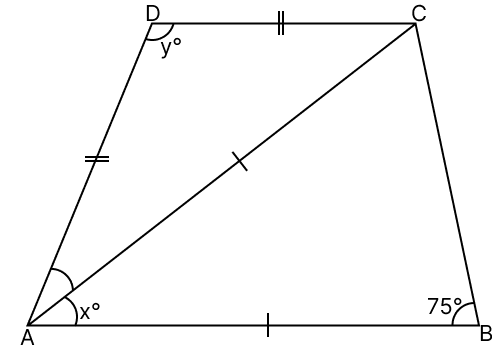
In the given figure, AC is the bisector of ∠A. If AB = AC, AD = CD and ∠ABC = 75°, find the values of x and y.
Answer
Given,
AB = AC, AD = CD, ∠ABC = 75° and AC is the bisector of ∠A.
In △ABC,
⇒ AB = AC [Given]
We know that, angles opposite to equal sides of a triangle are equal.
⇒ ∠ACB = ∠ABC = 75°
By angle sum property of a triangle,
⇒ ∠BAC + ∠ABC + ∠ACB = 180°
⇒ ∠BAC + 75° + 75° = 180°
⇒ ∠BAC = 180° - 150°
⇒ ∠BAC = 30°
⇒ x° = 30°
⇒ x = 30.
Since AC is the bisector of ∠A,
⇒ ∠CAB = ∠DAC = 30°.
In △ACD,
⇒ AD = CD [Given]
We know that, angles opposite to equal sides of a triangle are equal.
⇒ ∠DCA = ∠DAC = 30°
By angle sum property of a triangle,
⇒ ∠ADC + ∠DAC + ∠DCA = 180°
⇒ y° + 30° + 30° = 180°
⇒ y° = 180° - 60°
⇒ y° = 120°
⇒ y = 120.
Hence, x = 30 and y = 120.
If 4 cot θ = 3, show that .
Answer
Given,
⇒ 4 cot θ = 3
⇒ cot θ =
⇒ tan θ = .
Solving L.H.S.,
Dividing the numerator and the denominator by cos θ, we get :
Since, L.H.S. = R.H.S.
Hence, proved that .
Factorise a(a - 1) - b(b - 1).
Answer
Solving the given expression :
⇒ a(a - 1) - b(b - 1)
= a2 - a - b2 + b
= (a2 - b2) - (a - b)
= (a - b)(a + b) - (a - b)
= (a - b)(a + b - 1).
Hence, a(a - 1) - b(b - 1) = (a - b)(a + b - 1).
Show that log(1 + 2 + 3) = log 1 + log 2 + log 3.
Answer
Solving L.H.S.,
⇒ log(1 + 2 + 3)
⇒ log 6 ......... (1)
Solving R.H.S.,
We know that, log m + log n = log(m × n).
⇒ log 1 + log 2 + log 3
⇒ log (1 × 2 × 3)
⇒ log 6 .......(2)
From equations (1) and (2), L.H.S. = R.H.S.
Hence, proved that log(1 + 2 + 3) = log 1 + log 2 + log 3.
The sum of the length, breadth and depth of a cuboid is 19 cm and the length of its diagonal is 11 cm. Find the surface area of the cuboid.
Answer
Let the length, breadth and depth of the cuboid be l, b and h respectively.
Given,
⇒ l + b + h = 19 cm ......... (1)
⇒ Diagonal = = 11 cm
Squaring both the sides, we get :
⇒ l2 + b2 + h2 = 121 ......... (2)
Squaring equation (1) on both the sides, we get :
⇒ (l + b + h)2 = (19)2
⇒ l2 + b2 + h2 + 2(lb + bh + hl) = 361
Substituting value from equation (2), we get :
⇒ 121 + 2(lb + bh + hl) = 361
⇒ 2(lb + bh + hl) = 361 - 121
⇒ 2(lb + bh + hl) = 240.
By formula,
Surface area of a cuboid = 2(lb + bh + hl) = 240 cm2.
Hence, the surface area of the cuboid = 240 cm2.
The diameter of the driving wheel of a bus is 140 cm. How many revolutions must the wheel make in order to keep a speed of 66 km/hr?
Answer
Given,
Diameter of the wheel = 140 cm, so radius (r) = = 70 cm.
By formula,
Circumference of the wheel = 2πr
Substituting values we get :
Distance to be covered in 1 minute :
Speed = 66 km/hr = 66 × 1000 × 100 cm/hr = 6600000 cm/hr.
Distance covered in 1 minute = = 110000 cm.
By formula,
Hence, the wheel must make 250 revolutions per minute.
If 2x = 3y = 6-z, show that: .
Answer
Let 2x = 3y = 6-z = k.
Then,
⇒ 2x = k ⇒ 2 = ......... (1)
⇒ 3y = k ⇒ 3 = ......... (2)
⇒ 6-z = k ⇒ 6 = ......... (3)
We know that, 6 = 2 × 3.
Substituting values from equations (1), (2) and (3), we get :
Since the bases are equal, the exponents are equal.
⇒
⇒ .
Hence, proved that .
Show that the quadrilateral formed by joining the mid-points of the pairs of adjacent sides of a rectangle is a rhombus.
Answer
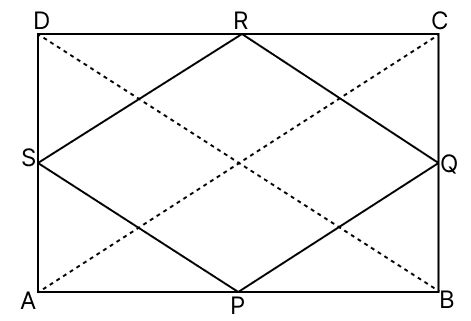
Given,
ABCD is a rectangle in which P, Q, R and S are the mid-points of the sides AB, BC, CD and DA respectively. PQRS is the quadrilateral formed by joining these mid-points.
Construction : Join the diagonals AC and BD.
In △ABC,
P and Q are the mid-points of AB and BC respectively.
By mid-point theorem,
⇒ PQ ∥ AC and PQ = AC ......... (1)
In △ADC,
S and R are the mid-points of AD and DC respectively.
By mid-point theorem,
⇒ SR ∥ AC and SR = AC ......... (2)
From equations (1) and (2),
⇒ PQ ∥ SR and PQ = SR.
Since one pair of opposite sides is equal and parallel, PQRS is a parallelogram.
In △ABD,
P and S are the mid-points of AB and AD respectively.
By mid-point theorem,
⇒ PS = BD ......... (3)
We know that, the diagonals of a rectangle are equal.
⇒ AC = BD
Thus,
⇒ PS = AC ......(4)
From equations (1) and (4),
⇒ PQ = PS
So, the adjacent sides PQ and PS of parallelogram PQRS are equal.
A parallelogram with adjacent sides equal is a rhombus.
Hence, proved that the quadrilateral PQRS formed is a rhombus.
In the adjoining figure, ABCD is a parallelogram. AB is produced to a point P and DP intersects BC at Q. Prove that: ar(△APD) = ar(quad. BPCD).
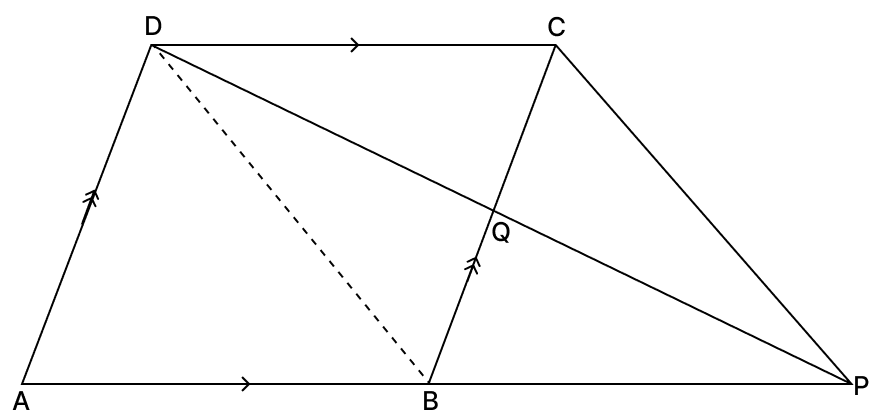
Answer
Given,
ABCD is a parallelogram. AB is produced to a point P and DP intersects BC at Q.
In △APD, BD is a line segment joining the vertex D to the point B on the base AP.
So, BD divides △APD into two triangles.
⇒ ar(△APD) = ar(△ABD) + ar(△BPD) ......... (1)
We know that,
A diagonal of a parallelogram divides it into two triangles of equal area.
Since BD is a diagonal of parallelogram ABCD,
⇒ ar(△ABD) = ar(△BCD) ......... (2)
From equations (1) and (2), we get :
⇒ ar(△APD) = ar(△BCD) + ar(△BPD) ......... (3)
The diagonal BC divides quadrilateral BPCD into △BCD and △BPC.
⇒ ar(quad. BPCD) = ar(△BCD) + ar(△BPC) ......... (4)
Since AB is produced to P, the point P lies on line AB, and DC ∥ AB. So △BPC and △BPD lie on the same base BP and between the same parallels BP and DC.
We know that, triangles on the same base and between the same parallels are equal in area.
⇒ ar(△BPC) = ar(△BPD) ......... (5)
Substituting ar(△BPC) = ar(△BPD) from equation (5) in equation (4), we get :
⇒ ar(quad. BPCD) = ar(△BCD) + ar(△BPD) ......... (6)
From equations (3) and (6), we get :
⇒ ar(△APD) = ar(quad. BPCD).
Hence, proved that ar(△APD) = ar(quad. BPCD).
In an examination, the ratio of passes to failures was 4 : 1. Had 30 less appeared and 20 less passed, the ratio of passes to failures would have been 5 : 1. How many students appeared for the examination?
Answer
Let the number of students who passed be 4k and the number of students who failed be k.
Total number of students who appeared = 4k + k = 5k.
According to the question,
If 30 less appeared, total students appeared = (5k - 30).
If 20 less passed, students passed = (4k - 20).
So, students failed = (Students appeared) - (Students passed)
⇒ Students failed = (5k - 30) - (4k - 20)
⇒ Students failed = 5k - 30 - 4k + 20
⇒ Students failed = (k - 10).
Given, the new ratio of passes to failures = 5 : 1.
⇒
⇒ 4k - 20 = 5(k - 10)
⇒ 4k - 20 = 5k - 50
⇒ 5k - 4k = 50 - 20
⇒ k = 30.
∴ Total number of students who appeared = 5k = 5 × 30 = 150.
Hence, 150 students appeared for the examination.
Find two rational numbers between 2 and 3.
Answer
We find rational numbers between 2 and 3 by the mean method.
A rational number between 2 and 3 :
A rational number between 2 and :
Since , the two rational numbers and lie between 2 and 3.
Hence, two rational numbers between 2 and 3 are and .
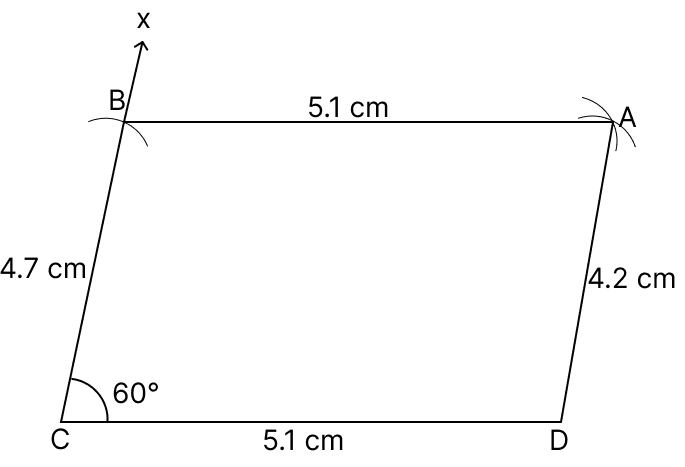
Construct a quadrilateral ABCD in which AB = CD = 5.1 cm, BC = 4.7 cm, DA = 4.2 cm and ∠BCD = 60°.
Answer
Steps of Construction:
Draw a line segment BC = 4.7 cm.
At C, construct ∠BCD = 60° and along this ray cut off CD = 5.1 cm.
With B as centre and radius equal to AB = 5.1 cm, draw an arc.
With D as centre and radius equal to DA = 4.2 cm, draw another arc cutting the previous arc at A.
Join AB and AD.
Hence, ABCD is the required quadrilateral.
The area of a triangle is 216 cm2 and its sides are in the ratio 3 : 4 : 5. Find the perimeter of the triangle.
Answer
Let the sides of the triangle be 3x, 4x and 5x.
We observe that, (3x)2 + (4x)2 = 9x2 + 16x2 = 25x2 = (5x)2.
Since the square of the longest side equals the sum of the squares of the other two sides, the triangle is a right-angled triangle with the right angle between the sides 3x and 4x.
By formula,
Area of the triangle = × base × height
Substituting values we get :
So, the sides are :
3x = 3 × 6 = 18 cm, 4x = 4 × 6 = 24 cm and 5x = 5 × 6 = 30 cm.
∴ Perimeter = 18 + 24 + 30 = 72 cm.
Hence, the perimeter of the triangle = 72 cm.
The radii of two concentric circles are 17 cm and 10 cm. A line segment PQRS cuts the larger circle at P and S and the smaller circle at Q and R. If QR = 12 cm, find the length PQ.
Answer
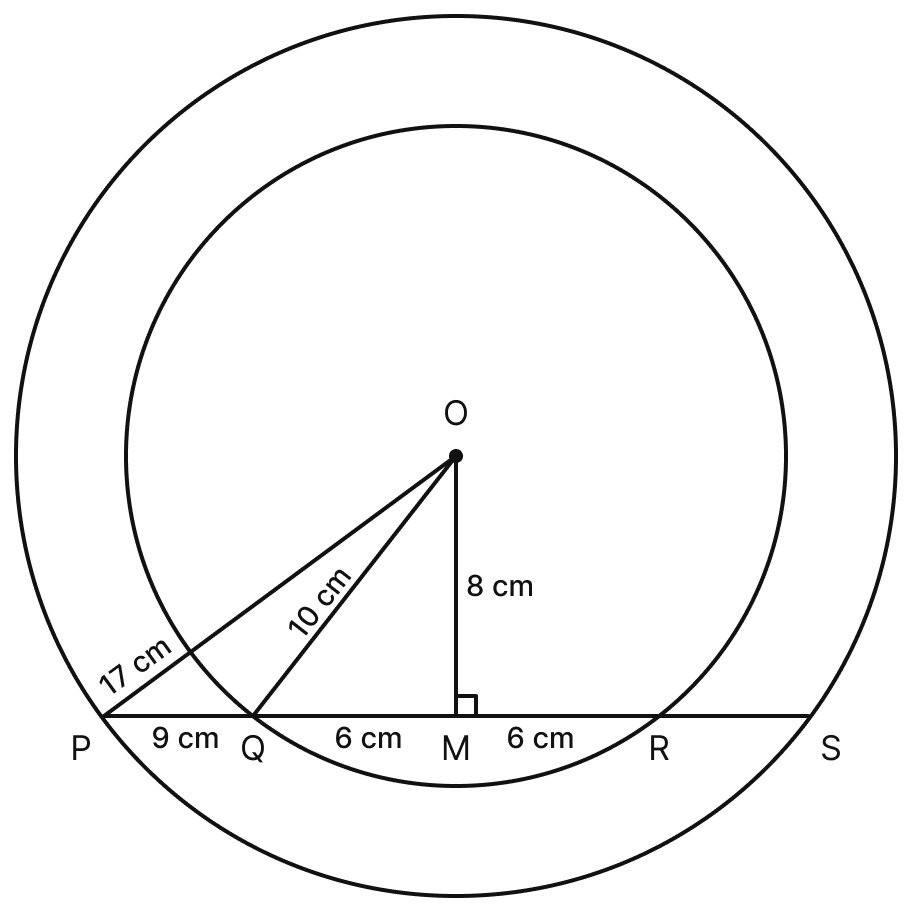
Given,
Radius of the larger circle (OP) = 17 cm, radius of the smaller circle (OQ) = 10 cm and QR = 12 cm.
Draw OM perpendicular to the line PQRS.
We know that, the perpendicular from the centre of a circle to a chord bisects the chord.
For the smaller circle, QR is a chord :
⇒ QM = MR = × 12 = 6 cm.
In right triangle OMQ,
By Pythagoras theorem,
⇒ OQ2 = OM2 + QM2
⇒ (10)2 = OM2 + (6)2
⇒ 100 = OM2 + 36
⇒ OM2 = 64
⇒ OM = 8 cm.
For the larger circle, PS is a chord and OM is the perpendicular from the centre.
In right triangle OMP,
By Pythagoras theorem,
⇒ OP2 = OM2 + PM2
⇒ (17)2 = (8)2 + PM2
⇒ 289 = 64 + PM2
⇒ PM2 = 225
⇒ PM = 15 cm.
From the figure,
⇒ PQ = PM - QM
⇒ PQ = 15 - 6
⇒ PQ = 9 cm.
Hence, the length PQ = 9 cm.
If two altitudes of a triangle are equal, prove that it is an isosceles triangle.
Answer
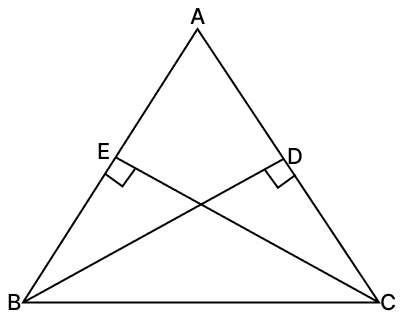
Given,
In △ABC, BE and CF are the two altitudes drawn from B and C to the sides AC and AB respectively, such that BE = CF.
In △BEC and △CFB,
⇒ ∠BEC = ∠CFB [Each = 90°]
⇒ BE = CF [Given]
⇒ BC = CB [Common side]
∴ △BEC ≅ △CFB (By RHS congruence rule)
⇒ ∠BCE = ∠CBF [By c.p.c.t.]
i.e., ∠BCA = ∠CBA.
We know that, sides opposite to equal angles of a triangle are equal.
∴ AB = AC.
Hence, proved that the triangle is an isosceles triangle.
Find the altitude of an equilateral triangle of side cm.
Answer
Given,
Side of the equilateral triangle (a) = cm.
By formula,
Altitude of an equilateral triangle =
Substituting values we get :
Hence, the altitude of the equilateral triangle = 7.5 cm.
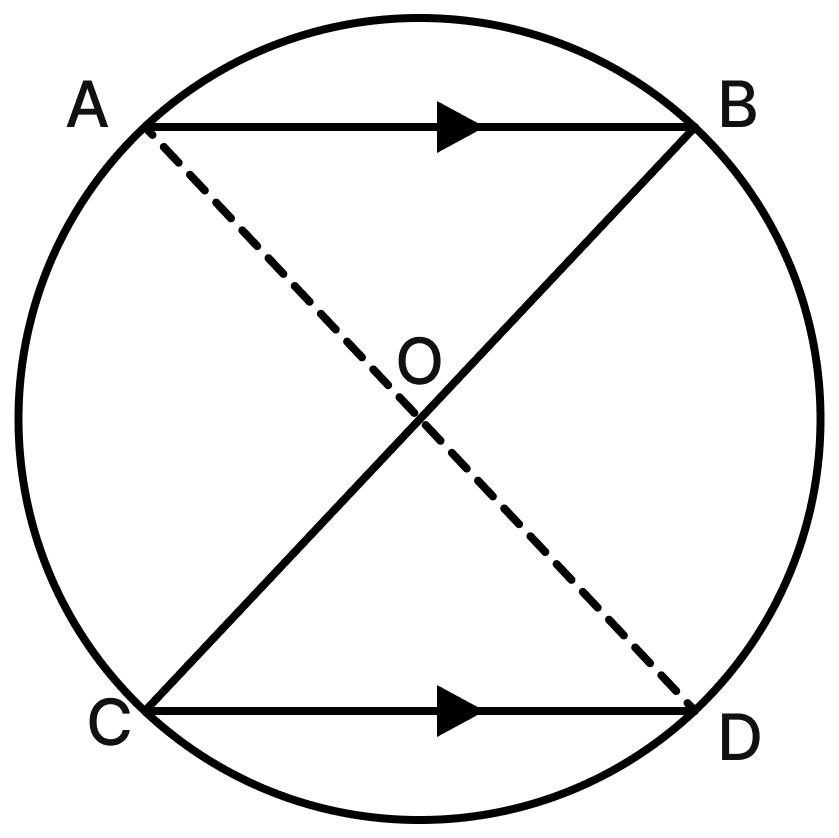
In the given figure, O is the centre of the circle. Chord AB is parallel to chord CD and CB is a diameter. Prove that : arc AC = arc BD.
Answer
Given,
O is the centre of the circle, chord AB ∥ chord CD and CB is a diameter.
Since AB ∥ CD and CB is a transversal,
⇒ ∠ABC = ∠BCD [Alternate interior angles are equal] ......... (1)
We know that,
The inscribed angle ∠ABC stands on arc AC and the inscribed angle ∠BCD stands on arc BD.
Also, equal inscribed angles subtend equal arcs in a circle.
Since ∠ABC = ∠BCD,
⇒ arc AC = arc BD.
Hence, proved that arc AC = arc BD.
Two years ago, the population of a village was 4000. During next year it increased by 6% but due to an epidemic, it decreased by 5% in the following year. What is its population now?
Answer
Given,
Population two years ago = 4000.
During the next year, the population increased by 6%.
By formula,
Population after increase =
Substituting values we get :
In the following year, the population decreased by 5%.
By formula,
Population after decrease =
Substituting values we get :
Hence, the present population of the village = 4028.
Prove that: tan(45° - A) tan(45° + A) = 1.
Answer
Solving L.H.S.,
We know that,
⇒ tan(45° + A) = tan[90° - (45° - A)]
⇒ tan(45° + A) = cot(45° - A) [Since tan(90° - θ) = cot θ]
⇒ tan(45° + A) = ......... (1)
Substituting value from equation (1) in L.H.S.,
Since, L.H.S. = R.H.S.
Hence, proved that tan(45° - A) tan(45° + A) = 1.