
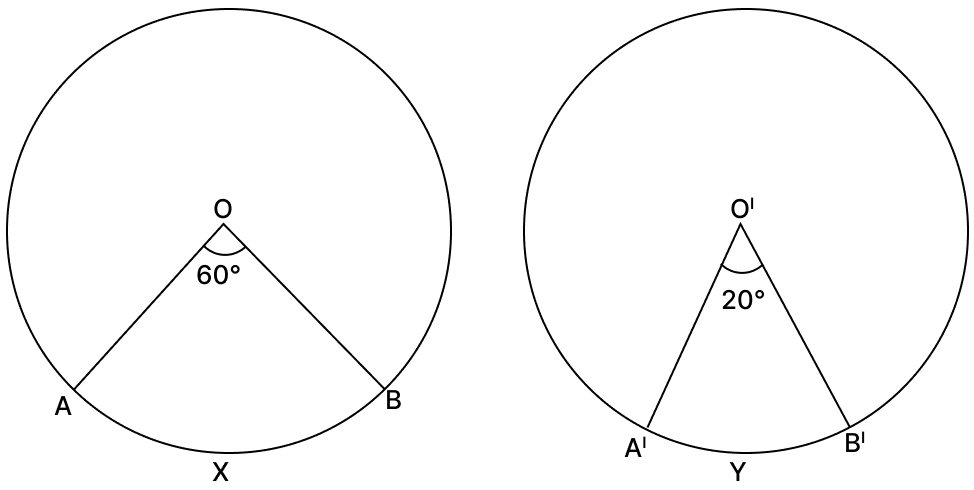
Assertion (A): In the figure, two congruent circles have centres O and O′.
Arc AXB subtends an angle of 60° at the centre O and arc AYB′ subtends an angle of 20° at the centre O′.
Then the ratio of arcs AXB and AY′B′ is 3 : 1.
Reason (R): Congruent arcs of a circle subtend equal angles at the centre.
A is true, R is false.
A is false, R is true.
Both A and R are true.
Both A and R are false.
Answer
Given, two circles are congruent.
For congruent circles,
Length of an arc is proportional to angle subtended at the centre.
∴ Assertion (A) is true.
Congruent arcs of a circle subtend equal angles at the centre because the length of an arc is directly proportional to the angle subtended by it at the centre.
∴ Reason (R) is true.
Hence, Option 3 is the correct option.
Assertion (A): Two congruent circles with centre O and O′ intersect at two points A and B. Then ∠AOB = ∠AO′B.
Reason (R): If a pair of opposite sides of a cyclic quadrilateral are equal, then its diagonals bisect each other.
A is true, R is false.
A is false, R is true.
Both A and R are true.
Both A and R are false.
Answer
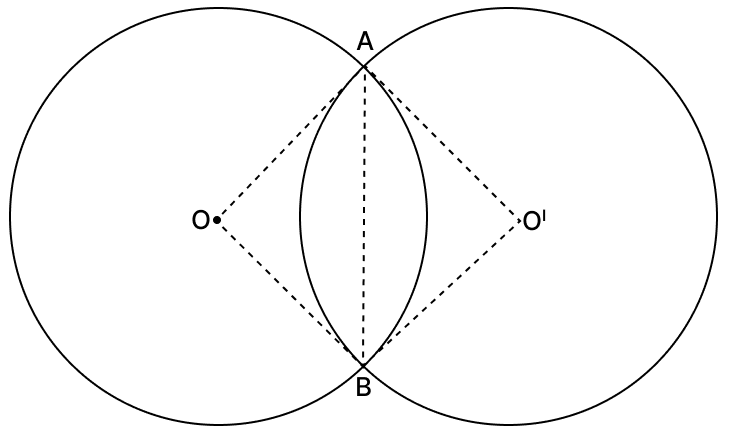
Join AB, OA, OB, O’A and O’B.
In triangle AOB and triangle AO’B,
⇒ OA = AO’ (circles have same radius as they are congruent)
⇒ OB = BO’ (circles have same radius as they are congruent)
⇒ AB = AB (common chord)
From the SSS congruence criterion,
△ AOB ≅ △ AO’B
Since, corresponding angles of congruent triangle are equal.
⇒ ∠AOB = ∠AO’B
∴ Assertion (A) is true.
If a pair of opposite sides of a cyclic quadrilateral are equal, then its diagonals bisect each other is not always true.
∴ Reason (R) is false.
Hence, Option 1 is the correct option.