
BP and CQ are two medians of a △ABC. If QP = 4 cm, then BC =
2 cm
6 cm
8 cm
9 cm
Answer
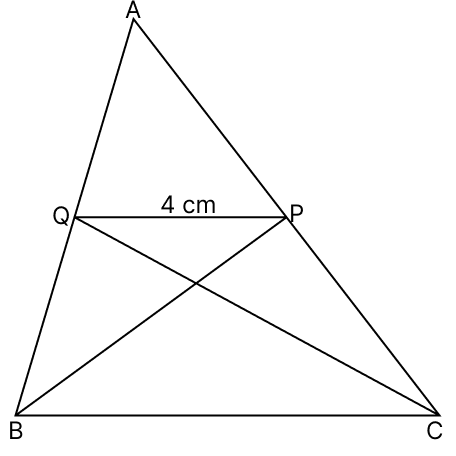
Given,
BP is the median.
∴ P is the mid-point of AC
CQ is the median.
∴ Q is the mid-point of AB
By mid-point theorem,
The line segment joining the mid points of any two sides of a triangle is parallel to the third side and is equal to half of it.
Since, Q and P are the mid-points of AB and AC respectively. Thus,
⇒ QP || BC and QP = BC
⇒ BC = 2 × QP
⇒ BC = 2 × 4
⇒ BC = 8 cm.
Hence, option 3 is the correct option.
ABC is a right angled isosceles triangle in which ∠A = 90°. If D and E are the mid-points of AB and AC respectively, then ∠ADE =
30°
45°
60°
90°
Answer
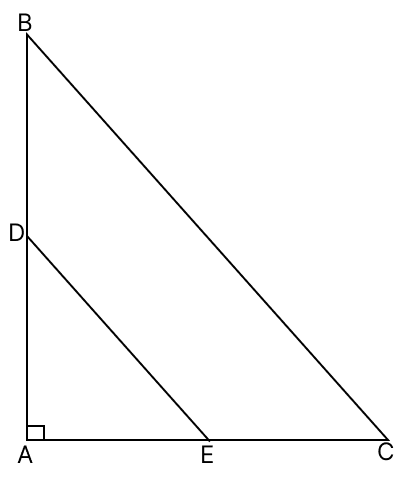
Given,
ABC is a right angled isosceles triangle. Since, hypotenuse is the largest side thus other two sides of triangle will be equal.
AC = AB
⇒ ∠C = ∠B = x (let)
In △ABC,
⇒ ∠A + ∠B + ∠C = 180°
⇒ 90° + x + x = 180°
⇒ 2x = 180° - 90°
⇒ 2x = 90°
⇒ x =
⇒ x = 45°
⇒ ∠C = ∠B = 45°
By mid-point theorem,
The line segment joining the mid points of any two sides of a triangle is parallel to the third side and is equal to half of it.
Since, D and E are the mid-points of AB and AC respectively.
DE || BC
AB is the transversal.
⇒ ∠ABC = ∠ADE (Corresponding angles are equal)
⇒ ∠ADE = 45°.
Hence, option 2 is the correct option.
On the sides AB and AC of a △ABC, D and E are two points such that AD : AB = AE : AC = 1 : 2. If BC = 7 cm, then DE =
3.5 cm
7 cm
14 cm
15 cm
Answer
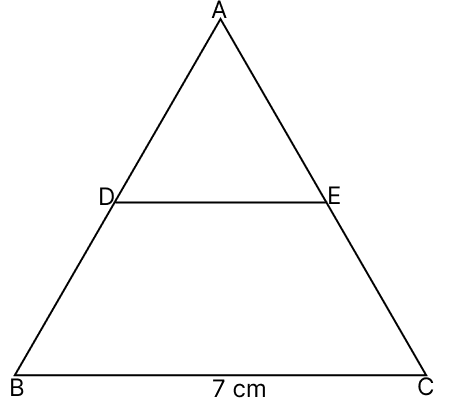
Given,
AD : AB = 1 : 2
⇒ AB = 2 AD
∴ D is the mid-point of AB
AE : AC = 1 : 2
⇒ AC = 2 AE
∴ E is the mid-point of AC
By mid-point theorem,
The line segment joining the mid points of any two sides of a triangle is parallel to the third side and is equal to half of it.
Since, D and E are the mid-points of AB and AC respectively.
⇒ DE = × 7 = 3.5 cm
Hence, option 1 is the correct option.
AD and BE are two medians of a ABC. F is a point on AC such that DF || BE. If AC = 12 cm, then FC =
6 cm
4 cm
3 cm
none of these
Answer
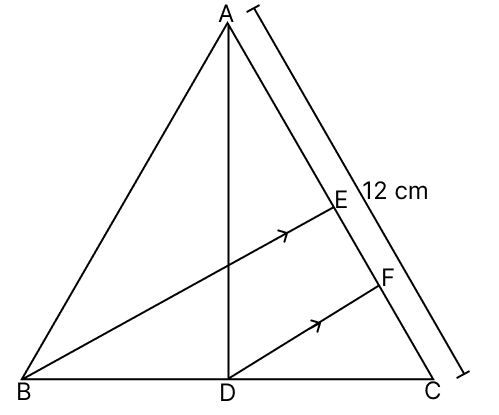
In △BCE,
D is the midpoint of BC (As AD is median)
Given,
DF || BE
By converse of mid-point theorem,
A line drawn through the midpoint of one side of a triangle, and parallel to another side, will bisect the third side.
Thus, in triangle BEC,
F is the mid-point of CE
⇒ FC = CE ....(1)
Given,
BE is median.
⇒ E is the mid-point of AC
⇒ AE = CE
⇒ CE = AC
Substituting value of CE in eq.(1), we get:
⇒ FC =
⇒ FC =
⇒ FC = 3 cm.
Hence, option 3 is the correct option.
D, E and F are respectively the mid-points of the sides BC, CA and AB of a ABC. If BC = 10 cm, CA = 12 cm and AB = 17 cm, then the perimeter of the DEF is :
13 cm
19.5 cm
39 cm
None of these
Answer
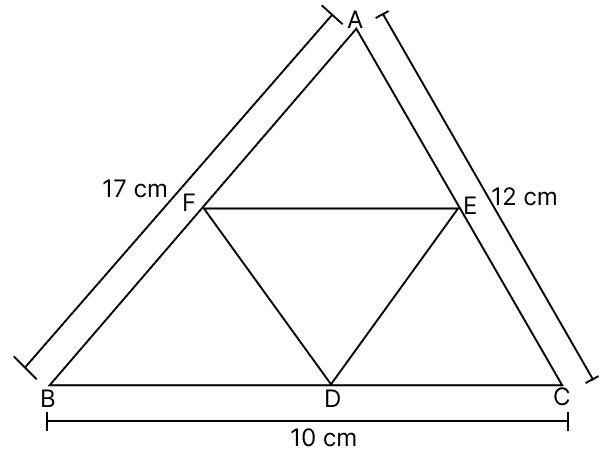
By mid-point theorem,
The line segment joining the mid points of any two sides of a triangle is parallel to the third side and is equal to half of it.
Since, F and E are the mid-points of AB and AC respectively.
⇒ FE || BC and FE = × 10 = 5 cm
Since, F and D are the mid-points of AB and BC respectively.
⇒ FD || AC and FD = × 12 = 6 cm
Since, D and E are the mid-points of BC and AC respectively.
⇒ DE || AB and DE = × 17 = 8.5 cm
Perimeter of DEF = DE + FE + FD = 8.5 + 5 + 6 = 19.5 cm
Hence, option 2 is the correct option.
D, E and F are respectively the mid-points of the sides BC, CA and AB of a ABC. If BC = 12 cm, CA = 15 cm and AB = 18 cm, then the perimeter of the quadrilateral DEAF is :
45 cm
27 cm
30 cm
33 cm
Answer
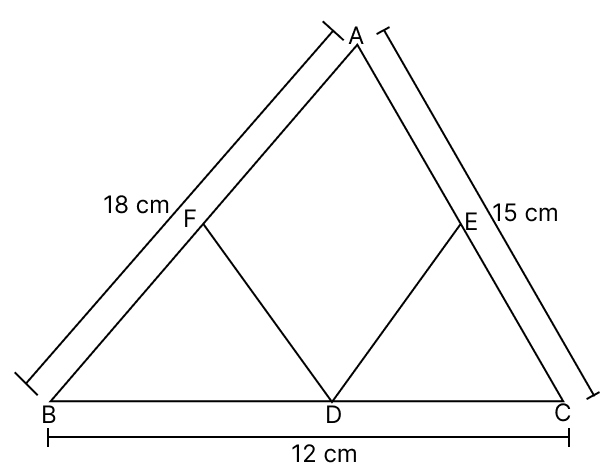
By mid-point theorem,
The line segment joining the mid points of any two sides of a triangle is parallel to the third side and is equal to half of it.
Since, D and E are the mid-points of BC and AC respectively.
⇒ DE || AB and DE = × 18 = 9 cm
Since, F and D are the mid-points of AB and BC respectively.
⇒ FD || AC and FD = × 15 = 7.5 cm
AE = = 7.5 cm
AF = = 9 cm
Perimeter of AFED = AF + FD + DE + AE = 9 + 7.5 + 9 + 7.5 = 33 cm.
Hence, option 4 is the correct option.
In the adjoining figure, AD = BD and DE || BC. If AC = 6 cm and DE = 4 cm, then the length of BC is :
4 cm
5 cm
6 cm
8 cm
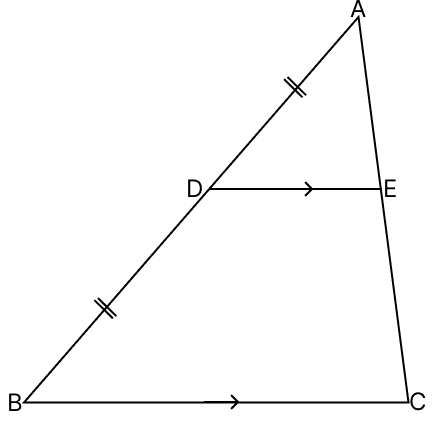
Answer
Given,
D is the mid-point of AB.
By converse of mid-point theorem,
A line drawn through the midpoint of one side of a triangle, and parallel to another side, will bisect the third side.
In △ABC,
Since, D is the mid-point of AB and DE // BC, thus :
E is mid-point of AC.
By mid-point theorem,
The line segment joining the mid points of any two sides of a triangle is parallel to the third side and is equal to half of it.
Since, D and E are the mid-points of AB and AC respectively.
DE || BC
⇒ DE = BC
⇒ BC = 2 DE
⇒ BC = 2 × 4
⇒ BC = 8 cm.
Hence, option 4 is the correct option.
In the given figure, BP and CQ are two medians of the △ABC. If BC = 12 cm, the length of QP =
4 cm
6 cm
8 cm
10 cm
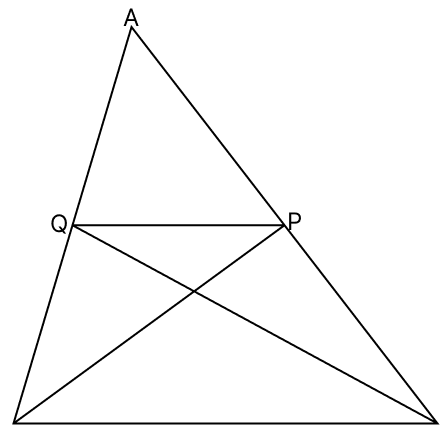
Answer
We know that,
Median drawn from the vertex bisects the opposite side.
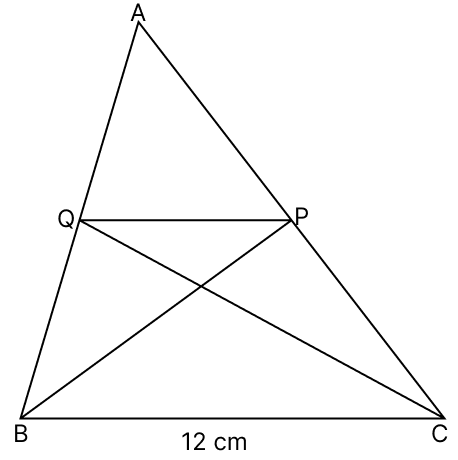
Since, CQ is the median to AB.
⇒ AQ = BQ
Since, BP is the median to AC
⇒ AP = CP
By mid-point theorem,
The line segment joining the mid points of any two sides of a triangle is parallel to the third side and is equal to half of it.
Since, Q and P are the mid-points of AB and AC respectively.
⇒ QP || BC and QP = BC
⇒ QP = × 12
⇒ QP = 6 cm.
Hence, option 2 is the correct option.
In △ABC, E is the mid-point of the median AD. BE is joined and produced to meet AC at F. Then, AF = ....AC.
3
2
Answer
Draw DY parallel to BF.
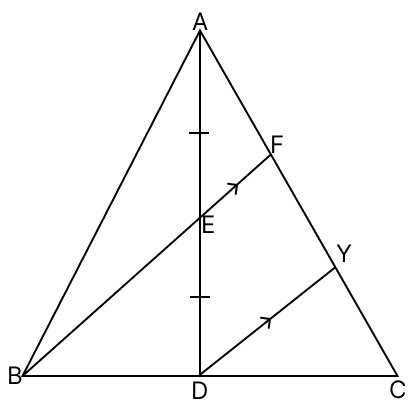
Since, BF || DY so, EF || DY
By converse of mid-point theorem,
A line drawn through the midpoint of one side of a triangle, and parallel to another side, will bisect the third side.
In △ADY,
Since, E is the mid-point of AD and EF || DY
⇒ F is the mid-point of AY.
∴ AF = FY
Given,
AD is the median.
In △BCF,
Since, D is the mid-point of BC and BF || DY
⇒ Y is the mid-point of FC.
∴ FY = CY
⇒ AF = FY = CY
From figure,
AC = AF + FY + CY = AF + AF + AF = 3 AF
⇒ AF = AC
Hence, option 3 is the correct option.
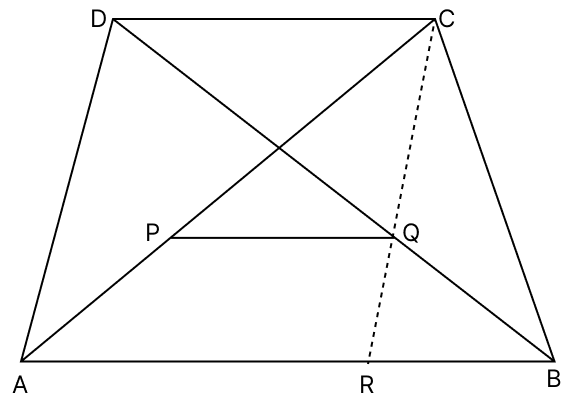
In the trapezium ABCD, AB || DC and AB > DC. P and Q are the mid-points of the diagonals AC and BD. Then, PQ || AB and PQ = .....(AB - DC).
2
3
Answer
In △BQR and △CQD,
⇒ ∠BQR = ∠CQD (Vertically opposite angles are equal)
⇒ ∠BRQ = ∠QCD (Alternate angles are equal)
⇒ BQ = DQ (Q is the mid-point of BD)
∴ △BQR ≅ △CQD
⇒ BR = DC (Corresponding parts of congruent triangles are equal)
⇒ QR = CQ (Corresponding parts of congruent triangles are equal)
Given,
AB || DC and PQ || AB
∴ PQ || AB || DC
In △ARC,
Since, P and Q are the mid-points of AC and CR respectively.
By mid-point theorem,
⇒ PQ = AR
⇒ PQ = (AB - BR)
⇒ PQ = (AB - DC) (∵ BR = DC)
Hence, option 3 is the correct option.