
The area of a rectangle is thrice that of a square. Length of the rectangle is 40 cm and the breadth of the rectangle is times that of the side of the square. The side of the square is:
15 cm
18 cm
20 cm
24 cm
Answer
Given,
Area of rectangle = 3 × Area of square ........(1)
Length of rectangle = 40 cm
Let side of square be x cm.
Breadth of rectangle = × side of a square
= 1.5 × x = 1.5x
Area of square = side2 = x2 cm.
Area of rectangle = length × breadth
= 40 × 1.5x
= 60x.
Substituting values in equation (1), we get :
⇒ 60x = 3 × x2
⇒ 60 = 3x
⇒ x = = 20 cm.
Hence, option 3 is the correct option.
A field is in the shape of parallelogram, whose adjacent sides are 120 m and 170 m. If its one diagonal is 250 m, then cost of ploughing the field at ₹20 per sq m is :
₹ 90,000
₹ 1,20,000
₹ 1,80,000
₹ 3,60,000
Answer
Let ABCD be a field in the shape of a || gm .
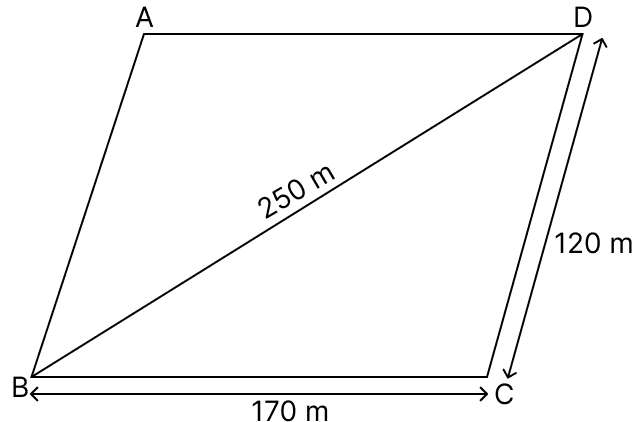
Calculating area of triangle BCD,
CD = a = 120 m, BC = b = 170 m, BD = c = 250 m
By formula,
We know that,
In a parallelogram, the diagonal divides the parallelogram into two congruent triangles.
Thus, area of triangle ABD = area of triangle BCD = 9000 m2.
Area of parallelogram ABCD = Area of triangle ABD + Area of triangle BCD
= 9000 + 9000 = 18000 m2.
Given,
Cost of ploughing the field = ₹20 per sq m.
Total cost = Area × Cost per sq m = 18000 × ₹20 = ₹3,60,000.
Hence, option 4 is the correct option.
The base of an isosceles triangle is 16 cm and its area is 48 cm2. The perimeter of the triangle is :
24 cm
30 cm
36 cm
42 cm
Answer
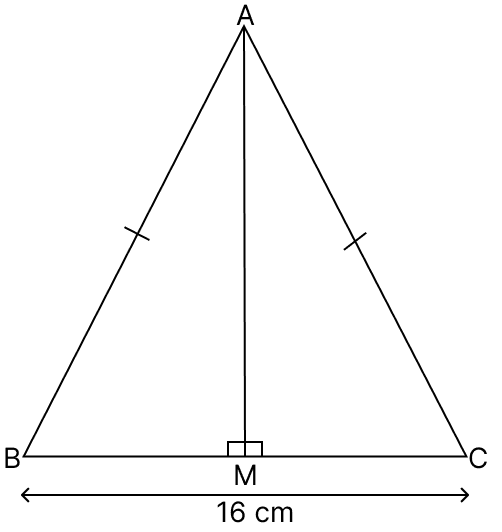
From figure,
ABC is an isosceles triangle with AM as the height and BC as the base.
Base (BC) = 16 cm
Area of triangle = × base × height
⇒ 48 = × 16 × AM
⇒ 48 = 8 × AM
⇒ AM = = 6 cm.
In an isosceles triangle,
The altitude from the common vertex bisects the base.
In triangle ABC,
The altitude AM bisects the base BC.
So, BM = MC = = 8 cm.
Using Pythagoras theorem for the △AMB,
Hypotenuse2 = Base2 + Height2
⇒ AB2 = BM2 + AM2
⇒ AB2 = 82 + 62
⇒ AB2 = 64 + 36
⇒ AB2 = 100
⇒ AB = = 10 cm.
∴ AC = AB = 10 cm.
Perimeter of triangle = Sum of all sides of the triangle
= AB + AC + BC
= 10 + 10 + 16 = 36 cm.
Hence, option 3 is the correct option.
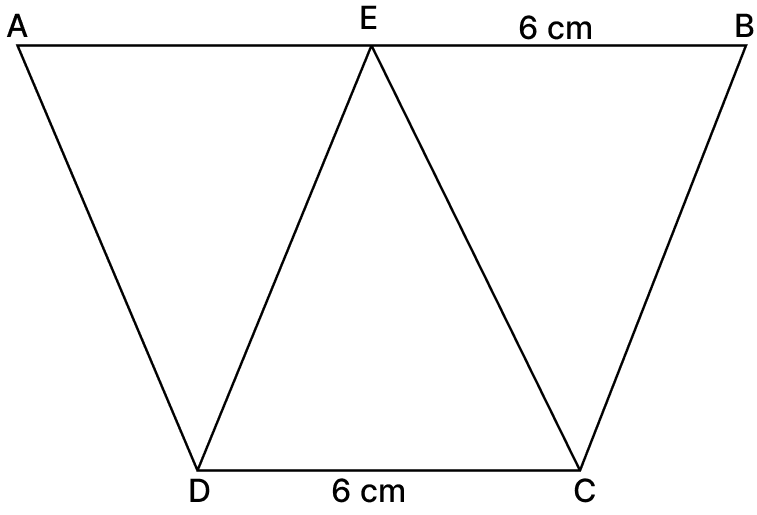
In the given figure, ABCD is a trapezium in which AB || CD. If area of △BEC is 12 cm2, then area of △EDC is :
12 cm2
6 cm2
24 cm2
none of these
Answer
Since, AB || DC.
∴ Triangles BEC and EDC lie between the same parallel lines.
Both triangles have the same height (distance between AB and CD).
There bases are also equal:
Base of △BEC = EB = 6 cm
Base of △EDC = DC = 6 cm
We know that,
Area of triangle = × base × height
Since both triangles (△BEC and △EDC) have same height and base.
So, there areas are also equal.
∴ Area of △BEC = Area of △EDC = 12 cm2.
Hence, option 1 is the correct option.
A student wrote the Heron's Formula in his notebook as below.
Area of a triangle with sides a, b and c
= .
Is it correct?
Answer
We know that,
For sides with a, b, c and semi-perimeter 's', Heron's Formula for area of triangle is :
Area of triangle =
But the given formula is :
.
Hence, the student wrote the incorrect formula.
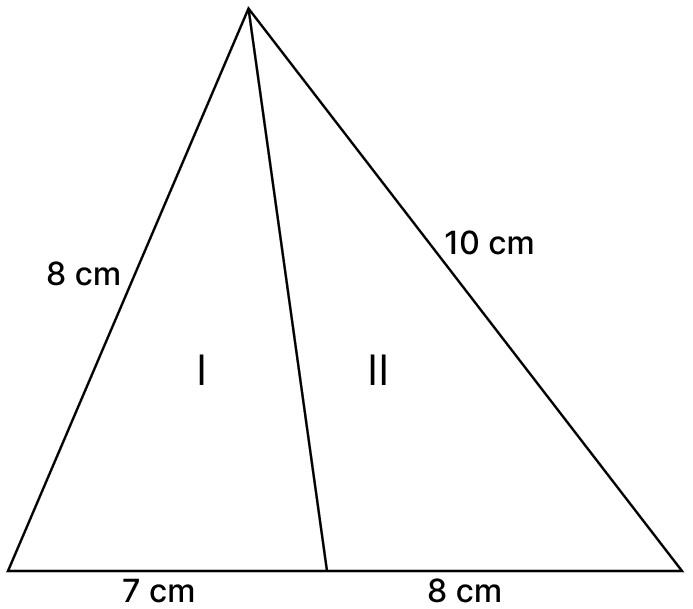
In the figure, semi perimeter of triangle I is known. Would you be able to find the area of triangle II using Heron's formula?
Answer
In triangle I,
Only 2 sides are given, but with the help of semi-perimeter from triangle I we can find 3rd side of the triangle, which is the common side for both the triangles.
In triangle II,
2 sides are already given and we got the 3rd side, which is common side for both triangles.
Since, the length of all the sides of the triangle are known. Thus, by using Heron's Formula we can find the area of triangle II.
Hence, yes we can find area of triangle II using Heron's Formula.
Look at the given triangles. A student argued that since the perimeter of △XYZ is more than that of △ABC, so area of △XYZ is also greater than that of △ABC. Is he right?
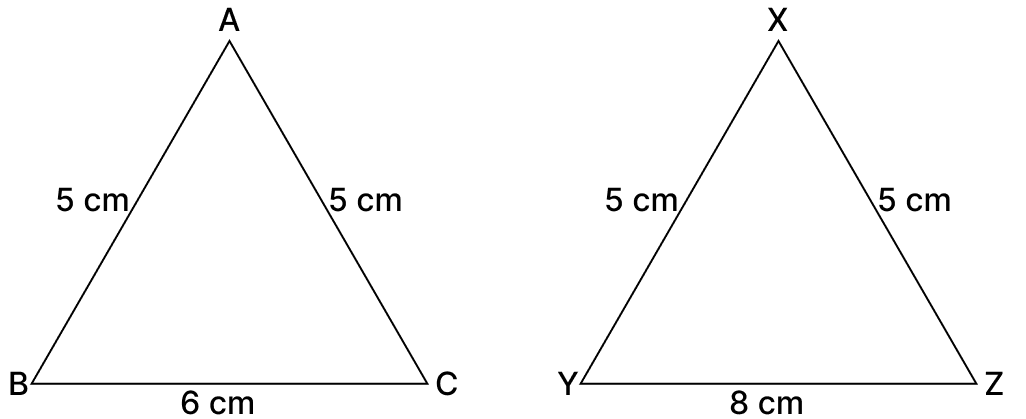
Answer
From figure,
Perimeter of △ABC = AB + BC + CA = 5 + 5 + 6 = 16 cm
Perimeter of △XYZ = XY + YZ + ZX = 5 + 5 + 8 = 18 cm.
By formula,
Area of an isosceles triangle = , where a is the length of equal sides and b is the length of base.
Area of △ABC =
Area of △XYZ =
Although, perimeter of △XYZ is more than that of △ABC, but area of both the triangles are equal.
Hence, the student is wrong.