
The blanket of air surrounding the earth is known as the:
- Ozone layer
- Nitrogen layer
- Lithosphere
- Atmosphere
Answer
Atmosphere
Reason — The atmosphere is the blanket of air surrounding the Earth. It is made up mainly of nitrogen and oxygen. The ozone layer is a part of the atmosphere, while the lithosphere is the Earth's solid outer layer.
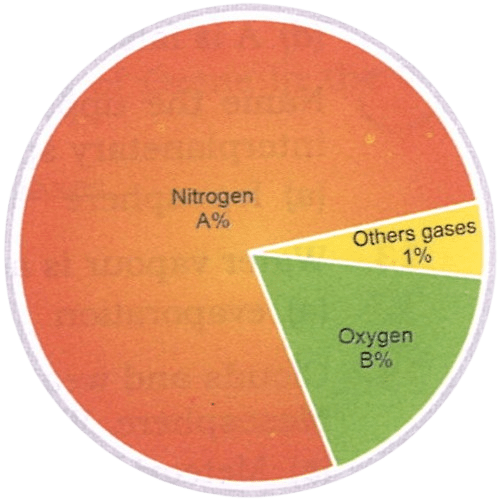
What is A% and B% as depicted in the diagram showing the composition of the atmosphere
- A: 72 B: 27
- A: 77 B: 22
- A: 78 B: 21
- A: 79 B: 20
Answer
A: 78 B: 21
Reason — A clean, dry sample of air contains 78% nitrogen, 21% oxygen, and 1% other gases. Hence, A represents nitrogen (78%) and B represents oxygen (21%).
A plume of volcanic ash from the eruption of the dormant Hayli Gubbi volcano (Ethiopia) has swept across the Red Sea through Oman and Yemen and reached Delhi, the India Meteorological Department (IMD) has said.
Volcanic ash is a cloud of tiny, abrasive particles released into the atmosphere during an eruption. It can damage aircraft engines, contaminate airfields and reduce visibility, making it hazardous to flight operations.
"The affected altitude is between 8.5 km (5.2 miles) and 15 km above the sea level," said Mrutyunjay Mohapatra, director general of IMD. "It will temporarily affect satellite functions and flight operations. But it is unlikely to affect weather conditions or air quality" he added.
(i) What does 'affected altitude' mean?
- The ash cloud is present at that altitude
- The effect of the volcanic ash is permanent
- The volcanic cloud has replaced other clouds
- All of the above.
(ii) Why would the volcanic cloud not affect weather conditions over India?
- It is present in the upper atmosphere
- Weather phenomenon occur in the lower atmosphere
- Both (a) and (b)
- Neither (a) nor (b)
(iii) After a volcanic eruption flight operations are affected in the areas surrounding the volcanoes. Why?
- Tiny abrasive particles of volcanic ash are released in the atmosphere
- These particles damage aircraft engines
- These particles reduce visibility.
- All of the above.
Answer
(i) The ash cloud is present at that altitude
Reason — The IMD statement refers to the ash plume suspended between 8.5 km and 15 km above sea level. Thus, 'affected altitude' means the height at which the ash cloud is present.
(ii) Both (a) and (b)
Reason — The volcanic ash cloud lies between 8.5 km and 15 km above sea level, away from the lower troposphere where weather occurs. Hence, it does not affect weather conditions over India.
(iii) All of the above
Reason — Volcanic ash is a cloud of fine particles released during an eruption. It damages aircraft engines, reduces visibility, and makes flying hazardous.
Mountain climbers set up camps at the base as well as at regular intervals along their climb. Why?
- To acclimatize their bodies to lower concentration of air.
- To acclimatize their bodies to lower temperature.
- To acclimatize their bodies to pressure.
- All of the above.
Answer
All of the above.
Reason — As altitude increases, air becomes thinner, reducing air pressure, oxygen, and temperature. Hence, camps are set up at intervals to help climbers acclimatize.
Assertion (A): The atmosphere is the most dynamic entity on the earth's surface.
Reason (R): Large masses of air are being moved up and down and across the surface of the earth.
- Both A and R are true and R is the correct explanation of A.
- Both A and R are true but R does not explain A.
- A is true but R is false.
- A is false but R is true.
Answer
Both A and R are true and R is the correct explanation of A.
Explanation — The atmosphere is the most dynamic entity because large masses of air are constantly moving vertically and horizontally due to the Sun's unequal heating of the Earth's surface. This continuous movement keeps the atmosphere in a dynamic state.
The composition of the atmosphere makes it a dynamic entity, however there are four thermal layers. Which of the following is in the correct order from the surface of the earth?
- Thermosphere - Mesosphere - Stratosphere - Troposphere
- Troposphere - Mesosphere - Stratosphere - Thermosphere
- Troposphere - Stratosphere - Mesosphere - Thermosphere
- Thermosphere - Stratosphere - Mesosphere - Troposphere
Answer
Troposphere - Stratosphere - Mesosphere - Thermosphere
Reason — From the Earth's surface upward, these are the Troposphere (the lowermost and densest layer), the Stratosphere (up to about 50 km), the Mesosphere (up to about 80 km), and the Thermosphere, which includes the Ionosphere and the Exosphere.
............... extends up to a height of about 400 km and is responsible for enabling radio communication.
- Mesosphere
- Ionosphere
- Stratosphere
- Troposphere
Answer
Ionosphere
Reason — The Ionosphere, a part of the Thermosphere, extends up to about 400 km. It contains electrically charged particles (ions) that reflect radio waves back to the Earth's surface, enabling radio communication.
Assertion (A): About 90 per cent of the mass of air lies within a height of about 20 km from the surface of the earth.
Reason (R): The air of the lower layer is always heavier or denser, while the upper layers are thinner or less dense.
- Both A and R are true and R is the correct explanation of A.
- Both A and R are true but R does not explain A.
- A is true but R is false.
- A is false but R is true.
Answer
Both A and R are true and R is the correct explanation of A.
Explanation — The atmosphere is denser near the Earth's surface because the weight of the upper layers compresses the lower layers. As a result, about 90% of the total mass of the atmosphere lies within the lowest 20 km above the Earth's surface.
Water vapour is added to the atmosphere by ............... .
- evaporation
- transpiration
- respiration
- All of the above
Answer
All of the above
Reason — Water vapour is added to the atmosphere by evaporation from oceans, lakes and rivers, by transpiration from vegetation and by respiration of animals. Hence all the given processes add water vapour to the atmosphere.
Clouds and weather phenomenon occur in the Troposphere but some clouds are found in the Mesosphere. Why?
- Meteoric dust particles reflect sunlight causing wispy clouds.
- Some water particles reach the Mesosphere to form clouds.
- Ions from the ionosphere deflect sunlight giving the impression of clouds.
- None of the above.
Answer
Meteoric dust particles reflect sunlight causing wispy clouds.
Reason — The Mesosphere extends up to about 80 km above the Earth's surface. Wispy clouds are seen in this layer due to sunlight reflected by meteoric dust particles. They are not weather clouds, as all weather phenomena occur only in the Troposphere.
Which of the following are the functions of the atmosphere?
- Facilitates the cyclic exchange of gases
- Maintain of optimum temperature
- Protects the earth from harmful solar radiation
- All of the above.
Answer
All of the above
Reason — The atmosphere facilitates the cyclic exchange of gases between air, land, and water, maintains a suitable temperature by trapping heat, and protects the Earth from harmful ultraviolet rays of the Sun. Hence, all of the above are functions of the atmosphere.
The decrease in the temperature with rise in altitude is known as the:
- Normal temperature rate
- Decreased temperature rate
- Normal lapse rate
- Decreased lapse rate
Answer
Normal lapse rate
Reason — The Troposphere is characterised by a regular decrease in temperature with altitude. This decrease in temperature is known as the normal lapse rate. The average decrease is 1°C for every 166 metre altitude gained.
Name the layer which contains ions electrically charged particles which create a sheet like display of light known as Aurora Borealis in the northern hemisphere.
- Ionosphere
- Exosphere
- Stratosphere
- Mesosphere
Answer
Ionosphere
Reason — The Ionosphere contains electrically charged particles called ions which create a sheet like display of light known as Aurora Borealis in the Northern Hemisphere and Aurora Australis in the Southern Hemisphere.
Assertion (A): The troposphere is heated more from below than from above.
Reason (R): The troposphere is heated by the incoming solar energy.
- Both A and R are true and R is the correct explanation of A.
- Both A and R are true but R does not explain A.
- A is true but R is false.
- A is false but R is true.
Answer
A is true but R is false.
Explanation — The troposphere is heated from below, not directly by incoming solar radiation. The Earth's surface absorbs the Sun's energy and then radiates heat upward, warming the air in the troposphere. Therefore, the assertion is true, but the reason is false.
Which amongst the following is not a direct impact of Global Warming?
- Precipitation Change
- Radiation Balance
- Rise in Sea Level
- Diseases
Answer
Radiation Balance
Reason — Global warming causes precipitation changes, sea level rise, and an increase in diseases. It also leads to radiation imbalance, not radiation balance, by disturbing the balance between incoming and outgoing radiation. Hence, radiation balance is not a direct impact of global warming.
What is known as atmosphere? State its composition.
Answer
The blanket of air surrounding the Earth is known as the atmosphere.
The atmosphere is a mixture of many gases and tiny solid particles. Atmosphere contains-
- 78% nitrogen gas
- 21% oxygen gas
- The remaining 1% of air is made up of Carbon dioxide, Water Vapour, Helium, Hydrogen, Argon etc.
Name the four layers of the atmosphere. Give one function of the outer most layer.
Answer
The four layers of the atmosphere are-
- Troposphere
- Stratosphere
- Mesosphere
- Thermosphere
Thermosphere is the outermost layer of the atmosphere where the satellites orbit the earth.
What is known as troposphere? List any two characteristics of the troposphere.
Answer
The troposphere is the lowermost and densest layer of the atmosphere. Its height varies from 18 km at the equator to 8 km at the poles.
Two characteristics of the troposphere are:
- Seventy-five per cent of the atmosphere is found in the troposphere and its concentration decreases as we go higher from ground level.
- The troposphere is heated more from below than from above.
Mention the chief characteristics of stratosphere.
Answer
The chief characteristics of stratosphere are-
- The air is thin, cold, and dry. The temperature at the base is about −55°C.
- The ozone layer lies in the stratosphere, mainly between 20 km and 50 km above the Earth's surface.
- Ozone absorbs the Sun's ultraviolet radiation, causing the temperature to increase with altitude in the upper part of the stratosphere.
- The lower stratosphere has very little water vapour and is almost free from weather disturbances, making it ideal for jet aircraft.
- The temperature rises from about −60°C at the base to about 0°C at the stratopause.
- The upper limit of the stratosphere is called the stratopause.
In which layer of atmosphere do all the weather conditions occur? Name the constituent gases of atmosphere which scientists consider responsible for climate change.
Answer
All the weather conditions occur in the troposphere.
The constituent gases of atmosphere which scientists consider responsible for climate change are Carbon dioxide, Methane, Chlorofluorocarbons, Ozone and Water Vapour.
Pratap was travelling by air from Kolkata to Chennai. There was heavy storm and rain in Bhubaneswar. Pratap's flight had flown over Bhubaneswar during that storm and he did not feel any turbulence due to it. As a student of geography how would you explain this?
Answer
Pratap did not feel any turbulence because aeroplanes generally fly in the lower stratosphere, where the weather is calm and stable. The troposphere, the layer below the stratosphere, contains all weather phenomena like storms and rain. Since the plane was flying above the troposphere (in the stratosphere), it did not experience the turbulence caused by the storm in Bhubaneswar.
What is known as Ozone Layer? What is leading to depletion of Ozone Layer in the atmosphere?
Answer
Ozone layer is a stratospheric layer that absorbs the Sun's harmful ultraviolet (UV) rays and helps maintain stable temperatures in the lower atmosphere.
It is depleted by chemicals such as chlorofluorocarbons (CFCs), chlorine, bromine, and sulphur dioxide from volcanic eruptions, solar storms, and human activities. CFCs break down in the stratosphere, releasing chlorine atoms that destroy ozone.
What would be the effect of Ozone Layer depletion? List the natural causes of Ozone Layer depletion.
Answer
The effects of ozone layer depletion are as follows:
- Increased levels of harmful ultraviolet (UV) radiation reaching the Earth's surface.
- Higher risk of skin cancer, eye damage (including cataracts), and weakened immune systems.
- Damage to marine ecosystems.
- Harm to crops, reducing agricultural productivity and causing food shortages.
- Disruption of biogeochemical cycles, including the nitrogen, sulphur, and carbon cycles.
- Changes in climate patterns by affecting atmospheric temperatures and rainfall.
The natural causes of ozone layer depletion are volcanic eruptions and solar flares.
Could Ozone in the lower layer of the atmosphere make up for loss of Ozone in the Ozone Layer? Give reasons to support your answer.
Answer
No, ozone in the lower layer of the atmosphere (the troposphere) cannot make up for the loss of ozone in the ozone layer (the stratosphere). This is because ozone near the Earth's surface is a harmful pollutant, whereas ozone in the stratosphere forms a protective layer that absorbs the Sun's harmful ultraviolet (UV) rays.
Therefore, ozone in the lower atmosphere cannot replace or perform the protective function of the stratospheric ozone layer.
What is known as Global Warming? Name important Greenhouse gases.
Answer
The rise in average mean temperature of the Earth on account of enhanced concentration of greenhouse gases in the atmosphere is known as global warming.
Some important Greenhouse gases are Carbon dioxide, Methane, Chlorofluorocarbons, Ozone and Water Vapour.
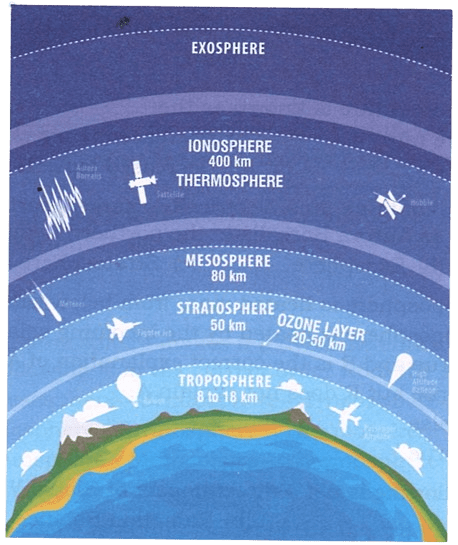
Describe the structure of the atmosphere based on the picture given alongside.
Answer
The atmosphere consists of concentric layers of air. On the basis of the characteristics of temperature and air pressure, it can be divided into four thermal layers — Troposphere, Stratosphere, Mesosphere and Thermosphere. The Thermosphere is divided into Ionosphere and Exosphere. The four layers are briefly described below:
- Troposphere — It is the lowermost and densest layer. Its height varies from 18 km at the Equator to 8 km at the Poles.
- Stratosphere — This layer lies above the Troposphere. It extends to a height of 50 km from sea level. The Ozone layer lies within the stratosphere. Ozone is generally found between the altitudes of 20 and 50 km.
- Mesosphere — This layer lies above the Stratosphere. It extends to a height of 80 km from ground level.
- Thermosphere — It lies above Mesosphere and consists of two parts:
- Ionosphere — It extends up to a height of about 400 km.
- Exosphere — It is the uppermost layer of the atmosphere. It lies between 400 to 1500 km above the earth.
What are the main components of the atmosphere? How does their composition support life on earth?
Answer
The main components of the atmosphere are Nitrogen (78%) and Oxygen (21%). These two gases play a significant role in supporting life on Earth.
- Oxygen gas helps in burning and breathing. Without breathing oxygen, most living things cannot survive.
- Nitrogen dilutes the oxygen and slows down the process of oxidation.
- It is essential for all living things but they cannot use it directly from the atmosphere. Plants obtain it from the soil and animals obtain nitrogen by eating plants or other animals.
- Nitrogen and Oxygen indirectly help in retaining the necessary warmth on the earth and helps in the circulation of water vapour—the source of rainfall.
Give a reason for each of the following:
(i) We find it difficult to breathe when we climb mountains.
(ii) The atmosphere is the most dynamic entity.
(iii) All the weather phenomena takes place in the troposphere.
Answer
(i) We find it difficult to breathe when we climb mountains because the layers of atmosphere become thinner at high altitudes. This means that there is less pressure to push the air into the lungs and a lower percentage of Oxygen in the air. This makes it harder to breath.
(ii) The atmosphere is the most dynamic entity because of its composition. Large masses of air are being moved up and down and across the surface of the Earth.
(iii) The troposphere is characterised by regular decrease in temperature with altitude. This decrease in temperature is known as normal lapse rate. The average decrease is 1°C for every 166 metre altitude gain. This temperature variation is responsible for many turbulences which result in all weather phenomena taking place in the troposphere.
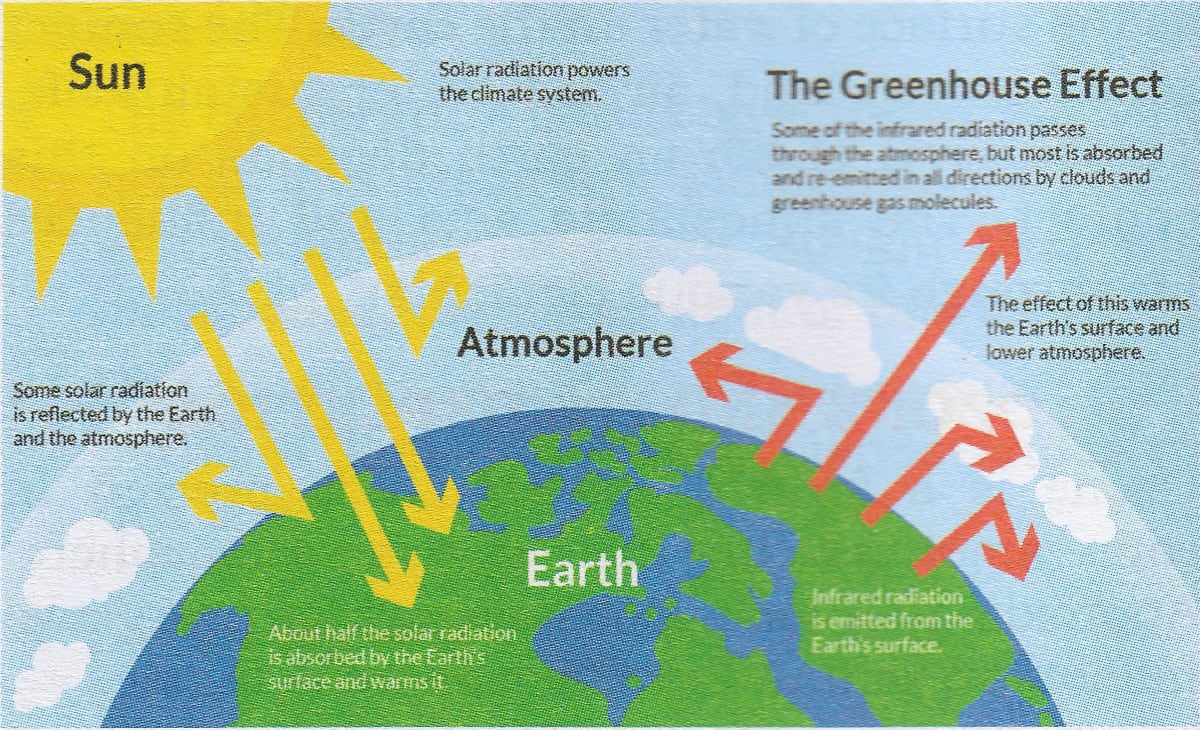
Draw a well labelled diagram to explain the Greenhouse Effect.
Answer
Below diagram shows the Greenhouse Effect:
How does conversion of forest land into agricultural land cause global warming?
Answer
Conversion of forest land into agricultural land cause global warming in the following ways:
Reduction of Carbon Dioxide Absorption: Forests absorb carbon dioxide (CO₂) from the atmosphere in large amount. When forests are cut down to create agricultural land, this ability to absorb CO₂ is reduced. As a result, more carbon dioxide remains in the atmosphere, which contributes to global warming.
Release of Stored Carbon: When trees are cut and often burned to clear the land, the carbon stored in trees is released into the atmosphere in the form of carbon dioxide, further increasing the concentration of greenhouse gases. This extra CO₂ traps more heat and raises the Earth's average temperature.
Thus, deforestation for agriculture both reduces CO₂ absorption and increases CO₂ emission, making it a major cause of global warming.
How does construction of high rise buildings cause global warming?
Answer
Construction of high rise buildings cause global warming in the following ways:
It increases energy consumption as high-rise buildings require large amounts of electricity for lighting, heating, cooling, and operating elevators. Much of this energy is often generated from burning fossil fuels, which releases carbon dioxide (CO₂) into the atmosphere.
The construction process itself (manufacturing cement, steel, etc.) releases a significant amount of greenhouse gases, further adding to global warming.
How does Fossil fuel production cause global warming?
Answer
Fossil fuel production cause global warming in the following ways:
Burning fossil fuels like coal, oil, and natural gas releases large amounts of carbon dioxide (CO₂) and other greenhouse gases into the atmosphere.
These gases trap heat from the sun, leading to a rise in the Earth's temperature, which is the main cause of global warming.
How does transportation industry cause global warming?
Answer
Transportation industry cause global warming in the following ways:
Vehicles like cars, trucks, ships, and airplanes burn fossil fuels (petrol, diesel, aviation fuel), releasing large amounts of carbon dioxide (CO₂) and other greenhouse gases into the atmosphere.
These gases trap heat and lead to a rise in the Earth's temperature, contributing to global warming.
Do you think any one layer of the atmosphere is more significant than the other layers? If yes, which one and why? If not give reasons to support your answer.
Answer
No single layer of the atmosphere is more significant than the others. Each layer has a unique and important role in supporting life on Earth.
The troposphere supports life and is where weather occurs. The stratosphere contains the ozone layer, which protects us from harmful ultraviolet (UV) rays. The mesosphere burns up most meteoroids before they reach the Earth. The thermosphere absorbs high-energy solar radiation and is where many satellites orbit. The exosphere is the outermost layer and gradually merges into space.
Therefore, all the layers of the atmosphere are interconnected and equally important for maintaining Earth's environment and protecting life.
How is atmosphere responsible for Global Warming? What changes human beings can make in their lifestyle to preserve the atmosphere and check Global Warming?
Answer
Global warming is caused by the increase in greenhouse gases in the atmosphere due to human activities. Gases such as carbon dioxide (CO2), methane (CH4), and nitrous oxide (N2O) trap the Sun's heat in the atmosphere, causing the Earth's average temperature to rise. This is known as the greenhouse effect.
To preserve the atmosphere and reduce global warming, people can:
- Reduce carbon emissions by using public transport, cycling, walking, or renewable energy instead of fossil fuels.
- Conserve energy by switching off lights and appliances when not in use and using energy-efficient devices.
- Support sustainable agriculture by reducing food waste and encouraging eco-friendly farming practices.
- Conserve water by using it wisely and preventing wastage.
- Follow the 3Rs - Reduce, Reuse, and Recycle to minimize waste and pollution.
Mention one significant effect of climate change that affects you.
Answer
One significant effect of climate change that affects me is the increasing frequency of heatwaves. Rising temperatures make summers much hotter, causing discomfort, dehydration, and heat-related illnesses. They also increase electricity consumption due to greater use of cooling appliances and can affect daily life and productivity.