
Which of the following constitute the guidelines given in the Constitution for governance of the Country?
- Fundamental Rights and Duties
- Directive Principles of State Policy
- Laws in the Constitution
- None of the above
Answer
Directive Principles of State Policy
Reason — The Directive Principles of State Policy (Part IV) serve as constitutional guidelines that governments must follow when framing laws for country governance. Unlike Fundamental Rights or Duties, which outline citizen entitlements and obligations, these principles specifically direct state policy rather than regulating individual conduct.
Which of the following formed the sources for drafting the Directive Principles of State Policy?
- Irish Constitution
- UN Human Rights Charter
- Mahatma Gandhi's ideas
- All of the above
Answer
All of the above
Reason — The framers of the Constitution were inspired by several sources while drafting the Directive Principles, including the Constitution of the Irish Republic, the Charter of Human Rights framed by the United Nations and the ideas of Mahatma Gandhi. As all three options are among these sources, "All of the above" is correct.
The Directive Principles are mere ............... to the State to attain certain set objectives.
- orders
- requests
- directions
- promises
Answer
directions
Reason — The Directive Principles are not binding laws but are mere directions to the State to attain certain set objectives.
Directive Principles: ............... :: Fundamental Rights: Justiciable.
- Enforceable by courts
- Not Justiciable
- Obligatory
- Mandatory
Answer
Not Justiciable
Reason — Just as Fundamental Rights are justiciable and can be enforced through the courts, the Directive Principles are their opposite, they are not justiciable and cannot be enforced by any court of law.
(A) The Directive Principles of State Policy are a substitute for the laws to ensure welfare of all the citizens.
(R) The Directive Principles are guidelines for the governments to make laws.
- (A) is true but (R) is false.
- (A) is false, but (R) is true.
- Both (A) and (R) are true, but (R) is not the correct explanation of (A).
- Both (A) and (R) are false.
Answer
(A) is false, but (R) is true.
Explanation — The Directive Principles are non-enforceable by courts and cannot substitute for actual legislation, but the government must actively take them into account when framing the country's laws.
Which of the following is incorrect regarding the Directive Principles?
- They provide a measure to judge a government's performance.
- They provide a framework for political, social and economic programmes for a modern democratic state.
- They enlighten and educate people about profitability for the nation.
- They provide a direction to courts in respect of safeguarding rights of the citizens.
Answer
They enlighten and educate people about profitability for the nation
Reason — The Directive Principles educate voters on what to expect from elected politicians rather than focusing on national financial profitability. The remaining options accurately describe their roles in benchmarking government performance, shaping policy frameworks, and guiding judicial interpretations.
Identify the statements about Directive Principles which are correct.
P : They are provided in Part IV of the Constitution.
Q : They are a certain kind of restriction on the State.
R : Their aim is to establish a Welfare State.
S : They provide a measure to judge a government’s performance.
- P and Q
- P and S
- P and R
- Q and R
Answer
P and R
Reason — Statements P and R are correct because the Directive Principles reside in Part IV and aim to establish a Welfare State. Statement Q is false because acting as a restriction on the State is a characteristic of Fundamental Rights, not Directive Principles.
Which of the following measures reflect the implementation of Directive Principles by the government?
- Untouchability made a punishable offence
- The Right to Education Act
- Reservations for Economically Weaker Sections (EWS)
- All of the above
Answer
All of the above
Reason — The government has implemented the Directive Principles through key measures like outlawing untouchability, enacting the Right to Education Act, and introducing EWS reservations. Because all three actions translate these non-justiciable principles into law, "All of the above" is correct.
(A) The Directive Principles are not enforceable by any court of law.
(R) They are mere directions to the State to attain certain set objectives.
- (A) is true but (R) is false.
- (A) is false, but (R) is true.
- Both (A) and (R) are true, but (R) is not the correct explanation of (A).
- Both (A) and (R) are false.
Answer
Both (A) and (R) are true, but (R) is not the correct explanation of (A).
Explanation — The Directive Principles are not enforceable by any court of law in the country. This means that the citizens cannot move the courts of law if the government fails to implement these directives. They are mere directions to the State to attain certain set objectives.
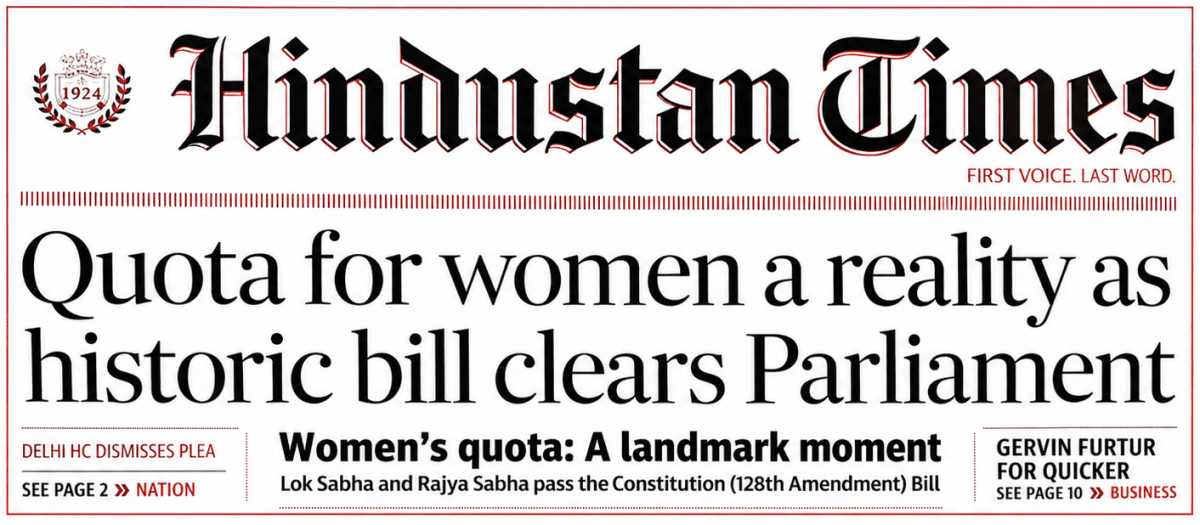
Which of the following aspect of the Welfare State is reflected in the newspaper clipping given alongside?
- Provide education in running the government
- Provide social equality and justice
- Provide health benefits to women
- Provide livelihood to marginalised women
Answer
Provide social equality and justice
Reason — Reserving a quota of seats for women promotes equality of opportunity and justice for a section of society, reflecting the Welfare State's aim of ensuring social equality and justice. It is not concerned with education in governance, health benefits or livelihood, making "Provide social equality and justice" the correct aspect.
What are known as Directive Principles of State Policy? In which part of the Constitution are Directive Principles incorporated?
Answer
The Directive Principles of state policy are the guidelines to be followed by the government in the governance of the country. They are not a substitute for laws of the country. The government has to take them into consideration while making laws.
Directive Principles are incorporated in part IV of the constitution, under Article 36 to 51.
Name four important sources of Directive Principles.
Answer
Four important sources of Directive Principles are:
- The Constitution of the Irish Republic
- The Ideas of Mahatma Gandhi
- The Charter of Human Rights framed by the United Nations
- The declaration of the rights of Man and Citizens of revolutionary France
When the Directive Principles are not enforceable by law courts, why have they been incorporated in the Constitution?
Answer
The Directive Principles are not enforceable by law courts, still they are very important. This importance stems from following:
- Directive Principles are in the nature of a pledge made by the framers of the Constitution to the people of India. They provide a framework, political, social and economic programme for a modern democratic State.
- The Directive Principles give guidelines to the governments to make laws and draft their policies, according to these fundamental principles. They provide an element of permanence in a democracy.
- They provide a measure to judge a government's performance.
- They enlighten and educate the people of what they can expect from the politicians whom they vote to power.
- They provide a direction to Courts in respect of safeguarding the rights of the citizens.
What happens in case of any conflict between the Directive Principles and Fundamental Rights? Give reason to support your answer.
Answer
In case of any conflict between the Directive Principles and Fundamental Rights, the former shall prevail. This is because the welfare of the people as a whole is of paramount importance over that of an individual.
Name any two measures taken by the Government towards implementation of the Directive Principles of State Policy.
Answer
Two measures taken by the Government towards implementation of the Directive Principles of State Policy are:
- 'The Right to Education' Act has made it mandatory for every child between the ages of 6-14 to be provided free education in all government and government aided schools.
- Untouchability has been made an offence punishable by law.
There are differences of opinion regarding the significance of both the Directive Principles and the Fundamental Rights. In this context explain the following:
(a) State any three differences between the Fundamental Rights and Directive Principles of State Policy.
(b) How do the Directive Principles complement the Fundamental Rights?
(c) What is the significance of Directive Principles?
Answer
(a) Three differences between Directive Principles and Fundamental Rights are:
| Sl. No. | Directive Principles | Fundamental Rights |
|---|---|---|
| 1 | Directive Principles are provided in Part-IV of the constitution. | Fundamental Rights are provided in Part-III of the constitution. |
| 2 | Directive Principles are not justiciable or enforceable by any court of law. | Fundamental Rights are justiciable. The citizens can seek protection from a High Court or Supreme Court in case of infringement. |
| 3 | Directive Principles are meant for the government to create certain privileges for the citizens | Fundamental Rights are privileges in existence for the citizens to enjoy. |
(b) Although the Directive Principles are not justiciable like Fundamental Rights but they are necessary for creating an atmosphere where Fundamental Rights can be enjoyed. The Directive Principles give guidelines to the Government to make laws and draft their policies in accordance to the welfare of people. They provide a direction to the Courts in respect of safeguarding the rights of the citizens. Thus we can say that the Directive Principles and the Fundamental Rights complement each other.
(c) The significance of the Directive Principles are following:
- Directive Principles are in the nature of a pledge made by the framers of the Constitution to the people of India. They provide a framework, political, social and economic programme for a modern democratic State.
- The Directive Principles give guidelines to the governments to make laws and draft their policies, according to these fundamental principles. They provide an element of permanence in a democracy.
- They provide a measure to judge a government's performance.
- They enlighten and educate the people of what they can expect from the politicians whom they vote to power.
- They provide a direction to Courts in respect of safeguarding the rights of the citizens.
- The Directive Principles direct the government to move towards the goal of a Welfare State. They reflect the ideas of Justice, Liberty, Equality and Fraternity mentioned in the Preamble.
- Since public opinion backs the Directive Principles, the goal of establishing social and economic order is clearly laid out before the government.
- The 42nd Amendment Act, 1976 provides that if a law is made to give effect to any of the Directive Principles it will not be declared unconstitutional even if it takes away any of the rights under Articles 14, 19 and 31.
With reference to the concept of a 'Welfare State', answer the following questions:
(a) What is meant by a 'Welfare State'?
(b) How does the Constitution of India seek to establish India as a Welfare State?
(c) Mention any four government schemes aimed at social upliftment of the poor.
Answer
(a) A Welfare State is a state which seeks to ensure the maximum happiness of maximum number of people living within its territory.
(b) The Constitution of India seeks to established India as a Welfare State. Although the words "Welfare State" are not specifically mentioned in the constitution, the aims and objectives of a Welfare State are clearly pointed out in the Directive Principles of State Policy. These Directives emphasise that the goal of the Indian Polity is a Welfare State, where the State has a positive duty to ensure to its citizens social and economic justice and dignity to the individual.
(c) Four government schemes aimed at social upliftment of the poor are:
- Ayushman Bharat Yojna
- Pradhan Mantri Samaan Nidhi Yojana
- Pradhan Mantri Ujjwala Yojana
- Pradhan Mantri Gramin Awaas Yojana (Housing for All)
The Directive Principles are guidelines to be followed by the government in the governance of the country. Explain with one example each, government schemes under the following heads:
(a) Social Equality and Justice
(b) Economic Welfare
(c) Foreign Policy.
Answer
(a) The government implemented many schemes to ensure 'Social Equality and Justice'. One of them is The Right to Education Act.
- The Right to Education Act has made it mandatory for every child between the ages of 6-14 to be provided free education in all government and government aided schools.
- The Act also requires all private schools to reserve 25 per cent of seats for the children belonging to economically weaker sections of the society as a part of the public-private partnership plan.
(b) One of the schemes implemented by the government to ensure Economic Welfare of the people is Pradhan Mantri Samaan Nidhi Yojana.
- Under this scheme, small and marginalised farmers (SMFs) are given Rs. 6000 per year in three instalments of Rs. 2000 each, which is transferred directly to the bank accounts of beneficiaries through direct benefit transfer (DBT) scheme.
- The scheme aims to help SMFs in procuring various inputs to ensure proper crop health and appropriate yields and thereby augment their income.
- The scheme will also help protect the farmers from falling in the clutches of money lenders.
(c) India follows the policy of non-alignment and peaceful co-existence.
- This policy reflects India's directive to promote international peace and security.
- In order to promote international peace and security India is opposed to colonialism and racialism and has helped many countries to win their freedom. India supported the cause of South Africa against Apartheid.
With reference to the excerpt given below, answer the following:

(a) What are the Directive Principles of State Policy? Name the three types of justice ensured by the Directive Principles of State Policy?
(b) State the Gandhian ideals which inspired the Directive Principles of State Policy.
(c) How do the Directive Principles of State Policy serve as a roadmap to ensure social justice?
Answer
(a) The Directive Principles of State Policy are the guidelines to be followed by the government in the governance of the country. They are incorporated in Part IV of the Constitution, under Articles 36 to 51, and are to be taken into consideration by the government while making laws.
The three types of justice ensured by the Directive Principles of State Policy are:
- Social Justice
- Economic Justice
- Political Justice
(b) The Gandhian ideals which inspired the Directive Principles of State Policy are:
- Establishment of village panchayats (local self-government).
- Promotion of cottage industries in rural areas.
- Welfare of the weaker sections of society.
- Prohibition of intoxicating drinks.
- Protection of cattle.
(c) The Directive Principles of State Policy serve as a roadmap to ensure social justice in the following ways:
- They direct the government to frame laws and policies for the welfare of the people, especially the weaker sections of society.
- They aim at establishing a Welfare State, where the State has a positive duty to ensure social and economic justice to its citizens.
- In pursuance of these directives, measures such as the Right to Education Act, abolition of untouchability, special scholarships and reservation of seats for Scheduled Castes and Scheduled Tribes, and reservation for the Economically Weaker Sections (EWS) have been implemented.
Why do you think the Directive Principles of State Policy are not justiciable by any court of law? Give reasons to support your answer.
Answer
The Directive Principles of State Policy are not justiciable by any court of law because they are only a set of guidelines for policy makers or the government. They are called so because the government has to take them in consideration while making laws. These principles contain lofty ideas, deep human thoughts, belief and knowledge. The policy makers can take these thoughts and ideas into consideration while making laws in a way to create certain privileges for the citizens of India. The directive Principles have wider scope as they deal with wide range of subjects and aim at establishment of a welfare state. They are not rules or rights and therefore, they are not justiciable. They are just moral obligation on state authority for establishment of a welfare state.
Suppose you are made the Minister for Social Welfare. What measures would you initiate for the welfare of weaker sections of the society?
Answer
Weaker section of society in India in ordinary sense refers to the section of population who are socially, economically, politically and educationally backward than the other section. They suffer due to their backwardness. Our constitution has many provisions for welfare of weaker sections in Indian society. The Directive principles provide us guideline for drafting policies for them.
If I would have been made Minister of Social Welfare, I would have given emphasis on their education because education is the ultimate tool that can help them to uplift their conditions. They should be aware about their rights. My priorities for their upliftment would have been:
- Providing them with healthcare and education facilities.
- Self employment schemes for them in order to make them self dependent.
- Provisions for vocational training of men and women.
- Eradicating corruption as it will help to realization of all the policies made for the people.