
How did humans live on Earth before the beginning of civilisation?
Answer
For much of early human history, people lived as hunter-gatherers. They moved in small groups in search of food and water, hunted wild animals, fished, gathered wild plants, and used stone tools. They lived in caves, rock shelters, and temporary camps. During the Neolithic period, some communities began cultivating crops and domesticating animals, which led to settled village life and eventually laid the foundation for civilisation.
How did humans communicate before writing was invented?
Answer
Before writing was invented, humans communicated in the following ways:
- They developed symbolic communication, which allowed them to express ideas without a script.
- They decorated the walls of caves and rock shelters with paintings, such as those at Bhimbetka in Madhya Pradesh.
- They engraved symbolic features on bones and shells, such as ostrich eggs, with a stone tool known as a burin or engraver.
- Later, graffiti on pottery and seals with geometric and simple animal motifs were used, and these are seen as forerunners of the script.
How is archaeology helpful in understanding our past?
Answer
Archaeology helps us understand the past, especially periods for which written records do not exist.
- Material evidence: Archaeologists excavate tools, bones, artefacts, and structures left by earlier people.
- Reconstructing daily life: These remains show how people obtained food, made tools, built settlements, and used natural resources.
- Tracing human development: Fossils and stone tools help us understand the evolution and movement of early humans. For example, remains show that Homo habilis lived in the Olduvai Gorge region of Tanzania and Kenya.
- Experimental archaeology: By making and using similar tools, archaeologists can understand how early tools were produced and used.
- Studying settlements: Excavations reveal houses, granaries, graves, fields, and other remains, such as those found at Mehrgarh and Kalibangan.
How did early civilisations interact with each other?
Answer
Early civilisations interacted mainly through trade and long-distance contacts. The Sindhu–Sarasvatī Civilisation had trade relations with Mesopotamia through regions such as Dilmun and Magan. Goods such as semi-precious stone beads, ivory, timber, gold dust, and probably copper were exchanged. Such contacts linked distant regions and strengthened their economic relations.
The cuneiform writing system was contemporary to the Harappan script, but while cuneiform has been deciphered, the Harappan script has not yet been deciphered. Do you think our understanding of a civilisation changes when its script is deciphered compared to when it is not?
Answer
Yes, deciphering a script greatly improves our understanding of a civilisation. When a script can be read, written records provide direct information about the people’s laws, beliefs, administration, economic activities, occupations, literature and everyday life. For example, deciphered cuneiform tablets reveal Mesopotamian myths, law codes and records of farming, crafts and trade.
In contrast, since the Harappan script has not yet been deciphered, historians have to depend mainly on archaeological evidence such as seals, pottery, buildings, tools and other artefacts. Therefore, many aspects of Harappan political, social and cultural life remain uncertain.
Do you remember studying about the Silk Route in Grade 7? How was India connected with it? Can you recollect China’s contact with India with reference to Buddhism that you studied in Grade 7?
Answer
India was connected with the Silk Route through overland and maritime trade routes linking it with Central Asia and China. Goods such as silk, spices and other products were exchanged through these routes.
The Silk Route also helped in the spread of ideas, religions and culture. Buddhism spread from India to China through travelling monks and traders. Chinese pilgrims such as Fa-Hien and Xuanzang later came to India to visit Buddhist centres and study Buddhist teachings.
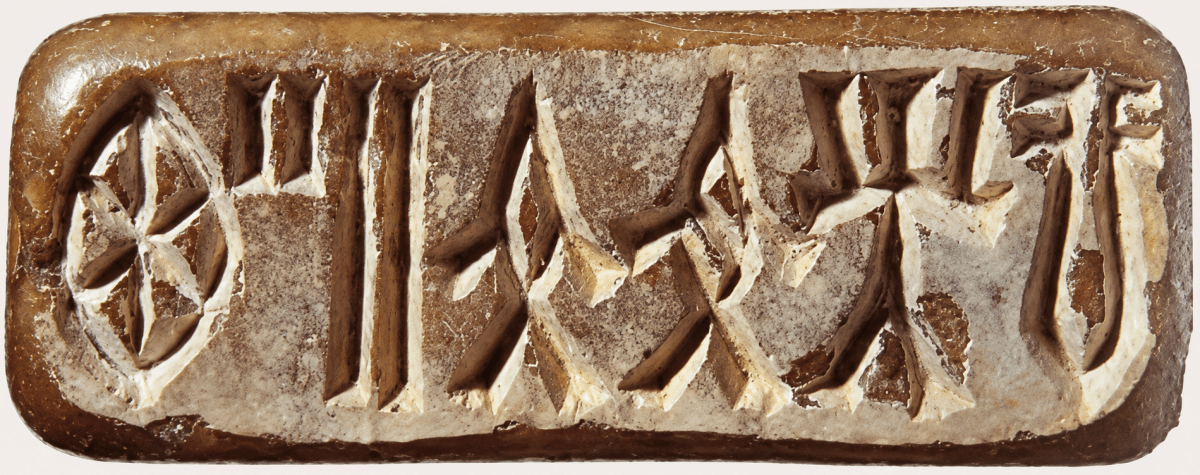
You have studied about the Harappan script in your previous grades. Observe this seal carefully and discuss why the script has not yet been deciphered. Also, find out what efforts have been made to decipher it. You can use your textbook, consult your teacher, or refer to online sources.
Answer
Reasons for why the Harappan script has not yet been deciphered are:
- Most Harappan inscriptions are very short and contain only a few symbols.
- The language represented by the script is still unknown.
- No bilingual inscription (an inscription written in both the Harappan script and a known script) has been found.
- Therefore, scholars have not been able to determine the meaning of the signs and symbols.
The efforts made to decipher the script are:
- Archaeologists and scholars have studied the inscriptions found on seals and other objects.
- Experts continue to study symbol patterns and compare them with known ancient languages.
- Despite these efforts, the Harappan script has not yet been deciphered.
Let us observe the images given below and answer the following question.
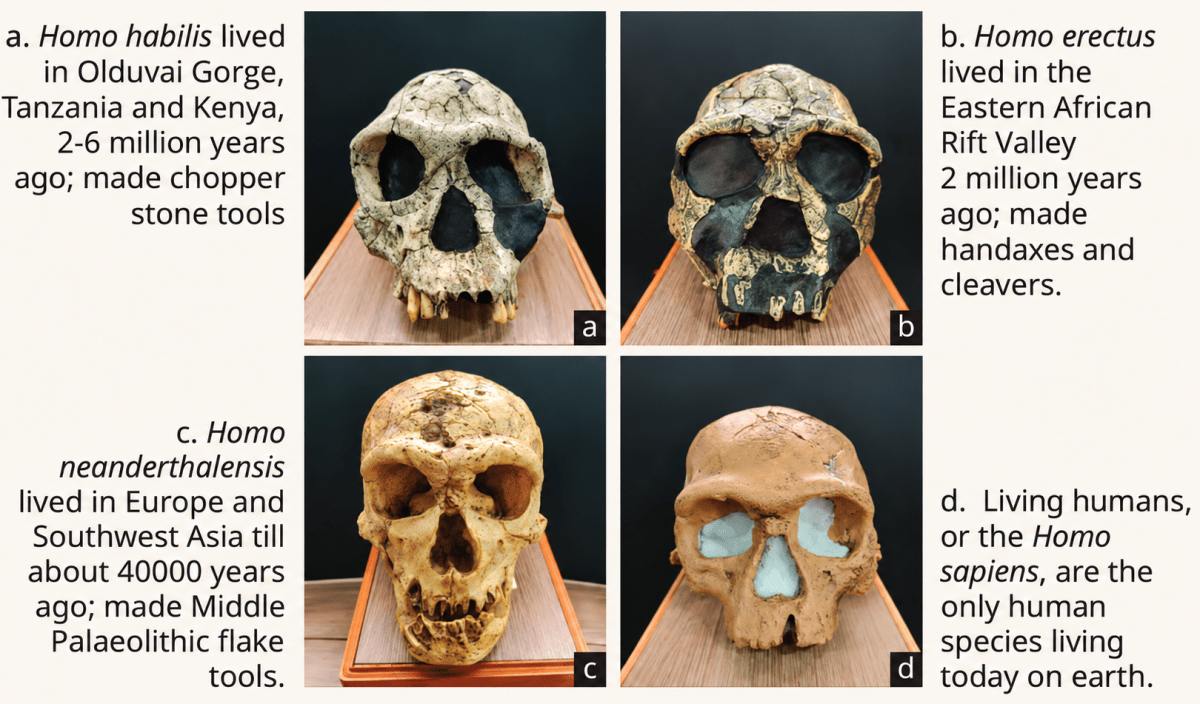
(i) Do you notice any changes in the shape or features of the skulls across different ancestors?
(ii) Can you observe a gradual straightening of the face?
Answer
(i) Yes. The skulls show clear changes from Homo habilis to Homo sapiens. Earlier human ancestors have more projecting jaws and lower foreheads, while later forms show a more rounded skull, a higher forehead, a smaller jaw, and a flatter face.
(ii) Yes. A gradual straightening of the face can be observed. The face becomes less projecting and more upright in later human ancestors, especially in Homo sapiens.
Can you find out which countries constitute West Asia in present times?
Answer
Historically, West Asia covers the region around the Tigris and Euphrates river valleys, primarily modern Iraq, Kuwait, parts of Turkey, and southwestern Iran. Ancient trade places like Dilmun and Magan correspond to modern-day Bahrain and the Oman peninsula in the Persian Gulf.
Today, West Asia includes Turkey, Syria, Lebanon, Israel, Palestine, Jordan, Iraq, Iran, Kuwait, Saudi Arabia, Bahrain, Qatar, the United Arab Emirates, Oman, Yemen, and Cyprus. Armenia, Azerbaijan, and Georgia are also frequently grouped within this region.
Do you find any similarities between the temples in India and those of the Sumerian civilisation as centres of socio-cultural and economic activity?
Answer
Yes, there were some similarities between temples in India and those of the Sumerian civilisation as centres of socio-cultural and economic activity.
- Both served as important religious centres where people gathered for worship and rituals.
- They also functioned as social centres, bringing people together during festivals and community activities.
- Both could be centres of economic activity, where goods were collected, stored, managed and distributed.
- Temple institutions supported various groups, including artisans, labourers and traders, through their economic activities.
- They contributed to the cultural life of the community by preserving and promoting religious traditions, beliefs and practices.
The Epic of Gilgamesh, written during the Mesopotamian civilisation, is one of the earliest stories written. Try and find out more such stories and share them in class.
Answer
Some other early stories and literary traditions mentioned in the chapter are:
- Mesopotamian cuneiform tablets preserve myths, hymns, epics, and other literary works.
- Egyptian papyri preserve the old story of Sindbad the Sailor.
- Egyptian literature also contains animal fables resembling Aesop’s Fables.
- Other Egyptian stories include tales of ghosts, miracles, romances, and an early form of the Cinderella story.
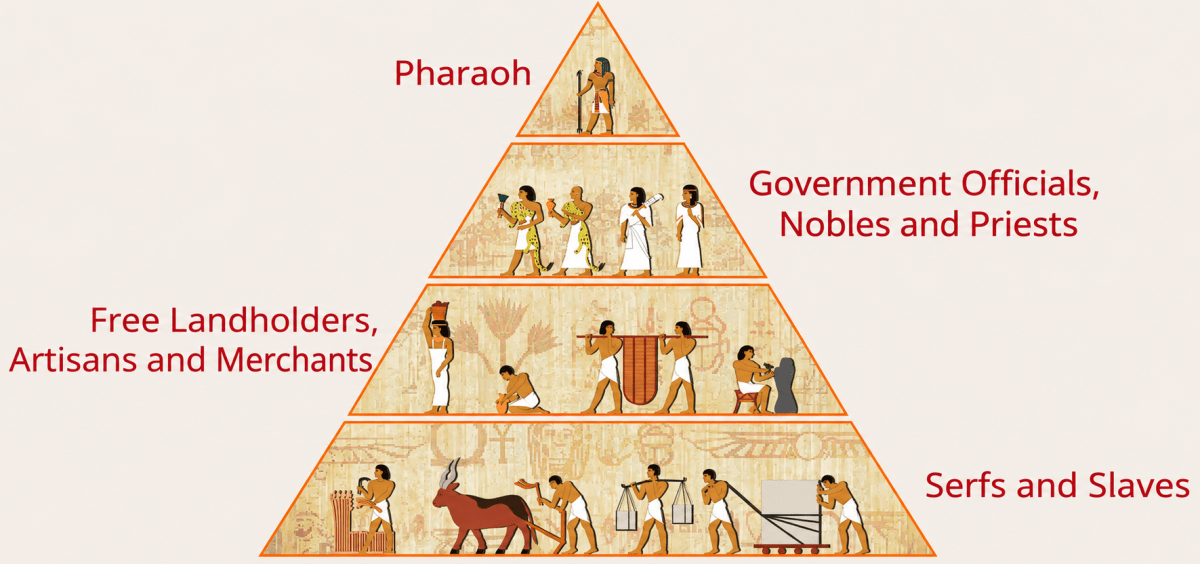
Look at the social hierarchy pyramid in the image. What were the social classes of early Egypt? What were the different kinds of occupations? What could have been a typical daily routine of the people from each class?
Answer
The social classes of early Egypt, as shown in the social hierarchy pyramid, were:
- The Pharaoh, who was the ruler and stood at the top of the pyramid.
- Government officials, nobles, and priests.
- Free landholders, artisans, and merchants.
- Serfs and slaves, who formed the base of the pyramid.
The different kinds of occupations were ruling and administration, priesthood, landholding, farming, craft work, trade, and manual labour.
A typical daily routine of the people from each class could have been:
- The Pharaoh would govern the kingdom and take part in important religious and state ceremonies.
- Government officials and nobles would manage administration and public works, while priests performed religious duties.
- Free landholders, artisans, and merchants would farm, make craft goods, and trade.
- Serfs and slaves would carry out agricultural and other forms of manual labour.
- People also enjoyed leisure activities such as swimming, canoeing, board games, music, and dancing, and festivals were an important part of Egyptian life.
The Chinese script is logographic, with characters representing entire words or morphemes (smallest meaningful units of language), rather than sounds.

Explore more examples of Chinese characters that resemble the objects or ideas they represent. Note down at least two such characters and explain how their shapes are connected to their meanings.
Answer
Ancient Chinese characters originated as picture-drawings (pictographs) that visually represented real-world objects:
- 山 (shān), meaning 'mountain': Features three vertical strokes joined at the base, directly mimicking the look of three peaks in a mountain range..
- 日 (rì), meaning 'sun': Drawn as a rectangular box split by a horizontal stroke, evolved from an early circular drawing with a dot in the middle representing the sun.
- Other Examples: 月 (moon) resembles a curved crescent moon, while 水 (water) looks like flowing streams of water. Over time, these direct drawings were simplified into stylized written characters.
Why do you think early humans left Africa to migrate to other regions?
Answer
Early humans gradually migrated from Africa to other regions due to the following reasons:
- They left Africa in search of food, water, and suitable places to live.
- Changes in climate and environment may have reduced the availability of resources in some areas.
- As they learned to make better tools and adapt to different environments, they gradually moved to new regions.
- Over time, these migrations led to the spread of humans from Africa to Asia, Europe, and other parts of the world.
Why do you think the shift to farming during the Neolithic period is called a revolution rather than a simple change? Discuss with your classmates.
Answer
The transition to agriculture is called a "revolution" because it completely transformed every aspect of human life:
- It changed the way of life completely, as people moved from a food-procuring way of life to a food-producing one.
- Its hallmark was the domestication of select animals and plants, bringing them under human control, and the development of new breeds through cultivation and husbandry.
- While hunter–gatherers produced tools for procuring food, Neolithic farmers made tools for food production and processing and developed a variety of earthenware pottery in various shapes and sizes.
- People established the first village settlements and began to live a settled life in one place.
- The ability to produce surplus food and material goods laid the foundations for the urban revolution and the emergence of civilisation.
- Since these changes affected food, tools, settlement, and society together and had long-lasting results, the shift is described as a revolution.
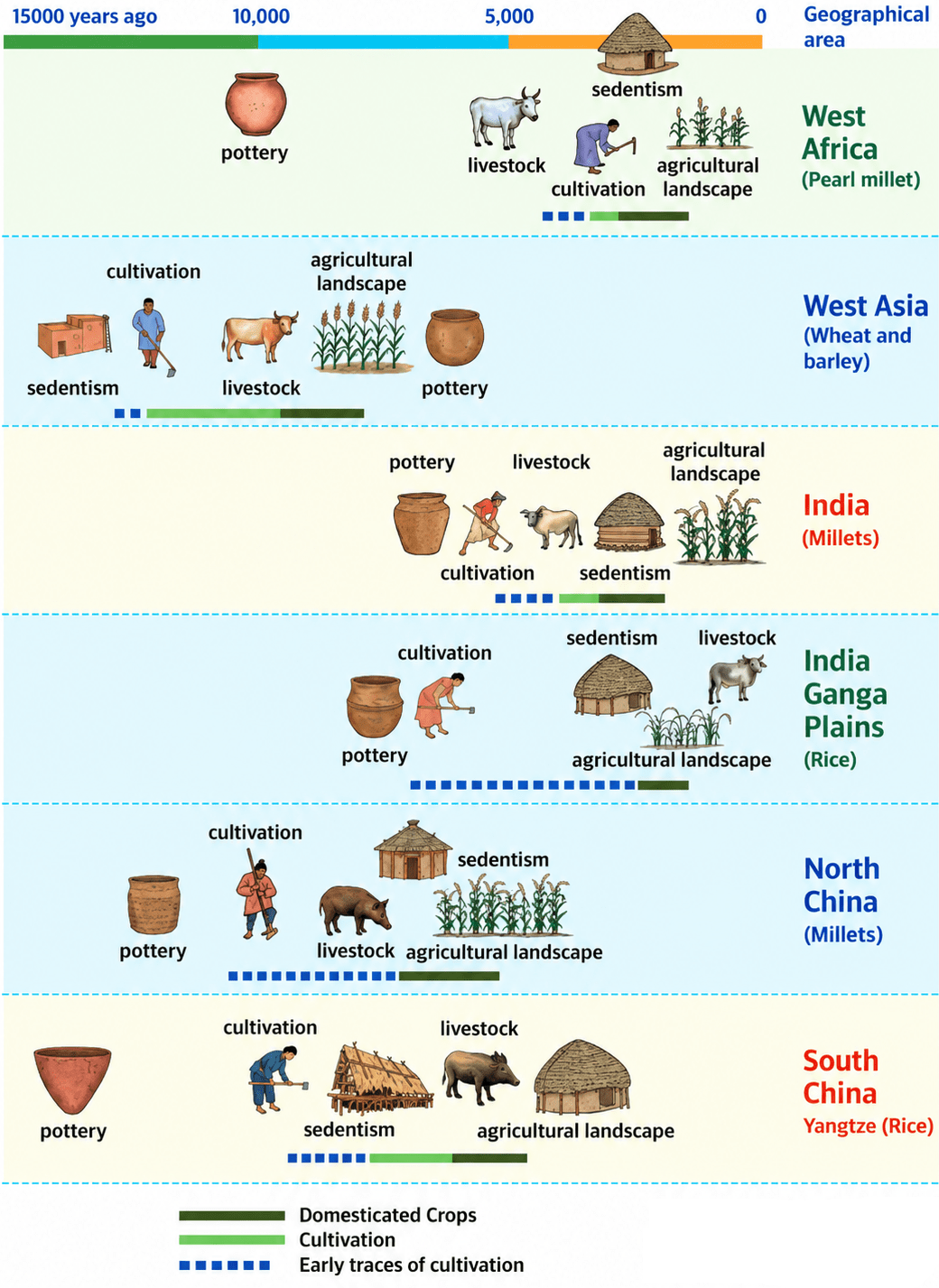
Observe the chart (Fig. 4.14) and identify the animals that were domesticated. Also try and identify the types of human habitats and objects that were used. Are any of these still used in present times?
Answer
The following conclusions can be drawn from the chart:
- The chart shows domesticated livestock such as cattle, sheep or goats, and pigs.
- People lived in settled habitats, including huts and simple houses, within agricultural landscapes.
- Pottery was commonly used, along with tools needed for cultivation.
- Many of these practices continue today. Farming, animal husbandry, pottery, and permanent rural settlements are still common in many parts of the world.
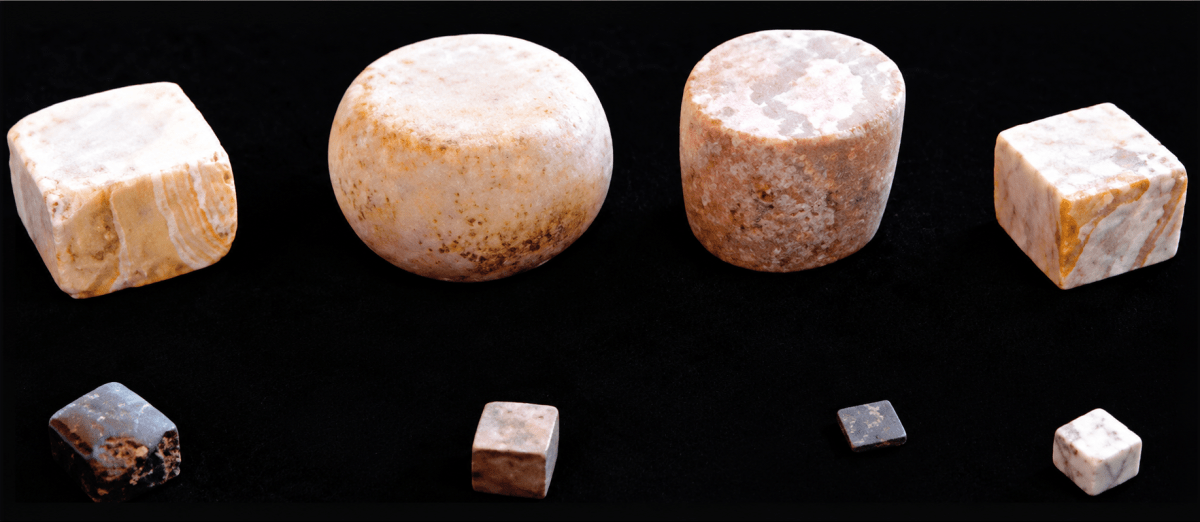
Harappans had their own standard systems of weight and measurement. This is evident from the meticulously planned settlements and efficient interregional trade practices of the Harappans. They followed a binary multiple (1, 2, 4, 8, 16, etc.) system for weighing smaller units and used multiples of ten for larger denominations. Such cubical stone weights have been reported from several sites. Can you imagine how long-distance trade would have been affected had the Harappans not followed a standard system of weights?
Answer
Without standard weights and measures, long-distance trade would have faced several problems:
- Different traders might use different quantities for the same unit, making exchanges unfair.
- Buyers and sellers could disagree about the amount of goods being exchanged.
- Record-keeping and comparison of prices would become difficult.
- Trade with distant regions such as Mesopotamia, Dilmun, and Magan would become slower and less reliable.
- Standardised weights therefore made Harappan trade more accurate, efficient, and trustworthy.
Why were rivers important in the growth of early civilisations?
Answer
The major early civilisations developed in fertile river plains: the Harappan civilisation along the Sindhu and Sarasvatī, the Mesopotamian civilisation around the Tigris and Euphrates, the Egyptian civilisation along the Nile, and the Chinese civilisation in the Huang He basin.
Rivers were important because:
- Annual river deposits created rich alluvial soil, boosting crop yields.
- Rivers provided essential drinking water and filled irrigation networks, such as Sumerian canals, Harappan gabarbands (check dams), and Egyptian water ditches..
- The Nile’s annual flood deposited black silt (kemet), making fields fertile.
- Abundant harvests due to fertile soil produced surplus food, supporting growing cities and non-farming professions.
- Rivers served as natural highways for moving trade goods smoothly over long distances.
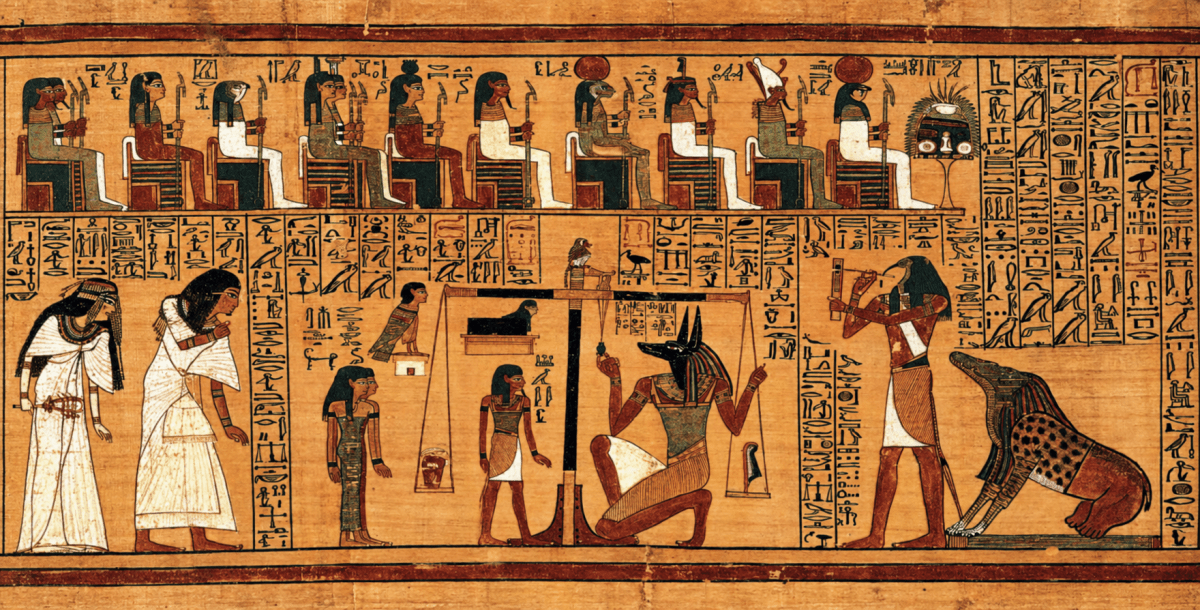
Why do you think there is a scale with a heart on one side and a feather on the other (Fig. 4.29)? What can this papyrus tell us about early Egyptian beliefs?
Answer
The scale with a heart on one side and a feather on the other shows that the Egyptians believed that a person was judged after death, and that the heart of the dead person was weighed against the feather to test whether the person had led a good and truthful life.
This papyrus tells us the following about early Egyptian beliefs:
- The Egyptians believed in life after death.
- They believed that a person's ka, or vital essence, continued after death and that preserving the body was important for the afterlife.
- They believed that good and truthful conduct during one's lifetime was important because the dead were judged after death.
- They believed in many gods and performed religious rituals associated with them.
- Their beliefs about the afterlife influenced their burial practices and the construction of monumental tombs, including pyramids for many early pharaohs.
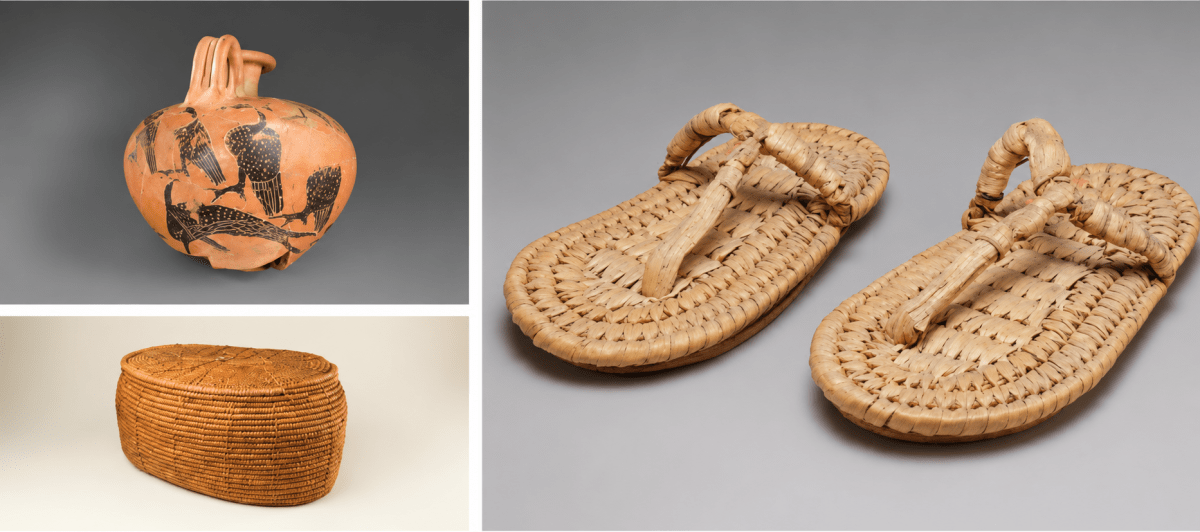
Observe the images given below. What do they tell you about Egyptian fashion?
(i) Which social classes do you think used these items?
(ii) What clues in the images help you to make this guess?
Try to explain your reasoning based on the materials, designs, or accessories shown in the pictures.
Answer
The images show a painted pottery vessel, a woven basket, and woven sandals. These objects suggest that Egyptians used practical everyday items made from materials such as clay and plant fibre.
(i) These items were most likely used by the common people, that is, the free landholders, artisans, and merchants, and also by serfs and slaves. Similar articles may also have been used in the households of the higher classes for everyday purposes.
(ii) The clues in the images that help in making this guess are:
- The pot, basket, and sandals are made from common materials such as clay and plant fibre.
- Their designs are mainly practical rather than highly luxurious.
- The woven sandals are suitable for everyday use in a hot climate.
- The objects do not show costly metals, precious stones, or royal symbols.
What could have been the other reasons for building the Great Wall of China? Explore and share your findings on the Great Wall through a model or presentation.
Answer
While initially built from 680 BCE onwards by the Zhou and other dynasties to defend their borders against nomadic raids, the Great Wall could have served several other state purposes:
- To mark the boundary of the empire and to show how far the ruler's authority extended.
- To control the movement of people and goods across the frontier.
- To guard the trade routes, such as the Silk Route, along which silk became a major item of external trade during the Han dynasty.
- To collect taxes and duties on goods carried across the border.
- To pass on messages and warnings quickly from one watchtower to another.
- To display the power, wealth, and unity of the empire and its rulers.
Do you think life became easier or more challenging after humans started farming? Give two reasons for your answer.
Answer
Life became easier in some ways after humans started farming.
- First, agriculture provided a more regular and reliable supply of food than hunting and gathering.
- Second, farming led to permanent settlements, allowing people to live in one place and develop villages.
The environment offers human societies both opportunities as well as challenges. Explain with reference to early farming communities and river-valley civilisations.
Answer
Environmental Opportunities:
- Around 12,000 years ago, a warmer climate expanded forests and grasslands and made a wider variety of food resources available.
- Fertile river plains supported productive agriculture in regions such as the Sindhu–Sarasvatī, Tigris–Euphrates, Nile, and Huang He valleys.
- Rivers supplied water for irrigation, while floods could deposit fertile soil, as in Egypt.
- The environment provided resources such as stone, clay, metals, and shells for tools, pottery, crafts, and trade.
- Agricultural surpluses supported permanent settlements, specialised occupations, trade, and the growth of civilisation.
Environmental Challenges:
- Floods could damage crops and settlements.
- Irrigation required collective labour to build and maintain canals, dams, ditches, and reservoirs.
- Communities depended heavily on reliable water and fertile land for their survival.
- Environmental degradation and increasing pressure on agricultural land could weaken societies, as happened in Babylonia.
Why do historians divide early human history into different ages such as Stone Age, Bronze Age, and Iron Age? What does this classification tell us about human progress?
Answer
Historians group early human history into distinct ages based on the main materials and technological advancements used for tools, alongside shifts in human lifestyle and settlement patterns.
This classification tells us the following about human progress:
- Palaeolithic (Old Stone Age): Nomadic hunter-gatherers using simple stone tools like handaxes and scrapers.
- Mesolithic (Middle Stone Age): Transition stage using tiny stone tools (microliths) alongside fishing and small-game hunting.
- Neolithic (New Stone Age): Beginning of agriculture, domesticated animals, polished stone tools, and settled village life.
- Chalcolithic (Copper & Stone Age): Early metallurgy using copper alongside stone tools.
- Bronze Age: Development of bronze metallurgy, along with the expansion of trade, towns, writing, and early civilisations.
- Iron Age: Smelting iron for stronger tools and weapons, enabling advanced, large-scale societies.
- This progression shows how human innovation continually built upon older skills over time.
Imagine you are a Neolithic farmer. Describe one day of your life. What challenges would you face that a hunter-gatherer would not?
Answer
As a Neolithic farmer, my daily life would be as described below:
- I would wake up early and work in the fields, sowing seeds, watering crops, and removing weeds.
- I would look after domesticated animals such as cattle, sheep, and goats.
- I would store food and grains in pots for future use.
- I would spend the evening in my settlement helping with household activities.
The challenges that I face are:
- I would have to bring water for irrigation from nearby rivers, streams, or other water sources.
- I would have to protect crops from animals and pests.
- I would have to wait for crops to grow before harvesting them.
- I would face the risk of crop failure due to poor weather.
- I would need to work regularly to maintain the fields and care for domesticated animals.
Imagine that the Harappan script gets deciphered tomorrow. What new types of information do you think historians might learn?
Answer
If the Harappan script were deciphered, historians might learn:
- Discovering the original spoken language of the Sindhu–Sarasvatī people.
- Unlocking the exact meanings behind the short inscriptions carved on seals and pottery.
- Learning the actual ancient names of cities, prominent leaders, merchants, and historical figures.
- Understanding how Harappan cities were governed and organized.
- Reading commercial logs detailing specific trade deals with Mesopotamia, Dilmun, and Magan.
- Gaining insights into Harappan myths, religious beliefs, and rituals, much like deciphered cuneiform tablets revealed for Mesopotamia.
Prepare a table with three columns—Palaeolithic, Mesolithic, and Neolithic—and fill in their distinctive features: tools, settlements, art, and subsistence.
Answer
| Features | Palaeolithic | Mesolithic | Neolithic |
|---|---|---|---|
| Tools | Large stone handaxes, cleavers, scrapers, and choppers made of quartzite/limestone; later added points, spearheads, and blade tools. | Microliths (tiny, sharp stone blades fitted into handles) and carved bone points. | Ground and polished stone axes, specialized food-processing grinding tools. |
| Settlements | Natural caves, overhang rock shelters, and temporary open-air camps. | Frequent occupation of caves and seasonal campsites near lakes and rivers. | Permanent, structured villages with sun-dried mud-brick houses and crop granaries (e.g., Mehrgarh). |
| Art | Cave wall paintings, body pigments, shell/bone beads, and carved ostrich eggshells | Rich cave and rock-shelter paintings (e.g., painted rock shelters at Bhimbetka). | Shaped earthenware pottery in varied forms, and jewelry made of semi-precious stones (lapis lazuli, carnelian). |
| Subsistence | Hunting wild animals, gathering wild plants, roots, and tubers. | Small-game hunting, gathering wild grains, and freshwater/marine fishing. | Farming crops (wheat, barley, millets, rice) and herding animals (cattle, sheep, goats). |
"Bronze Age civilisations developed independently but shared common features." Examine this statement with reference to the civilisations given in the chapter.
Answer
The Bronze Age civilisations developed independently in different regions but shared several common features:
- They developed in fertile river valleys — the Harappan along the Indus and Sarasvati, Mesopotamian around the Tigris and Euphrates, Egyptian along the Nile, and Chinese in the Huang He basin.
- Agriculture was the main occupation and surplus food supported larger populations.
- They developed cities, organised settlements and specialised occupations such as farming, craft, trade and administration.
- They practised trade and exchanged goods with distant regions.
- They developed metallurgy and used bronze for tools, weapons and other objects.
- They developed writing systems, such as cuneiform in Mesopotamia, hieroglyphic writing in Egypt, and the Harappan script.
- Religion, social organisation and administration played important roles in their societies.
- Despite these similarities, each civilisation had distinctive features, such as Mesopotamian ziggurats, Egyptian pyramids and Chinese jade objects, showing their independent development.
Although rivers provided many benefits, they also created challenges for early societies. Discuss both the advantages and disadvantages of settling near rivers.
Answer
The advantages of settling near rivers were:
- Fertile alluvial soil supported productive agriculture.
- Rivers provided water for drinking, daily needs and irrigation.
- Surplus food supported larger populations and the growth of settlements.
- River valleys encouraged transport, exchange, and trade.
- Regular natural cycles, such as the Nile floods, helped people organise agricultural activities and develop calendars.
The disadvantages were:
- Floods could destroy crops, houses and settlements.
- Water-management works such as canals, dams and ditches required collective labour.
- People became dependent on rivers, so changes in their flow affected their lives.
- Rivers could change course or dry up, forcing people to migrate.
- Environmental degradation and pressure on agricultural land could create difficulties for river-based societies.
With the help of your teacher, find out more about the Code of Hammurabi. Why was it important? Do you think it was fair to all sections of society? Give reasons for your answer.
Answer
The Code of Hammurabi was a collection of laws issued by King Hammurabi of Babylon. It is one of the best-preserved and most famous ancient law codes. It dealt with matters such as trade, property, family life, agriculture and crimes. It was important because it provided written rules and punishments to regulate Babylonian society.
However, it was not completely fair to all sections of society. Punishments and compensation often varied according to a person's social status. Free people and slaves, and different classes of free people, were not always treated equally under the law. Thus, while the Code helped maintain order, it did not provide equal treatment to everyone.
If you had to choose one major innovation from early civilisations that changed the world permanently, what would it be and why?
Answer
The one major innovation from early civilisations that changed the world permanently is the invention of writing.
The reasons for choosing writing are:
- Writing marks the beginning of the historical period, about 5000 years ago, and divides human history into the period before and after its invention.
- Before writing, it was generally difficult to understand the thoughts and ideas of people, and the measurement of time was only approximate.
- After writing, both material remains and written documents became sources for reconstructing the lives of people and society, and the dating of cultures and events became relatively accurate.
- Written records made it possible to keep accounts of farming, craft activities, and trade, as seen in the cuneiform tablets of Mesopotamia.
- Writing preserved laws, such as the Code of Hammurabi, which served as a foundational model for many future legal systems.
- It also led to the composition of literary and creative texts, such as myths, epics, hymns, and stories like The Epic of Gilgamesh.
- Because of writing, the knowledge, beliefs, and experiences of early people could be passed on to later generations, and this remains true even today.
Compare the social hierarchy and daily life of people in the Egyptian civilisation with those in Mesopotamia or China. What similarities and differences do you notice?
Answer
A comparison of Egyptian and Mesopotamian society is given below.
Similarities:
- Both had rulers at the top of society—Pharaohs in Egypt and kings in Mesopotamian city-states.
- Priests and religious institutions held an important position in both civilisations.
- Agriculture was central to daily life, and irrigation required organised labour.
- Both societies had artisans, merchants, and other specialised occupations.
Differences:
- Egypt had a clearly shown hierarchy of Pharaoh, government officials/nobles/priests, free landholders/artisans/merchants, and serfs/slaves. In Sumerian Mesopotamia, the chapter emphasises kings, high priests and priestesses, farmers, artisans, merchants, and traders.
- In Sumer, major economic activities such as agriculture, trade, and transport were closely connected with temple authority and the ziggurat.
- Egyptian beliefs about the afterlife strongly influenced mummification and pyramid building, whereas Mesopotamian religious life centred strongly on temples and city gods.
- Mesopotamian scribes enjoyed high social status because writing and record-keeping were important in administration and economic life.