
A heavy object and a light object are placed on a seesaw. Which arrangement produces the maximum turning effect about the pivot?
- Both objects near the pivot on opposite sides.
- Heavy object close to the pivot; light object at the far end on the opposite side.
- Light object close to the pivot; heavy object at the far end on the opposite side.
- Both objects at the ends of the seesaw, on opposite sides of pivot.
Answer
Light object close to the pivot; heavy object at the far end on the opposite side.
Reason — Moment = force × perpendicular distance from the pivot. This arrangement maximises the heavy object’s moment and minimises the opposing moment of the light object.
The energy transformation taking place during photosynthesis in plants is:
- heat to chemical
- chemical to light
- light to chemical
- chemical to heat
Answer
light to chemical
Reason — Photosynthesis converts sunlight into chemical energy stored in food.
Two balls, A and B have the same gravitational potential energy. Ball A is six times the mass of ball B. How do their heights above the ground compare?
- Height of A is the same as height of B.
- Height of A is twice the height of B.
- Height of A is one-sixth the height of B.
- Height of A is six times the height of B.
Answer
Height of A is one-sixth the height of B.
Reason — The gravitational potential energy of a body of mass m raised to a height h is U = mgh.
Given,
mA = 6mB and UA = UB
So,
Hence, the height of A is one-sixth the height of B.
The Velocity Ratio (V.R.) of a block and tackle system of three pulleys with the effort in upward direction is:
- 1
- 2
- 3
- 4
Answer
4
Reason — With the effort directed upwards, two pulleys are in the movable block and one is fixed. Four string segments support the load, so V.R. = 4.
If red, blue, green and yellow lights are allowed to enter the same glass block with the same angle of incidence (∠i), then for which colour will the angle of deviation be the greatest?
- blue
- green
- yellow
- red
Answer
blue
Reason — The refractive index of a given transparent medium decreases with the increase in the wavelength of light. Among red, yellow, green and blue, blue light has the shortest wavelength, so glass has the highest refractive index for blue light.
Since a medium of higher refractive index bends the light more, blue light is refracted (i.e., deviated) the most and red light the least for the same angle of incidence.
Hence, the angle of deviation is greatest for blue light.
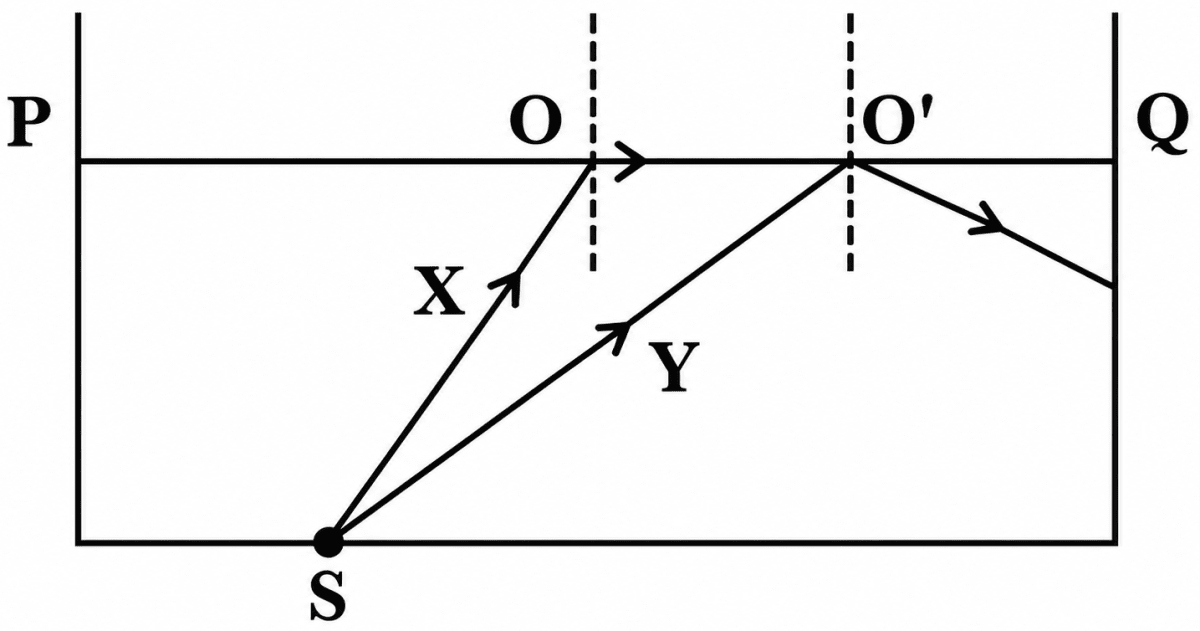
The figure shows a source of light S at the bottom of a trough containing a transparent liquid. Rays X and Y emerge from the source. If ∠SOP = 43°, state the possible angle of incidence of ray Y.
- 43°
- 45°
- 47°
- 49°
Answer
49°
Reason — Ray X grazes the liquid surface, so its incidence angle is the critical angle: 90° − 43° = 47°. Ray Y undergoes total internal reflection, requiring an incidence angle greater than 47°; hence, 49°.
A concave lens diverges light because its upper and lower parts act as:
- inverted prisms
- upright prisms
- upright and inverted prisms respectively
- inverted and upright prisms respectively
Answer
inverted and upright prisms respectively
Reason — The upper and lower parts of a concave lens act as prisms with their bases upwards and downwards respectively. Each bends light towards its base, causing the rays to diverge.

Assertion (A): Blue light scatters more than red light in the atmosphere.
Reason (R): Intensity of scattered light is inversely proportional to the fourth power of wavelength.
- (A) is true and (R) is false.
- (A) is false and (R) is true.
- Both (A) and (R) are true, and (R) is the correct explanation of (A).
- Both (A) and (R) are true, but (R) is not the correct explanation of (A).
Answer
Both (A) and (R) are true, and (R) is the correct explanation of (A).
Explanation
(A) is true: blue light has a shorter wavelength and scatters more than red light. (R) is true: scattering intensity varies inversely as the fourth power of wavelength. Therefore, (R) explains (A).
Two sound waves, X and Y have the same amplitude and the same wave pattern, but their frequencies are 60 Hz and 120 Hz respectively, then:
- X will be shriller, and Y will be grave.
- X will be grave, and Y will be shriller.
- X will differ in quality than Y.
- X will be louder than Y.
Answer
X will be grave, and Y will be shriller.
Reason — The shrillness of a sound wave is directly proportional to its frequency, meaning that higher frequencies result in shriller sounds and lower frequencies result in grave sound.
A radioactive nucleus has 90 protons and 140 neutrons. It undergoes two successive alpha decays. What are the mass number and atomic number of the final nucleus?
- Mass number = 222, atomic number = 86
- Mass number = 226, atomic number = 88
- Mass number = 224, atomic number = 86
- Mass number = 222, atomic number = 88
Answer
Mass number = 222, atomic number = 86
Reason — For the given nucleus,
Atomic number Z = number of protons = 90
Mass number A = number of protons + number of neutrons = 90 + 140 = 230
An alpha particle is a helium nucleus 4He2, so each alpha emission decreases the mass number by 4 and the atomic number by 2.
For two successive alpha decays,
New mass number = 230 − (2 × 4) = 230 − 8 = 222
New atomic number = 90 − (2 × 2) = 90 − 4 = 86
Hence, the final nucleus has mass number 222 and atomic number 86.
According to the old convention, the colour of the earth wire is:
- black
- green
- yellow
- red
Answer
green
Reason — In the old colour convention, the earth wire is green.
The amount of heat energy required to melt a given mass of a substance at its melting point, without any rise in its temperature is called the:
- specific heat capacity
- specific latent heat of fusion
- latent heat of fusion
- heat capacity
Answer
latent heat of fusion
Reason — The heat energy absorbed by a substance in changing its phase from solid to liquid at its melting point, which is not externally manifested by any rise in temperature, is called the latent heat of fusion.
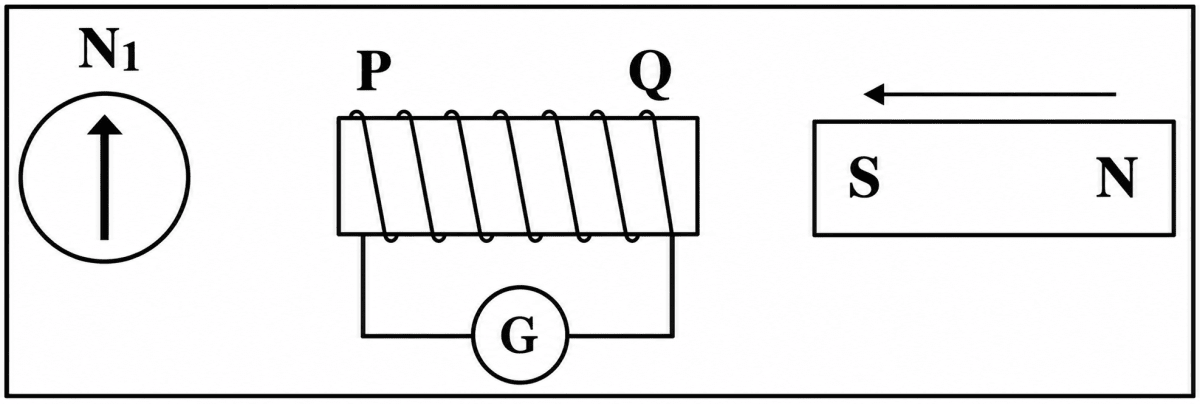
The above diagram shows a strong bar magnet moved towards the coil PQ along its axis, in the direction shown by the arrow. Which option correctly shows the momentary deflection of magnetic needle N1 and the direction of current through the galvanometer?
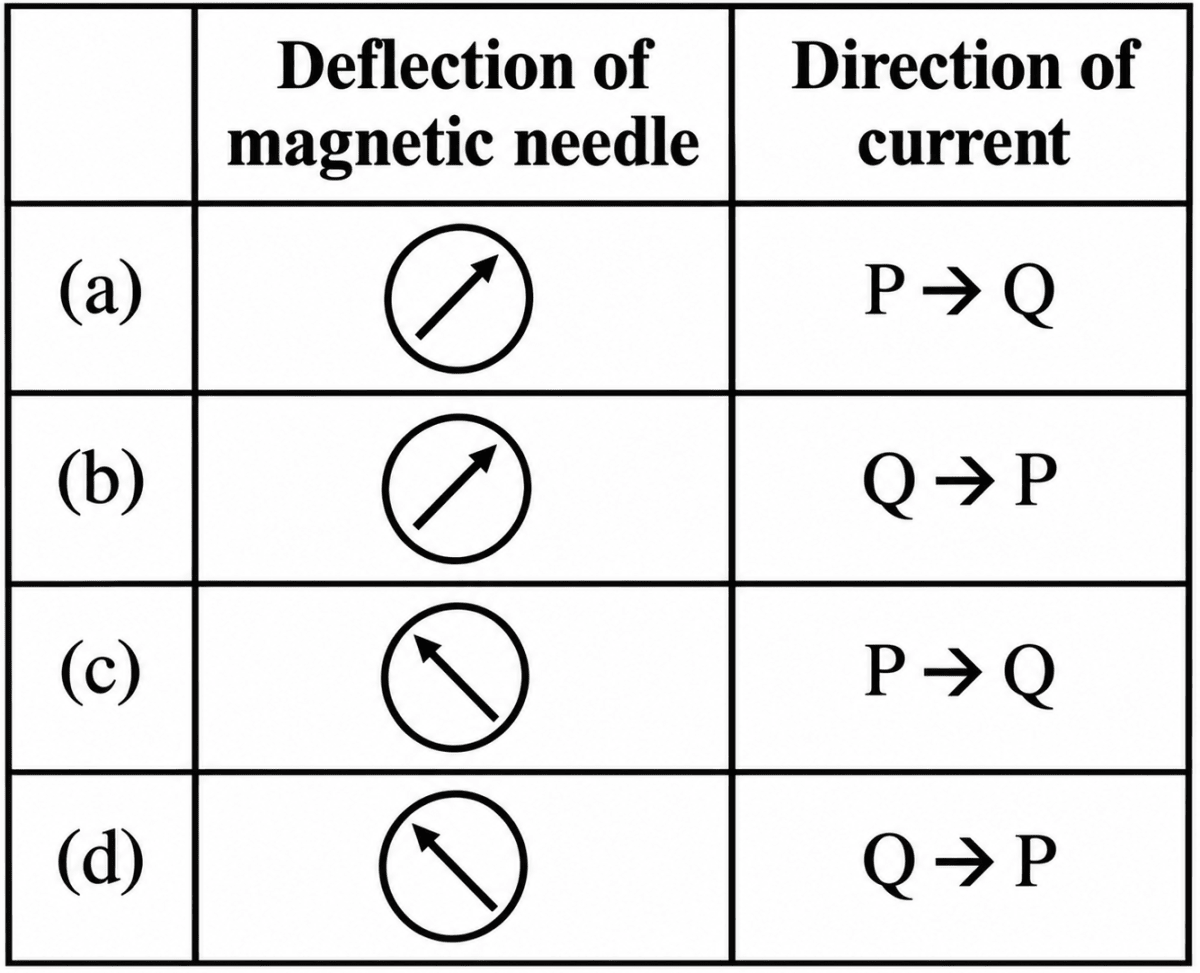
Answer

Reason — As the magnet moves towards the coil, the magnetic flux linked with the coil PQ changes, so an e.m.f. is induced in it and a momentary current flows through the galvanometer. This is electromagnetic induction.
By Lenz's law, the direction of the induced current is such that it opposes the cause producing it. Here the south pole of the magnet approaches the end Q, so the end Q of the coil must itself become a south pole in order to repel the approaching south pole. Consequently the other end P of the coil becomes a north pole, and the induced current flows from P to Q through the galvanometer.
Since the end P near the needle now behaves as a north pole, it repels the north pole of the magnetic needle N1, so the needle is deflected away from the coil.
A metallic wire is stretched in such a way that its new length becomes twice the original length. How does its specific heat capacity change?
- becomes double
- becomes 4 times
- becomes
- remains the same
Answer
remains the same
Reason — Specific heat capacity is a property of the material and does not depend on the shape, length or size of the object. When the metallic wire is stretched so that its length becomes twice the original length, only its dimensions change, while the material remains the same.
Therefore, the specific heat capacity remains unchanged.
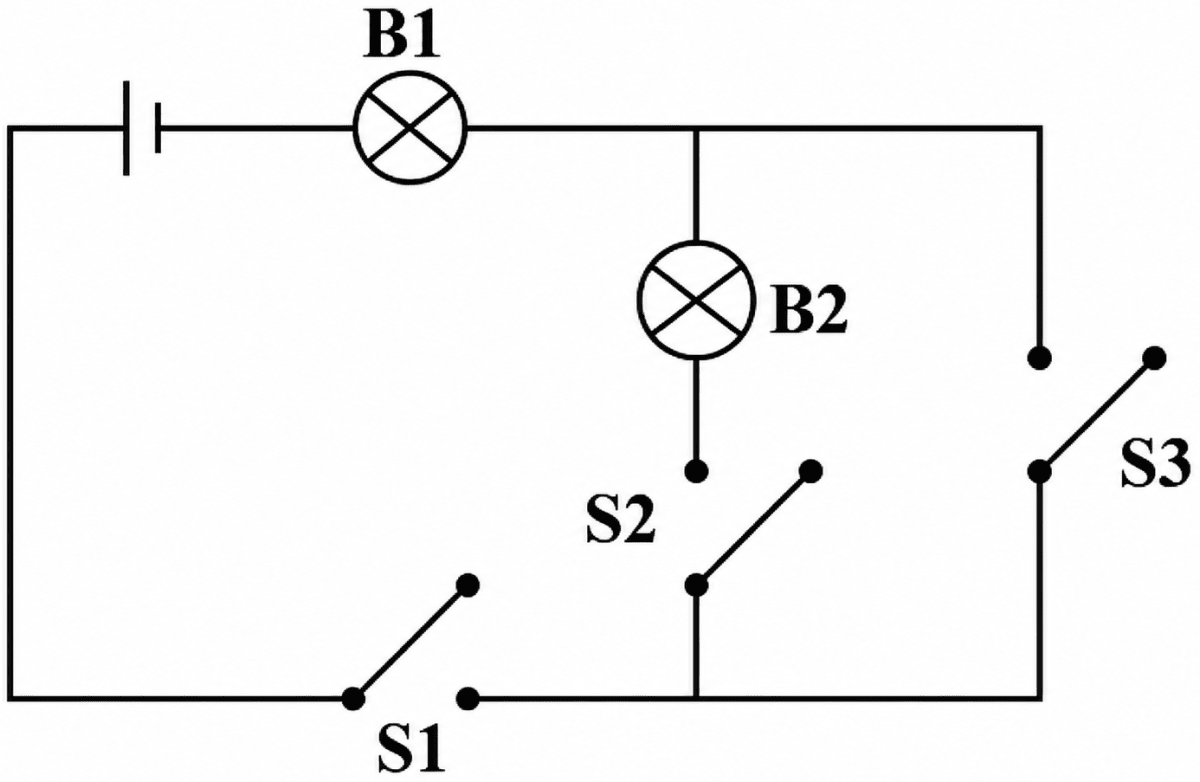
Priya built the circuit as shown in the figure given below. If she wants both bulbs (B1 and B2) to glow, which switches (S1, S2, S3) should be kept ON?
- S1 and S2 only
- S1 and S3 only
- S2 and S3 only
- S1, S2 and S3
Answer
S1 and S2 only
Reason — The bulb B1 lies in the main circuit, so it can glow only when the circuit is complete. This requires the switch S1 (which lies in the main line) to be ON.
The bulb B2 together with the switch S2 forms one branch, and the switch S3 forms a second branch connected in parallel with it. If S3 is put ON, it provides a path of practically zero resistance across the branch containing B2, so B2 gets short circuited and no current passes through it.
Hence, both the bulbs glow only when S1 and S2 are ON and S3 is OFF.
Complete the following by choosing the correct answers from the bracket:
(a) Friction acts ............... [tangential / radial] to a car undergoing circular motion.
(b) A glass prism is immersed in water. The angle of minimum deviation will ............... [decrease / increase].
(c) The CGS unit of specific heat capacity is ............... [erg g-1 K-1 / cal g-1 K-1].
(d) The minimum distance for distinct echo formation is ............... [greater / lesser] in water as compared to air.
(e) Two copper wires can have different resistivity if they have different ............... [lengths / temperatures].
(f) Nuclear ............... [fusion / fission] is possible at ordinary temperature and pressure.
Answer
(a) Friction acts radial to a car undergoing circular motion.
(b) A glass prism is immersed in water. The angle of minimum deviation will decrease.
(c) The CGS unit of specific heat capacity is erg g-1 K-1.
(d) The minimum distance for distinct echo formation is greater in water as compared to air.
(e) Two copper wires can have different resistivity if they have different temperatures.
(f) Nuclear fission is possible at ordinary temperature and pressure.
Match the movement of the body part in Column A to the class of lever in Column B.
| Column A | Column B |
|---|---|
| (a) Nodding head | 1. Class III |
| (b) Lifting body weight on your toes | 2. Class II |
| 3. Class I |
Answer
| Movement of the body part (Column A) | Class of lever (Column B) |
|---|---|
| (a) Nodding head | • Class I |
| (b) Lifting body weight on your toes | • Class II |
Reason —
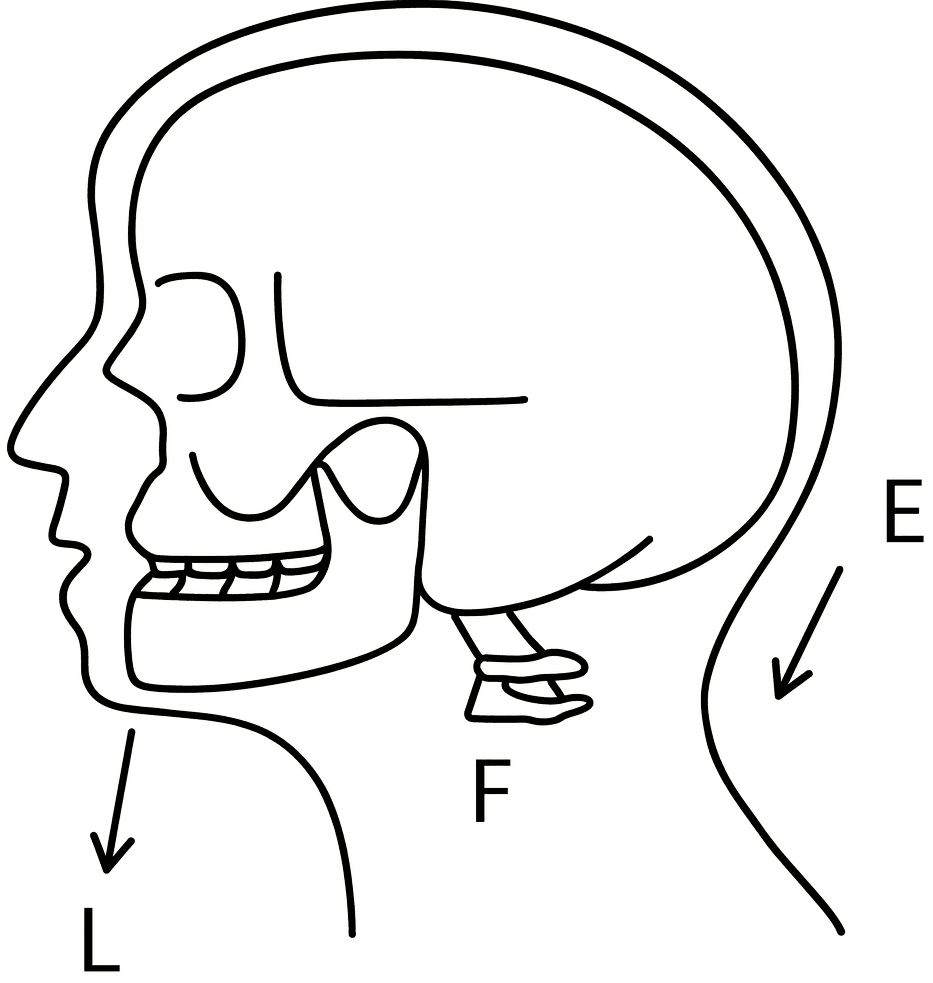
(a) In class I lever, the fulcrum is in between the effort and the load so in the same manner in nodding head, the spine acts as the fulcrum, load is at its front part while effort is at its rear part as shown in below figure.
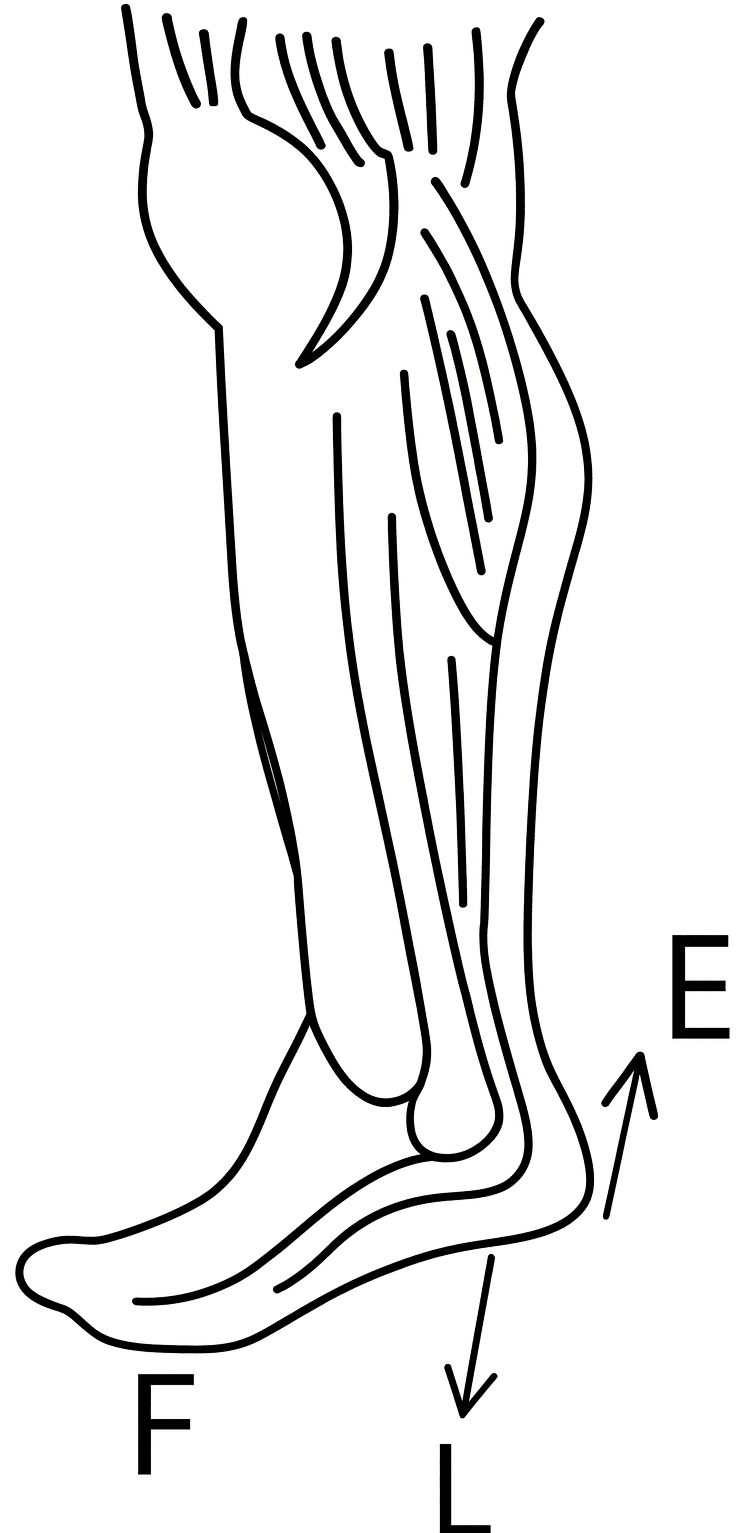
(b) In class II lever, the fulcrum and the effort are at the two ends of the lever and the load is somewhere in between the effort and the fulcrum so like class II, the weight of the body is raised on toes where the fulcrum is at the toes at one end, the load (i.e., weight of the body) is in the middle and effort by muscles is at the other end as shown in below figure.
Analyse the displacement position graph and answer the questions that follow.
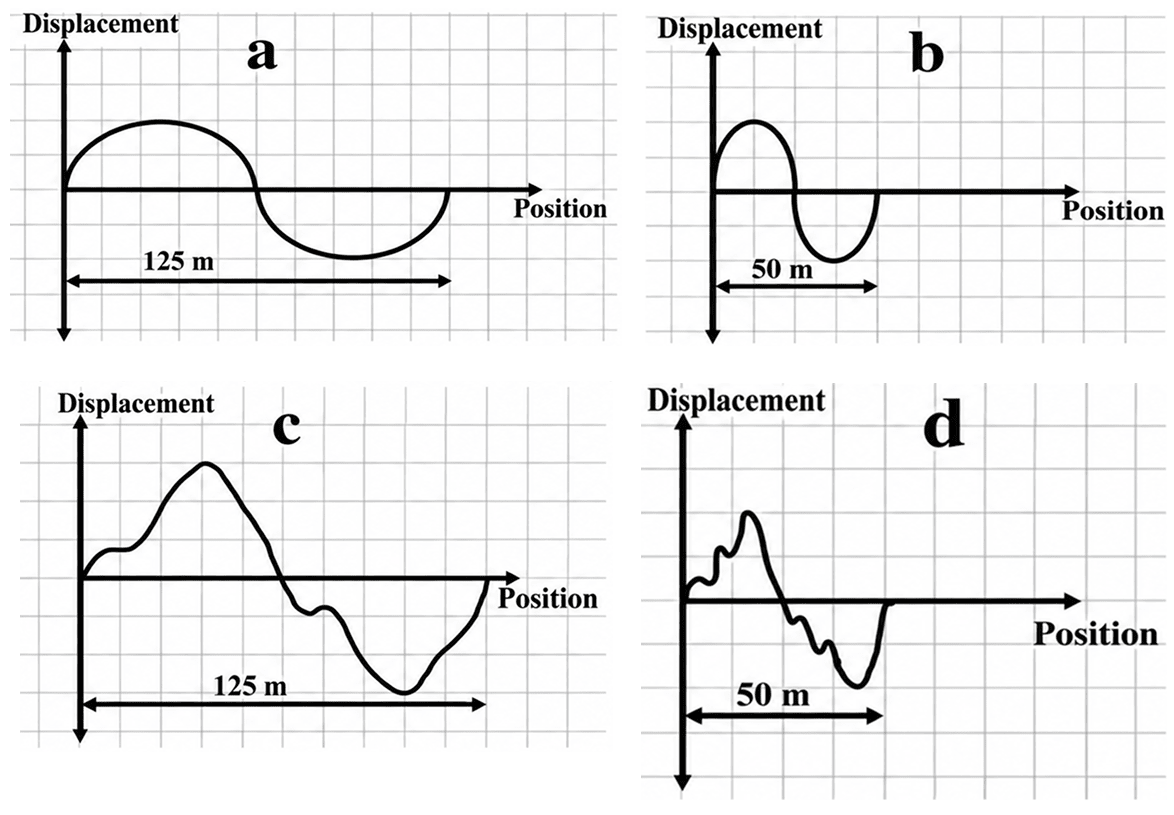
Find two figures that show:
(a) sound of same loudness and pitch but different quality.
(b) sound of same pitch but different loudness.
Answer
(a) Figures b and d.
(b) Figures a and c.
Reason —
(a) Loudness depends on the amplitude and pitch depends on the frequency (i.e., on the wavelength for the same speed), while quality depends on the wave form. Waves b and d have the same amplitude and the same wavelength (50 m), but their wave forms are different. So they represent sounds of the same loudness and pitch but of different quality.
(b) Waves a and c have the same wavelength (125 m), so they have the same pitch, but their amplitudes are different, so they differ in loudness.
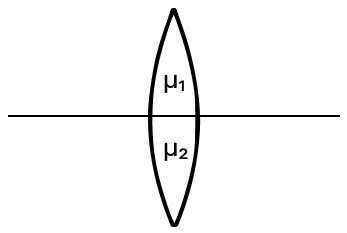
(a) Refer to the diagram given below. A lens is made of two materials of different refractive indices (μ1, μ2) as shown. If the rays are coming from a distant object, then how many images will be formed?
(b) A glass lens always forms a virtual, erect, and diminished image of an object kept in front of it. Identify the lens.
Answer
(a) The two materials bend the incoming rays by different amounts and produce two focal points. Hence, two images are formed.
(b) Concave lens because irrespective of the position of the object, the image formed by a thin concave (or divergent) lens is always virtual, upright, diminished, and it is situated on the side of the object between the focus and the lens.
The image given below displays kilowatt-hour meter readings recorded at two distinct points in time.
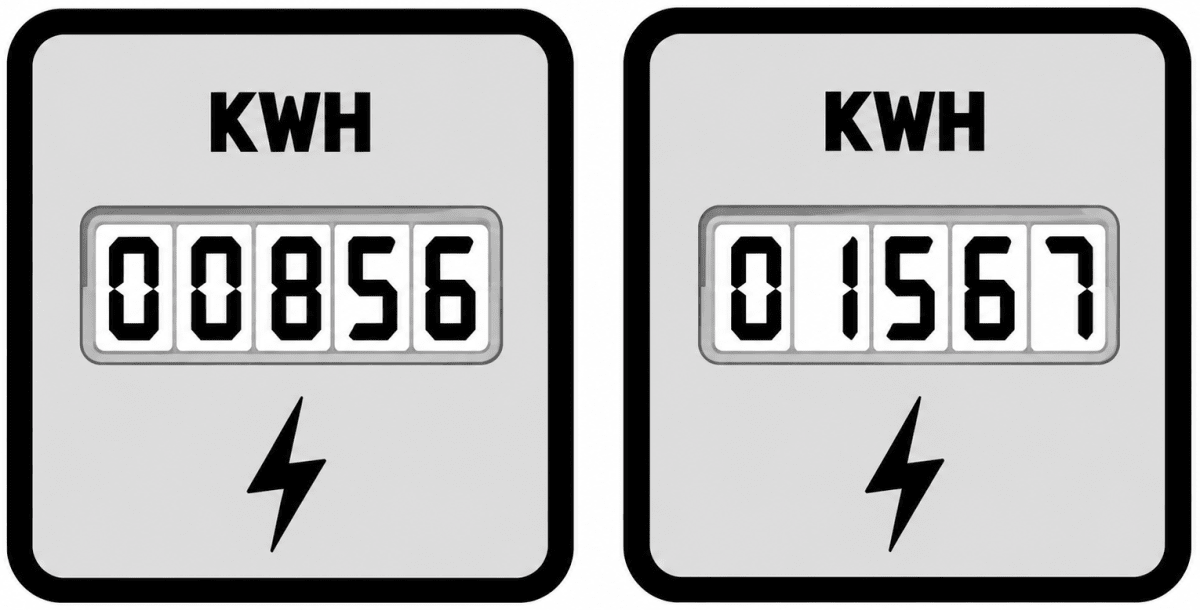
Assuming a continuously running 2000W air conditioner as the sole electrical device in use, calculate the time interval, in hours, between these two meter readings.
Answer
Given,
- Power rating of air conditioner (P) = 2000 W
- Initial meter reading = 856 kWh
- Final meter reading = 1567 kWh
Now,
Electrical energy used (E) = 1567 − 856 = 711 kWh
Hence, the time interval is 355.5 h.
ABCDE is a regular pentagon with its centre of gravity (CG) at O. What will be the most probable position (W, X, Y, Z or O) of the new centre of gravity:

(a) if a piece of clay is attached at point A?
(b) if the pentagon is cut along the line PQ? (CG of the remaining part DCBQPE)
Answer
(a) X
(b) Z
Reason —
(a) If a piece of clay is attached at point A of the pentagon ABCDE then new centre of gravity will be shifted towards A; hence, the most probable position is X.
(b) If the pentagon is cut along the line PQ then only DCBQPE remains which has equal mass distribution on left and right portions about the point O but has greater mass distributed on the upper portion than the lower portion about the point O. So, new centre of gravity will shift towards upper portion i.e. at a point above O; hence, the most probable position of the new centre of gravity is Z.
The diagram given below shows a copper wire wound around a U-shape soft iron bar. An iron pin is brought near the arrangement. First Source P and then Source Q are connected across AB, each operating independently.

(a) State True or False: Source P as well as Source Q, when connected across AB, can attract the iron pin.
(b) Justify your answer to (a) with a suitable reason.
Answer
(a) True.
(b) The coil on a soft-iron core acts as an electromagnet with either supply.
- With P (AC): an alternating magnetic field repeatedly magnetises the soft iron; a ferromagnetic pin is attracted in both half-cycles (polarity doesn't matter).
- With Q (DC): a steady field magnetises the core continuously, so the pin is attracted.
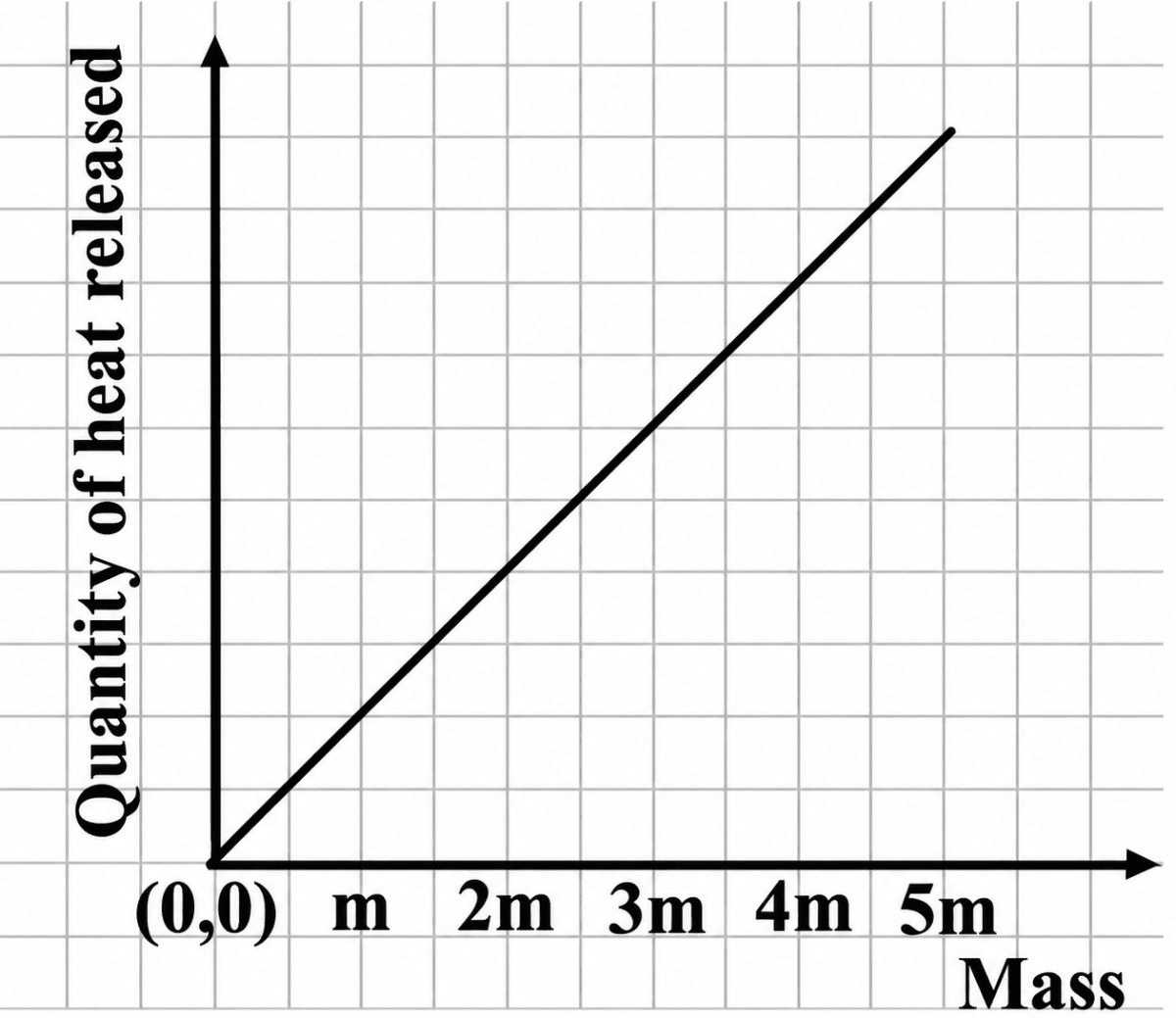
Blocks of identical material, having masses m, 2m, 3m, 4m, and 5m are heated to 150°C, and then cooled to 50°C.
(a) Draw the nature of the graph connecting the amount of heat released vs the mass of the blocks.
(b) Write the mathematical expression that enables the determination of the specific heat capacity using the graph.
Answer
(a) The heat energy released by a block is Q = mcΔt, where c is the specific heat capacity of the material and Δt = 150 − 50 = 100°C is the same for all the blocks.
Since c and Δt are constant, Q ∝ m. So the graph of heat released against mass is a straight line passing through the origin, as shown below.
(b) The slope of the above straight line is
So the specific heat capacity is
Answer the following questions according to the instructions given:
(a) When 6Li3 is bombarded with a neutron, it produces 4He2 and an isotope of hydrogen. Write the notation for the hydrogen isotope formed.
(b) Fill in the blank:
The mass of the reactants in a fission reaction is ............... (greater / less) than the mass of the products.
Answer
(a) The nuclear reaction is
6Li3 + 1n0 ⟶ 4He2 + 3H1
Balancing the mass numbers, 6 + 1 = 4 + 3, and balancing the atomic numbers, 3 + 0 = 2 + 1.
Hence, the hydrogen isotope formed is 3H1 (tritium).
(b) The mass of the reactants in a fission reaction is greater than the mass of the products.
Reason — In a fission reaction a small part of the mass of the reactants disappears. This loss of mass (mass defect) is converted into a large amount of energy in accordance with E = mc2, so the total mass of the products is less than the total mass of the reactants.
Advanced optical sensors in missiles use fibre optic cables to transmit light signals with minimal loss. This relies on a physical phenomenon that confines light within the fibres, making the system very dependable for guiding the missile precisely.
(a) Name the optical phenomenon that allows light signals to remain confined within the fibre optic cables during transmission.
(b) List the two main conditions necessary for this phenomenon to occur.
Answer
(a) Total internal reflection.
(b) The two necessary conditions for total internal reflection are :
- The light must travel from an optically denser medium to an optically rarer medium.
- The angle of incidence in the denser medium must be greater than the critical angle for that pair of media.
A diagram shows a ray of light travelling through three different transparent media having refractive indices μ1, μ2 and μ3 as shown. Points Q and R are points on the surfaces separating the media. Given PQ || RS.
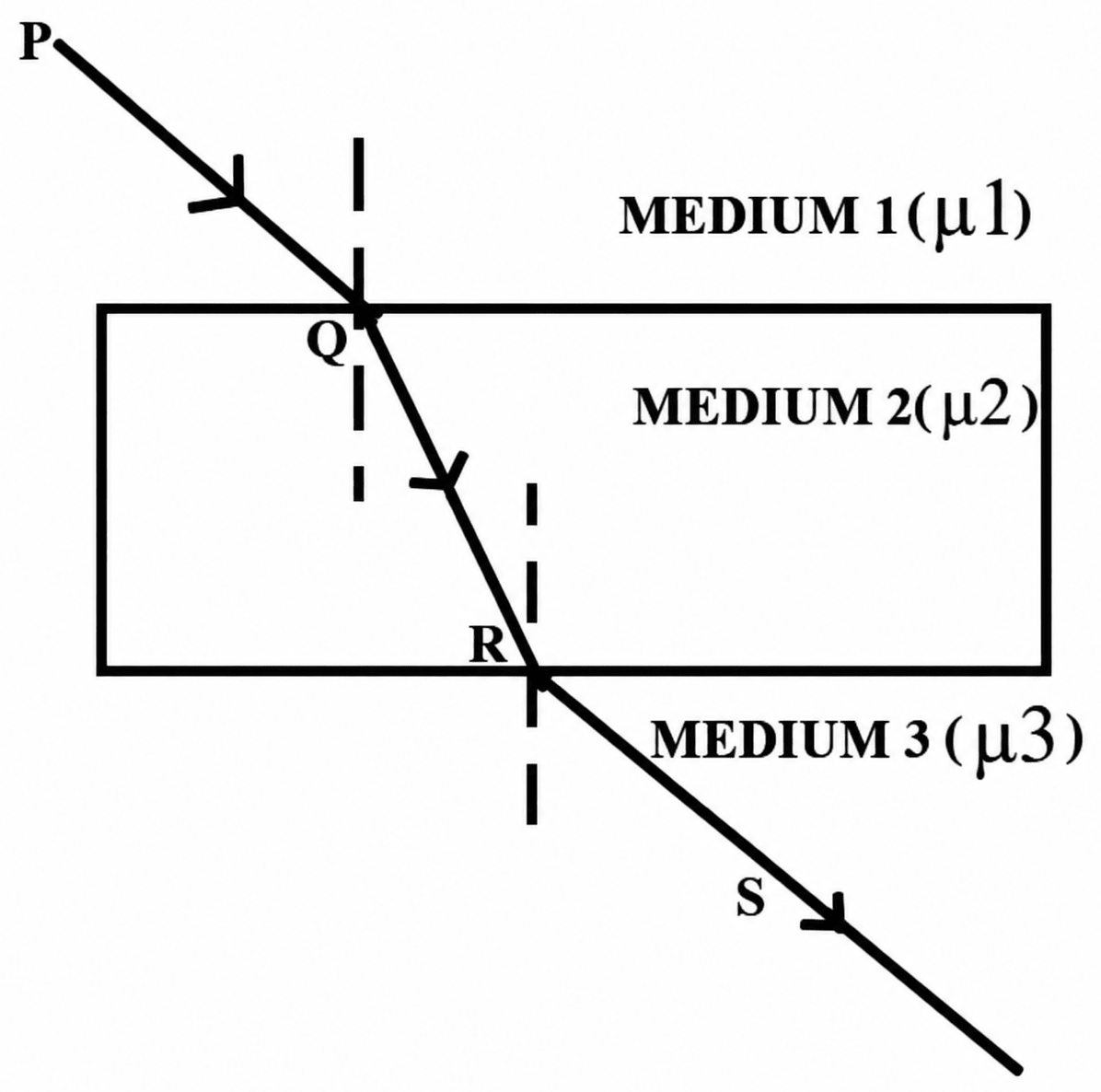
(a) Among the three media shown, in which medium is the speed of light minimum?
(b) As the ray of light travels from medium 1 to medium 2, how does the wavelength of light change? (State whether it increases, decreases, or remains constant.)
(c) State the relationship between the refractive indices μ1 and μ3 that ensures the emergent ray (RS) is parallel to the incident ray (PQ).
Answer
(a) When the light ray travels from Medium 1 to Medium 2, it bends towards the normal, indicating that Medium 2 is optically denser than Medium 1. When it travels from Medium 2 to Medium 3, it bends away from the normal, indicating Medium 2 is also denser than Medium 3. Because light travels slowest in the optically densest medium, its speed is minimum in Medium 2.
(b) The frequency of light does not change on refraction, and speed = frequency × wavelength. Since the speed of light decreases on entering medium 2, the wavelength also decreases.
Hence, the wavelength decreases.
(c) The emergent ray RS is parallel to the incident ray PQ only when the ray suffers equal and opposite bending at the two surfaces, i.e., when the first and the third media are optically identical.
Hence, μ1 = μ3.
The diagram below shows two graphs showing variation in angle of deviation against angle of incidence for two colours of light (blue, orange) while passing through the same prism. [Diagrams are not drawn to the same scale.]
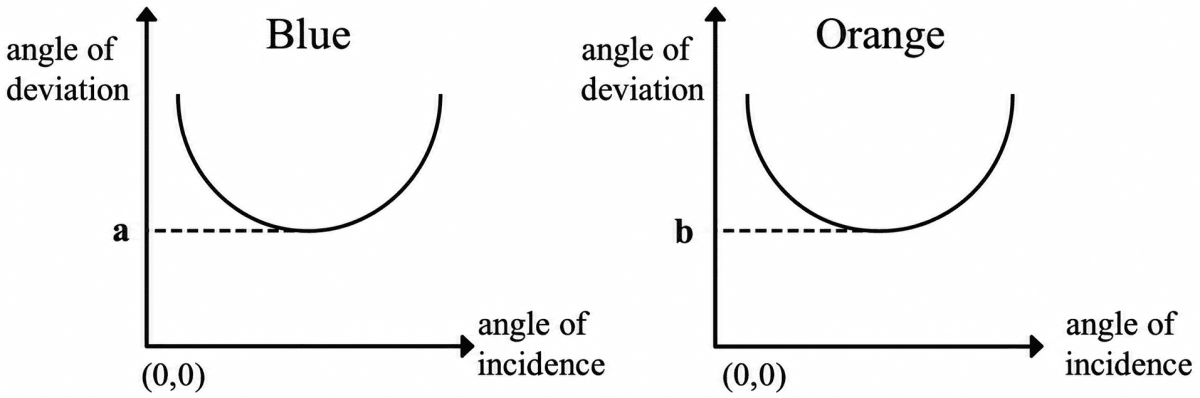
(a) State with a reason whether a = b, a < b, or a > b.
(b) If we increase the angle of the prism then what is the effect on the values of a and b?
Answer
(a) a > b
Reason — In each graph the lowest point of the curve gives the angle of minimum deviation, so a is the angle of minimum deviation for blue light and b is that for orange light.
The refractive index of the material of a prism decreases with the increase in the wavelength of light. As the wavelength of blue light is smaller than that of orange light, the prism has a greater refractive index for blue light and therefore deviates it more.
Hence, a > b.
(b) The angle of deviation produced by a prism increases with the increase in the angle of the prism.
Hence, on increasing the angle of the prism, the values of both a and b will increase.
A candle and a screen are placed 90 cm apart. Steve placed a lens between them such that a clear image is formed on the screen and the image is twice the size of the object.
(a) Which type of lens is used by Steve?
(b) Write an equation relating the object distance u, image distance v, and the distance between the candle and the screen.
(c) State the ratio between the image distance v and the object distance u.
(d) Calculate the image distance.
Answer
(a) A clear image is obtained on a screen, so the image is real and magnified. Only a convex lens can form a real and magnified image.
Hence, Steve used a convex lens.
(b) The candle and the screen lie on opposite sides of the lens, so the sum of the two distances is equal to the separation between them.
u + v = 90 cm
(c) The image is twice the size of the object, so its image distance is twice its object distance.
Hence, v : u = 2 : 1
(d) From part (c), v = 2u
Substituting in u + v = 90, we get
Then,
v = 90 − 30 = 60 cm
Hence, the image distance is 60 cm.
Draw a ray diagram to show the formation of an image by a concave lens when the object is placed between F and 2F.
Answer
The ray diagram is shown below :
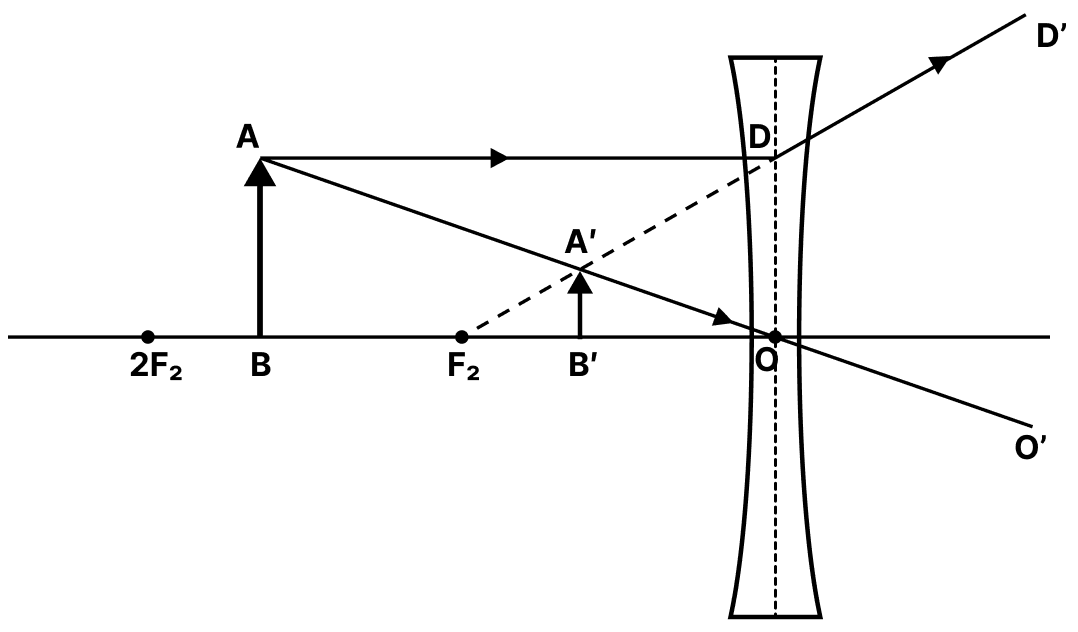
A ray from the top of the object travelling parallel to the principal axis, after refraction, appears to come from the focus F1 on the same side of the lens, while a ray directed towards the optical centre O passes undeviated. These two refracted rays appear to meet at A'.
The image A'B' so formed is virtual, erect and diminished, and it lies between the optical centre and the focus F1, on the same side of the lens as the object.
The diagram below shows a cooling curve for a substance X:
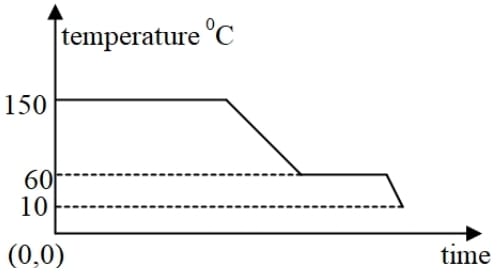
(a) State the temperature at which the substance condenses.
(b) Mention the temperature range in which the substance is in its liquid state.
(c) State True or False: The amount of heat released when a substance is cooled by 10°C in its liquid state is greater than the heat released when it is cooled by the same amount in its solid state.
Answer
(a) Substance condenses at 150 °C.
(b) 150 °C to 60 °C.
(c) True.
Reason — The amount of heat released when a substance is cooled depends on :
Q = mcΔT
Where:
- Q = heat released
- m = mass of the substance
- c = specific heat capacity
- ΔT = change in temperature
Now, for the same mass and same temperature drop (10°C), the specific heat capacity (c) of a liquid is usually greater than that of its solid form.
So,
Qliquid > Qsolid
Hence, more heat is released when cooling a substance by 10°C in its liquid state than in its solid state, due to higher specific heat capacity.
In an experiment to measure the temperature of the flame of a Bunsen burner, a lump of copper of mass 0.12 kg is heated on the flame for a long time. The copper then is quickly transferred into a beaker of negligible heat capacity containing 0.84 kg of water and the temperature of the water rose from 15°C to 35°C. Calculate the temperature of the flame.
[Given sp. Heat capacity of copper = 0.4 Jg-1 oC-1, Sp. Heat capacity of water = 4.2 Jg-1 oC-1.]
Answer
Given,
- Mass of copper (mC) = 0.12 kg = 0.12 x 1000 g = 120 g
- Mass of water (mW) = 0.84 kg = 0.84 x 1000 = 840 g
- Initial Temperature of water (T1) = 15 °C
- Final Temperature of water = Final Temperature of copper = (T2) = 35 °C
- Specific heat capacity of copper (cC) = 0.4 J g-1 °C-1
- Specific heat capacity of water (cW) = 4.2 J g-1 °C-1
Let,
Temperature of the flame = Initial Temperature of copper = T
Now,
Heat lost by copper = mC x cC x (T - T2)
= 120 x 0.4 x (T - 35)
= 48 x (T - 35)
And
Heat gained by water = mW x cW x (T2 - T1)
= 840 x 4.2 x (35 - 15)
= 840 x 4.2 x 20
= 70560 J
As,
Heat lost by copper = Heat gained by water
⟹ 48 x (T - 35) = 70560
⟹ T - 35 = = 1470
⟹ T = 1470 + 35 = 1505 °C
Hence, temperature of the flame is 1505 °C.
A metal rod AB of length 80 cm is balanced at 45 cm from the end A with 100 gf weights suspended from the two ends.
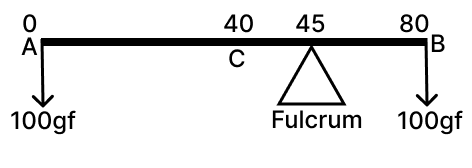
(a) If this rod is cut at the centre C, then compare the weight of AC to the weight of BC. (Use >, < or =)
(b) Give a reason for your answer in (a).
Answer
(a) Given,
- Weight at the end A (WA) = 100 gf
- Weight at the end B (WB) = 100 gf
- Length of the rod (L) = 80 cm
- Distance of A from the fulcrum (lA) = 45 cm
- Distance of B from the fulcrum (lB) = 80 cm - 45 cm = 35 cm
Let,
Weight of the rod AC is (WAC) and distance of centre of gravity of the rod AC from the fulcrum is (lAC).
And
Weight of the rod BC is (WBC) and distance of centre of gravity of the rod BC from the fulcrum is (lBC).
Here,
(lAC) = 45 - 20 = 25 cm,
(lBC) = 60 - 45 = 15 cm,
Now,
Anticlockwise moment (due to weight of 100 gf at end A and weight of rod AC) = lA x WA + lAC x WAC = 45 x 100 + 25 x WAC
Clockwise moment (due to weight of 100 gf at end B and weight of rod BC) = lB x WB + lBC x WBC = 35 x 100 + 15 x WBC
As system is balanced then for equilibrium,
Anticlockwise moment of force about the fulcrum = Clockwise moment of force about the fulcrum
45 x 100 + 25 x WAC = 35 x 100 + 15 x WBC
⇒ 4500 + 25WAC = 3500 + 15WBC
⇒ 15WBC - 25WAC = 4500 - 3500 = 1000
⇒ 3WBC - 5WAC = 200
⇒ 3WBC - 5WAC > 0
⇒ 3WBC > 5WAC
⇒ WBC > WAC
Hence, weight of AC < weight of BC.
(b) Even though the weights present are the same at both ends and the torque arm of B is less than the torque arm of A. This means the moment of the weight of the rod acts from side B and the C.G. lies beyond 45. Thus, more weight is concentrated between C to B.
For each of the following scenarios, state whether the work done by gravity is positive, negative, or zero.
(a) A person walks on a levelled road.
(b) A person climbs a ladder.
(c) A car in a neutral gear is coming down the slope.
Answer
(a) Zero
(b) Negative
(c) Positive
Reason —
(a) Zero because when a person walks on a levelled road, no work is done against the force of gravity as the displacement of the person is normal to the direction of force of gravity which is vertically downwards.
(b) Negative because when a person climbs a ladder (upward), the displacement covered by the person is opposite to the direction of force of gravity (downwards), so the work done on the person by the force of gravity is negative.
(c) Positive because when a car in neutral gear is coming down the slope, the direction of displacement covered by it has some angle θ with the direction of force of gravity (downwards) such that 0° ≤ θ < 90°, so the work done on the car by the force of gravity is positive.
An empty supermarket trolley of mass 10 kg is moving with a speed of 8 m s-1. An identical trolley is loaded with 10 kg of goods and moves with a speed of 4 m s-1. Both trolleys are brought to rest over the same stopping distance.
(a) Calculate the kinetic energy of the empty trolley.
(b) Calculate the kinetic energy of the loaded trolley.
(c) Compare the braking force required to stop the empty trolley and the loaded trolley.
(d) Name the principle applied in solving part (c).
Answer
Given,
- Mass of the empty trolley (m1) = 10 kg
- Speed of the empty trolley (v1) = 8 m s-1
- Mass of the loaded trolley (m2) = 10 + 10 = 20 kg
- Speed of the loaded trolley (v2) = 4 m s-1
(a) Kinetic energy of the empty trolley
Hence, the kinetic energy of the empty trolley is 320 J.
(b) Kinetic energy of the loaded trolley
Hence, the kinetic energy of the loaded trolley is 160 J.
(c) The work done by the braking force in stopping a trolley is equal to its kinetic energy. If the stopping distance is s and the braking force is F, then
F × s = kinetic energy
So,
Hence, F1 : F2 = 2 : 1, i.e., the braking force needed for the empty trolley is twice that needed for the loaded trolley.
(d) The work-energy theorem, i.e., the work done by the braking force is equal to the change in the kinetic energy of the trolley.
A bar of length 120 cm is used as a lever to raise a load placed at point P. Seven equidistant points are marked along the bar: P, Q, R, S, T, U, and V, each 20 cm apart. You are permitted to place the fulcrum at any of the marked points and exert the effort at a different point.
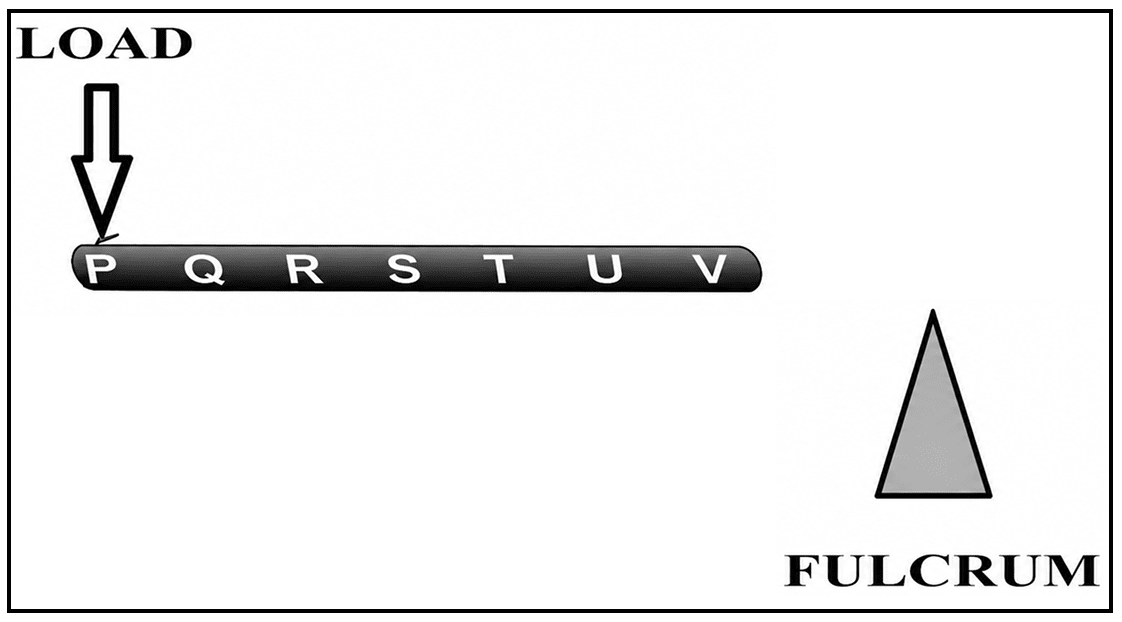
(a) Specify the fulcrum and effort points that yield the greatest mechanical advantage.
(b) Based on the lever arrangement identified in part (a), calculate the maximum mechanical advantage using the distances shown in the diagram.
(c) To which class of lever does this arrangement belong?
Answer
(a) For a lever,
So the mechanical advantage is greatest when the load arm is as small as possible and the effort arm as large as possible. The load is at P, so the fulcrum must be at the point nearest to P and the effort must be applied at the farthest point.
Hence, the fulcrum should be at Q and the effort should be applied at V.
(b) Load arm = PQ = 20 cm
Effort arm = QV = 120 − 20 = 100 cm
Hence, the maximum mechanical advantage is 5.
(c) In this arrangement the fulcrum Q lies in between the load at P and the effort at V.
Hence, it is a class I (first class) lever.
A boy is located asymmetrically between two parallel walls, closer to the left wall than the right. If he claps, the time interval between successive echoes is 0.25 s, then find the value of X in metres. [speed of sound in air = 340 m/s.]
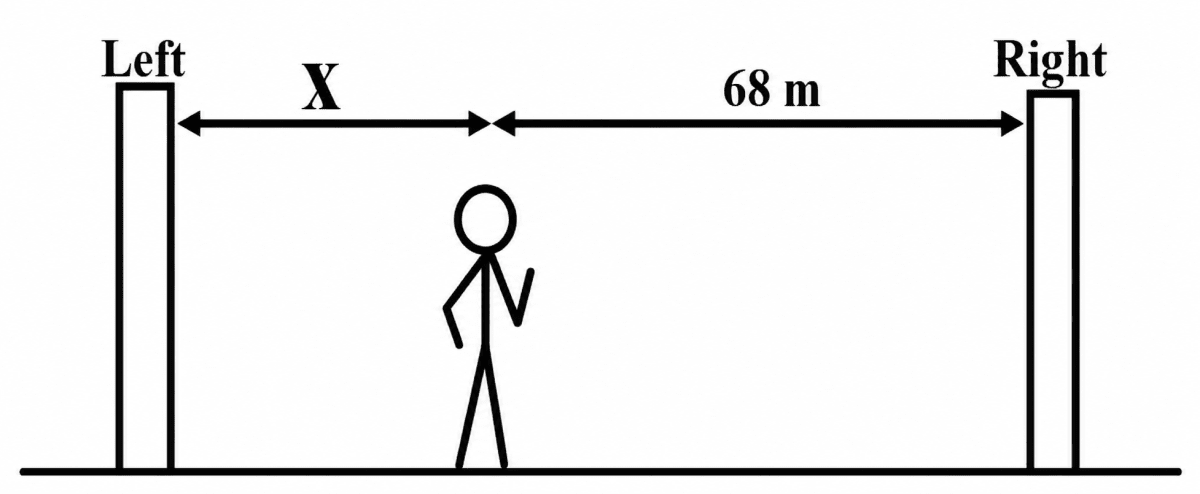
Answer
Given,
- Distance of the boy from the right wall = 68 m
- Distance of the boy from the left wall = X
- Time interval between the two echoes = 0.25 s
- Speed of sound in air (v) = 340 m s-1
Since the boy is nearer to the left wall, the echo from the left wall is heard first and that from the right wall is heard later.
Time taken by the echo from the right wall,
Time taken by the echo from the left wall,
t1 = t2 − 0.25 = 0.4 − 0.25 = 0.15 s
Now,
Hence, the value of X is 25.5 m.
Two wires A and B of the same material and length are fixed to a wooden board and stretched under the same tension. The cross-sectional area of wire A is greater than that of wire B. When set into vibration using identical tuning forks of frequency 300 Hz, only wire B produces a loud sound.
(a) Name and explain the phenomenon responsible for the loud sound produced by wire B.
(b) A loud sound is heard from wire A when the experiment is repeated using a tuning fork of frequency f. Is 'f' greater than, less than or equal to 300 Hz? Justify your answer.
Answer
(a) The phenomenon is resonance.
The vibrating tuning fork applies an external periodic force of frequency 300 Hz on both the wires, so both of them execute forced vibrations. The natural frequency of wire B happens to be exactly equal to 300 Hz, so wire B vibrates with a very large amplitude and sends out a large amount of energy into the surrounding air. Hence a loud sound is heard from wire B only.
(b) f < 300 Hz
Reason — For wires of the same material, same length and under the same tension, a thicker wire has a greater mass per unit length and therefore a lower natural frequency of vibration. Since wire A is thicker than wire B, the natural frequency of A is less than that of B, i.e., less than 300 Hz.
A loud sound will be heard from wire A only when the frequency of the tuning fork is equal to the natural frequency of A, so that resonance occurs.
Hence, f is less than 300 Hz.
The below diagram shows the part of a complete circuit. The ammeter reads 1A.
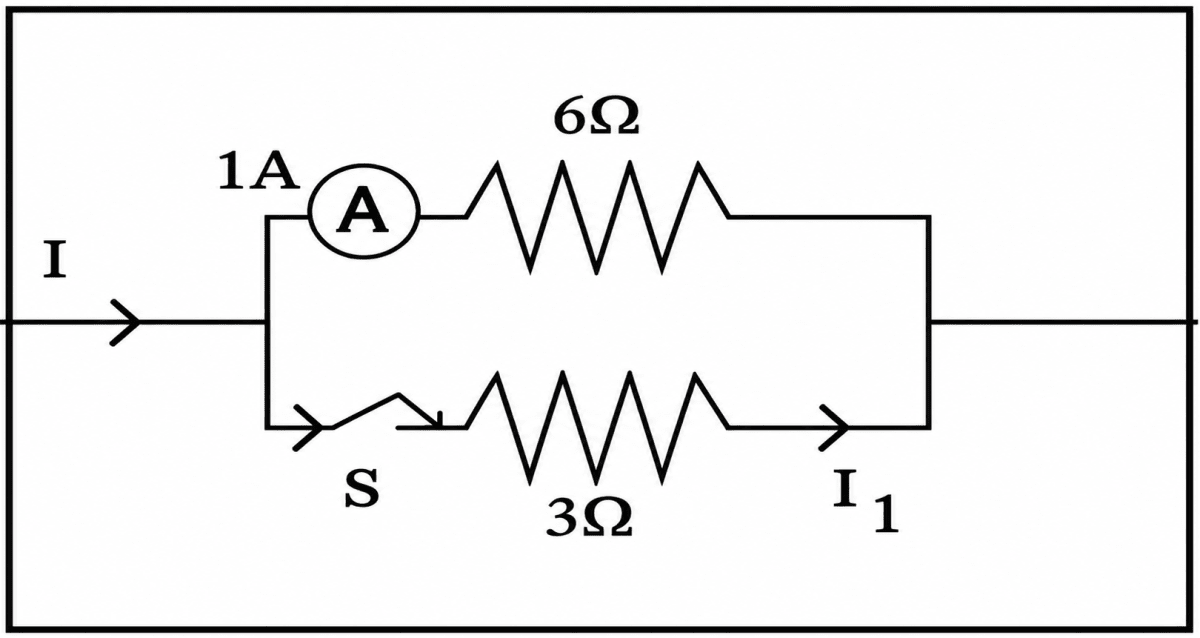
Calculate:
(a) the current I1 through the 3Ω resistor.
(b) the total current I in the circuit.
(c) State True or False: When the switch (S) is opened and the entire current flows through the 6Ω resistor, the ammeter reading will be (1+I1).
Answer
Given,
- Current through the 6Ω resistor = ammeter reading = 1 A
(a) The 6Ω and 3Ω resistors are joined in parallel, so the potential difference across both of them is the same.
Hence, the current through the 3Ω resistor is 2 A.
(b) In a parallel combination the main current is the sum of the currents in the branches.
I = 1 + I1 = 1 + 2 = 3 A
Hence, the total current in the circuit is 3 A.
(c) False.
Reason — When the switch S is opened, the 3Ω branch is broken and only the 6Ω resistor is left in the circuit. The resistance of the parallel combination was
which now rises to 6 Ω. For the same supply voltage, an increase in resistance decreases the current.
Hence, the ammeter reading will become less than 1 A, and not (1 + I1) = 3 A.
An appliance with a metal covering, rated at 2 kW, 220 V, is to be connected in a circuit. Given below are two diagrams (R & S) depicting different circuit configurations.
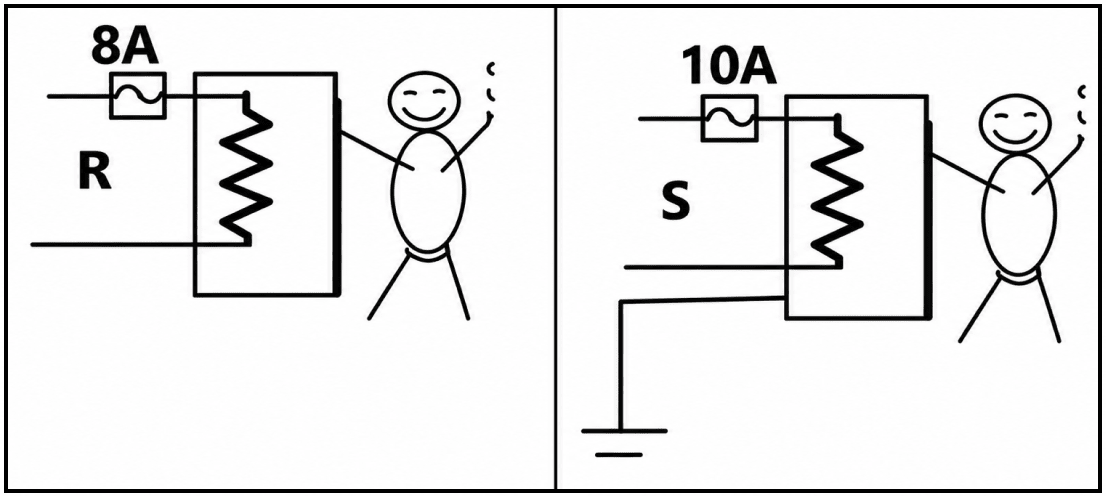
(a) Identify the safest circuit.
(b) Write two reasons, supported by mathematical calculations, where applicable, to justify your choice.
Answer
Given,
- Power rating of the appliance (P) = 2 kW = 2000 W
- Voltage rating (V) = 220 V
(a) The safest circuit is S.
(b) The current drawn by the appliance is
Earthing — The appliance has a metal covering. In circuit S the metal body is connected to the earth, so if the live wire accidentally touches the body, a large fault current flows through the earth wire, helping the fuse disconnect the supply and protecting a person touching the appliance. Circuit R has no earth connection, so it is unsafe.
Correct fuse rating — The current rating of the fuse must be slightly more than the current drawn by the appliance. In circuit S the fuse is rated 10 A, which is just above 9.09 A, so it carries the normal current safely and blows only when the current becomes excessive. In circuit R the fuse is rated 8 A, which is less than 9.09 A, so it would blow even during the normal working of the appliance.
Hence, circuit S satisfies both the requirements of a safe circuit.
A Nichrome wire X with length (l) and cross-sectional area (A) is connected to a 10 V source and another Nichrome wire Y with length (2 l) and cross-sectional area , is connected to a 20 V source.
(a) Compare the resistances of wires X and Y. [Given that the resistivity of Nichrome is (ρ).]
(b) Compare the electrical power consumed by each wire.
(c) Compare the masses of these wires. [Given that the density of nichrome is d.]
(d) State True or False: Wire X and wire Y both show the same rise in temperature at the same time.
Answer
Given,
- Length of nichrome wire X (lX) = l
- Cross-sectional area of nichrome wire X (AX) = A
- Potential difference across nichrome wire X (VX) = 10 V
- Length of nichrome wire Y (lY) = 2l
- Cross-sectional area of nichrome wire Y (AY) = A/2
- Potential difference across nichrome wire Y (VY) = 20 V
- Resistivity of nichrome = ρ
(a) Let 'RX' and 'RY' be the resistance of nichrome wire X and Y respectively.
Now,
And
As,
So, RX : RY = 1 : 4
(b)
And
So, PX : PY = 1 : 1
(c) Given,
Mass density of nichrome = d
Then,
Mass of wire X (mX) = d x volume = d x Al
And,
Mass of wire Y (mY) = d x volume = d x 2l x = d x Al = mX
So, mX : mY = 1 : 1
(d) True.
Reason —
Let, heat gained by the wire X be 'QX' and change in temperature be 'ΔTX'. Similarly, heat gained by the wire Y be 'QY' and change in temperature be 'ΔTY'.
Again, let specific heat capacity of nichrome be 'c' and same time be 't'.
Then,
QX = PX x t = mXc x ΔTX
and
QY = PY x t = mYc x ΔTY
As, PX = PY then QX = QY for same time t.
⇒ mXc x ΔTX = mYc x ΔTY
⇒ mX x ΔTX = mY x ΔTY
So,
ΔTX : ΔTY = mY : mX = 1 : 1
Hence, wire X and wire Y both show the same rise in temperature in the same time.
Three bulbs of powers P1, P2 and P3 (P1 < P2 < P3) are connected in a certain way such that P3 glows the brightest.
(a) What type of connection exists between these bulbs?
(b) Compare the voltages (V1, V2, V3) across these bulbs. (Use >, < or =)
(c) Will the circuit still function if one of the bulbs is fused?
Answer
(a) All bulbs are connected in parallel combination because in a parallel connection, voltage across each bulb is the same, and brightness depends directly on power rating. So, the bulb with the highest power rating (P3) will draw the most current and glow brightest.
(b) In a parallel circuit, all components share the same voltage.
So,
V1 = V2 = V3
(c) Yes because in a parallel circuit, each bulb has an independent path to the power supply and if one bulb fuses, the others continue to receive power and function normally.
Study the diagram and answer the following questions:
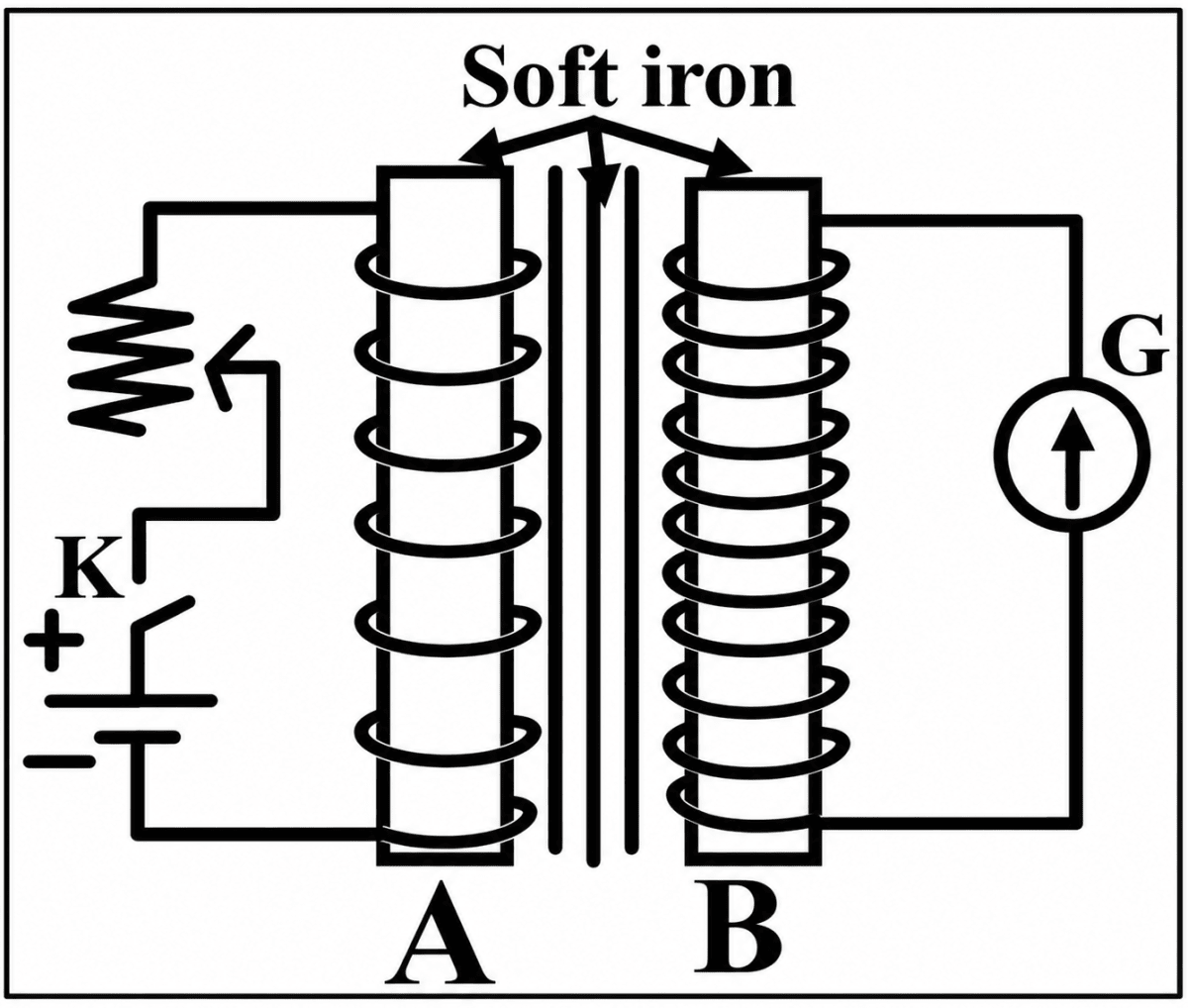
(a) In the given circuit when the key is closed, the galvanometer in the coil B shows momentary deflection. Give a reason for this deflection.
(b) How will the galvanometer deflect if the variable resistance in the closed circuit is decreased? (in the same direction / in the opposite direction)
(c) Give a reason for your answer to (b).
Answer
(a) When the key is closed, the current in the coil A grows from zero to its steady value, so the magnetic field produced by it changes. Since both the coils are wound on the same soft iron core, the magnetic flux linked with the coil B also changes and an e.m.f. is induced in it by electromagnetic induction. As the circuit of B is closed through the galvanometer, an induced current flows in it and the galvanometer shows a deflection.
The deflection is only momentary because once the current in A becomes steady, the flux linked with B no longer changes and the induced e.m.f. falls to zero.
(b) In the same direction.
(c) On decreasing the variable resistance, the current in the coil A increases. This increases the magnetic flux linked with the coil B, i.e., the flux again increases just as it did at the moment of closing the key.
Since the change in flux is of the same kind as before, by Lenz's law the induced current in B flows in the same direction as earlier, and hence the galvanometer deflects in the same direction.
The graph given below illustrates the correlation between the number of protons (x-axis) and the number of neutrons (y-axis) for elements A, B, C, D, and E in the periodic table. These elements are denoted by the letters rather than their conventional symbols.
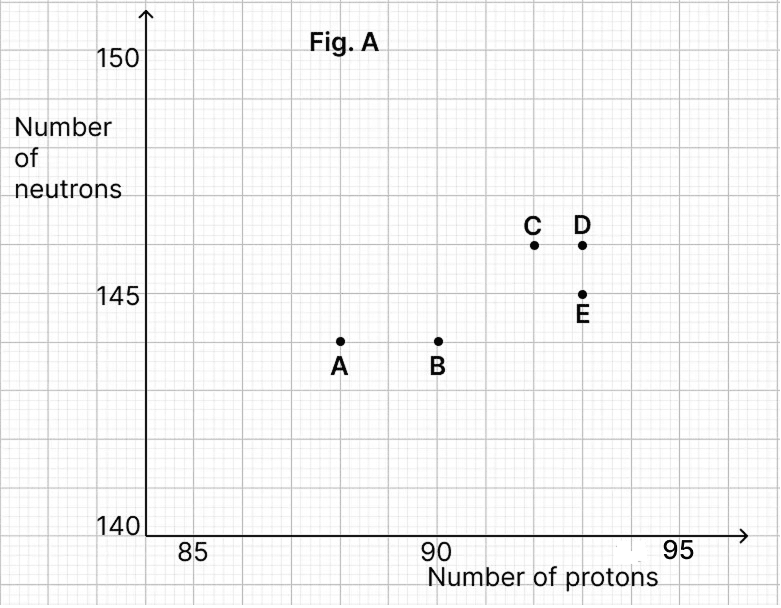
(a) Identify the radioactive radiation emitted when element C decays into element E. Represent this using a nuclear reaction.
(b) What is the special name given to elements like D and E?
(c) If element C transforms into element B by emitting a radioactive ray, how will this ray behave in an electric field?
Answer
(a) From the graph,
Number of protons in C = 92
Number of neutrons in C = 146
Mass number of C = Number of protons in C + Number of neutrons in C = 92 + 146 = 238
Number of protons in E = 93
Number of neutrons in E = 145
Mass number of E = Number of protons in E + Number of neutrons in E = 93 + 145 = 238
Since element C has one less proton and one neutron more than the element E, if C decays into E, its proton number increases by one and its neutron number decreases by one, keeping the mass number the same, which happens only in the case of beta radiation.
Thus, the reaction will be as follows :
23892C → 23893E + 0-1β
(b) As points D and E are situated on the same vertical line but on different horizontal lines, they have the same number of protons but different numbers of neutrons, i.e., their atomic number is the same but their mass numbers are different, so they are isotopes of each other.
(c) Number of protons in B = 90
Number of neutrons in B = 144
Mass number of B = Number of protons in B + Number of neutrons in B = 90 + 144 = 234
As element B has two protons less than element C and a mass number four less than that of C, during the decay of C into B, two protons and two neutrons are emitted, which is nothing but an alpha particle.
Alpha particles shift towards the negative plate in an electric field.