
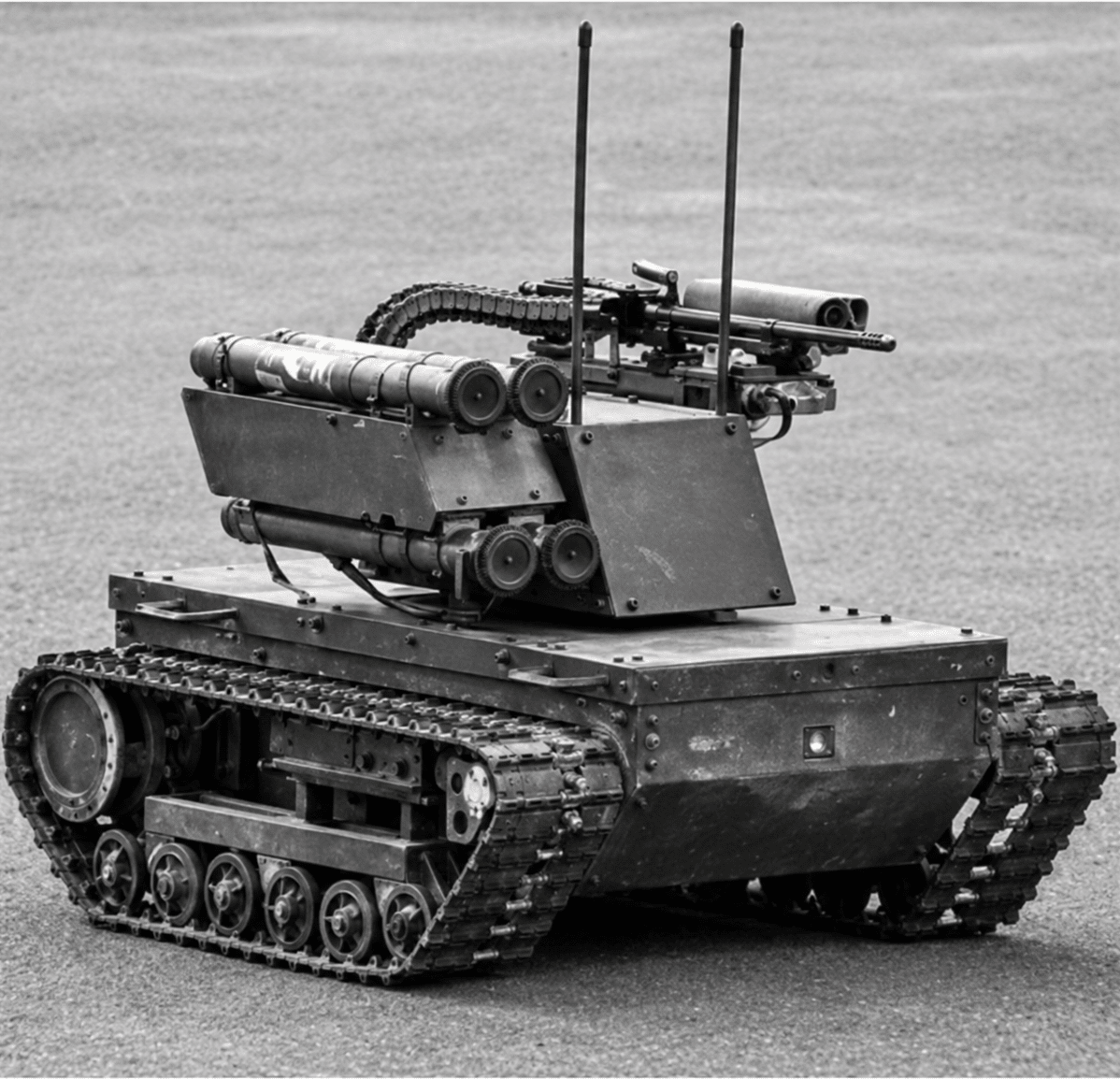
Study the image given below. In which field is this robot used?
- Healthcare
- Defence
- Warehouse management
- Entertainment
Answer
Defence
Reason — The figure shows a tracked, armoured robot fitted with a mounted weapon system. Such robots are used in the defence sector for tasks like surveillance, bomb disposal, and combat operations in dangerous areas, keeping soldiers safe from harm.
Which of the following is an application of AI?
- Face recognition
- Microwave ovens
- Room heater
- Geyser
Answer
Face recognition
Reason — Face recognition uses artificial intelligence to identify a person by analysing and matching facial features with stored data. The other options - microwave ovens, room heaters, and geysers, are simple electrical machines that work on fixed mechanisms and do not use AI.
A Cobot is best described as a robot that:
- mimics human behaviour
- collaborates with humans
- is used underwater
- is without sensors
Answer
collaborates with humans
Reason — A cobot (collaborative robot) is designed to work alongside humans in a safe and collaborative environment. It assists humans in performing tasks with a focus on cooperation and involvement, rather than working completely on its own.
A revolute joint shows rotation along ............... .
- Multiple axis
- Double axis
- Triple axis
- Single axis
Answer
Single axis
Reason — A revolute joint, also known as a rotary joint, allows the links of a robot to rotate around a single fixed axis. It provides angular movement, similar to the working of a human elbow.
The gear that converts rotational motion to linear motion is:
- Rack and pinion gear
- Spur gear
- Bevel gear
- Helical gear
Answer
Rack and pinion gear
Reason — A rack and pinion gear consists of a circular pinion that meshes with a straight, flat rack. As the pinion rotates, it moves the rack in a straight line, thus converting rotational motion into linear motion.
The actuator best suited for the rotational movement of a wheel is:
- Hydraulic actuator
- Pneumatic actuator
- Electric rotary actuator
- Linear piston actuator
Answer
Electric rotary actuator
Reason — A rotary actuator provides torque to rotate or turn objects by producing rotational motion around an axis. An electric rotary actuator is therefore best suited for turning a wheel, which requires continuous rotational movement.
............... is a string function in Python.
- upper()
- sort()
- append()
- extend()
Answer
upper()
Reason — The upper() function is a string method that converts all the characters of a string into uppercase. The functions sort(), append(), and extend() are list methods, not string functions.
When a small spur gear turns a big spur gear, what happens?
- The big gear turns faster and in the same direction.
- The big gear spins slower and in the same direction.
- The big gear spins slower and in the opposite direction.
- The big gear spins faster and in the opposite direction.
Answer
The big gear spins slower and in the opposite direction.
Reason — When two meshing spur gears rotate, their teeth interlock, so the driven gear always turns in the opposite direction to the driving gear. Since the big gear has more teeth than the small driving gear, it completes fewer rotations, so it spins slower and in the opposite direction.
The Python library for plotting graphs is:
- NumPy
- Pandas
- Matplotlib
- SciPy
Answer
Matplotlib
Reason — Matplotlib is a Python library used to plot different types of graphs and charts, such as line charts, bar charts, and pie charts. NumPy, Pandas, and SciPy are mainly used for numerical operations, data handling, and scientific computations.
The main function of a control system is to:
- provide power to enable the mobility of the robot only.
- process sensor data, make decisions, and act on it.
- design the robot's skeletal framework.
- store the information only.
Answer
process sensor data, make decisions, and act on it.
Reason — A control system continually measures the system's performance using sensors, processes this data, generates suitable control signals, and applies them to the actuators to perform the required action.
The main purpose of data modelling in Artificial Intelligence (AI) is to:
- design user interfaces for better view.
- create algorithms that make predictions and discover patterns from data.
- store large amounts of data acquired from multiple reliable sources like Kaggle.
- visualise the data for better data evaluation.
Answer
create algorithms that make predictions and discover patterns from data.
Reason — AI modelling refers to the development of a program or algorithm that is trained on data to discover patterns and draw conclusions or generate predictions.
The main function of gears in a robotic system is to:
- measure temperature.
- process sensor data.
- store code of programming language.
- transmit and amplify force.
Answer
transmit and amplify force.
Reason — The function of gears is to transmit motion and power from one component to another through the interlocking of their teeth. By using suitable gear ratios, gears can also amplify force (torque).
Identify the feature of supervised learning.
- Works with labelled data
- Works without labelled data
- Uses clustering techniques
- Works without any dataset
Answer
Works with labelled data
Reason — In supervised learning, the machine learning program is trained on a set of data that has already been labelled. The algorithm learns to find patterns by matching the input data with the given labels. Working without labels and clustering are features of unsupervised learning.
............... is an ethical issue in computing.
- Gear design
- Bevel gears
- Data theft
- Sensor calibration
Answer
Data theft
Reason — Data theft means acquiring someone's personal data, such as financial credentials or confidential documents, without permission. It violates an individual's right to control their personal information, and hence it is an ethical issue in computing.
Assertion (A): Data acquisition is a stage of AI project cycle.
Reason (R): Without collecting data, a model cannot be trained.
- (A) is true but (R) is false.
- (A) is false but (R) is true.
- Both (A) and (R) are true and (R) is the correct explanation for (A).
- Both (A) and (R) are true but (R) is not the correct explanation for (A).
Answer
Both (A) and (R) are true and (R) is the correct explanation for (A).
Reason — Data acquisition is the second stage of the AI Project Cycle in which relevant data is collected, so the Assertion is true. Since an AI model learns and makes predictions only from data, it cannot be trained without collecting data. Thus, the Reason is true and correctly explains why data acquisition is a necessary stage.
The important factor to consider when collecting data for an AI project is:
- data should be obtained from random websites on the internet.
- data should be authentic, reliable and accurate.
- data collection methods can be unethical and unlawful.
- private data can be accessed without permission.
Answer
data should be authentic, reliable and accurate.
Reason — Data acquisition involves collecting accurate and reliable data from relevant and authentic sources. The methods used to collect the data should also be ethical and lawful.
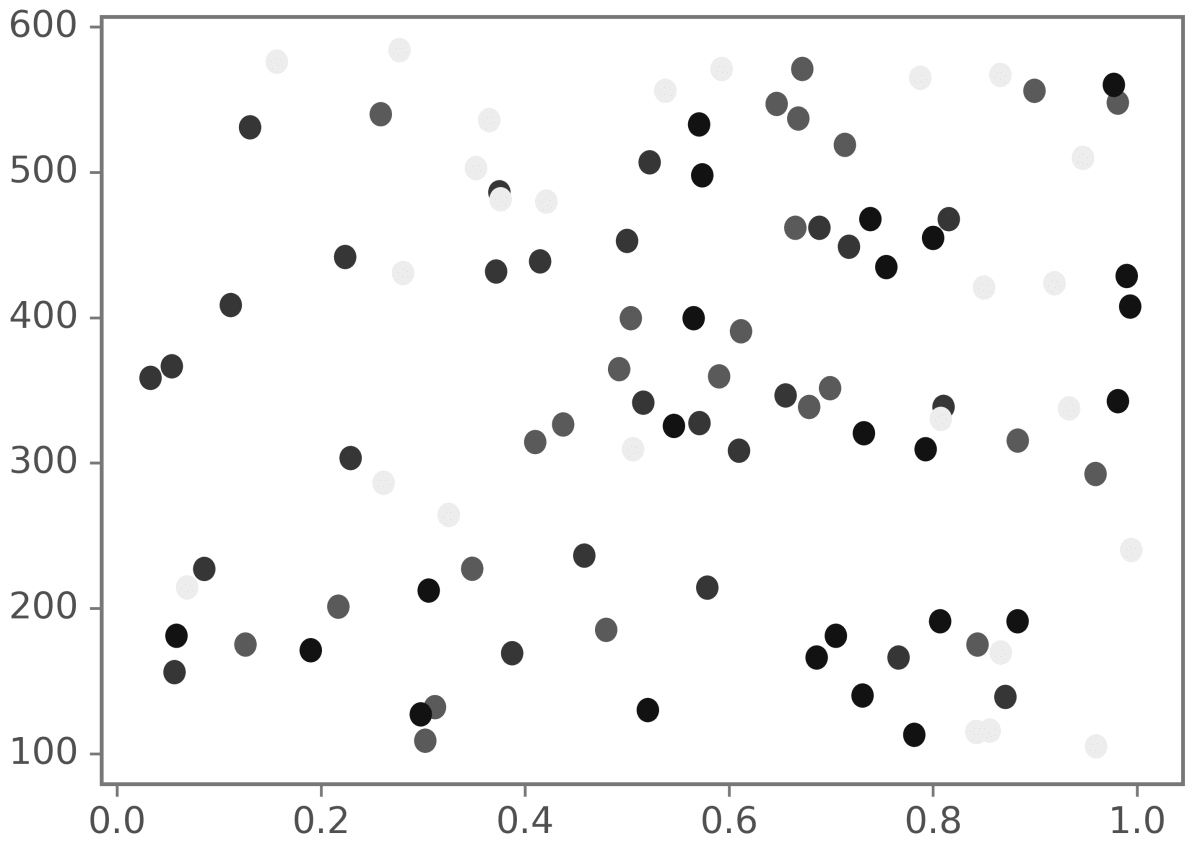
Identify the type of plot shown below.
- Line plot
- Bar plot
- Pie plot
- Scatter plot
Answer
Scatter plot
Reason — The figure shows data represented using scattered dots, where each dot represents a single data point. Such a plot is used to show the relationship between two sets of values and is known as a scatter plot.
What is the primary benefit of using Tinkercad in robotics design?
- To simulate and test robotic systems virtually.
- To program robots using Arduino.
- To build physical prototypes.
- To control robot movements.
Answer
To simulate and test robotic systems virtually.
Reason — Tinkercad is a free online software used to design, visualise, and simulate circuits and robotic systems in a virtual environment. Its primary benefit is that it allows users to test robotic systems virtually before building them physically.
Function to count the number of items in a string 'a' in Python is ............... .
- string.cnt('a')
- count.string('a')
- cnt.string('a')
- string.count('a')
Answer
string.count('a')
Reason — The count() function is a string method that counts the number of times a particular character or substring occurs in a string. Its correct syntax is string.count('a'). The other options are not valid Python string methods.
Give the output of the following Python code:
print("A" * 2)- A2
- AA
- A22
- Error
Answer
AA
Reason — When a string is multiplied by an integer, Python repeats the string that many times. Here, "A" * 2 repeats the string "A" two times, producing AA.
Mention any two sensors used in autonomous cars.
Answer
Two sensors used in autonomous cars are:
- LiDAR sensor
- Camera (vision) sensor
"Autonomous delivery robots are being tested in cities to transport food and parcels directly to customers' doorsteps. These robots are equipped with sensors and cameras for navigation, and they help reduce delivery time and human effort."
Based on the above paragraph, mention any two benefits of using delivery robots in urban areas.
Answer
Two benefits of using delivery robots in urban areas are:
- They reduce the delivery time by transporting food and parcels directly to the customer's doorstep.
- They reduce human effort and labour in delivering goods to customers.
What is gear ratio?
Answer
The gear ratio shows how the number of teeth on the driving gear (input) relates to the number of teeth on the driven gear (output). It indicates the number of times the output gear turns in relation to the input gear. It is calculated as:
Describe how a machine will classify a raw mango from images of other fruits.
Answer
The machine is first trained using a labelled dataset containing images of a raw mango and other fruits. During training, the machine learning algorithm learns the important features of a raw mango, such as its colour, shape, and texture. When a new image is given, the machine compares it with the features learnt during training and classifies it as a raw mango if the features match, otherwise it identifies it as a different fruit.
Mention any two methods of how a computer is used for committing cyber fraud.
Answer
Two methods of committing cyber fraud using a computer are:
- Malware — Harmful software is installed on a computer unknowingly to steal personal information by gaining a backdoor entry into the system.
- Phishing — A genuine-looking email or message with a link is sent, which directs the user to a fake website to steal their credentials and other sensitive details.
What is supervised learning approach in training AI models?
Answer
Supervised learning is an approach in which the machine learning model is trained on a set of data that has already been labelled. By matching the labels with the data, the algorithm learns to find patterns and relationships. After training, the model can predict an output for new, unseen input data. For example, a spam email predictor is trained on a labelled collection of emails (spam or not spam) to classify new incoming emails.
Explain 'Who' and 'Why' in problem scoping.
Answer
Who: The "Who" block helps identify the people who are directly or indirectly affected by the problem. These people are called stakeholders, who are involved in the problem and will benefit from the solution.
Why: The "Why" block helps us think about why the given problem is worth solving and how the solution would benefit the stakeholders as well as society, such as by improving quality of life, increasing efficiency, or enhancing safety.
What will be the output of the following Python code?
t = (1, 2, 3)
t = t + (4, 5)
print(t)
Answer
(1, 2, 3, 4, 5)
The tuple t = (1, 2, 3) is created. The + operator concatenates (joins) two tuples. Here, the tuple (4, 5) is joined to t, forming a new tuple (1, 2, 3, 4, 5), which is stored back in t.
What will be the output of the following Python code?
s = "Python"
print(s[: :-1])
Answer
nohtyP
The string "Python" is stored in the variable s. The slice s[::-1] uses a step of -1, which reverses the string by reading all its characters from the last to the first.
Hence, the output is nohtyP.
What will be the output of the following Python code?
sal = (7000, 4000, 11000, 1700)
print(max(sal))
print(min(sal))
Answer
11000
1700
The tuple sal contains the values (7000, 4000, 11000, 1700).
- The
max(sal)function returns the largest value in the tuple, which is11000. - The
min(sal)function returns the smallest value in the tuple, which is1700.
Hence, the output is:
11000
1700
State any three advantages of Smart schools.
Answer
Three advantages of Smart schools are:
- They provide personalised attention to each student, helping ensure that all students get an equal opportunity to learn.
- They deliver educational content in a variety of ways, making learning more engaging, effective, and attractive for students of all learning styles.
- They free up teachers' time by handling tasks like grading, allowing teachers to focus on providing individual attention to students.
Briefly explain Autonomous systems. Give any two examples.
Answer
Autonomous systems are systems that can learn from their environment and have decision-making capability. They are flexible and adaptable, as they work on the basis of learning and do not follow a fixed rule-based algorithm. This allows them to operate in real-world situations and take decisions according to the situation.
Two examples of autonomous systems are:
- Self-driving cars
- Drones
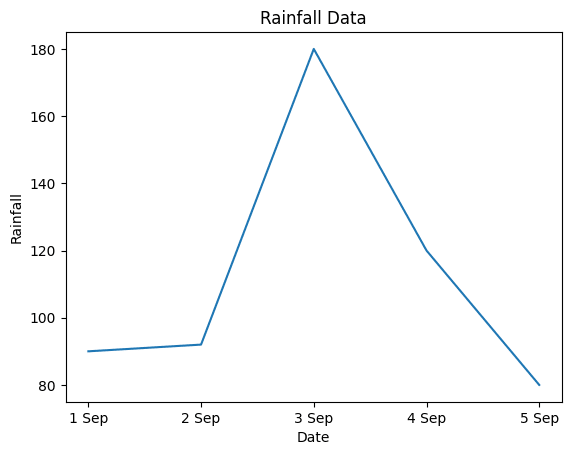
Write a Python program to plot a line chart using Matplotlib library using the following data:
- Import the necessary libraries.
- Store the dates from 1st September to 5th September (both inclusive) and their corresponding rainfall data as 90 mm, 92 mm, 180 mm, 120 mm, and 80 mm respectively.
- Plot a line chart to visualise the rainfall.
- Add appropriate labels for the X-axis (Date) and Y-axis (Rainfall).
- Set a title for the chart as 'Rainfall Data'.
Answer
import matplotlib.pyplot as plt

date = ['1 Sep', '2 Sep', '3 Sep', '4 Sep', '5 Sep']
rainfall = [90, 92, 180, 120, 80]

plt.plot(date, rainfall)
plt.xlabel("Date")
plt.ylabel("Rainfall")
plt.title("Rainfall Data")
plt.show()
Output
State three advantages of using cobots in industries.
Answer
Three advantages of using cobots in industries are:
- Safety: Cobots have built-in safety mechanisms that keep them from injuring humans even on contact, making them a safer choice than standard industrial robots.
- Flexibility: Cobots can be easily programmed to perform new tasks and, being lightweight, can be relocated to different work areas as needed.
- Productivity: Cobots increase productivity by automating repetitive and risky operations, working faster and more accurately than humans without needing breaks.
Briefly explain Data Modelling.
Answer
Data modelling (AI modelling) refers to the development of a program or algorithm that can be used to draw conclusions or generate predictions based on the available data. At this stage, an appropriate model is selected and trained with the data that has been acquired and explored, in order to achieve the goal of the AI project. AI models are mainly built using two approaches — the rule-based approach and the learning-based approach.
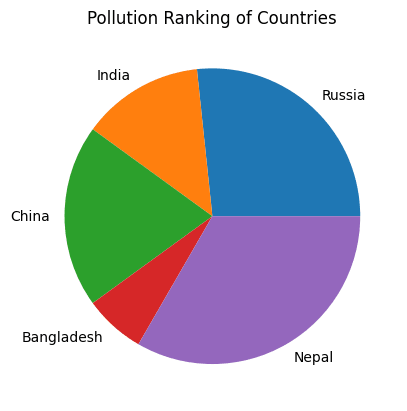
Write a Python program to plot a pie chart comparing pollution ranking of five countries as given below:
Country = ['Russia', 'India', 'China', 'Bangladesh', 'Nepal']
Pollution = [4, 2, 3, 1, 5]
Import the necessary libraries.
Answer
import matplotlib.pyplot as plt

Country = ['Russia', 'India', 'China', 'Bangladesh', 'Nepal']
Pollution = [4, 2, 3, 1, 5]

plt.pie(Pollution, labels=Country)
plt.title("Pollution Ranking of Countries")
plt.show()
Output
Explain the difference between contact-type sensors and non-contact type sensors. Give an example for each.
Answer
| Contact-type Sensors | Non-contact type Sensors |
|---|---|
| These sensors measure the target parameter by making physical contact with the object or medium. | These sensors measure the target parameter without making physical contact with the object or medium. |
| Example: Touch sensor (or thermocouple) | Example: Ultrasonic distance sensor (or infrared temperature sensor) |
Mention any three security measures to be taken to safeguard your computer from cyber threats.
Answer
Three security measures to safeguard a computer from cyber threats are:
- Use strong, secure passwords and update them frequently.
- Keep the software up to date, as updates include security fixes that protect the system.
- Use trusted antivirus and antimalware programs, and use firewalls to protect the system.
Write a Python program that performs the following tasks:
- Create a tuple having elements (100, 200, 700, 300, 150)
- Convert the above tuple to list.
- Remove the element 700 and in its place insert an element 650.
- Sort all the elements in ascending order.
- Convert the list to a tuple.
- Print the final tuple.
tup = (100, 200, 700, 300, 150)

lst = list(tup)

idx = lst.index(700)
lst.remove(700)
lst.insert(idx, 650)

lst.sort()

final_tup = tuple(lst)

print("Final tuple:")
print(final_tup)Final tuple:
(100, 150, 200, 300, 650)
Describe briefly how a robotic arm with a revolute joint is controlled by a motor.
Answer
In a robotic arm with a revolute joint, the sensors first provide input about the position and orientation of the arm to the controller. The controller processes this input and generates control signals using control algorithms. These signals are sent to the actuator, which is an electric motor. The motor converts the electrical signal into mechanical motion, producing the rotational (angular) movement of the revolute joint. A feedback mechanism monitors the movement so that the arm reaches the desired position accurately.
All robots are machines, but not all machines are robots. How can machines and robots be identified and distinguished from each other?
Answer
| Machines | Robots |
|---|---|
| Machines are designed to perform a specific, predefined task. | Robots are complex machines that can perform different tasks on their own or with the help of humans. |
| Their operations are fixed and based on their mechanical, electrical, or software design. | They can sense the environment, take decisions, and perform desired tasks. |
| They usually cannot learn or update themselves. | They can learn from their environment and update themselves. |
| Example: Washing machine | Example: Surveillance dog robot |
Write a Python program that performs the following operations on a string:
- Create a string with the value "Computer Applications"
- Find and print the length of the string.
- Count and print the occurrences of 'p' in the substring "Applications"
- Find and print the position of the substring "Applications" within the string.
- Check whether the string is in uppercase and print the result.
- Replace the substring "Applications" with "Science" and print the new string.
s = "Computer Applications"

length = len(s)
print("Length of the string:", length)

count_p = "Applications".count('p')
print("Occurrences of 'p' in 'Applications':", count_p)

pos = s.find("Applications")
print("Position of 'Applications':", pos)

upper_check = s.isupper()
print("Is the string in uppercase:", upper_check)

new_s = s.replace("Applications", "Science")
print("New string:", new_s)Length of the string: 21
Occurrences of 'p' in 'Applications': 2
Position of 'Applications': 9
Is the string in uppercase: False
New string: Computer Science
What role do vision sensors play in robotics? Give one example.
Answer
A vision sensor is a device that collects visual information from its surroundings and processes it to perform activities such as object detection, recognition, and tracking. In robotics, vision sensors help the robot to "see" and understand its environment so that it can navigate and interact with objects.
Example: Camera sensor.
In the AI project cycle, what is the purpose of the data acquisition stage?
Answer
The purpose of the data acquisition stage is to acquire or collect accurate and reliable data from relevant sources. Data acts as the fuel for AI algorithms, as AI systems learn patterns and make predictions based on this data. Therefore, collecting authentic and sufficient data in this stage is essential for training the AI model correctly.
Write a Python program that performs the following task on a tuple:
- Create a tuple 't1' with elements (100, 110, 120, 330, 440)
- Concatenate a tuple 't2' with elements (77, 88) to 't1'
- Convert the above tuple to list.
- Append another list 'lst2' with elements [16, 26]
- Remove element in the second index.
- Insert element 40 to the list at index 5.
- Print the list.
t1 = (100, 110, 120, 330, 440)

t2 = (77, 88)
t1 = t1 + t2

lst1 = list(t1)

lst2 = [16, 26]
lst1.append(lst2)

lst1.pop(2)

lst1.insert(5, 40)

print("List after operations:")
print(lst1)List after operations:
[100, 110, 330, 440, 77, 40, 88, [16, 26]]
List any three key components required to design a simple wheeled robot.
Answer
Three key components required to design a simple wheeled robot are:
- Breadboard — used to connect multiple components of the circuit.
- DC Motors — act as actuators to move the wheels of the robot.
- Arduino Uno — a microcontroller that acts as the controller (brain) of the robot.
(a) What are the different ways of representing data?
(b) Name any one graph ideal for showing trends and changes in data over time.
Answer
(a) Data can be represented in different forms such as text, image, audio, and video.
(b) A line chart (line graph) is ideal for showing trends and changes in data over a period of time.
Write a Python program that does the following using string built-in functions:
stg = " Welcome to My Python Project "- Convert entire string to lowercase.
- Replace "my" with "your".
- Find the length of the new string.
- Check if the string ends with 'T'.
- Print the characters from index 3 to 6 in reverse order.
stg = " Welcome to My Python Project "

stg = stg.lower()
print("Lowercase string:", stg)

stg = stg.replace("my", "your")
print("After replacement:", stg)

length = len(stg)
print("Length of the new string:", length)

ends = stg.endswith('T')
print("Ends with 'T':", ends)

reversed_chars = stg[3:7][::-1]
print("Characters from index 3 to 6 in reverse order:", reversed_chars)Lowercase string: welcome to my python project
After replacement: welcome to your python project
Length of the new string: 32
Ends with 'T': False
Characters from index 3 to 6 in reverse order: mocl