
Mathematics
A floor which measures 15 m x 8 m is to be laid with tiles measuring 50 cm x 25 cm. Find the number of tiles required.
Further, if a carpet is laid on the floor so that a space of 1 m exists between its edges and the edges of the floor, what fraction of the floor is left uncovered.
Mensuration
29 Likes
Answer
Given:
Dimensions of the floor = 15 m x 8 m
Dimensions of the tile = 50 cm x 25 cm = 0.5 m x 0.25 m
Area of floor = l x b
= 15 x 8 m2
= 120 m2
Area of tile = ltile x btile
= 0.5 x 0.25 m2
= 0.125 m2
Let n be the number of tiles.
Area of floor = Area of tile x Number of tiles
⇒ 120 = 0.125 x n
⇒ n =
⇒ n =
⇒ n = 960
Now, a carpet is laid on the floor, leaving a space of 1 m between its edges and the edges of the floor.
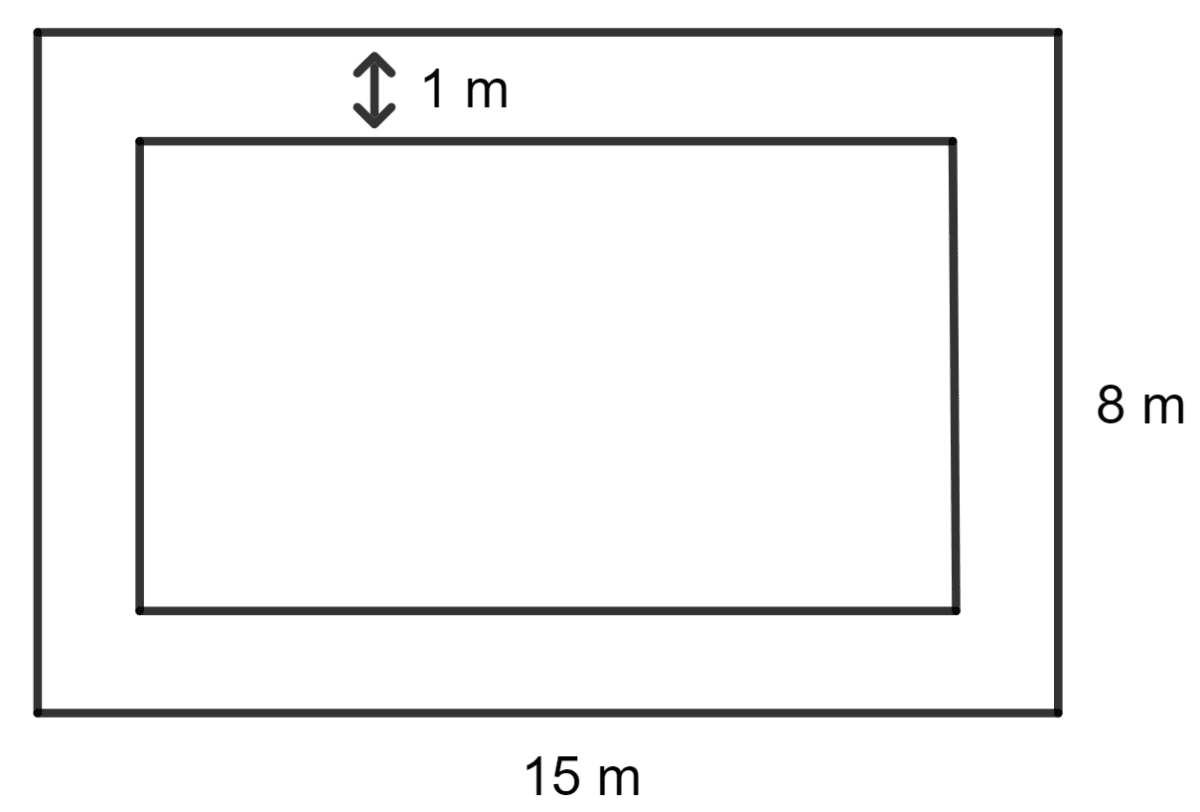
Length of the carpet = 15 - 1 - 1 m = 13 m
Breadth of the carpet = 8 - 1 - 1 m = 6 m
Area of uncovered floor = Area of floor - Area of carpet
= 15 x 8 - 13 x 6 m2
= 120 - 78 m2
= 42 m2
Fraction of floor left uncovered = =
Hence, the number of tiles needed is 960 and the fraction of the floor left uncovered is .
Answered By
22 Likes
Related Questions
Find the area and perimeter of a square plot of land, the length of whose diagonal is 15 metres. Give your answer correct to 2 places of decimals.
The shaded region of the given diagram represents the lawn in the form of a house. On the three sides of the lawn there are flower-beds having a uniform width of 2 m.
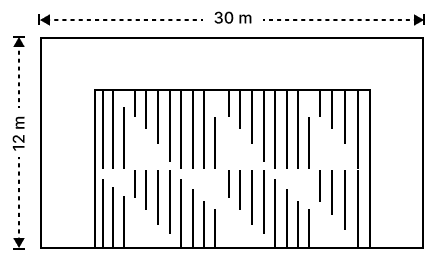
(i) Find the length and the breadth of the lawn.
(ii) Hence, or otherwise, find the area of the flower-beds.
Two adjacent sides of parallelogram are 24 cm and 18 cm. If the distance between the longer sides is 12 cm; find the distance between the shorter sides.
Two adjacent sides of a parallelogram are 28 cm and 26 cm. If one diagonal of it is 30 cm long; find the area of the parallelogram. Also, find the distance between its shorter sides.