Physics
A ray of light is incident normally on a plane glass slab. What will be (i) the angle of refraction and (ii) the angle of deviation for the ray?
Answer
(i) The ray of light incident normally on a plane glass slab passes undeviated, ( i.e. such a ray suffers no bending at the surface). Thus, if angle of incidence ∠i = 0°, then the angle of refraction ∠r = 0°.
(ii) In the case when ray of light is incident normally on a plane glass slab, it passes undeviated. Hence, the angle of deviation is 0°.
Related Questions
The optical density of turpentine is higher than that of water, while its mass density is lower than water. The figure given below shows a layer of turpentine floating over water taken in a container. For which one of the four rays incident on turpentine in the path shown in the figure is correct?
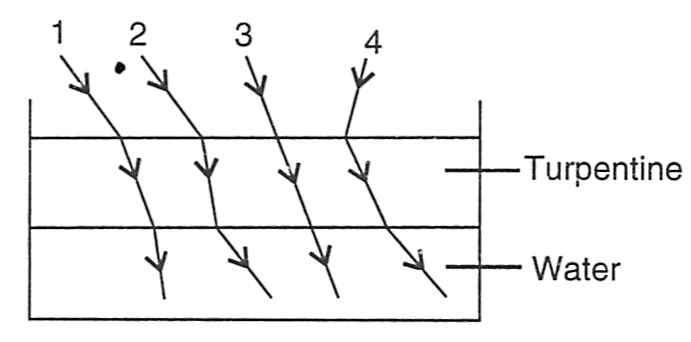
- Ray 1
- Ray 2
- Ray 3
- Ray 4
With respect to light passing from air into water, which of the following statements is correct?
- Angle of incidence is equal to the angle of refraction.
- Angle of incidence is always greater than the angle of refraction
- Angle of incidence is always less than the angle of refraction
- Angle of incidence has no effect on the angle of refraction.
For the same angle of incidence, the angles of refraction in three different media A, B and C are 15°, 25°, and 35° respectively. In which medium will the velocity of light be minimum?
Can relative refractive index of a medium with respect to another medium be less than unity? If yes, give example.