
Mathematics
A ΔABC with vertices A(1, 2), B(4, 4) and C(3, 7) is first reflected in the line y = 0 onto ΔA'B'C' and then ΔA'B'C' is reflected in the origin onto ΔA"B"C".
Write down the co-ordinates of :
(i) A', B' and C'
(ii) A", B" and C"
Write down the single transformation that maps Δ ABC directly onto ΔA"B"C".
Reflection
3 Likes
Answer
(i) y = 0 is the equation of x-axis.
We know that,
Rule to find reflection of a point in x-axis :
Retain the abscissa i.e. x-coordinate.
Change the sign of ordinate i.e. y-coordinate.
∴ Point A'(1, -2) is the image of A(1, 2) on reflection in x-axis.
∴ Point B'(4, -4) is the image of B(4, 4) on reflection in x-axis.
∴ Point C'(3, -7) is the image of C(3, 7) on reflection in x-axis.
The coordinates of the vertices of ΔA'B'C' are A'(1, -2), B'(4, -4), C'(3, -7).
(ii) We know that,
Rule to find reflection of a point in origin :
Change the sign of abscissa i.e. x-coordinate and ordinate i.e. y-coordinate.
∴ Point A"(-1, 2) is the image of A'(1, -2) on reflection in origin.
∴ Point B"(-4, 4) is the image of B'(4, -4) on reflection in origin.
∴ Point C"(-3, 7) is the image of C'(3, -7) on reflection in origin.
The coordinates of the vertices of ΔA"B"C" are A"(-1, 2), B"(-4, 4), C"(-3, 7).
(iii) Transformation,
A(1, 2) ⇒ A" (-1, 2)
B(4, 4) ⇒ B"(-4, 4)
C(3, 7) ⇒ C"(-3, 7)
A transformation that changes the sign of the x-coordinate while keeping the y-coordinate the same is a reflection in the y-axis.
The single transformation that maps Δ ABC directly onto ΔA"B"C" is a reflection in the y-axis.
Answered By
1 Like
Related Questions
The point P(3, 4) is reflected to P' in x-axis and O' is the image of O (origin) when reflected in the line PP'.
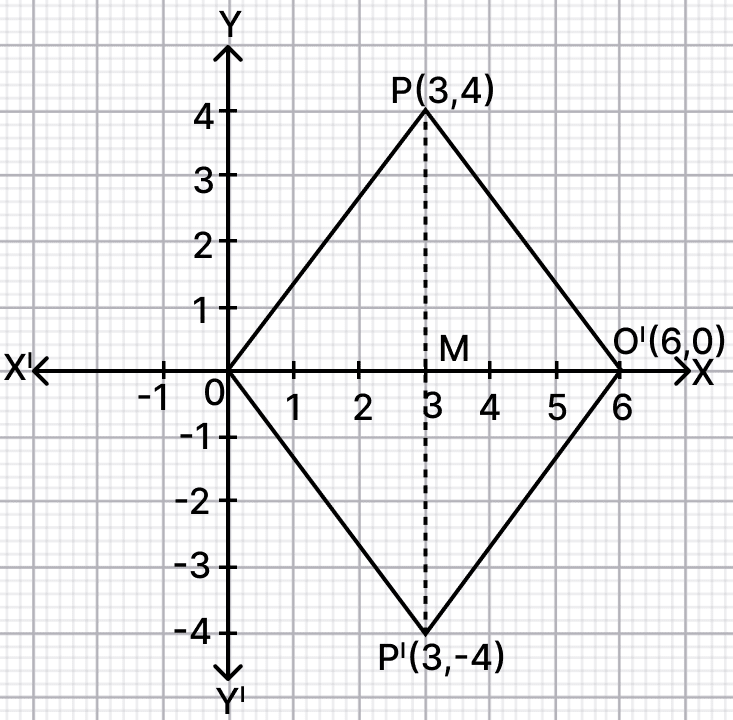
Using graph paper, give :
(i) the co-ordinates of P' and O'.
(ii) the length of the segments PP' and OO'.
(iii) the geometrical name of the figure POP'O'.
(iv) the perimeter of the quadrilateral POP'O'.
Use a graph paper for this question. A(1, 1), B(5, 1), C(4, 2) and D(2, 2) are the vertices of a quadrilateral.
(i) Name the quadrilateral ABCD.
(ii) A, B, C, D are reflected in the origin onto A', B', C' and D' respectively. Locate A', B', C', D' on the graph paper and write their co-ordinates.
(iii) Are D, A, A' and D' collinear?
Use graph paper for this question.
The points A(2, 3), B(4, 5) and C(7, 2) are the vertices of ΔABC.
(i) Write down the co-ordinates of A', B', C' if ΔA'B'C' is the image of ΔABC when reflected in the origin.
(ii) Write down the co-ordinates of A", B", C" if ΔA"B"C" is the image of ΔABC when reflected in the x-axis.
(iii) Mention the special name of the quadrilateral BCC"B" and find its area.
Use graph paper taking 2 cm = 1 unit along both the axes. Plot the points O(0, 0), A(-4, 4), B(-3, 0) and C(0, -3).
(i) Reflect points A and B on y-axis and name them A' and B' respectively. Write down their co-ordinates.
(ii) Name the figure OABCBA'.
(iii) State the line of symmetry of this figure.