
Mathematics
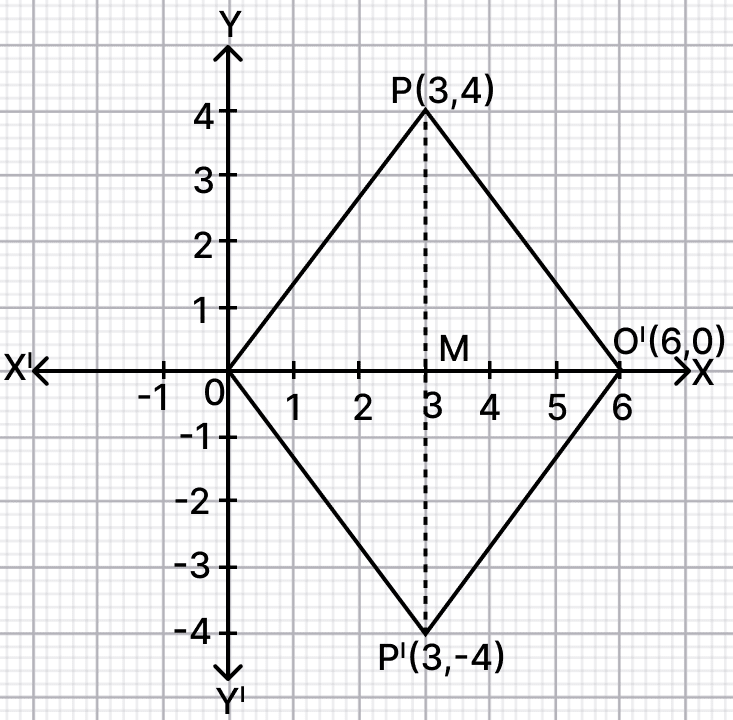
The point P(3, 4) is reflected to P' in x-axis and O' is the image of O (origin) when reflected in the line PP'.
Using graph paper, give :
(i) the co-ordinates of P' and O'.
(ii) the length of the segments PP' and OO'.
(iii) the geometrical name of the figure POP'O'.
(iv) the perimeter of the quadrilateral POP'O'.
Reflection
4 Likes
Answer
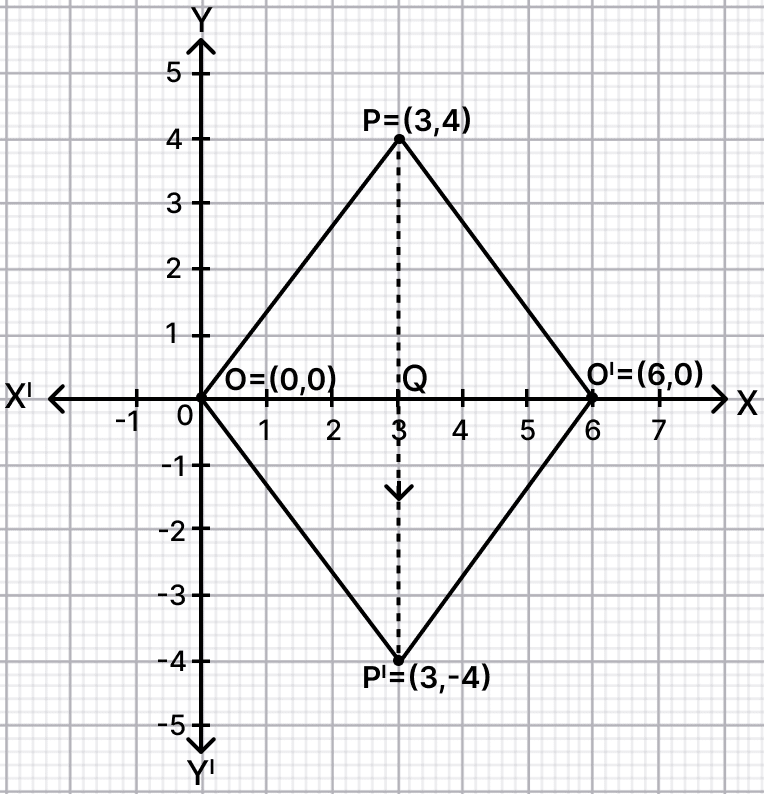
Plot point P(3, 4). Reflect point P in x-axis and origin in the line PP'.
(i) From graph we get,
The coordinates of P' and O' are (3, -4) and (6, 0) respectively.
(ii) From graph we get,
Length of PP' = 8 units and OO' = 6 units.
(iii) Join POP'O'.
POP'O' is a rhombus because all sides are equal (as all sides are hypotenuse with equal bases and height) and parallel but angles of quadrilateral are not right angles.
POP'O' is a rhombus.
(iv) Let point PP' touch axis at point Q.
In right angle triangle OQP,
⇒ OP2 = OQ2 + QP2
⇒ OP2 = 32 + 42
⇒ OP2 = 9 + 16
⇒ OP2 = 25
⇒ OP = = 5 units.
Since, POP'O' is a rhombus, thus :
Perimeter of POP'O' = 4 × side = 4 × OP = 4 × 5 = 20 units.
The perimeter of the quadrilateral POP'O' is 20 units.
Answered By
1 Like
Related Questions
Points P and Q have co-ordinates (0, 5) and (-2, 4).
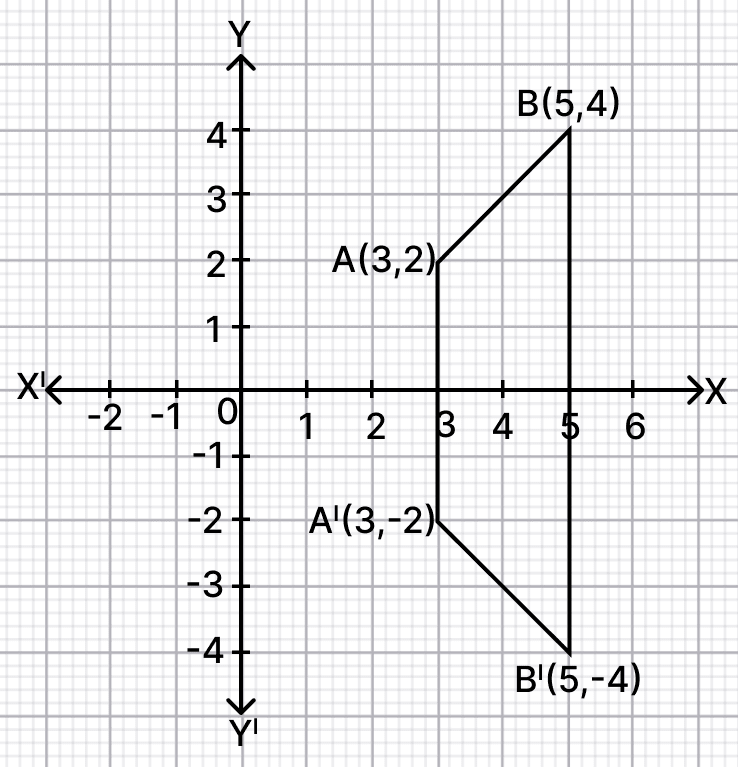
(i) P is invariant when reflected in an axis. Name the axis.
(ii) Find the image of Q on reflection in the axis found in (i).
(iii) (0, k) on reflection in the origin is invariant. Write the value of k.
(iv) Write the co-ordinates of the image of Q, obtained by Reflecting it in the origin followed by reflection in the x-axis.
Use a graph paper for this question. Plot the points P(3, 2) and Q(-3, -2). From P and Q, draw perpendiculars PM and QN on the x-axis.
(i) Name the image of P on reflection in the origin.
(ii) Assign the special name to the geometrical figure PMQN and find its area.
(iii) Write the co-ordinates of the point to which M is mapped on reflection in
(a) x-axis
(b) y-axis
(c) originUse a graph paper for this question. A(1, 1), B(5, 1), C(4, 2) and D(2, 2) are the vertices of a quadrilateral.
(i) Name the quadrilateral ABCD.
(ii) A, B, C, D are reflected in the origin onto A', B', C' and D' respectively. Locate A', B', C', D' on the graph paper and write their co-ordinates.
(iii) Are D, A, A' and D' collinear?
A ΔABC with vertices A(1, 2), B(4, 4) and C(3, 7) is first reflected in the line y = 0 onto ΔA'B'C' and then ΔA'B'C' is reflected in the origin onto ΔA"B"C".
Write down the co-ordinates of :
(i) A', B' and C'
(ii) A", B" and C"
Write down the single transformation that maps Δ ABC directly onto ΔA"B"C".