
Mathematics
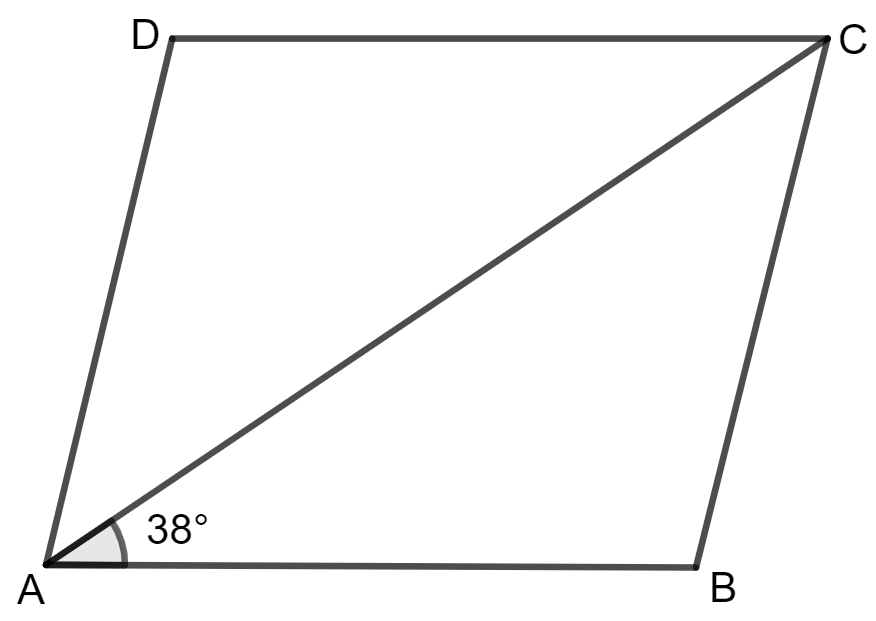
ABCD is a rhombus. If ∠BAC = 38°, find :
(i) ∠ACB
(ii) ∠DAC
(iii) ∠ADC.
Quadrilaterals
14 Likes
Answer
(i) In a rhombus, all sides are equal.
⇒ AB = BC = CD = DA
And, opposite angles of a rhombus are equal.
∠BAC = ∠ACB
It is given that ∠BAC = 38°.
So, ∠ACB = ∠BAC = 38°.
Hence, the value of ∠ACB is 38°.
(ii) Since ABC is a triangle, the sum of angles in a triangle is 180°.
Therefore,
⇒ ∠ABC + ∠BAC + ∠ACB = 180°
⇒ ∠ABC + 38° + 38° = 180°
⇒ ∠ABC + 76° = 180°
⇒ ∠ABC = 180° - 76°
⇒ ∠ABC = 104°
Since opposite angles of a rhombus are equal:
⇒ ∠ABC = ∠ADC
⇒ ∠ADC = 104°
As AD = CD, we have:
∠DAC = ∠DCA
Now,
⇒ ∠DAC = [180° - 104°]
= [76°]
= 38°
Hence, the value of ∠DAC is 38°.
(iii) Since opposite angles of a rhombus are equal:
⇒ ∠ABC = ∠ADC
⇒ ∠ADC = 104°
Hence, the value of ∠ADC is 104°.
Answered By
7 Likes
Related Questions
In square PQRS :
(i) if PQ = 3x - 7 and QR = x + 3, find PS.
(ii) if PR = 5x and QS = 9x — 8. Find QS.
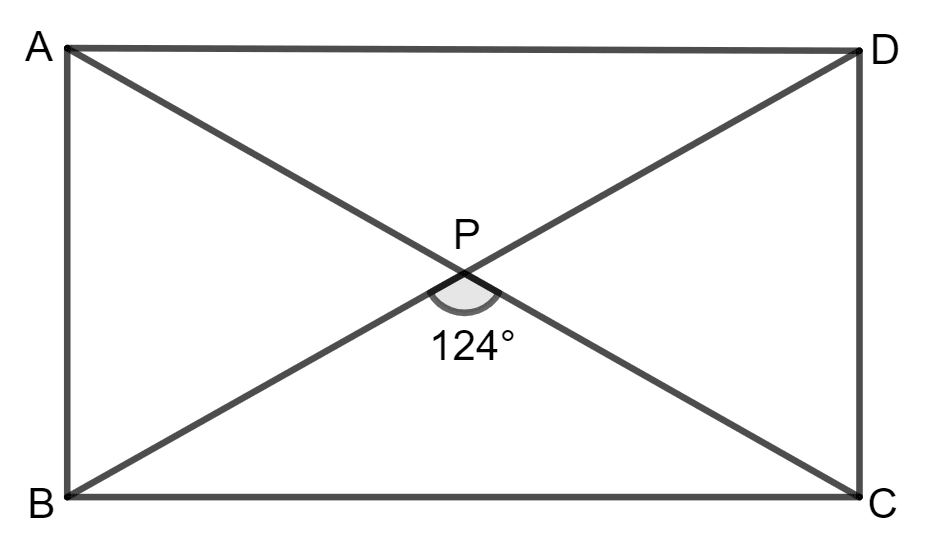
ABCD is a rectangle. If ∠BPC = 124°, calculate :
(i) ∠BAP
(ii) ∠ADP.
ABCD is a rhombus. If ∠BCA = 35°, find ∠ADC.
PQRS is a parallelogram whose diagonals intersect at M.
If ∠PMS = 54°, ∠QSR = 25° and ∠SQR = 30°, find :
(i) ∠RPS
(ii) ∠PRS
(iii) ∠PSR.