
Mathematics
ABCD is a rhombus with P, Q and R as mid-points of AB, BC and CD respectively. Prove that PQ ⊥ QR.
Mid-point Theorem
61 Likes
Answer
Join AC and BD.
Diagonals of rhombus intersect at right angle.
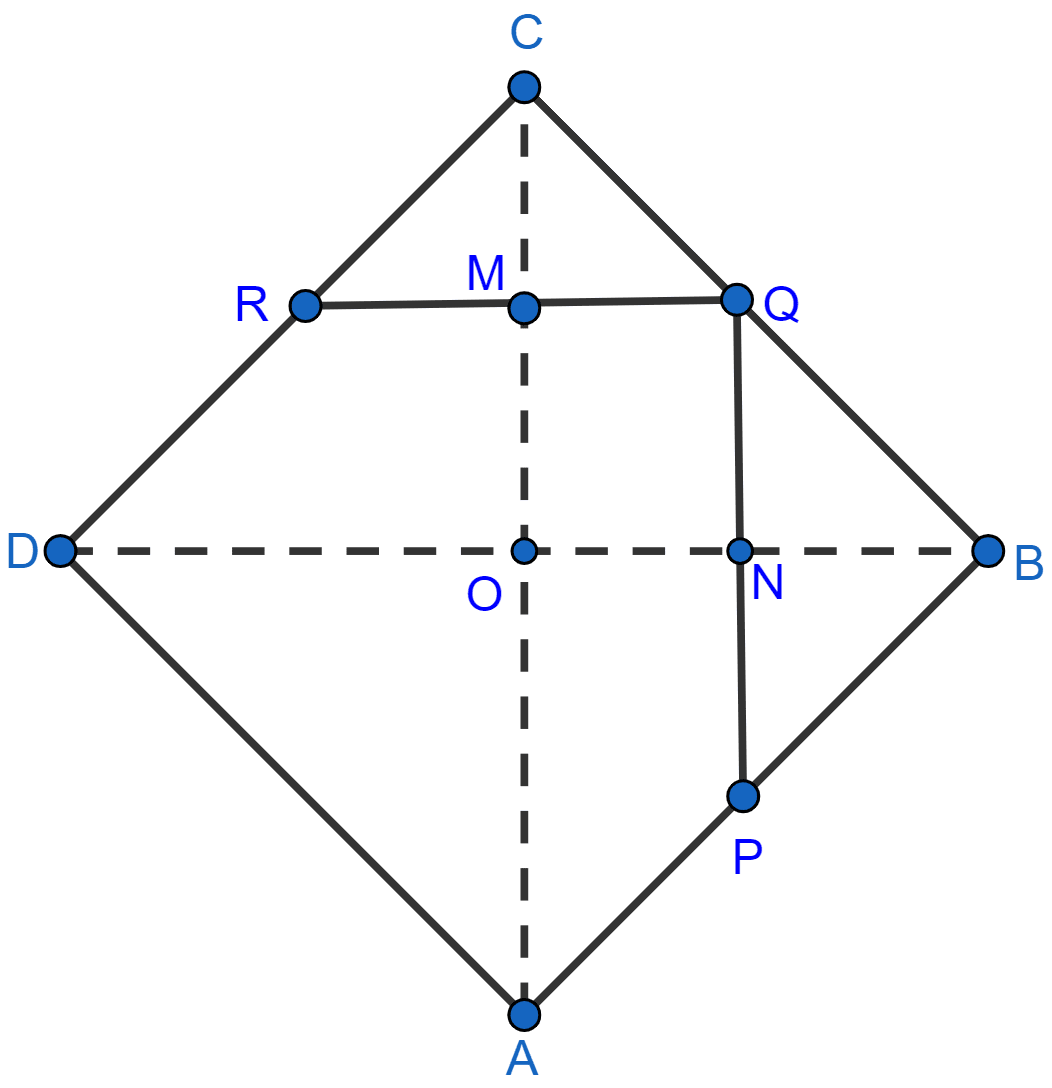
∠MON = 90°
In △BCD,
Q and R are mid-points of BC and CD.
RQ || DB and RQ = DB
RQ || DB ⇒ MQ || ON
From figure,
∠MON + ∠MQN = 180° (Sum of alternate angles of quadrilateral = 180°)
∠MQN = 180° - 90° = 90°
∴ PQ ⊥ QR.
Hence, proved that PQ ⊥ QR.
Answered By
33 Likes
Related Questions
Assertion (A): In a Δ DEF, we have DE = EF = DF = 6 cm. A line segment PQ is drawn parallel to DF such that EP = 3 cm. Then we can conclude that PQ = 3 cm.
Reason (R): Any line segment drawn inside a triangle parallel to the base of the triangle cuts the removing two sides in half.
Assertion (A) is true, Reason (R) is false.
Assertion (A) is false, Reason (R) is true.
Both Assertion (A) and Reason (R) are true, and Reason (R) is the correct reason for Assertion (A).
Both Assertion (A) and Reason (R) are true, but Reason (R) is not the correct reason (or explanation) for Assertion (A).
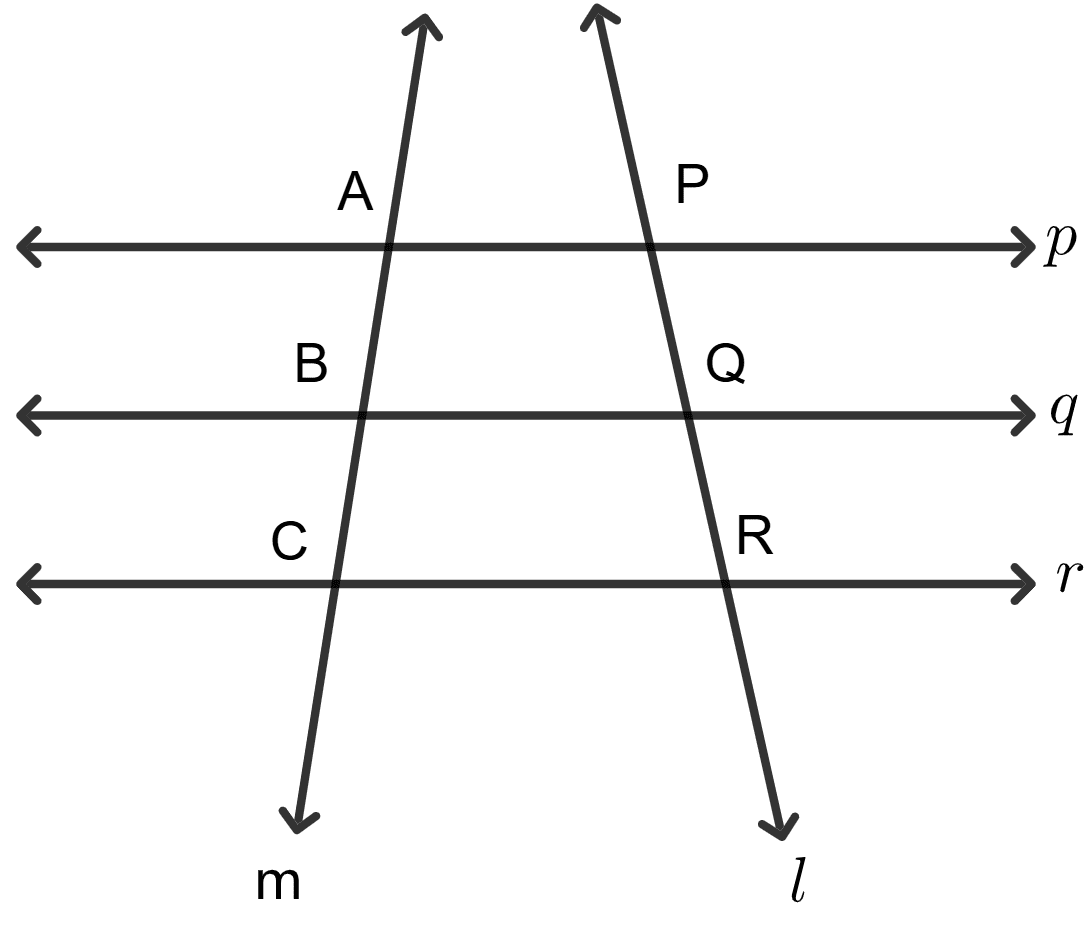
Assertion (A): Refer to the adjoining figure. Three lines p, q, r are parallel to each other and PQ = QR = 1 cm. Then we conclude that AB = AC.
Reason (R): If a tranversal makes equal intercepts on three parallel lines, then another transversal will also make equal intercepts.
Assertion (A) is true, Reason (R) is false.
Assertion (A) is false, Reason (R) is true.
Both Assertion (A) and Reason (R) are true, and Reason (R) is the correct reason for Assertion (A).
Both Assertion (A) and Reason (R) are true, but Reason (R) is not the correct reason (or explanation) for Assertion (A).
The diagonals of a quadrilateral ABCD are perpendicular. Show that the quadrilateral formed by joining the mid-points of its adjacent sides is a rectangle.
If D, E and F are mid-points of the sides BC, CA and AB respectively of a △ABC, prove that AD and FE bisect each other.