
Mathematics
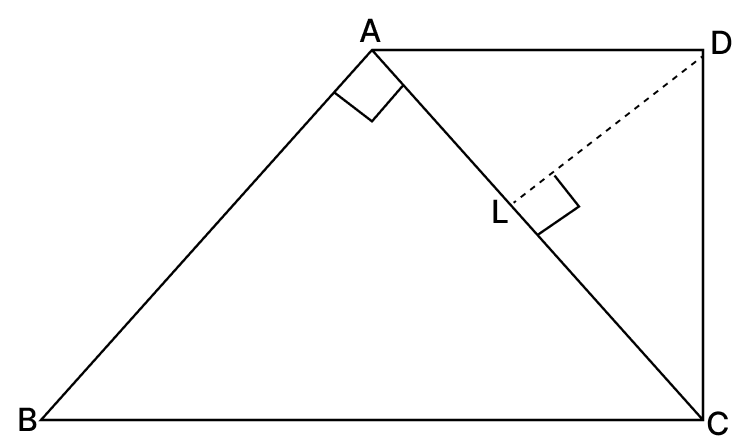
In the adjoining figure, △ABC is right angled at A, BC = 7.5 cm and AB = 4.5 cm. If the area of quad. ABCD is 30 cm2 and DL is the altitude of △DAC, calculate the length DL.
Mensuration
1 Like
Answer
Given,
△ABC is right-angled at A.
BC = 7.5 cm (hypotenuse)
AB = 4.5 cm
Area of quadrilateral ABCD = 30 cm2
In △ABC,
By using pythagoras theorem,
⇒ BC2 = AB2 + AC2
⇒ (7.5)2 = (4.5)2 + AC2
⇒ 56.25 = 20.25 + AC2
⇒ AC2 = 56.25 - 20.25
⇒ AC2 = 36
⇒ AC = = 6 cm.
From figure,
Area of △DAC = Area of quad. ABCD − Area of △ABC
= 30 - 13.5
= 16.5 cm2.
Hence, DL = 5.5 cm.
Answered By
1 Like
Related Questions
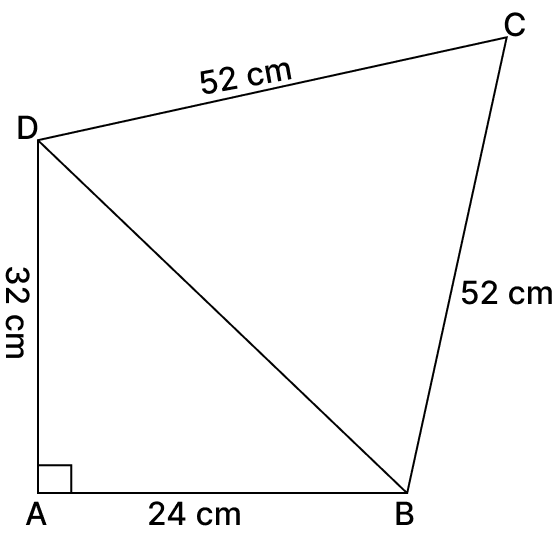
Calculate the area of quadrilateral ABCD in which : AB = 24 cm, AD = 32 cm, ∠BAD = 90°, and BC = CD = 52 cm.
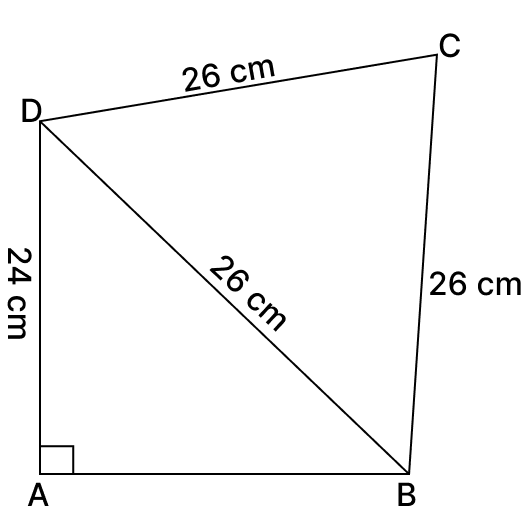
Calculate the area of quadrilateral ABCD in which △BCD is equilateral with each side equal to 26 cm, ∠BAD = 90° and AD = 24 cm.
The perimeter of a rectangle is 81 m and its breadth is 12 m. Find its length and area.
The perimeter of a rectangular field is km and its length is twice breadth. Find the area of the field in m2.