Mathematics
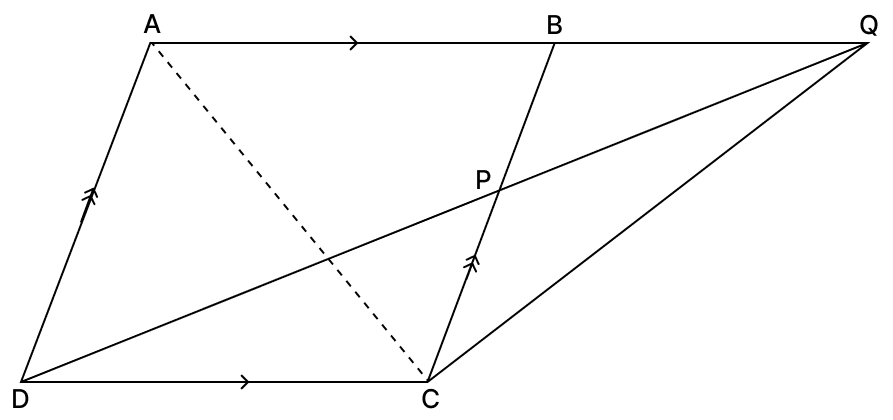
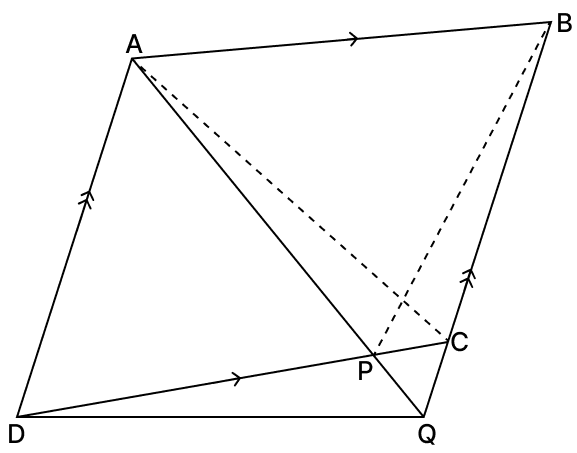
In the adjoining figure, ABCD is a parallelogram. P is a point on BC such that BP : PC = 1 : 2. DP produced meets AB produced at Q. Given ar (ΔCPQ) = 20 cm2. Calculate :
(i) ar (ΔCDP)
(ii) ar (∥ gm ABCD)
Theorems on Area
1 Like
Answer
(i) Draw QN perpendicular CB as shown in the figure below :
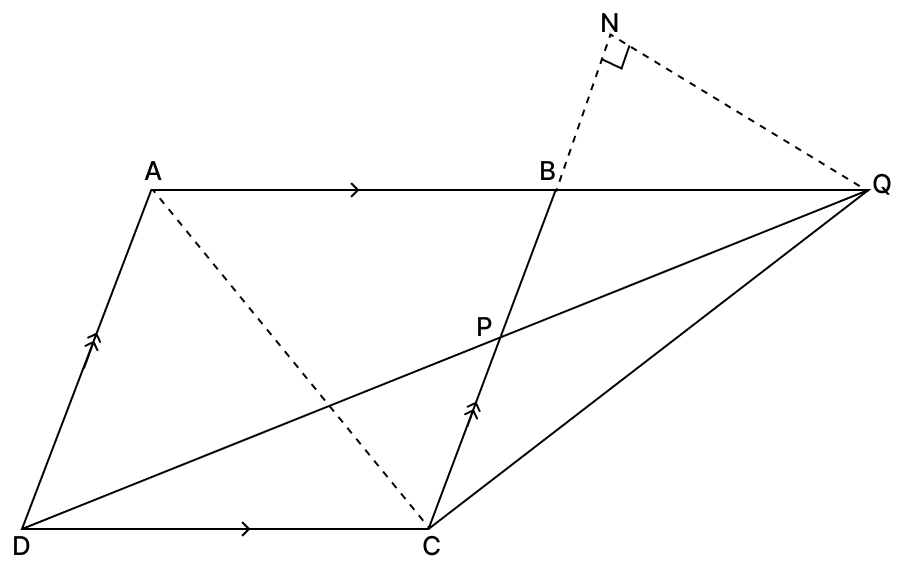
Considering △CDP and △BQP,
∠CPD = ∠QPB (Vertically opposite angles are equal)
∠PDC = ∠PQB (Alternate angles are equal)
Hence, by AA axiom △CDP ~ △BQP.
We know that, the ratio of the areas of two similar triangles is equal to the ratio of the square of their corresponding sides.
∴ Area of △CDP = 4 × Area of △BQP = 4 × 10 = 40 cm2.
Hence, the area of △CDP = 40 cm2.
(ii) Area of ||gm ABCD = 2 Area of △DCQ (As △DCQ and ||gm ABCD have same base DC and are between same parallels AQ and DC)
= 2(Area of △CDP + Area of △CPQ)
= 2(40 + 20)
= 2 × 60
= 120 cm2.
Hence, the area of ||gm ABCD = 120 cm2.
Answered By
3 Likes
Related Questions
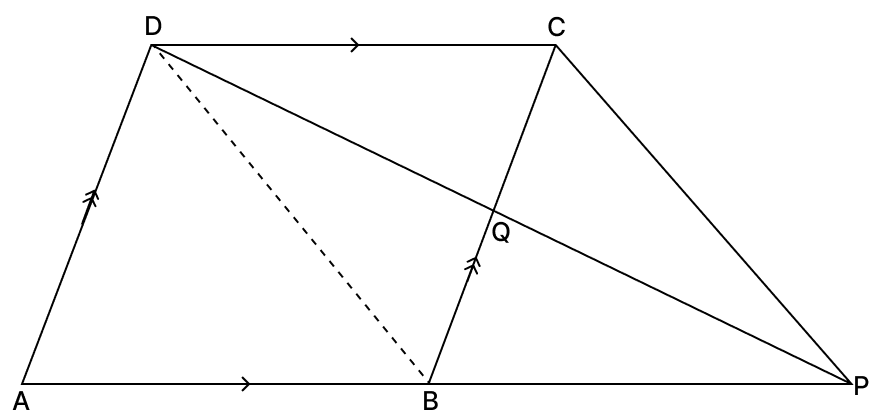
In the adjoining figure, ABCD is a parallelogram. AB is produced to a point P and DP intersects BC at Q. Prove that : ar (ΔAPD) = ar (quad. BPCD).
In the adjoining figure, ABCD is a parallelogram. Any line through A cuts DC at a point P and BC produced at Q. Prove that : ar (ΔBPC) = ar (ΔDPQ).
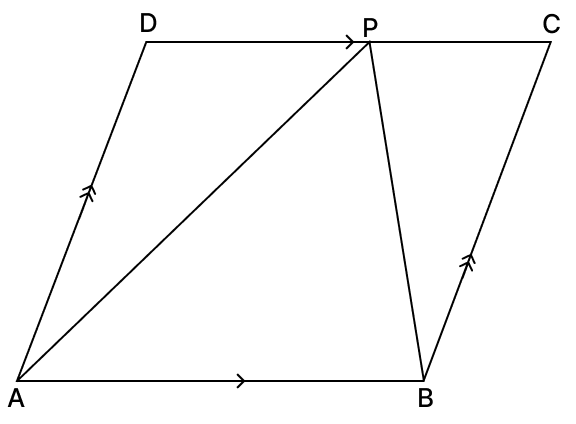
In the adjoining figure, ABCD is a parallelogram. P is a point on DC such that ar (ΔAPD) = 25 cm2 and ar (ΔBPC) = 15 cm2. Calculate :
(i) ar (∥ gm ABCD)
(ii) DP : PC
In the given figure, AB ∥ DC ∥ EF, AD ∥ BE and DE ∥ AF. Prove that : ar (∥ gm DEFH) = ar (∥ gm ABCD).