Mathematics
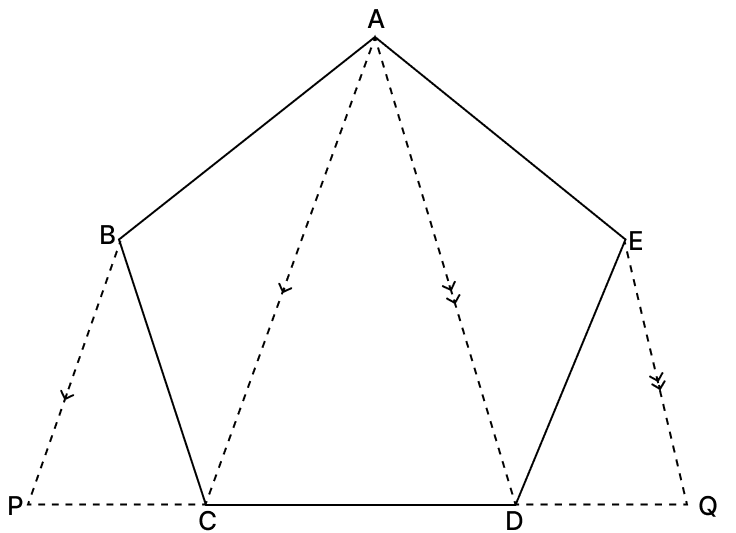
In the adjoining figure, ABCDE is a pentagon. BP drawn parallel to AC meets DC produced at P and EQ drawn parallel to AD meets CD produced at Q. Prove that : ar (Pentagon ABCDE) = ar (ΔAPQ).
Theorems on Area
1 Like
Answer
Join AP and AQ.
We know that,
Triangles on the same base and between the same parallel lines are equal in area.
Since, triangle ABP and BPC lie on the same base BP and between the same parallel lines BP and AC.
∴ Area of △ ABP = Area of △ BPC
Subtracting △ BOP from both sides, we get :
⇒ Area of △ ABP - Area of △ BOP = Area of △ BPC - Area of △ BOP
⇒ Area of △ AOB = Area of △ POC …….(1)
Since, triangle AEQ and EDQ lie on the same base EQ and between the same parallel lines EQ and AD.
∴ Area of △ AEQ = Area of △ EDQ
Subtracting △EXQ from both sides, we get :
⇒ Area of △ AEQ - Area of △ EXQ = Area of △ EDQ - Area of △ EXQ
⇒ Area of △ AXE = Area of △ DQX …….(2)
From figure,
⇒ Area of △ APQ = Area of △ POC + Area of △ DQX + Area of pentagon CDXAO
⇒ Area of △ APQ = Area of △ AOB + Area of △ AXE + Area of pentagon CDXAO
⇒ Area of △ APQ = Area of pentagon ABCDE.
Hence, proved that area of pentagon ABCDE is equal to the area of triangle APQ.
Answered By
2 Likes
Related Questions
In the adjoining figure, DE ∥ BC. Prove that :
(i) ar (ΔABE) = ar (ΔACD)
(ii) ar (ΔOBD) = ar (ΔOCE)

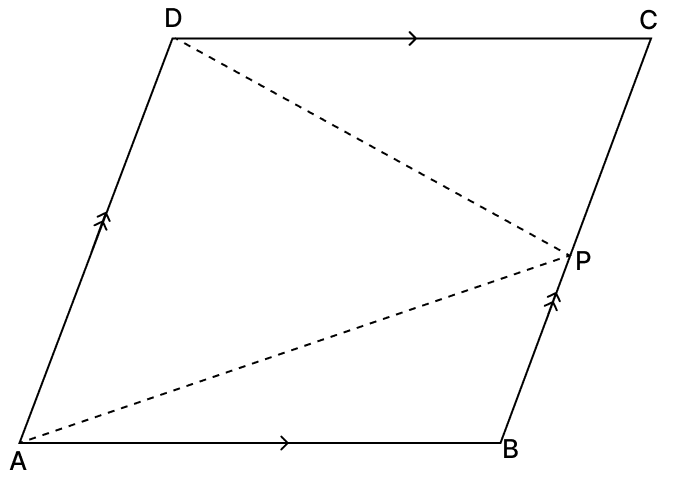
In the given figure, ABCD is a parallelogram and P is a point on BC. Prove that :
ar (ΔABP) + ar (ΔDPC) = ar (ΔAPD).
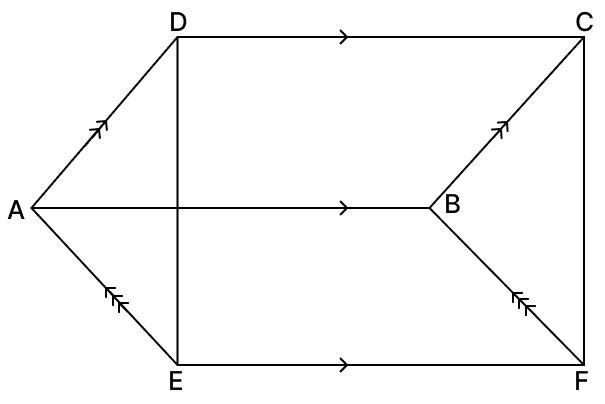
In the adjoining figure, two parallelograms ABCD and AEFB are drawn on opposite sides of AB. Prove that : ar (∥ gm ABCD) + ar (∥ gm AEFB) = ar (∥ gm EFCD).
In the adjoining figure, ABCD is a parallelogram and O is any point on its diagonal AC. Show that : ar (ΔAOB) = ar (ΔAOD).