Mathematics
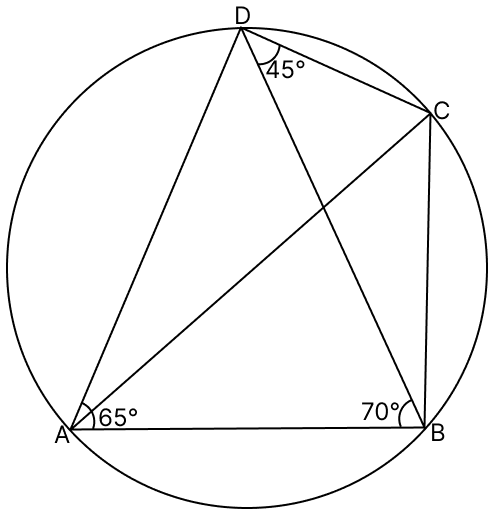
In the adjoining figure, ∠BAD = 65°, ∠ABD = 70° and ∠BDC = 45°. Find: (i) ∠BCD (ii) ∠ADB Hence, show that AC is a diameter.
Circles
3 Likes
Answer
(i) We know that,
Sum of opposite angles in a cyclic quadrilateral = 180°.
In cyclic quadrilateral ABCD,
∴ ∠BCD + ∠BAD = 180°
⇒ ∠BCD + 65° = 180°
⇒ ∠BCD = 180° - 65° = 115°.
Hence, ∠BCD = 115°.
(ii) In △ABD,
⇒ ∠ADB + ∠BAD + ∠DBA = 180° [Angle sum property of triangle]
⇒ ∠ADB + 65° + 70° = 180°
⇒ ∠ADB + 135° = 180°
⇒ ∠ADB = 180° - 135° = 45°.
We know that,
Angles in same segment are equal.
∴ ∠ACB = ∠ADB = 45°.
From figure,
∠ADC = ∠ADB + ∠BDC = 45° + 45° = 90°.
Since, angle in a semi-circle is a right angle. Thus, AC is the diameter.
Hence, ∠ADB = 45° and proved that AC is a diameter.
Answered By
1 Like
Related Questions
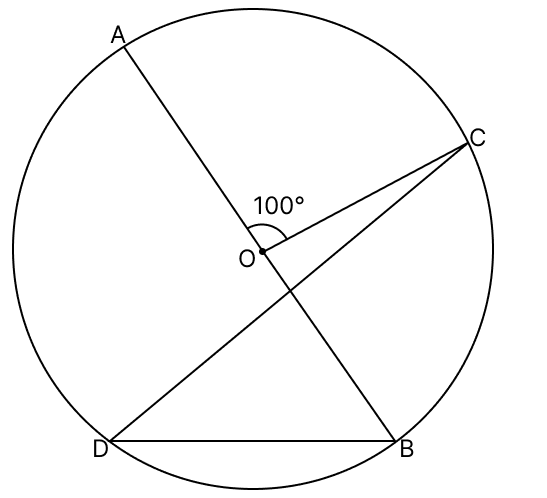
In the given figure, AOB is a diameter of the circle with centre O and ∠AOC = 100°, find ∠BDC.
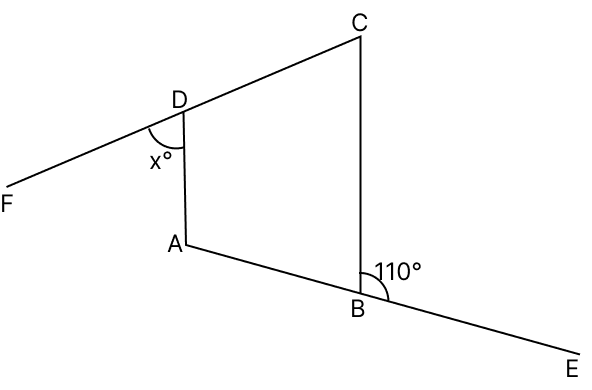
In the given figure, find whether the points A, B, C, D are concyclic when:
(i) x = 70
(ii) x = 80
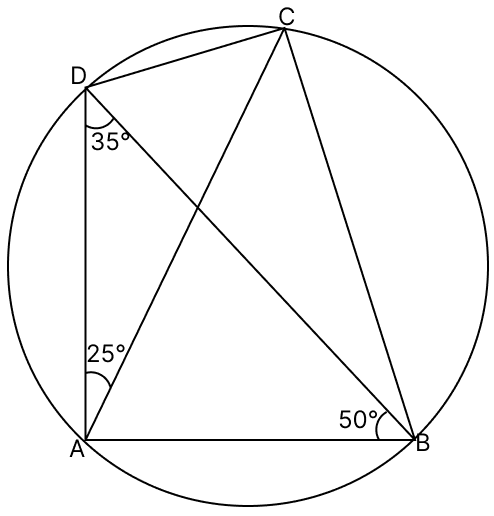
In the given figure, ABCD is a cyclic quadrilateral in which ∠CAD = 25°, ∠ADB = 35° and ∠ABD = 50°. Calculate:
(i) ∠CBD
(ii) ∠CAB
(iii) ∠ACB
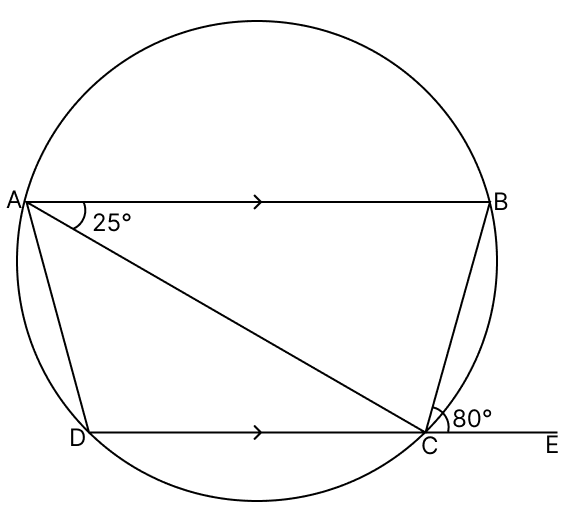
In the figure, AB is parallel to DC, ∠BCE = 80° and ∠BAC = 25°. Find :
(i) ∠CAD
(ii) ∠CBD
(iii) ∠ADC