Physics
Assertion (A) : When current is passed through a wire, a magnetic field is generated around the wire.
Reason(R) : Whenever there is a change of magnetic flux linked up with the coil, the induced current is generated in the coil.
- Both A and R are correct, and R is the correct explanation of A.
- Both A and R are correct, but R is not the correct explanation of A.
- A is correct but R is wrong.
- Both A and R are wrong.
Answer
Both A and R are correct, but R is not the correct explanation of A
Explanation :
Assertion (A) is true: According to Oersted’s experiment and Ampere’s law, passing an electric current through a conductor generates concentric circular magnetic field lines around it.
Reason (R) is true: According to Faraday’s law of electromagnetic induction, A changing magnetic flux through a coil induces an electromotive force, hence a current.
Reason (R) describes electromagnetic induction (how a changing magnetic field induces current in a coil). Assertion (A) describes the generation of a magnetic field by a steady current. These are two distinct phenomenon, one is about field creation, the other about induced currents, so the Reason (R) does not explain the Assertion (A).
Related Questions
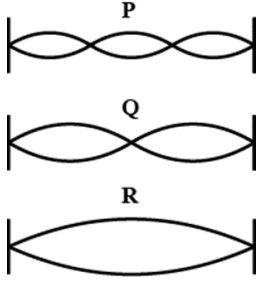
What is the ratio of wavelengths between P, Q and R?
- 3:2:1
- 1:2:3
- 6:3:2
- 2:3:6
During the change of state of a substance from solid to liquid, heat is absorbed by a body, but its temperature does not rise. Which of the following statements explains the phenomenon?
- Only K.E of the molecules increases, but P.E remains the same.
- Only P.E of the molecules increases, but K.E remains the same.
- Both K.E and P.E of the molecules increase.
- There is no increase in the P.E and K.E of the molecules.
Which of the following combinations correctly shows the charges on the particles?
+ 1.6 X 10⁻¹⁹ C - 1.6 X 10⁻¹⁹ C + 3.2 X 10⁻¹⁹ C (a) proton neutron alpha particle (b) alpha particle electron neutron (c) proton electron alpha particle (d) electron Proton alpha particle