Mathematics
Assertion (A) : One of the diagonals of a rhombus is equal to one of its side. The angles of a rhombus are 60°, 120°, 60°, 120°.
Reason (R) : All sides of a rhombus are equal.
Both A and R are correct, and R is the correct explanation for A.
Both A and R are correct, and R is not the correct explanation for A.
Statement 1 is true, and statement 2 is false.
Statement 1 is false, and statement 2 is true.
Answer
By property,
All the sides of a rhombus are equal.
So, reason (R) is true.
ABCD is the rhombus and AC is the diagonal such that AC = AB.
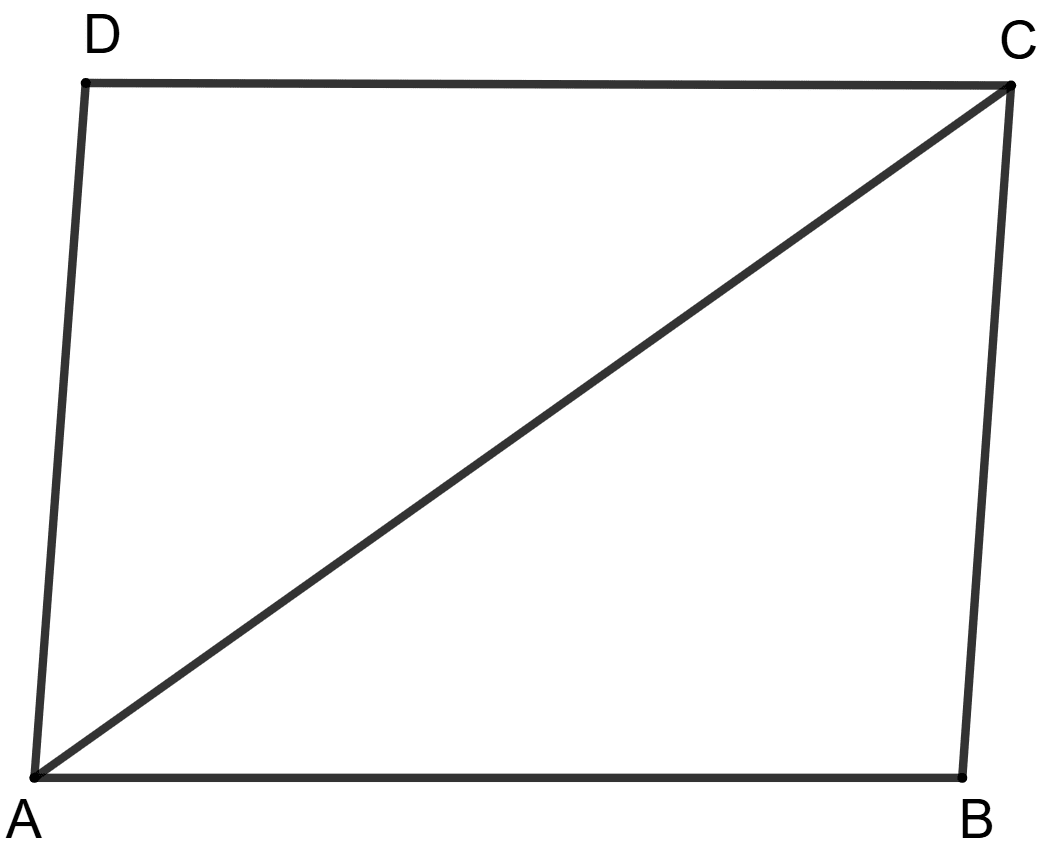
In triangle ABC,
⇒ AB = BC (Sides of rhombus are equal)
⇒ AB = AC (Given)
⇒ AB = AC = BC
So, triangle ABC is an equilateral triangle.
∴ ∠B = 60°, ∠BAC = 60° and ∠BCA = 60°.
In triangle ADC,
⇒ AD = CD (Sides of rhombus are equal)
⇒ AD = AC (Since, AB = AC and AB = AD)
⇒ AD = CD = AC
So, triangle ADC is an equilateral triangle.
∴ ∠D = 60°, ∠DAC = 60° and ∠DCA = 60°
⇒ ∠A = ∠BAC + ∠DAC = 60° + 60° = 120°.
⇒ ∠C = ∠BCA + ∠DCA = 60° + 60° = 120°.
Hence, the angles of a rhombus are 60°, 120°, 60°, 120°.
So, assertion (A) is true.
∴ Both A and R are correct, and R is not the correct explanation for A.
Hence, option 2 is the correct option.
Related Questions
Statement 1: In order to prove that a given parallelogram is a rectangle, we must prove that (a) any angle of it is 90° or (b) its diagonal are equal.
Statement 2: A kite is an arrowhead in which two pairs of adjacent sides are equal.
Which of the following options is correct?
Both the statements are true.
Both the statements are false.
Statement 1 is true, and statement 2 is false.
Statement 1 is false, and statement 2 is true.
Assertion (A) : In a parallelogram, the bisectors of any two pair of adjacent angles meet at a right angle.
Reason (R) : In a parallelogram, opposite angles are equal.
Both A and R are correct, and R is the correct explanation for A.
Both A and R are correct, and R is not the correct explanation for A.
Statement 1 is true, and statement 2 is false.
Statement 1 is false, and statement 2 is true.
Assertion (A) : If one angle of a parallelogram measures 90°, the parallelogram is a rectangle.
Reason (R) : If each interior angle of a parallelogram is 90°, then all sides of it are equal.
Both A and R are correct, and R is the correct explanation for A.
Both A and R are correct, and R is not the correct explanation for A.
Statement 1 is true, and statement 2 is false.
Statement 1 is false, and statement 2 is true.
Assertion (A) : The adjacent angles of a parallelogram are in ratio 2 : 3 the remaining angles are 78° and 102°.
Reason (R) : Opposite angles of a parallelogram are equal.
Both A and R are correct, and R is the correct explanation for A.
Both A and R are correct, and R is not the correct explanation for A.
Statement 1 is true, and statement 2 is false.
Statement 1 is false, and statement 2 is true.