Mathematics
Assertion (A): In rhombus ABCD, angle ABC = 120° and length of its each side is 20 cm. The length of diagonal BD = 20 cm.
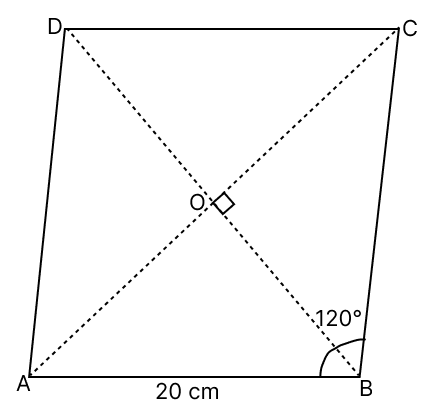
Reason (R): In ΔAOB, cos 60° = and BD = 2 x OB
A is true, but R is false.
A is false, but R is true.
Both A and R are true, and R is the correct reason for A.
Both A and R are true, and R is the incorrect reason for A.
Trigonometric Identities
1 Like
Answer
Given, angle ABC = 120° and length of its each side = 20 cm.
As we know that, each diagonal divides the angles at its endpoints into two equal parts.
The diagonal BD bisects ∠ABC and ∠ADC.
⇒ ∠ABD = ∠CBD = = 60°
By formula,
cos θ =
We know that,
Diagonals of rhombus are perpendicular to each other.
Thus, triangle AOB is a right angle triangle.
In ΔAOB,
Since, diagonals of a rhombus bisect each other.
⇒ BD = 2 x OB
So, reason (R) is true.
⇒ BD = 2 x 10 cm = 20 cm
So, assertion (A) is true.
∴ Both A and R are true, and R is the correct reason for A.
Hence, option 3 is the correct option.
Answered By
1 Like
Related Questions
Statement 1: At a particular time, the length of the shadow of a 50 m tower is m.
Statement 2: The sun's altitude is 30°.
Both the statements are true.
Both the statements are false.
Statement 1 is true, and statement 2 is false.
Statement 1 is false, and statement 2 is true.
Statement 1: The distance between B and C = 5 m.
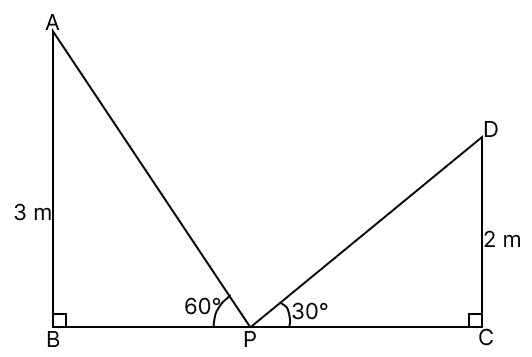
Statement 2: BC = m.
Both the statements are true.
Both the statements are false.
Statement 1 is true, and statement 2 is false.
Statement 1 is false, and statement 2 is true.
Assertion (A): The length of the line AB is 100 m.
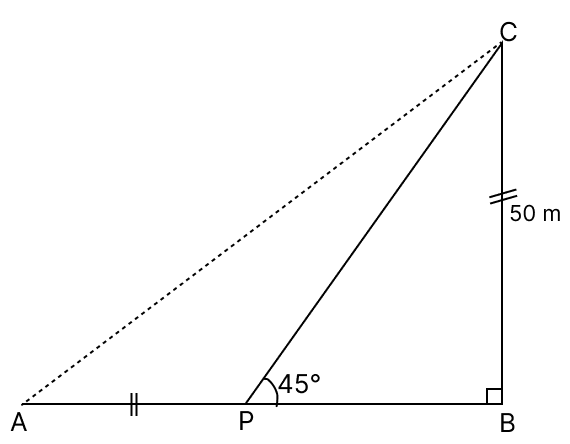
Reason (R): tan 45° = ⇒ PB = 50 m and AB = 50 m + 50 m = 100 m
A is true, but R is false.
A is false, but R is true.
Both A and R are true, and R is the correct reason for A.
Both A and R are true, and R is the incorrect reason for A.
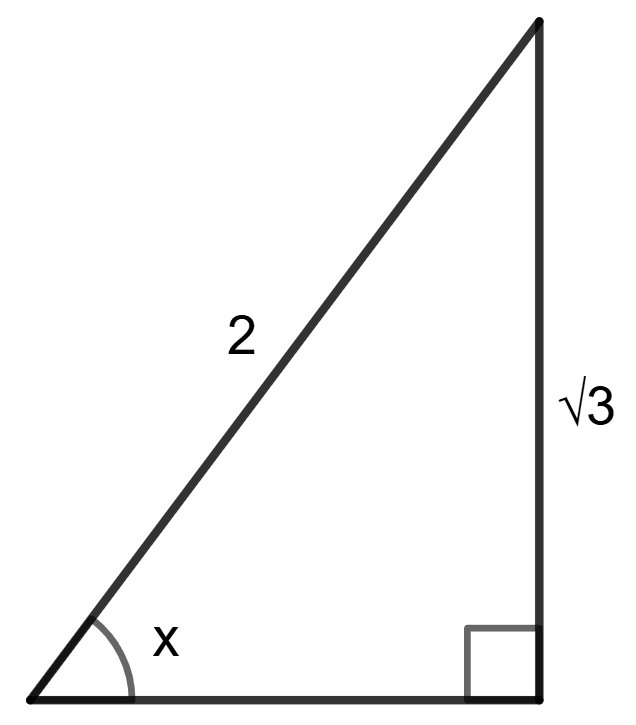
Find the value of cot x.