
Physics
(a) Why does it become pleasantly warm when the lakes start freezing?
(b) Water freezes to form ice. What change would you expect in the average kinetic energy of the molecules?
(c) Which will contain more heat energy 1 g of ice at 0°C or 1 g water at 0°C ?
Calorimetry
14 Likes
Answer
(a) The surroundings become pleasantly warm when water in a lake starts freezing because the specific latent heat of fusion of ice is very high, hence large quantity of heat is released when the water in the lake freezes. Therefore, the temperature of the surrounding becomes pleasantly warm.
(b) The average kinetic energy of the molecules decreases as water freezes to produce ice because the temperature of the water molecules drops, and they hold to one another to form a crystal.
(c) 1 g of water at 0° C has more heat energy because 1 g of water at 0° C liberates 80 cal heat to form 1 g of ice at 0° C.
Answered By
8 Likes
Related Questions
Below is the diagram of a transformer :
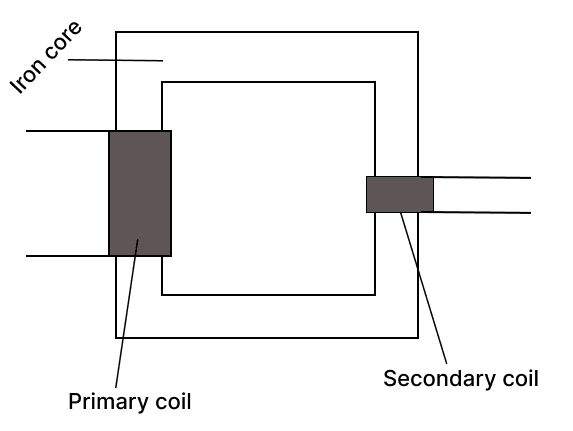
(a) Identify the type of transformer.
(b) In this type of transformer which of the wire is thicker, the primary or the secondary? Give a reason.
Study the diagram :
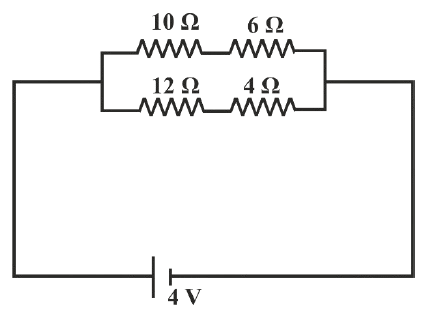
(a) Calculate the total resistance of the circuit.
(b) Calculate the current drawn from the cell.
(c) State whether the current through 10 Ω resistor is greater than, less than or equal to the current through the 12 Ω resistor.
85 g of water at 30°C is cooled to 5°C by adding certain mass of ice. Find the mass of ice required.
[Specific heat capacity of water = 4.2 J g⁻¹ °C⁻¹ , Specific latent heat of fusion = 336 J g⁻¹]
(a) State one factor that affects the magnitude of induced current in an AC generator.
(b) Given below is a circuit to study the magnetic effect of electric current. ABCD is a cardboard kept perpendicular to the conductor XY. A magnetic compass is placed at the point P of the cardboard. P1 and P2 are the positions of the magnetic compass, before and after passing a current through XY respectively.
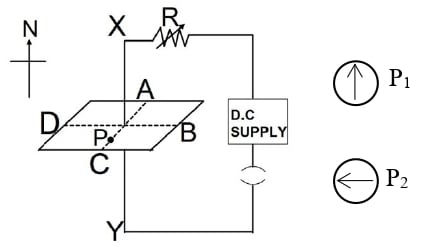
- Name the rule that is used to predict the direction of deflection of the magnetic compass.
- State the direction of current in the conductor (X to Y or Y to X) when the circuit is complete.
- If resistance R is increased, then what will be the effect on the magnetic lines of force around the conductor?