
Physics
Study the diagram :
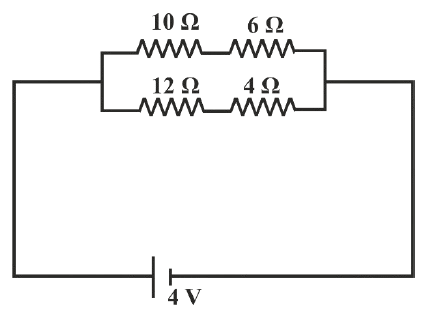
(a) Calculate the total resistance of the circuit.
(b) Calculate the current drawn from the cell.
(c) State whether the current through 10 Ω resistor is greater than, less than or equal to the current through the 12 Ω resistor.
Current Electricity
16 Likes
Answer
Given,
V = 4 V
Let,
R1 = 10 Ω,
R2 = 6 Ω,
R3 = 12 Ω and
R1 = 4 Ω
(a) As, R1 and R2 are in series then
RS = R1 + R2 = 10 + 6 = 16 Ω
Similarly,
R3 and R4 are also in series,
RS' = R3 + R4 = 12 + 4 = 16 Ω
Now, RS and RS' are in parallel combination then
⟹
So, total resistance of the circuit is 8 Ω.
(b) From Ohm's law :
Current drawn from the cell is 0.5 A.
(c) As potential difference across 10 Ω and 6 Ω resistances is same as potential difference across 12 Ω and 4 Ω resistances which is V = 4 V.
Now,
…..equation 1
and
…..equation 2
From equations 1 and 2
Current through 10 Ω resistance = Current through 12 Ω resistance = 0.25 A
So, the current through 10 Ω resistor is equal to the current through the 12 Ω resistor.
Answered By
8 Likes
Related Questions
The voltage - current readings of a certain material are shown in the table given below :
Voltage (V) Current (I) 10 V 2 A 20 V 3 A 30 V 4 A Study the table.
(a) State whether the conductor used is ohmic or non-ohmic.
(b) Justify your answer.
(c) State Ohm’s law.
Below is the diagram of a transformer :
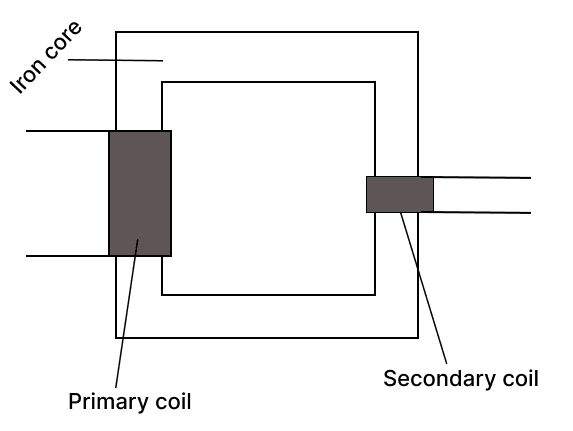
(a) Identify the type of transformer.
(b) In this type of transformer which of the wire is thicker, the primary or the secondary? Give a reason.
85 g of water at 30°C is cooled to 5°C by adding certain mass of ice. Find the mass of ice required.
[Specific heat capacity of water = 4.2 J g⁻¹ °C⁻¹ , Specific latent heat of fusion = 336 J g⁻¹]
(a) Why does it become pleasantly warm when the lakes start freezing?
(b) Water freezes to form ice. What change would you expect in the average kinetic energy of the molecules?
(c) Which will contain more heat energy 1 g of ice at 0°C or 1 g water at 0°C ?