
Physics
The voltage - current readings of a certain material are shown in the table given below :
| Voltage (V) | Current (I) |
|---|---|
| 10 V | 2 A |
| 20 V | 3 A |
| 30 V | 4 A |
Study the table.
(a) State whether the conductor used is ohmic or non-ohmic.
(b) Justify your answer.
(c) State Ohm’s law.
Current Electricity
13 Likes
Answer
(a) The conductor is non-ohmic.
(b) As, from Ohm's Law
For V = 10 V and I = 2 A
……. Equation 1
For V = 20 V and I = 3 A
……. Equation 2
For V = 30 V and I = 4 A
……. Equation 3
From equations 1, 2 and 3
Here, the ratio V/I is not constant and plot of V vs I graph will not be linear but if a conductor is an ohmic conductor then V/I should be constant to follow Ohm's law and V vs I graph should be linear which is not the case here.
Hence, the conductor does not follow Ohm's law and is a non-ohmic conductor.
(iii) Ohm's law states that the current flowing through the conductor is directly proportional to the potential difference across it's ends provided that the physical conditions and the temperature of the conductor remain constant.
Answered By
7 Likes
Related Questions
(a) Complete the following radioactive reaction :
(b) Uranium is available in two forms U-235 and U-238. Which of the two isotopes of Uranium is more fissionable?
In the given diagram, a vibrating tuning fork is kept near the mouth of a burette filled with water. The length of the air column is adjusted by opening the tap of the burette. At a length of 5 cm of the air column, a loud sound is heard.
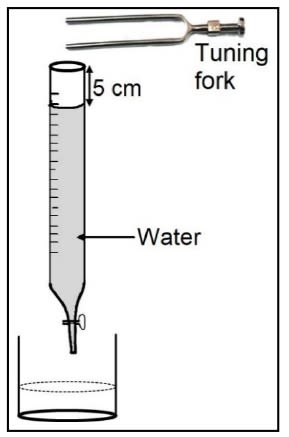
(a) Name the phenomenon illustrated by the above experiment.
(b) Why is a loud sound heard at this particular length?
(c) If the present tuning fork is replaced with a tuning fork of higher frequency, should the length of the air column increase or decrease to produce a loud sound? Give a reason.
Below is the diagram of a transformer :
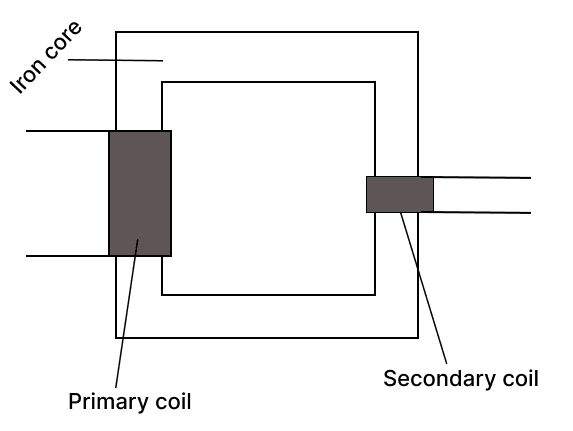
(a) Identify the type of transformer.
(b) In this type of transformer which of the wire is thicker, the primary or the secondary? Give a reason.
Study the diagram :
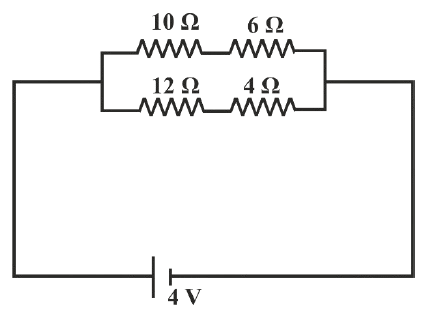
(a) Calculate the total resistance of the circuit.
(b) Calculate the current drawn from the cell.
(c) State whether the current through 10 Ω resistor is greater than, less than or equal to the current through the 12 Ω resistor.