Physics
The diagram below displays four solid plastic balls attached to wires, all mounted on a wooden base. When a person shakes the wooden base back and forth at a steady pace, the balls begin to vibrate as well. It is noted that while all the balls vibrate, only one of them vibrates vigorously.
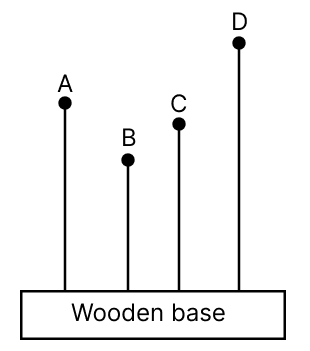
(a) Explain why only one ball vibrates vigorously.
(b) If fA, fB, fC, and fD are the natural frequencies of vibration of the wires, then arrange them in the increasing order of their frequencies and justify.
Answer
(a) As the frequency of vibration of the wooden base matches with the natural frequency of only one ball, it starts to vibrate vigorously due to resonance which increases the amplitude of vibration of the ball.
(b) Since frequency of vibration in a wire is inversely proportional to the vibrating length.
Let,
lA, lB, lC and lD are length of the wire A, B, C and D respectively.
From the figure,
lB < lC < lA < lD
Then,
fD < fA < fC < fB
Related Questions
The graph shows load against effort for a lever with load and effort on the same side of the fulcrum.
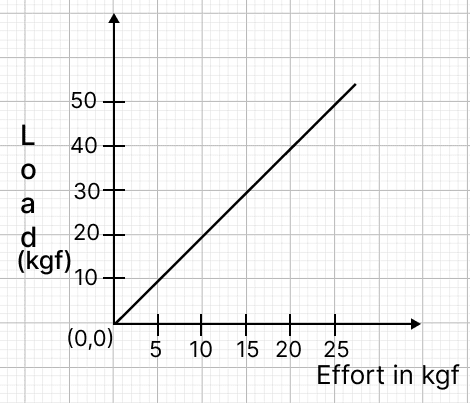
(a) Which attribute of the load vs effort graph must be calculated to determine the mechanical advantage?
(b) Which class does this lever belong to? How did you arrive at this conclusion?
(a) A man fires a gun and hears its echo after 3 s. The man then moves 80 m towards the hill and fires his gun again. This time he hears the echo after 2.5 s. Calculate the speed of the sound.
(b) State one reason of using ultrasonic waves in SONAR.
The diagram given below shows a bulb connected by dual control switches. Observe the diagrams and answer the questions that follow.
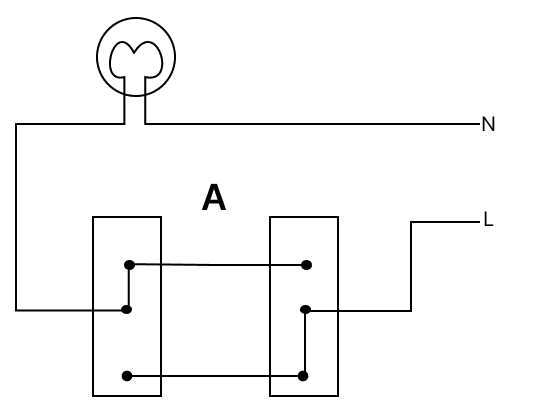
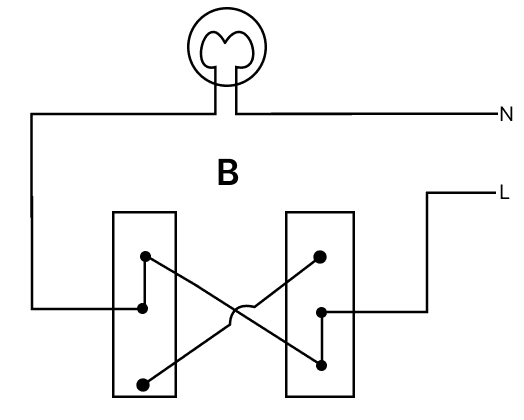
(a) Which switch can successfully turn the bulbs ON or OFF? (Circuit A, Circuit B, or both)
(b) At present, in which circuit is the bulb glowing?
(c) If the L and N wires are swapped in the circuit (your answer to (b)), will the circuit still function?
Study the diagram and answer the questions that follow:
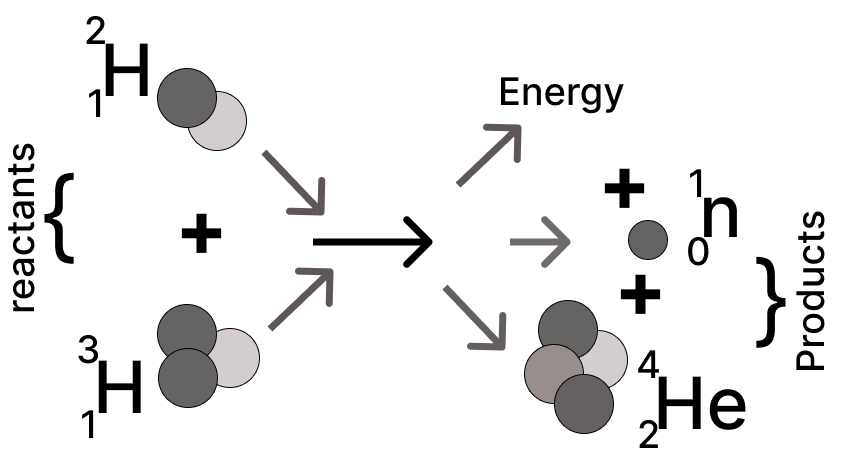
(a) Name the nuclear process displayed in the diagram.
(b) Is it possible to conduct this process at room temperature?
(c) Mass of reactants …………… mass of the products.
[Fill in the blank using <, > or =]