
Physics
The diagram given below shows a triangular prism of a certain material with fluorescent screen placed adjacent to it. The yellow light ray striking the surface ST of the prism shows a fluorescent spot at point X.
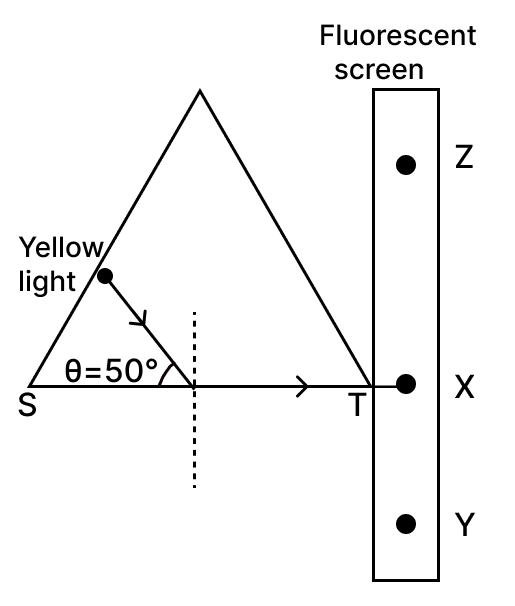
(a) Calculate the critical angle of the material of the prism for yellow colour.
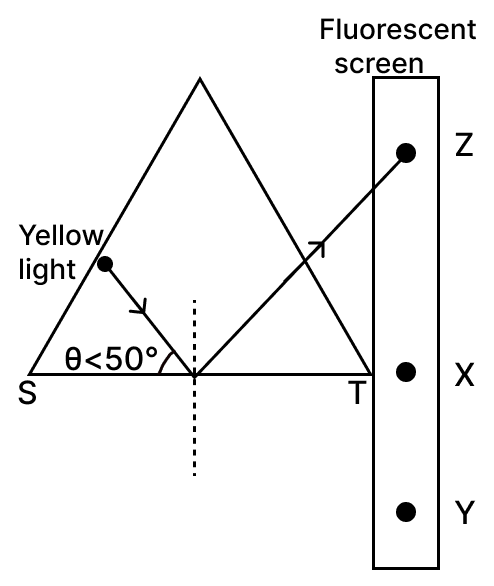
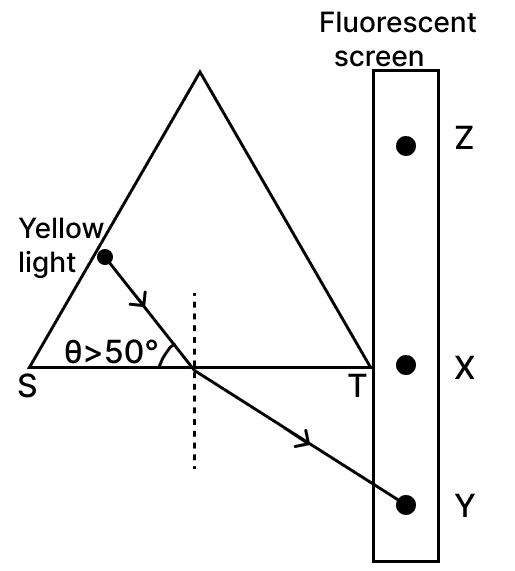
(b) To move the fluorescent spot towards Y, the value of θ should be …………… [> 50, < 50 or = 50].
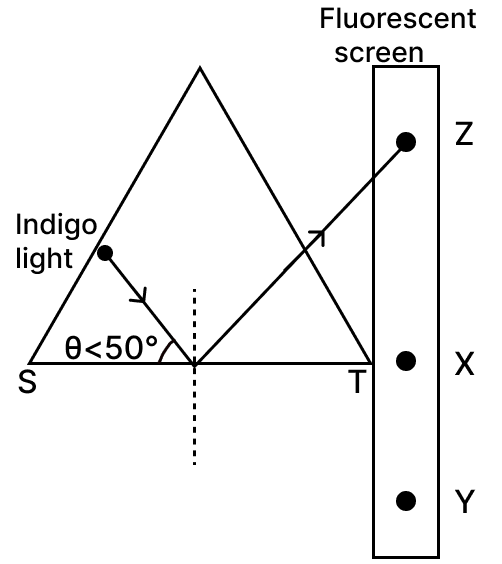
(c) Which direction will the florescent spot move if yellow light is replaced with indigo light? (towards Y or towards Z)
Refraction Plane Surfaces
12 Likes
Answer
(a) As, the ray emerges via ST then it's angle of refraction with the normal is 90° and since, critical angle is the angle of incidence in the denser medium corresponding to which the angle of refraction in the rarer medium is 90° so here, angle of incidence is at critical angle.
Now,
From the diagram,
θ = 50°
Then,
Angle of incidence of the yellow ray = 90° - 50° = 40°
Hence, critical angle of the material of the prism for yellow colour is 40°.
(b) To move the fluorescent spot towards Y, the value of θ should be > 50.
Reason—
Case 1 : When θ is equal to 50°, the ray strikes at X which is the present case.
Case 2 : When θ is less than 50°, the incident angle becomes greater than the critical angle i.e., 40° so light will reflect at the surface ST and hence move toward Z depending upon the value of θ but will never move towards Y as shown below.
Case 3 : When θ is greater than 50°, the incident angle becomes less than the critical angle i.e., 40° so no total internal reflection takes place and light will suffer refraction at the surface ST and hence move toward Y depending upon the value of θ as shown below.
(c) Towards Z
Reason— The critical angle increases with increase in the wavelength of light. Since indigo light has a shorter wavelength than yellow light, its critical angle is less than 40°. Here, the angle of incidence at ST is 50°, which is greater than the critical angle. Therefore, the indigo light will undergo total internal reflection at ST and travel towards Z, as shown below.
Answered By
6 Likes
Related Questions
Draw a ray diagram to invert the image without deviation of light using right angle isosceles prism.
Answer the following with respect to a concave lens (L).
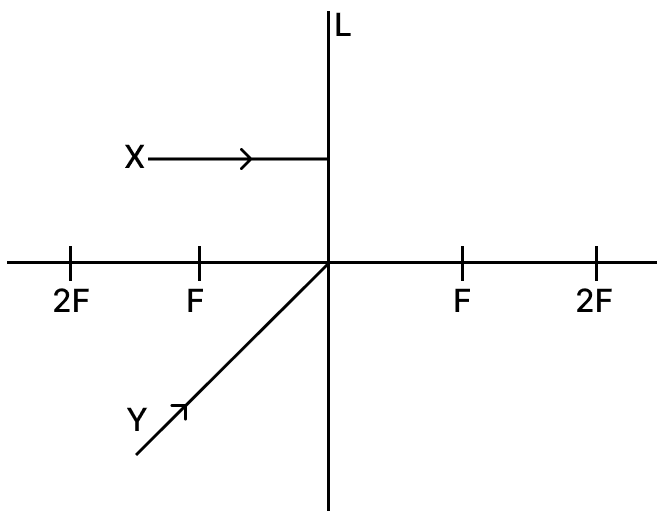
(a) Describe the path of the rays X and Y through the lens.
(b) Give one use of this lens.
(c) Calculate its power if the focal length of this lens is 20 cm.
An object is placed at a distance of 10 cm from a convex lens of focal length 20 cm.
(a) Find the position of the image.
(b) What is the nature of the image?
(a) Name the electromagnetic radiations which are used for sterilising water in a water purifier.
(b) State any one property of the radiations mentioned by you in part (a).
(c) Why are the danger signals red in colour?