
Physics
Answer the following with respect to a concave lens (L).
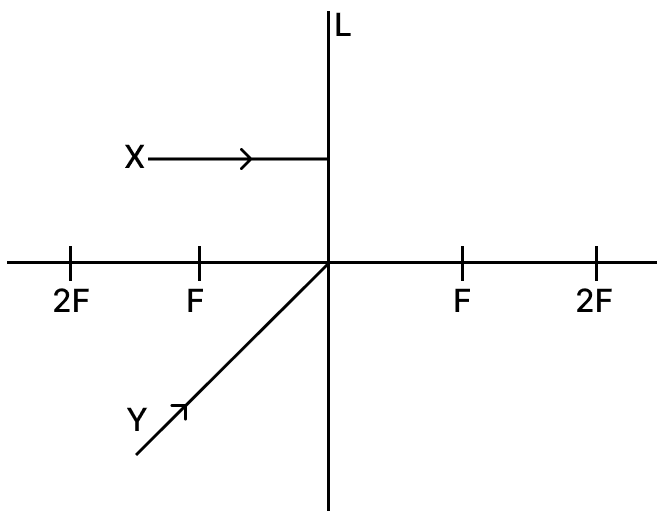
(a) Describe the path of the rays X and Y through the lens.
(b) Give one use of this lens.
(c) Calculate its power if the focal length of this lens is 20 cm.
Refraction Lens
12 Likes
Answer
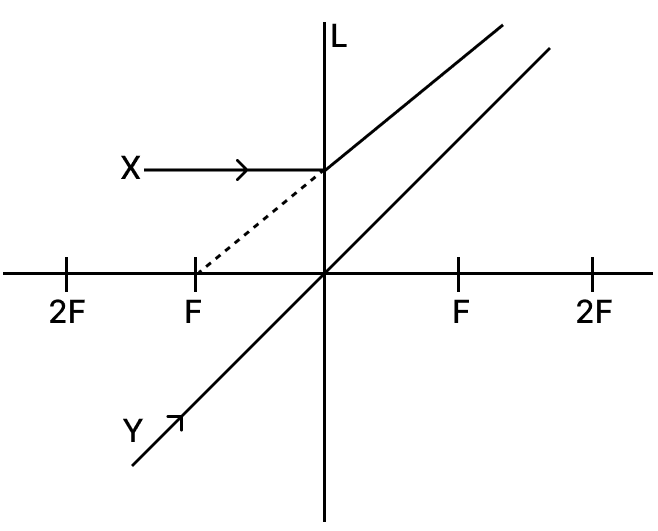
(a) Ray X : As the ray is parallel to the principal axis of the concave lens then after refraction, it appears to come from the second focus F, as shown in below diagram.
Ray Y : As the ray is incident at the optical centre of the lens then it passes undeviated through the lens because angle of incidence of the ray with the normal at optic centre is zero as shown in below diagram.
(b) A concave lens is used in spectacles for correcting short-sightedness (myopia).
(c) Given,
- Focal length = -20 cm = -0.2 m
Then,
Answered By
8 Likes
Related Questions
(a) A coin lies at the bottom of a beaker. Water is poured into the beaker upto a height of 8 cm. Calculate the shift seen in the position of the coin.
(The refractive index of water is 4/3. The width of the glass wall of the beaker is negligible.)(b) How will the apparent depth be affected if the temperature of water is increased?
Draw a ray diagram to invert the image without deviation of light using right angle isosceles prism.
The diagram given below shows a triangular prism of a certain material with fluorescent screen placed adjacent to it. The yellow light ray striking the surface ST of the prism shows a fluorescent spot at point X.
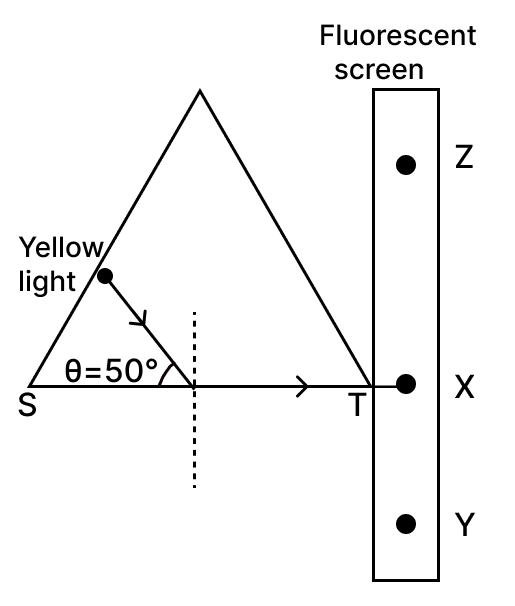
(a) Calculate the critical angle of the material of the prism for yellow colour.
(b) To move the fluorescent spot towards Y, the value of θ should be …………… [> 50, < 50 or = 50].
(c) Which direction will the florescent spot move if yellow light is replaced with indigo light? (towards Y or towards Z)
An object is placed at a distance of 10 cm from a convex lens of focal length 20 cm.
(a) Find the position of the image.
(b) What is the nature of the image?