Chemistry
The figure given below demonstrates the preparation of oxygen. 2KClO3 (s) 2KCl (s) + 3O2 (g) (I) Which of the following statements is/are correct about the reaction? 1. It is a decomposition reaction and is exothermic. 2. It is a decomposition reaction and is endothermic. 3. It is a photochemical decomposition reaction. 4. It is a combination reaction. (II) Potassium chlorate is: 1. an oxidising agent. 2. a reducing agent. 3. both reducing as well as an oxidising agent. 4. all options are correct. (III) In the reaction, manganese dioxide: 1. takes part in the reaction. 2. acts as a catalyst. 3. decreases the speed of reaction. 4. helps in producing more oxygen.
Answer
(I) It is a decomposition reaction and is endothermic.
Reason — When potassium chlorate (2KClO3) is heated in the presence of manganese dioxide it will undergo decomposition reaction. Since heat is absorbed during the process it is a endothermic reaction.
(II) an oxidising agent
Reason — Potassium chlorate (KClO3) provides oxygen, which supports oxidation of other substances. It releases oxygen, hence it can oxidize other materials.
(III) acts as a catalyst.
Reason — Potassium chlorate decomposes only at 700°C and even then the rate of release of oxygen is very slow. But when potassium chlorate is heated in the presence of manganese dioxide, decomposition begins at a much lower temperature, 300°C and manganese dioxide remains unaffected. Thus, in this reaction, manganese dioxide acts as a catalyst
Related Questions
Which of the following statements is/are correct with respect to the figure shown alongside?
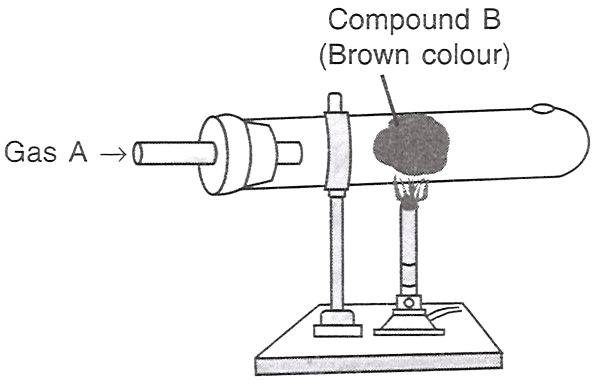
P — A is HCl, B is iron.
Q — A is Cl2, B is copper.
R — A is Cl2, B is iron.
Only P
Only Q
Only R
Both P and R
Aman performed the following four experiments
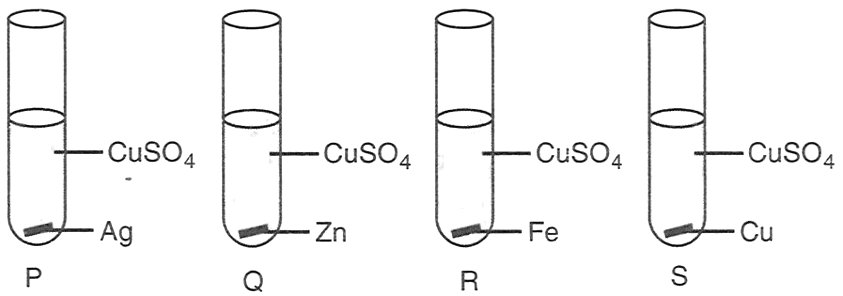
The experiments in which the blue colour of the solution will fade are :
P and Q
P, Q and R
Q and R
Q, R and S
What happens when a solution of an acid is mixed with a solution of a base in a test tube?
P — The temperature of the solution increases.
Q — The temperature of the solution decreases.
R — The temperature of the solution remains the same.
S — Salt formation takes place.
Only P
P and R
Q and R
P and S
Assertion (A): Zinc can displace copper from aqueous copper sulphate solution.
Reason (R): Copper is placed above zinc in the reactivity series.
- Both A and R are true and R is the correct explanation of A.
- Both A and R are true but R is not the correct explanation of A.
- A is true but R is false.
- A is false but R is true.