
Physics
The figure below shows a simple pendulum of mass 200 g. It is displaced from the mean position A to the extreme position B. The potential energy at the position A is zero. At the position B the pendulum bob is raised by 5 m.
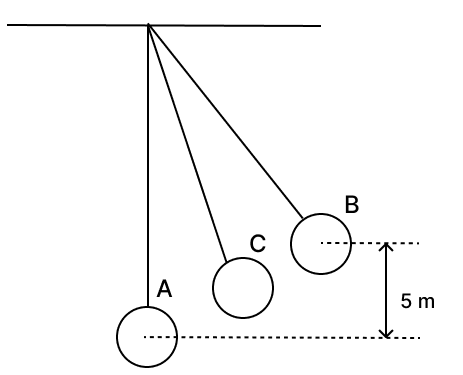
(a) What is the potential energy of the pendulum at the position В?
(b) What is the total mechanical energy at point C?
(c) What is the speed of the bob at the position A when released from B?
(Take g = 10 ms-2 and given that there is no loss of energy.)
Work, Energy & Power
3 Likes
Answer
Given,
h = 5 m,
m = 200 g = 0.2 kg,
g = 10 ms-2
(a) Potential energy UB at B is given by
UB = m x g x h
Substituting the values we get,
UB = 0.2 x 10 x 5
⇒ UB = 10 J
Hence, the potential energy of the pendulum at the position B = 10 J.
(b) Total mechanical energy at point C = 10 J
The total mechanical energy is same at all points of the path due to conservation of mechanical energy.
(c) At A, bob has only kinetic energy which is equal to potential energy at B,
Therefore,
Answered By
2 Likes
Related Questions
A metal rod AB of length 80 cm is balanced at 45 cm from the end A with 100 gf weights suspended from the two ends.
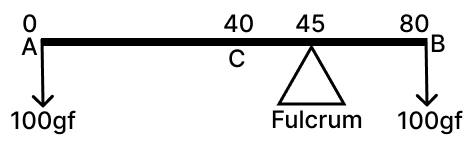
(a) If this rod is cut at the centre C, then compare the weight of AC to the weight of BC.
(b) Give a reason for your answer in (a)
For each of the following scenarios, state whether the work done by gravity is positive, negative, or zero.
(a) a person walks on a levelled road.
(b) a person climbs a ladder.
(c) a car in neutral gear is coming down the slope.
A block and tackle system of pulleys has velocity ratio 4.
(a) Draw a labelled diagram of the system indicating clearly, the direction of the load and effort.
(b) Calculate the potential energy of the load 100 kgf lifted by this pulley to a height 5 m. (g = 10 ms-2)
A person standing in front of a cliff fires a gun and hears its echo after 3s. If the speed of sound in air is 336 ms-1.
(a) Calculate the distance of the person from the cliff.
(b) After moving a certain distance from the cliff, he fires the gun again and this time the echo is heard 1.5 s later than the first. Calculate the distance that the person moved.