
Physics
Fill in the blanks :
(a) All the molecules of a substance are …………… .
(b) The inter-molecular spacing is …………… in solids …………… in liquids and …………… in gases.
(c) The molecular motion in liquid and gas is in …………… path.
(d) In a solid, the molecules …………… but they remain at their fixed positions.
(e) The inter-molecular forces are the weakest in …………… .
(f) A solid exerts pressure …………… .
(g) Gases are …………… dense.
(h) Solids are …………… rigid.
Matter
10 Likes
Answer
(a) All the molecules of a substance are identical.
(b) The inter-molecular spacing is least in solids more in liquids and still more in gases.
(c) The molecular motion in liquid and gas is in zig-zag path.
(d) In a solid, the molecules vibrate on either side but they remain at their fixed positions.
(e) The inter-molecular forces are the weakest in gases.
(f) A solid exerts pressure downwards on its base.
(g) Gases are least dense.
(h) Solids are most rigid.
Answered By
5 Likes
Related Questions
The inter-molecular forces in liquids are :
- as strong as in solids
- stronger than in solids
- weaker than in solids
- weaker than in gases
The diagram below shows the arrangement of molecules in three states of matter.
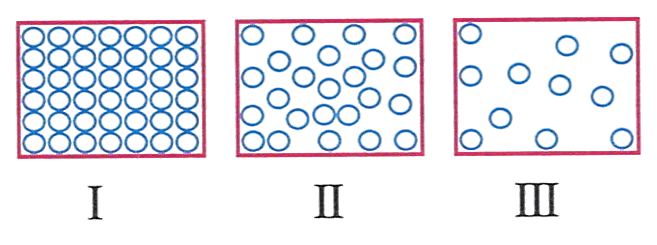
The arrangement of molecules in drinking water would look like.
- I
- II
- III
- all of these
Write true or false for each statement :
(a) The molecules of each substance are identical.
(b) The inter-molecular forces are effective at all distances between the two molecules.
(c) The molecules in a substance are in random motion.
(d) In a gas, the molecules can move anywhere in space.
(e) Liquids are less viscous than gases.
Match the following columns :
Column A Column B (a) A molecule is composed of (i) does not exist free in nature. (b) Ice, water and water vapour (ii) can vibrate only up to about 10-10 m from their mean positions. (c) An atom (iii) atoms. (d) Gases (iv) are the three states of water. (e) The molecules of a solid (v) occupy space