
Physics
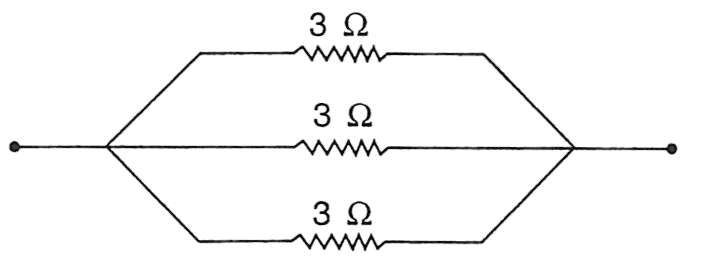
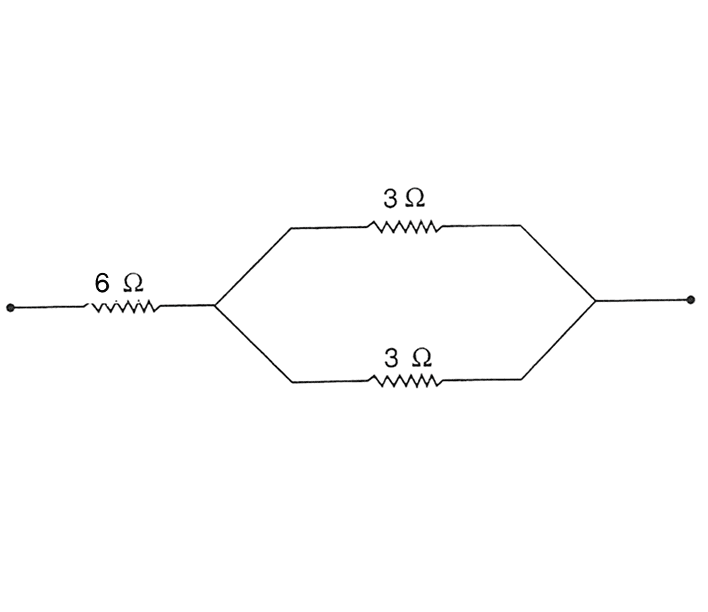
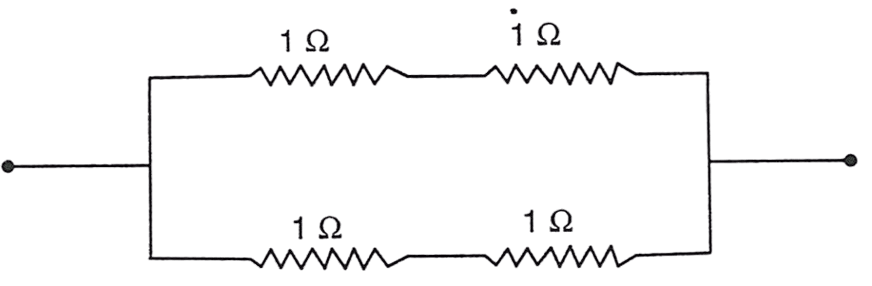
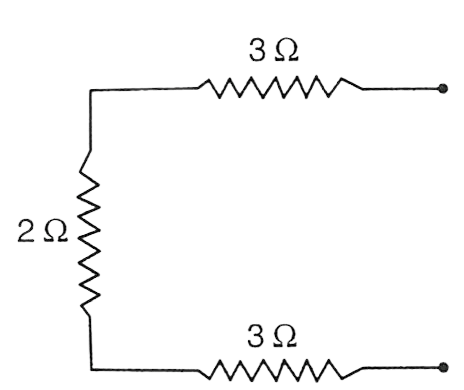
Which of the following circuits have the same resistance ?
i
ii
iii
iv
- (i) and (ii)
- (ii) & (iii)
- (i) & (iii)
- (ii) & (iv)
Current Electricity
1 Like
Answer
(i) & (iii)
Reason —
(i) Here all resistances are in parallel combination and have same resistance value equal to 3 Ω.
Then,
(ii) In this case two resistances of value 3 Ω are in parallel combination and this combination is in series with 6 Ω resistance.
For parallel combination,
For series combination,
(iii) Here two 1 Ω resistances are in series combination and this whole combination is in parallel combination with itself.
For series combination,
For Parallel combination,
(iv) Here all resistances are in series combination.
Answered By
2 Likes
Related Questions
A student wishes to measure the speed of sound in air. He plans to measure the time between making the sound and hearing its echo from a cliff. What type of sound should he make and which distance should he use in his calculations ?
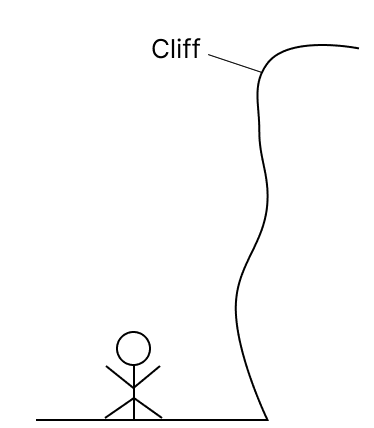
Sound Distance (a) Continuous sound (b) Continuous sound Distance to cliff x 2 (c) Short, sharp sound (d) Short, sharp sound Distance to cliff x 2 - Option (a)
- Option (b)
- Option (c)
- Option (d)
When a tuning fork is sounded in air, the sound given by it is feeble. But when it is placed on a table top, the sound becomes much louder. The reason is :
- amplitude of the wave
- its prongs start vibrating rapidly
- presence of a surrounding wave
- large surface area of the vibrating body
Three bulbs of equal resistance are connected as shown in figure. Out of the following statements which one is correct ?
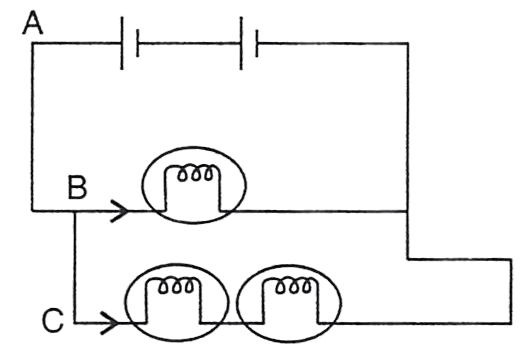
- The current at B is greater than that at C.
- The current at A equals the current at B.
- The current at C is greater than that at B.
- The current at A equals the current at C.
Assertion (A) : The direction of induced current is such that it opposes the cause which produces it.
Reason (R) : A current is induced in the coil if there is a change in the magnetic flux linked with the coil.
- both A and R are true and R is the correct explanation of A
- both A and R are true and R is not the correct explanation of A
- assertion is false but reason is true
- assertion is true but reason is false