
Biology
Given alongside is the figure of an organism. Study the same and answer the following questions.
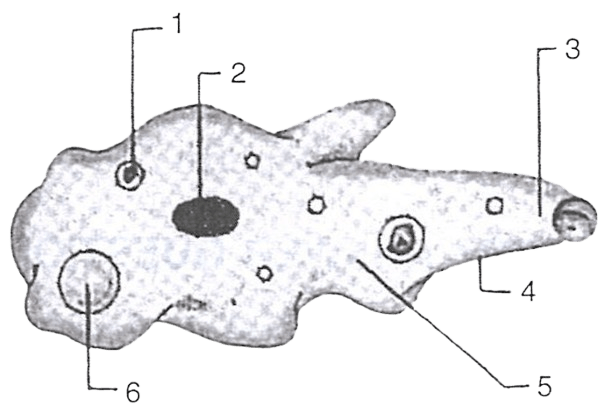
(i) Identify the organism.
(ii) Is it a plant/ animal ? Give reason in support of your answer.
(iii) Label the guidelines 1 to 6 shown in the figure.
(iv) Which kingdom does it belong to ?
(v) Write one important role of the parts shown as 3 and 6.
Classification of Plants
8 Likes
Answer
(i) The organism shown in the given figure is Amoeba.
(ii) No, Amoeba is neither a plant nor an animal. Amoebas lack chlorophyll and the ability to photosynthesize, unlike plants. Animals have specialized tissues and organs, which amoebas lack. Hence, Amoeba don't fall under either category.
(iii) The guidelines 1 to 6 are:
1 → Food Vacuole
2 → Nucleus
3 → Pseudopodium
4 → Cell Membrane
5 → Cytoplasm
6 → Contractile Vacuole
(iv) Amoeba is a single-celled organism classified under the Kingdom Protista.
(v) Part 3 (Pseudopodium) — Pseudopodium is the organ of locomotion in an Amoeba. It helps amoeba move in the direction it wants to move in.
Part 6 (Contractile Vacuole) — Excess ammonia (waste) and water gets expelled out of the body of Amoeba from Contractile Vacuole.
Answered By
6 Likes
Related Questions
Distinguish between the following pairs on the basis of the words indicated in the brackets [].
Prokaryotes and Eukaryotes [examples]
Draw a neat, generalized diagram of a bacterium and label its six important parts. Answer the following questions.
(i) Name the kingdom to which it belongs.
(ii) Write two characteristic features of the kingdom.
(iii) Name the gelatinous, proteinaceous covering which surrounds the cell wall.
(iv) Mention two cellular organelles which are absent in bacterium.
(v) Write the scientific name of a comma-shaped bacterium.
Study the figure given alongside and answer the following questions :
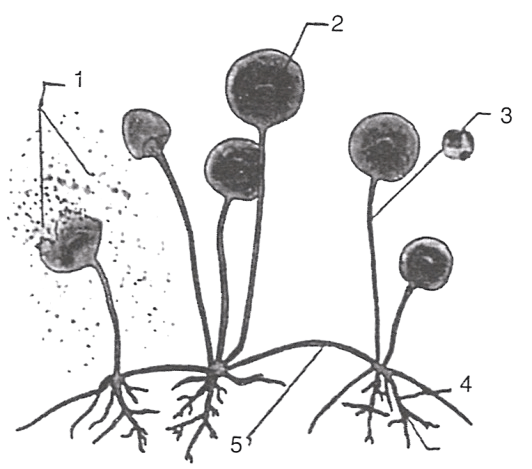
(i) Identify the organism. Write its common name as well as scientific name.
(ii) Label the guidelines 1 to 5.
(iii) Which kingdom does it belong to ?
(iv) Write one important role of a part shown as 2.
(v) Mention one very specific feature of this category of plants.
Briefly explain four types of bacteria on the basis of their shape.