
Mathematics
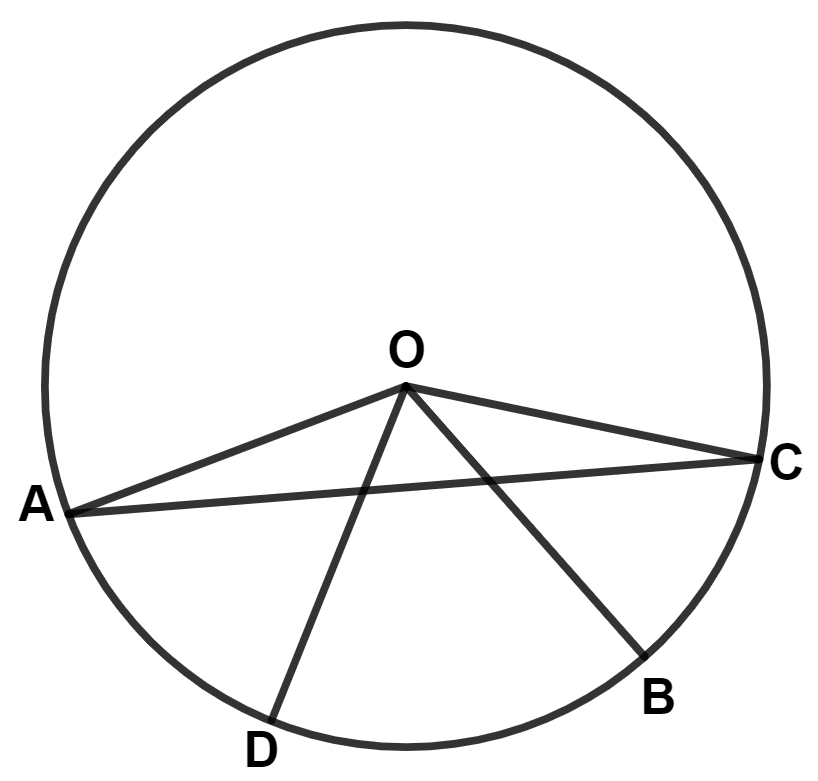
The given figure shows a circle with center O. Points A, D, B and C lie on the circumference of the given circle and angle AOB = 108°. If arc ADB = 2 × arc BC, find :
(i) ∠ACB
(ii) ∠CAB
(iii) ∠ADB
Circles
28 Likes
Answer
(i) Join BC.
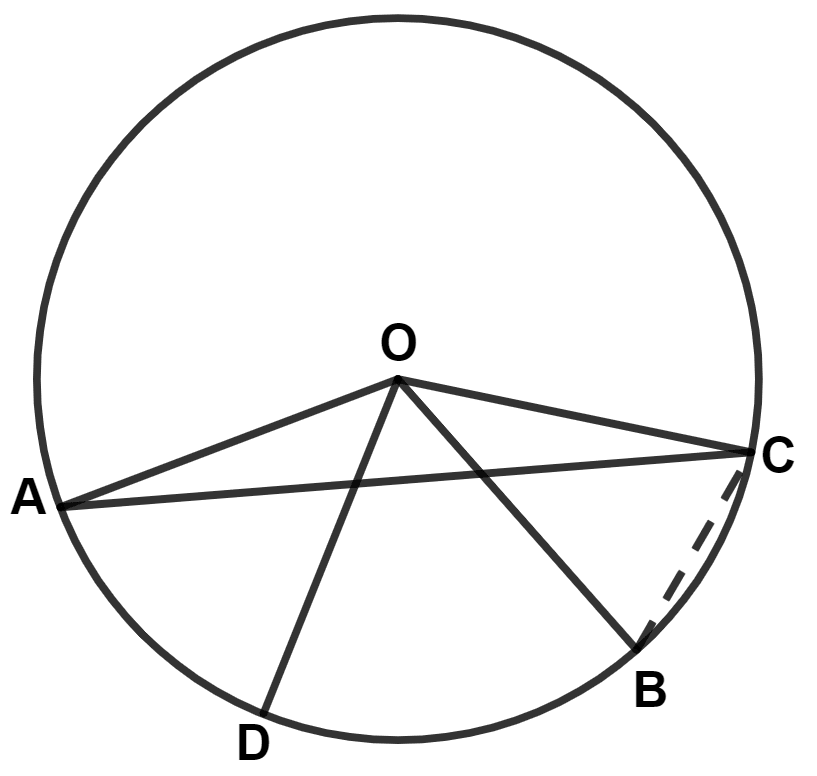
Given,
⇒ arc ADB = 2 × arc BC
⇒ ∠AOB = 2∠BOC
∠BOC = = 54°.
In △ AOC,
⇒ OA = OC (Radius of circle)
⇒ ∠OAC = ∠OCA = y (let) [Angles opposite to equal sides are equal]
By angle sum property of triangle,
⇒ ∠OAC + ∠OCA + ∠AOC = 180°
⇒ y + y + (108° + 54°) = 180° [∵ ∠AOC = ∠AOB + ∠BOC]
⇒ 2y = 180° - 162°
⇒ 2y = 18°
⇒ y = = 9°.
⇒ ∠OCA = 9°
In △ BOC,
⇒ OB = OC (Radius of circle)
⇒ ∠OBC = ∠OCB = x (let) [Angles opposite to equal sides are equal]
By angle sum property of triangle,
⇒ ∠OBC + ∠OCB + ∠BOC = 180°
⇒ x + x + 54° = 180°
⇒ 2x = 180° - 54°
⇒ 2x = 126°
⇒ x = = 63°.
⇒ ∠OCB = 63°
From figure,
⇒ ∠ACB = ∠OCB - ∠OCA = 63° - 9° = 54°.
Hence, ∠ACB = 54°.
(ii) We know that,
Angle which and arc subtends at the center is double that which it subtends at any point on the remaining part of the circumference of the circle.
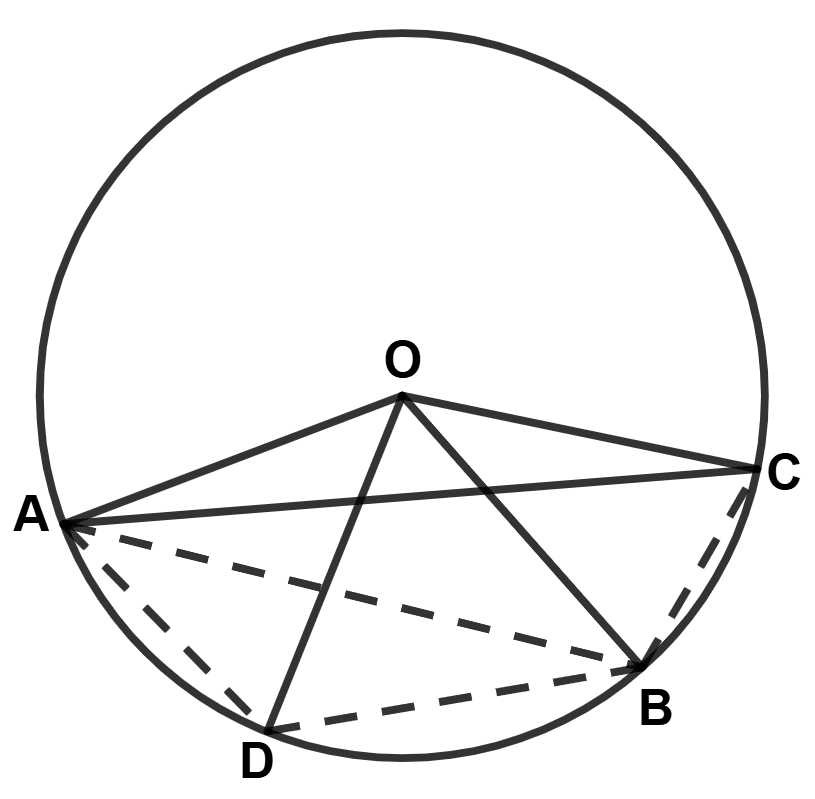
∴ ∠BOC = 2∠CAB
⇒ ∠CAB = = 27°.
Hence, ∠CAB = 27°.
(iii) Arc AB subtends ∠AOB at the centre and ∠ACB at the remaining part of the circle.
∴ ∠AOB = 2∠ACB
∠ACB = = 54°.
In cyclic quadrilateral ADBC,
⇒ ∠ADB + ∠ACB = 180° [∵ Sum of opp ∠'s in cyclic quadrilateral = 180°]
⇒ ∠ADB + 54° = 180°
⇒ ∠ADB = 180° - 54° = 126°.
Hence, ∠ADB = 126°.
Answered By
14 Likes
Related Questions
(i) Express in terms of sec A and tan A.
(ii) Express in terms of sec A and tan A.
(iii) Prove that : = 2 tan A
If a, c, a2 + b2 and b2 + c2 are in proportion, show that b is mean proportion between a and c.
The daily wages of 160 workers in a building project are given below :
Wages (in ₹) No. of workers 130-140 48 140-150 34 150-160 26 160-170 32 170-180 20 Draw a cumulative frequency curve and use it to estimate :
(i) the median wage
(ii) semi-inter quartile range
(iii) percentage of workers who earn between ₹ 145 and ₹ 165.
Let matrix A = , find matrix M so that AM = B.