
Mathematics
In the given graph ABCD is a parallelogram.
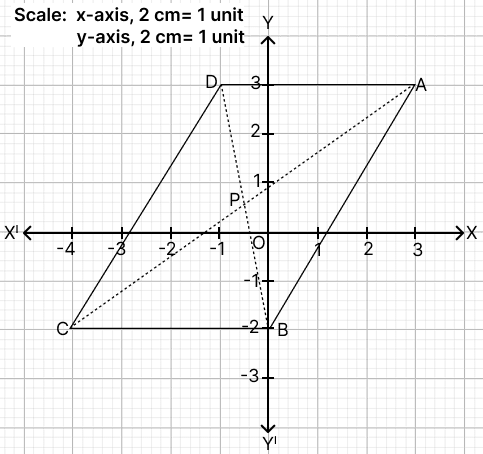
Using the graph, answer the following:
(a) write down the coordinates of A, B, C and D.
(b) calculate the coordinates of ‘P’, the point of intersection of the diagonals AC and BD.
(c) find the slope of sides CB and DA and verify that they represent parallel lines.
(d) find the equation of the diagonal AC.
Straight Line Eq
34 Likes
Answer
(a) From graph,
A(3, 3), B(0, −2), C(−4, −2), D(−1, 3).
Hence, A(3, 3), B(0, −2), C(−4, −2), D(−1, 3).
(b) Given,
The diagonals of a parallelogram bisect each other.
Hence, the intersection point P is the midpoint of both AC and BD.
By mid-point formula,
Mid-point of AC :
Hence, P = (-0.5, 0.5).
(c) By formula,
Substituting values for line CB,
Substituting values for line DA,
Since, slope of parallel lines are equal, thus CB || DA.
Hence, proved that CB || DA.
(d) By formula,
Slope of line =
Slope of AC = .
Using point-slope formula,
y - y1 = m(x - x1)
Equation of AC :
Hence, equation of the diagonal AC is 5x - 7y + 6 = 0.
Answered By
22 Likes
Related Questions
Use ruler and compass for the following construction. Construct a ΔABC, where AB = 6 cm, AC = 4.5 cm and ∠BAC = 120°. Construct a circle circumscribing the ΔABC. Measure and write down the length of the radius of the circle.
Find:
(a) A + C
(b) B(A + C)
(c) 5B
(d) B(A + C) − 5B
Solve the following inequation, write the solution set and represent it on the real number line.
The first term of an Arithmetic Progression (A.P.) is 5, the last term is 50 and their sum is 440. Find:
(a) the number of terms
(b) common difference