Physics
The graph shows load against effort for a lever with load and effort on the same side of the fulcrum.
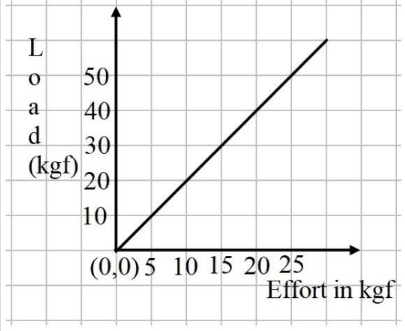
(a) Which feature of the load and effort graph must be calculated to determine mechanical advantage?
(b) Which class does this lever belong to?
Answer
(a) Slope
(b) 2nd class
Explanation:
(a) The slope of the load-effort graph is the key to finding mechanical advantage.
(b) In a linear load-effort graph that passes through the origin, the slope represents the ratio of Load to Effort. So, we just need to calculate the slope of the line to get the mechanical advantage. Choose any point on the line — for instance, (Effort = 10 kgf, Load = 20 kgf) gives MA = 2.
Since MA > 1, meaning effort arm > load arm. This is characteristic of a class II lever, where the load lies between the fulcrum and the effort.
Related Questions
Will the centre of gravity of a hollow sphere filled half with mercury and half with oil be identical to that of an empty hollow sphere? Give reasons for your answer.
Study the diagram and answer the questions that follow.
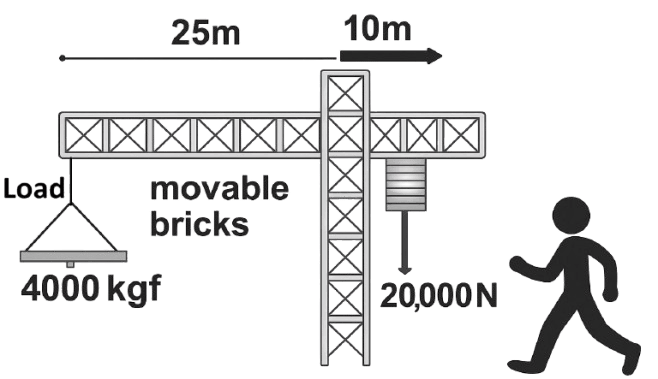
(a) In the diagram, is the worker attempting to raise or lower the load?
(b) Justify your answer to (a) with the necessary calculation.
(a) Convert to SI unit: 1 J/g °F
(b) Why does 1 g of water at 0°C have 336 J more heat energy than 1 g of ice at 0°C?
Match the columns by choosing the body part and corresponding mechanical lever of the same class.
Human body part Mechanical lever i. Nodding head (a) Bottle Opener ii. Lifting body weight on your toes. (b) Tongs (c) See-Saw