Mathematics
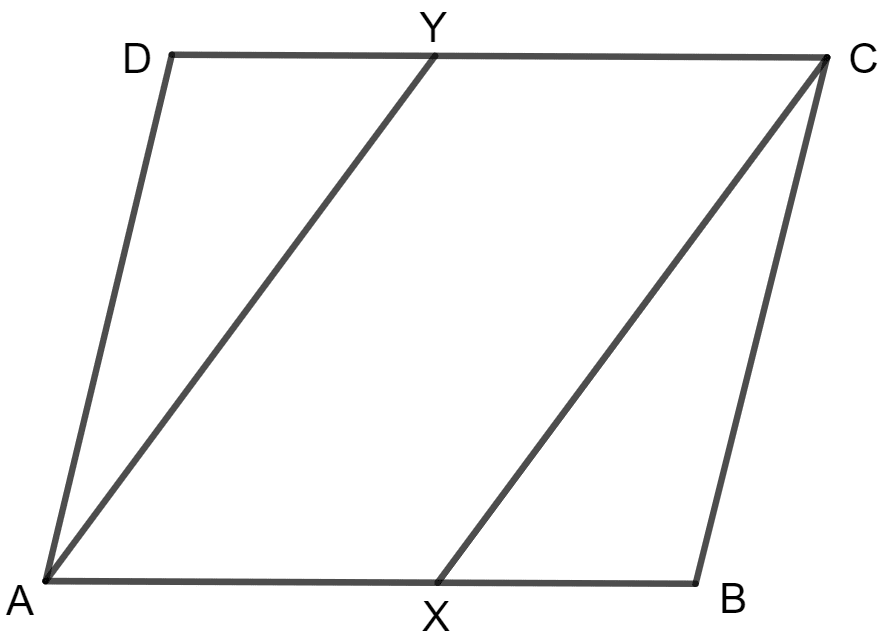
In a parallelogram ABCD, X and Y are mid-points of opposite sides AB and DC respectively. Prove that:
(i) AX = YC.
(ii) AX is parallel to YC
(iii) AXCY is a parallelogram.
Quadrilaterals
5 Likes
Answer
(i) Given:
ABCD is a parallelogram.
To prove:
AX = YC.
Proof:
We know that, opposite sides of parallelogram are equal.
AB = CD
⇒ AB = CD
⇒ AX = CY (As, X and Y are mid - points of AB and CD respectively)
Hence, AX = YC.
(ii) To prove:
AX is parallel to YC.
Proof:
Opposite sides of parallelogram are equal.
AB is parallel to DC.
⇒ AX is parallel to YC.
Hence, AX is parallel to YC.
(iii) To prove:
AXCY is a parallelogram.
Proof:
AX = YC
And, AX is parallel to YC.
Since, one pair of opposite sides of quadrilateral AXCY are equal and parallel.
Hence, AXCY is a parallelogram.
Answered By
4 Likes
Related Questions
In a parallelogram ABCD, E is the mid-point of side AB and CE bisects angle BCD. Prove that :
(i) AE = AD
(ii) DE bisects ∠ADC and
(iii) Angle DEC is a right angle.
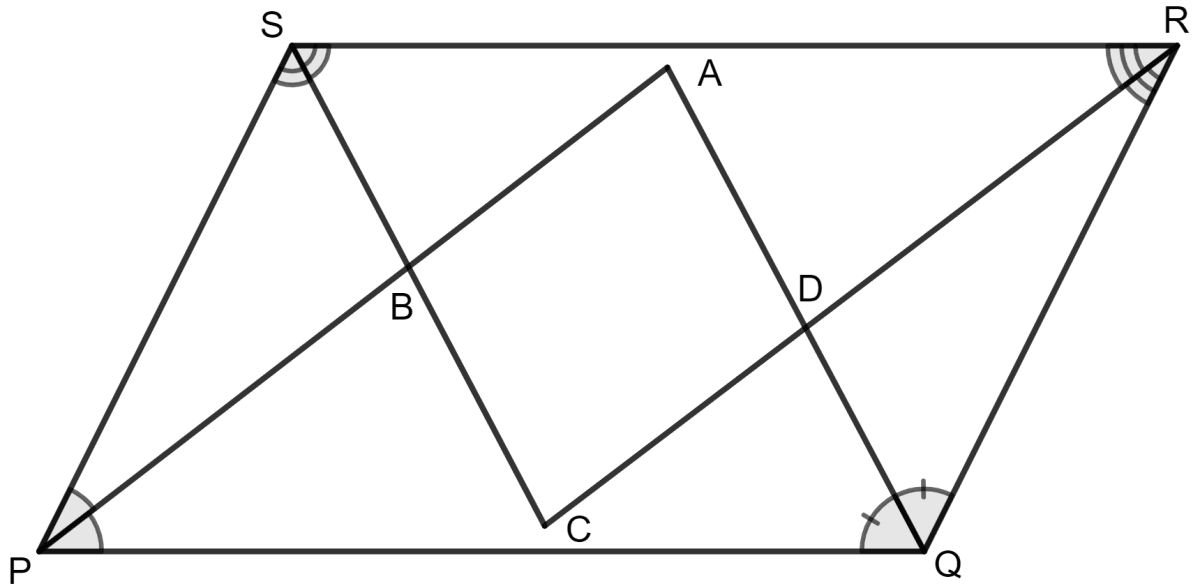
In the diagram given below, the bisectors of interior angles of the parallelogram PQRS enclose a quadrilateral ABCD. Show that:
(i) ∠PSB + ∠SPB = 90°
(ii) ∠PBS = 90°
(iii) ∠ABC = 90°
(iv) ∠ADC = 90°
(v) ∠A = 90°
(vi) ABCD is a rectangle
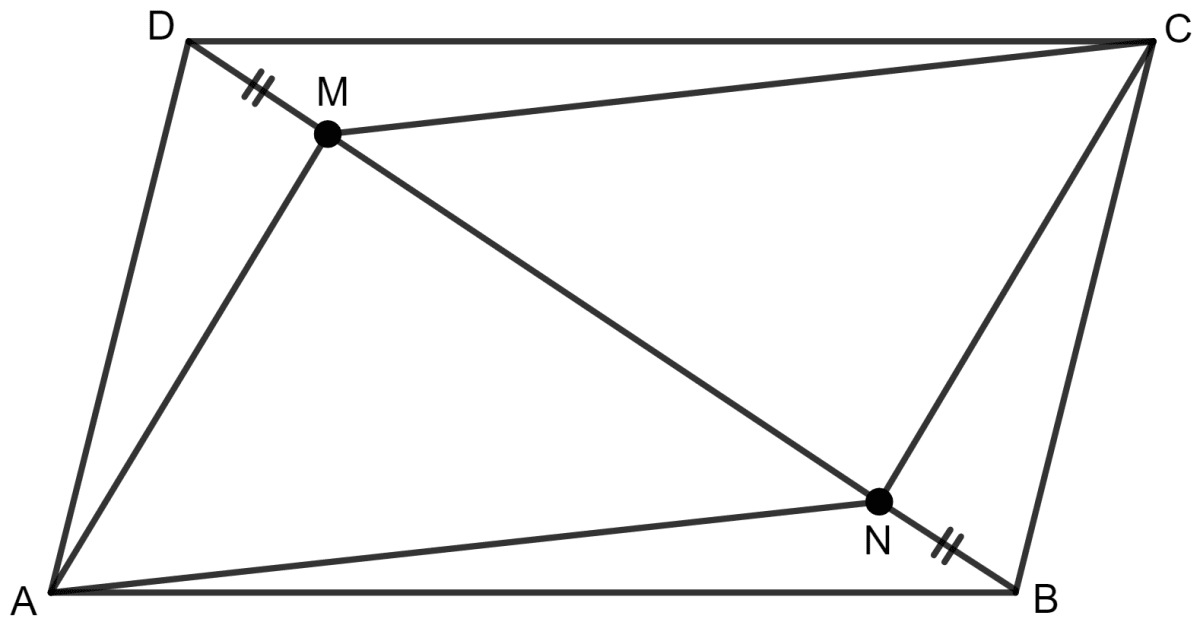
The given figure shows a parallelogram ABCD. Points M and N lie in diagonal BD such that DM = BN. Prove that:
(i) △DMC ≅ △BNA and so CM = AN.
(ii) △AMD ≅ △CNB and so AM = CN.
(iii) ANCM is a parallelogram.
The given figure shows a rhombus ABCD in which angle BCD = 80°. Find angles x and y.