
Mathematics
In △ ABC, E is mid-point of the median AD and BE produced meets side AC at point Q. Show that BE : EQ = 3 : 1.
Mid-point Theorem
13 Likes
Answer
Draw DY || BQ.
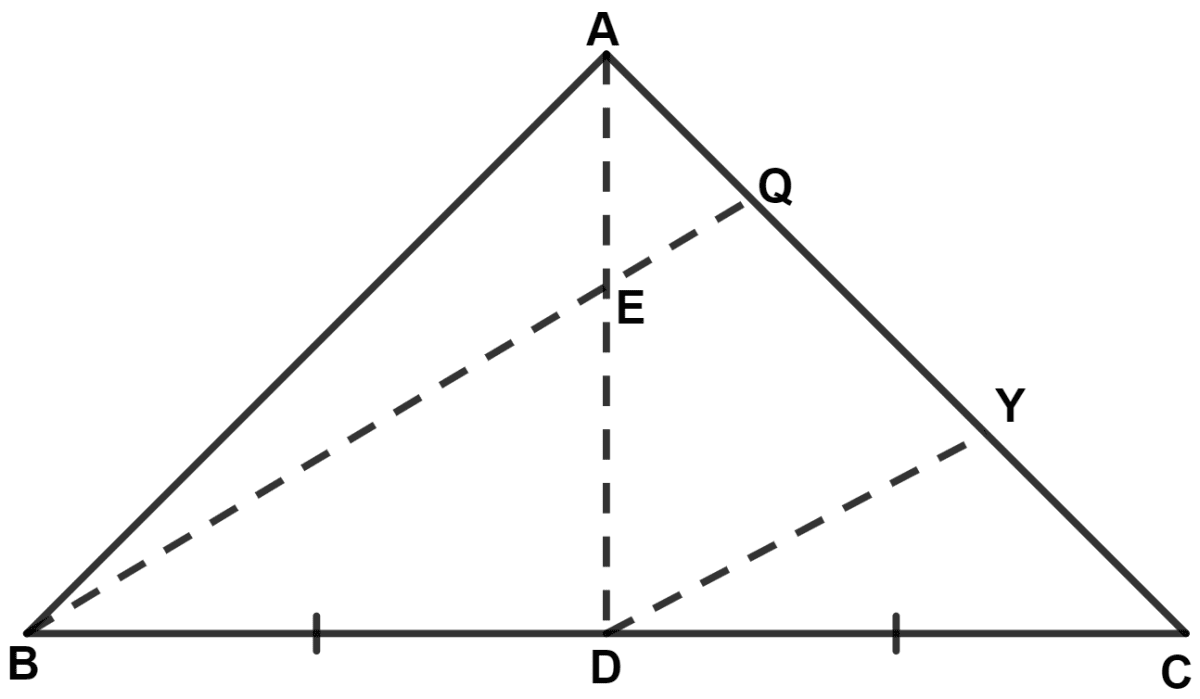
In △ BCQ and △ DCY,
⇒ ∠BCQ = ∠DCY (Common)
⇒ ∠BQC = ∠DYC (Corresponding angles are equal)
∴ △ BCQ ~ △ DCY (By A.A. axiom)
We know that,
Corresponding sides of similar triangle are proportional.
……….(1)
Since, D is the mid-point of BC.
∴ BC = 2CD
Considering L.H.S. of the equation (1), we get :
In △ AEQ and △ ADY,
⇒ ∠EAQ = ∠DAY (Common)
⇒ ∠AEQ = ∠ADY (Corresponding angles are equal)
∴ △ AEQ ~ △ ADY (By A.A. axiom)
We know that,
Corresponding sides of similar triangle are proportional.
(Since, E is the mid-point of AD)
…………(2)
Dividing equation (1) by (2), we get :
Hence, proved that BE : EQ = 3 : 1.
Answered By
4 Likes
Related Questions
P, Q and R are mid-points of sides AB, BC and CD respectively of a rhombus ABCD. Show that PQ is perpendicular to QR.
The diagonals of a quadrilateral ABCD are perpendicular to each other. Prove that the quadrilateral obtained by joining the mid-points of its adjacent sides is a rectangle.
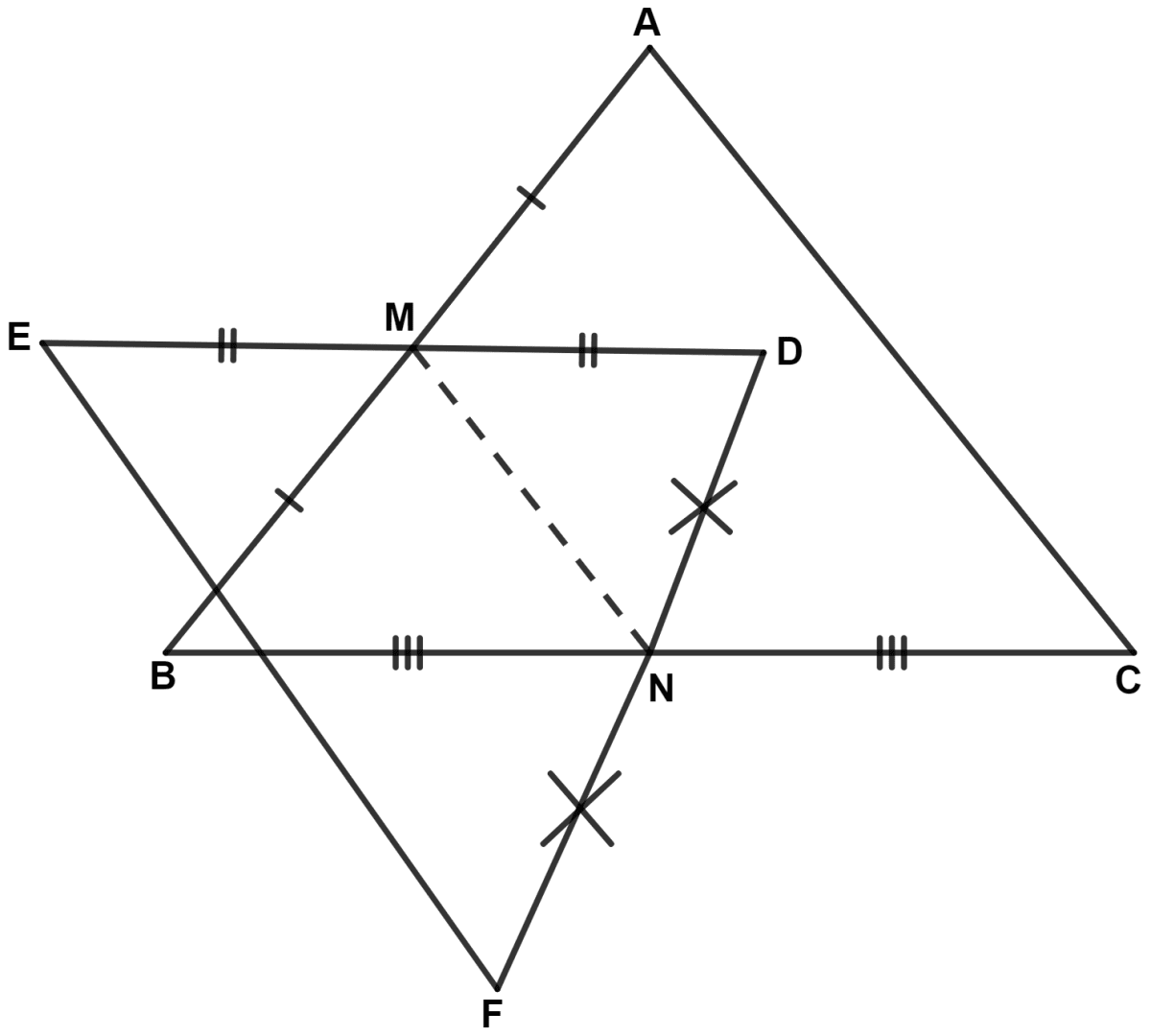
In the given figure, M is the mid-point of AB and DE, whereas N is mid-point of BC and DF. Show that : EF = AC.
In triangle ABC; D and E are mid-points of the sides AB and AC respectively. Through E, a straight line is drawn parallel to AB to meet BC at F. Prove that BDEF is a parallelogram. If AB = 16 cm, AC = 12 cm and BC = 18 cm, find the perimeter of the parallelogram BDEF.