Mathematics
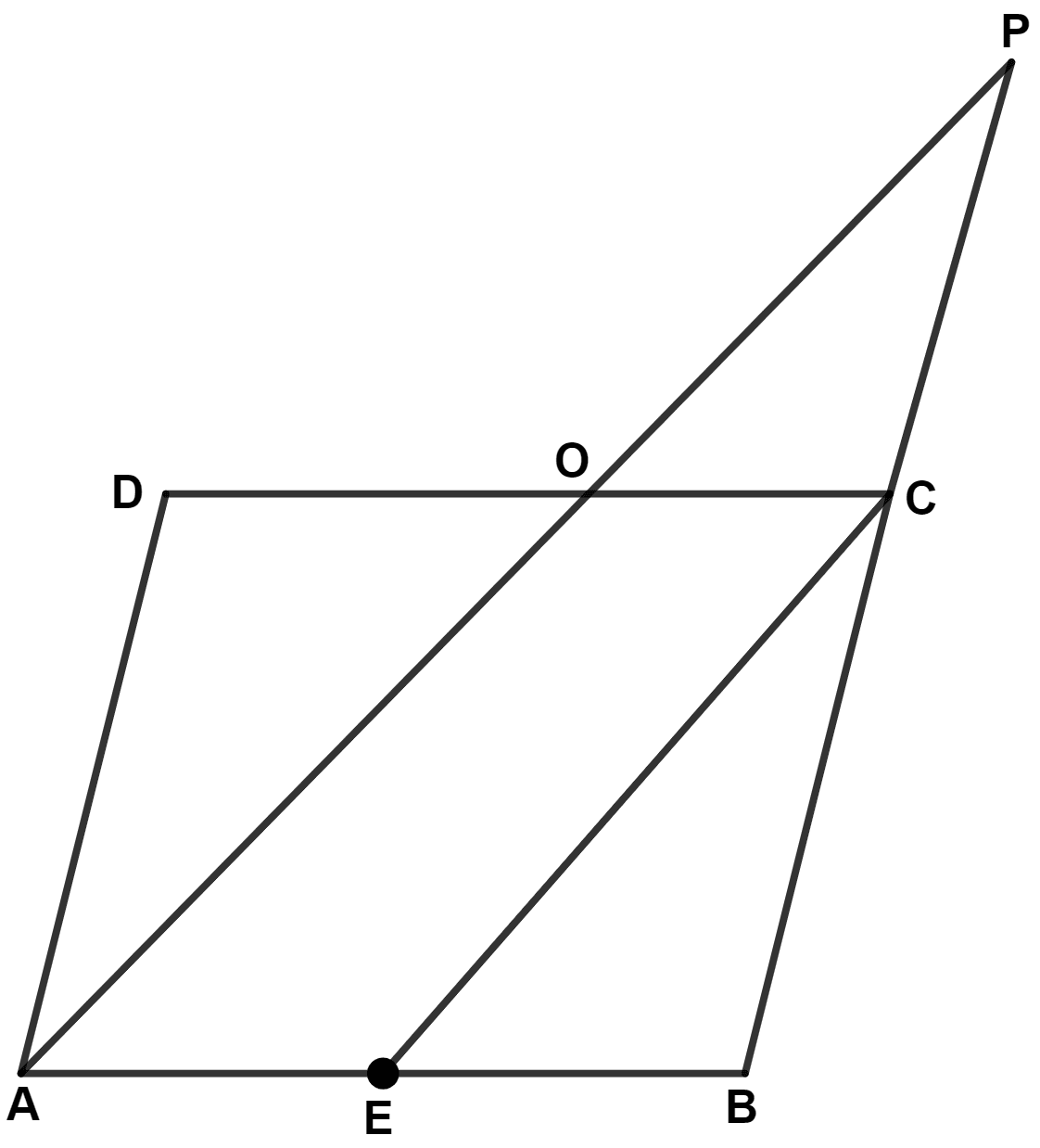
In parallelogram ABCD, E is the mid-point of AB and AP is parallel to EC which meets DC at point O and BC produced at P. Prove that :
(i) BP = 2AD
(ii) O is mid-point of AP.
Answer
By mid-point theorem,
The line segment joining the mid-points of any two sides of a triangle is parallel to the third side and is equal to half of it.
By converse of mid-point theorem,
The straight line drawn through the mid-point of one side of a triangle parallel to another, bisects the third side.
(i) In △ ABP,
⇒ E is the mid-point of AB and EC || AP.
∴ C is the mid-point of BP. (By converse of mid-point theorem)
∴ BP = 2BC ………(1)
Since, ABCD is a parallelogram.
∴ AD = BC (Opposite sides of parallelogram are equal) …….(2)
From equation (1) and (2), we get :
⇒ BP = 2AD.
Hence, proved that BP = 2AD.
(ii) Since, opposite sides of parallelogram are parallel.
∴ AB || CD
⇒ AB || OC.
In △ ABP,
⇒ E is the mid-point of AB and OC || AB.
∴ O is the mid-point of AP. (By converse of mid-point theorem)
Hence, O is the mid-point of AP.
Related Questions
In triangle ABC; D and E are mid-points of the sides AB and AC respectively. Through E, a straight line is drawn parallel to AB to meet BC at F. Prove that BDEF is a parallelogram. If AB = 16 cm, AC = 12 cm and BC = 18 cm, find the perimeter of the parallelogram BDEF.
In a trapezium ABCD, sides AB and DC are parallel to each other. E is mid-point of AD and F is mid-point of BC.
Prove that :
AB + DC = 2EF.
In △ ABC, AD is the median and DE is parallel to BA, where E is a point in AC. Prove that BE is also a median.